Eugene Wigner
| Eugene Wigner | |
|---|---|
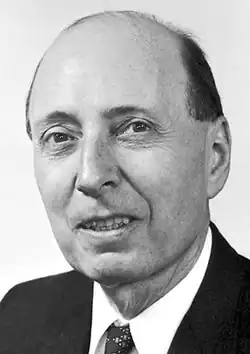 | |
| Amigo de Wigner, símbolo 6-j, símbolo 9-j | |
| Nascimento | 17 de novembro de 1902 Budapeste |
| Morte | 1 de janeiro de 1995 (92 anos) Princeton |
| Sepultamento | Cemitério de Princeton |
| Nacionalidade | húngaro (pré 1937), estadunidense (pós 1937) |
| Cidadania | Hungria, Estados Unidos |
| Etnia | judeus |
| Cônjuge | Amelia Frank, Mary Annette Wheeler, Eileen Clare-Patton Hamilton |
| Filho(a)(s) | David Wheeler Wigner |
| Irmão(ã)(s) | Margit Dirac |
| Alma mater | Universidade Técnica de Berlim |
| Ocupação | matemático, físico, professor universitário, físico teórico, físico nuclear |
| Distinções | Medalha Franklin (1950), Prêmio Enrico Fermi (1958), Prêmio Átomos pela Paz (1959), Medalha Max Planck (1961),  Nobel de Física (1963), John von Neumann Lecture (1966), Medalha Nacional de Ciências (1968), Gibbs Lecture (1968), Racah Lectures in Physics (1973), Medalha Wigner (1978) Nobel de Física (1963), John von Neumann Lecture (1966), Medalha Nacional de Ciências (1968), Gibbs Lecture (1968), Racah Lectures in Physics (1973), Medalha Wigner (1978) |
| Empregador(a) | Universidade de Princeton, Universidade Técnica de Berlim, Universidade de Wisconsin–Madison, Universidade de Göttingen, Universidade de Leiden, Universidade de Princeton, Projeto Manhattan, Universidade de Princeton, Laboratório Nacional de Oak Ridge |
| Orientador(a)(es/s) | Michael Polanyi[1] |
| Instituições | Universidade de Göttingen, Universidade do Wisconsin-Madison, Universidade de Princeton, Projeto Manhattan |
| Obras destacadas | The Unreasonable Effectiveness of Mathematics in the Natural Sciences, teorema de Wigner |
| Causa da morte | pneumonia |
Eugene Paul Wigner (Budapeste, 17 de novembro de 1902 — Princeton, 1 de janeiro de 1995) foi um físico húngaro.
Foi laureado com o Nobel de Física de 1963, por contribuições para a teoria do núcleo atômico e partículas elementares, particularmente pela descoberta e aplicações dos princípios fundamentais de simetria.
Publicações selecionadas
- Wigner, E. P. (1939), «On unitary representations of the inhomogeneous Lorentz group», Annals of Mathematics, 40 (1): 149–204, doi:10.2307/1968551,
 .
. - (com Creutz, E. C. & R. R. Wilson) "Absorption of Thermal Neutrons in Uranium," Universidade de Princeton, Departamento de Energia dos Estados Unidos (through predecessor agency the Atomic Energy Commission), (Sept. 26, 1941).
- "Radioactivity of the Cooling Water," Metallurgical Laboratory of the University of Chicago, Departamento de Energia dos Estados Unidos (through predecessor agency the Atomic Energy Commission), (March 1, 1943).
- "Solutions of Boltzmann`s Equation for Mono-energetic Neutrons in an Infinite Homogeneous Medium," Metallurgical Laboratory of the University of Chicago, Departamento de Energia dos Estados Unidos (through predecessor agency the Atomic Energy Commission), (Nov. 30, 1943).
- (com Weinberg, A. M. & J. Stephenson) "Recalculation of the Critical Size and Multiplication Constant of a Homogeneous UO{sub 2} – D{sub 2}O Mixtures," Metallurgical Laboratory of the University of Chicago, (Feb. 11, 1944).
- (com F.L. Friedman) "On the Boundary Condition Between Two Multiplying Media," Metallurgical Laboratory of the University of Chicago, (April 19, 1944).
- (com J. E. Wilkins, Jr.) "Effect of the Temperature of the Moderator on the Velocity Distribution of Neutrons with Numerical Calculations for H as Moderator," Oak Ridge National Laboratory (ORNL), Departamento de Energia dos Estados Unidos (through predecessor agency the Atomic Energy Commission), (Sept. 14, 1944).
- "On the Variation of Eta with Energy in the 100-1000 ev Region," Brookhaven National Laboratory, Departamento de Energia dos Estados Unidos (through predecessor agency the Atomic Energy Commission), (Nov. 1, 1949).
- "The Magnitude of the Eta Effect," Du Pont de Nemours (E.I.) & Co., Departamento de Energia dos Estados Unidos (through predecessor agency the Atomic Energy Commission), (April 25, 1951).
- 1958 (com Alvin Weinberg). Physical Theory of Neutron Chain Reactors (University of Chicago Press. ISBN 0-226-88517-8
- 1959. Group Theory and its Application to the Quantum Mechanics of Atomic Spectra. New Yor: Academic Press. Translation by J. J. Griffin of 1931, Gruppentheorie und ihre Anwendungen auf die Quantenmechanik der Atomspektren, Vieweg Verlag, Braunschweig.
- 1960, "The Unreasonable Effectiveness of Mathematics in the Natural Sciences," Communications on Pure and Applied Mathematics 13(1): 1–14.
- 1970. Symmetries and Reflections: Scientific Essays. MIT Press. ISBN 0-262-73021-9
- 1992 (as told to Andrew Szanton). The Recollections of Eugene P. Wigner. Plenum. ISBN 0-306-44326-0
- 1997 (com G. G. Emch; Jagdish Mehra and Arthur S. Wightman, eds.). Philosophical Reflections and Syntheses. Springer. ISBN 3-540-63372-3
Referências
- ↑ Eugene Wigner (em inglês) no Mathematics Genealogy Project
Ligações externas
- Eugene Wigner em Nobelprize.org
- O'Connor, John J.; Robertson, Edmund F., «Eugene Wigner», MacTutor History of Mathematics archive (em inglês), Universidade de St. Andrews
- Eugene Wigner (em inglês) no Mathematics Genealogy Project
- «Perfil no sítio oficial do Nobel de Física 1963» (em inglês)
| Precedido por Theodor Svedberg |
Medalha Franklin 1950 |
Sucedido por James Chadwick |
| Precedido por Ernest Orlando Lawrence |
Prêmio Enrico Fermi 1958 |
Sucedido por Glenn Theodore Seaborg |
| Precedido por Lev Landau |
Medalha Max Planck 1961 |
Sucedido por Ralph Kronig |
| Precedido por Lev Landau |
Nobel de Física 1963 com Maria Goeppert-Mayer e Johannes Hans Daniel Jensen |
Sucedido por Charles Hard Townes, Nicolay Gennadiyevich Basov e Aleksandr Mikhailovich Prokhorov |
Linha do tempo | ||
| Locais |  | |
| Administradores |
| |
| Cientistas |
| |
| Operações |
| |
| Armas |
| |
| Tópicos relacionados |
| |
 Projeto Manhattan Projeto Manhattan | ||
| Controle de autoridade |
|
|---|
