| James Peebles |
|---|
 |
| radiação cósmica de fundo em micro-ondas |
| Nascimento | Phillip James Edwin Peebles
25 de abril de 1935 (90 anos)
Winnipeg, Canadá |
|---|
| Cidadania | Canadá, Estados Unidos |
|---|
| Alma mater | Universidade de Manitoba (BSc), Universidade de Princeton (PhD) |
|---|
| Ocupação | astrônomo, astrofísico, professor universitário, físico |
|---|
| Distinções | Medalha Eddington (1981), Prêmio Dannie Heineman de Astrofísica (1982), Medalha Bruce (1995), Racah Lectures in Physics (1996), Medalha Oskar Klein (1997), Medalha de Ouro da RAS (1998), Prêmio Gruber de Cosmologia (2000), Prêmio Harvey (2001), Prêmio Tomalla (2003), Prêmio Shaw (2004), Prêmio Crafoord (2005), Nobel de Física (2019) |
|---|
| Empregador(a) | Universidade de Princeton |
|---|
| Orientador(a)(es/s) | Robert Henry Dicke |
|---|
| Instituições | Universidade de Princeton |
|---|
|
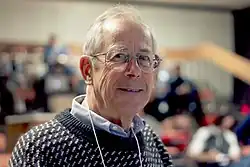
Phillip James Edwin Peebles (Winnipeg, 25 de abril de 1935) é um físico canadense naturalizado estadunidense. Foi distinguido com o Nobel de Física de 2019, por suas investigações em cosmologia teórica.[1]
Honrarias
Prêmios
- Medalha Eddington 1981
- Prêmio Dannie Heineman de Astrofísica 1982
- Henry Norris Russell Lectureship 1993
- Medalha Bruce 1995
- Medalha Oskar Klein 1997
- Medalha de Ouro da Royal Astronomical Society 1998
- Prêmio Gruber de Cosmologia 2000
- Prémio Harvey 2001
- Prêmio Shaw 2004
- Prêmio Crafoord, com James Gunn e Martin Rees 2005
- Nobel de Física 2019
Epônimos
Referências
Bibliografia
- B. Rhatra and P. J. E. Peebles, "The cosmological constant and dark energy", Rev. Mod. Phys. 75, 559 (2003) arXiv:astro-ph/0207347.
- M. Fukugita, C. J. Hogan and P. J. E. Peebles, "The cosmic baryon budget", Astrophys. J. '503, 518 (1998) arXiv:astro-ph/9712020.
- P. J. E. Peebles, Principles of Physical Cosmology (Princeton University Press, Princeton, 1993).
- B. Rhatra and P. J. E. Peebles, "Cosmology with a time-variable cosmological 'constant'", Astrophys. J. 325, L17 (1988).
- B. Rhatra and P. J. E. Peebles, "Cosmological consequences of a rolling homogeneous scalar field", Phys. Rev. D 37, 3406 (1988).
- M. Davis and P. J. E. Peebles, "A survey of galaxy redshifts. V – The two-point position and velocity correlations", Astrophys. J. 267, 465 (1983).
- P. J. E. Peebles, "Large-scale background temperature and mass fluctuations due to scale-invariant primeval perturbations", Astrophys. J. 263, L1 (1982).
- P. J. E. Peebles, The large-scale structure of the universe (Princeton University Press, Princeton, 1980).
- E. J. Groth and P. J. E. Peebles, "Statistical Analysis Of Catalogs Of Extragalactic Objects. 7. Two And Three Point Correlation Functions For The High-Resolution Shane-Wirtanen Catalog Of Galaxies", Astrophys. J. 217, 385 (1977).
- J. P. Ostriker and P. J. E. Peebles, "A Numerical Study of the Stability of Flattened Galaxies: or, can Cold Galaxies Survive?", Astrophys. J. 186, 467 (1973).
- P. J. E. Peebles, Physical Cosmology, (Princeton University Press, Princeton, 1971).
- P. J. E. Peebles and J. T. Yu, "Primeval adiabatic perturbation in an expanding universe", Astrophys. J. 162, 815 (1970).
- P. J. E. Peebles, "Origin of the Angular Momentum of Galaxies", Astrophys. J. 155, 393 (1969).
- P. J. E. Peebles and R. H. Dicke, "Origin of the Globular Star Clusters", Astrophys. J. 154, 891 (1968).
- P. J. E. Peebles, "Primordial Helium Abundance and the Primordial Fireball. II", Astrophys. J. 146, 542 (1966).
- P. J. E. Peebles, “Primordial Helium Abundance and the Primordial Fireball. I", Phys. Rev. Lett. 16, 410 (1966).
- R. H. Dicke, P. J. E. Peebles, P. G. Roll and D. T. Wilkinson, "Cosmic Black-Body Radiation", Astrophys. J. 142, 414 (1965).
Ligações externas
Medalha de Ouro da Royal Astronomical Society (1824 – 2024) |
|---|
| Século XIX | | Década de 1820 |
- 1824: Charles Babbage, Johann Franz Encke
- 1826: John Herschel, James South, Wilhelm Struve
- 1827: Francis Baily
- 1828: Thomas Brisbane, James Dunlop, Caroline Herschel
- 1829: William Pearson, Friedrich Wilhelm Bessel, Heinrich Christian Schumacher
|
|---|
| Década de 1830 |
- 1830: William Richardson, Johann Franz Encke
- 1831: Henry Kater, Marie-Charles Damoiseau
- 1833: George Biddell Airy
- 1835: Manuel John Johnson
- 1836: John Herschel
- 1837: Otto August Rosenberger
- 1839: John Wrottesley
|
|---|
| Década de 1840 |
- 1840: Giovanni Plana
- 1841: Friedrich Wilhelm Bessel
- 1842: Peter Andreas Hansen
- 1843: Francis Baily
- 1845: William Henry Smyth
- 1846: George Biddell Airy
- 1849: William Lassell
|
|---|
| Década de 1850 |
- 1850: Otto Wilhelm von Struve
- 1851: Annibale de Gasparis
- 1852: Christian August Friedrich Peters
- 1853: John Russell Hind
- 1854: Karl Rümker
- 1855: William Rutter Dawes
- 1856: Robert Grant
- 1857: Samuel Heinrich Schwabe
- 1858: Robert Main
- 1859: Richard Christopher Carrington
|
|---|
| Década de 1860 |
- 1860: Peter Andreas Hansen
- 1861: Hermann Mayer Salomon Goldschmidt
- 1862: Warren De La Rue
- 1863: Friedrich Wilhelm August Argelander
- 1865: George Phillips Bond
- 1866: John Couch Adams
- 1867: William Huggins, William Allen Miller
- 1868: Urbain Le Verrier
- 1869: Edward James Stone
|
|---|
| Década de 1870 |
- 1870: Charles-Eugène Delaunay
- 1872: Giovanni Schiaparelli
- 1874: Simon Newcomb
- 1875: Heinrich Louis d'Arrest
- 1876: Urbain Le Verrier
- 1878: Ercole Dembowski
- 1879: Asaph Hall
|
|---|
| Década de 1880 |
- 1881: Axel Möller
- 1882: David Gill
- 1883: Benjamin Apthorp Gould
- 1884: Andrew Ainslie Common
- 1885: William Huggins
- 1886: Edward Charles Pickering, Charles Pritchard
- 1887: George William Hill
- 1888: Arthur Auwers
- 1889: Maurice Loewy
|
|---|
| Década de 1890 |
- 1892: George Darwin
- 1893: Hermann Carl Vogel
- 1894: Sherburne Wesley Burnham
- 1895: Isaac Roberts
- 1896: Seth Carlo Chandler
- 1897: Edward Barnard
- 1898: William Frederick Denning
- 1899: Frank McClean
|
|---|
| Medalha de Prata |
- 1824: Karl Rümker, Jean-Louis Pons
- 1827 William Samuel Stratford, Mark Beaufoy
|
|---|
Medalha de
Reconhecimento |
- 1848: George Biddell Airy
- John Couch Adams
- Friedrich Wilhelm August Argelander
- George Bishop
- George Everest
- John Herschel
- Peter Andreas Hansen
- Karl Ludwig Hencke
- John Russell Hind
- Urbain Le Verrier
- John William Lubbock
- Maximilian von Weiße
|
|---|
| |
|---|
| Século XX | | Década de 1900 |
- 1900: Henri Poincaré
- 1901: Edward Charles Pickering
- 1902: Jacobus Kapteyn
- 1903: Hermann Struve
- 1904: George Ellery Hale
- 1905: Lewis Boss
- 1906: William Wallace Campbell
- 1907: Ernest William Brown
- 1908: David Gill
- 1909: Oskar Backlund
|
|---|
| Década de 1910 |
- 1910: Karl Friedrich Küstner
- 1911: Philip Herbert Cowell
- 1912: Arthur Robert Hinks
- 1913: Henri-Alexandre Deslandres
- 1914: Max Wolf
- 1915: Alfred Fowler
- 1916: John Dreyer
- 1917: Walter Sydney Adams
- 1918: John Evershed
- 1919: Guillaume Bigourdan
|
|---|
| Década de 1920 | |
|---|
| Década de 1930 | |
|---|
| Década de 1940 | |
|---|
| Década de 1950 |
- 1950: Joel Stebbins
- 1951: Anton Pannekoek
- 1952: John Jackson
- 1953: Subrahmanyan Chandrasekhar
- 1954: Walter Baade
- 1955: Dirk Brouwer
- 1956: Thomas George Cowling
- 1957: Albrecht Unsöld
- 1958: André-Louis Danjon
- 1959: Raymond Lyttleton
|
|---|
| Década de 1960 | |
|---|
| Década de 1970 | |
|---|
| Década de 1980 |
- 1980: Chaim Leib Pekeris, Maarten Schmidt
- 1981: James Freeman Gilbert, Bernard Lovell
- 1982: Riccardo Giacconi, Harrie Massey
- 1983: Michael Seaton, Fred L. Whipple
- 1984: Keith Runcorn, Jakov Seldovich
- 1985: Thomas Gold, Stephen Hawking
- 1986: George Edward Backus, Alexander Dalgarno
- 1987: Takeshi Nagata, Martin Rees
- 1988: Don Lynn Anderson, Cornelis de Jager
- 1989: Raymond Hide, Ken Pounds
|
|---|
| Década de 1990 |
- 1990: James Dungey, Bernard Pagel
- 1991: Vitaly Ginzburg, Gerald Joseph Wasserburg
- 1992: Dan Peter McKenzie, Eugene Parker
- 1993: Peter Goldreich, Donald Lynden-Bell
- 1994: James Gunn, Thomas Reeve Kaiser
- 1995: John Houghton, Rashid Sunyaev
- 1996: Kenneth Creer, Vera Rubin
- 1997: Donald Farley, Donald Edward Osterbrock
- 1998: Robert Ladislav Parker, James Peebles
- 1999: Kenneth Budden, Bohdan Paczyński
|
|---|
|
|---|
| Século XXI | | Década de 2000 |
- 2000: Leon Lucy, Robert Hutchison
- 2001: Hermann Bondi, Henry Rishbeth
- 2002: Leon Mestel, John Arthur Jacobs
- 2003: John Norris Bahcall, David Gubbins
- 2004: Jeremiah Paul Ostriker, Grenville Turner
- 2005: Margaret Burbidge, Geoffrey Burbidge, Carole Jordan
- 2006: Simon White, Stanley William Herbert Cowley
- 2007: Leonard Culhane, Nigel Weiss
- 2008: Joseph Silk, Brian Kennett
- 2009: David Williams, Eric Priest
|
|---|
| Década de 2010 | |
|---|
| Década de 2020 |
- 2020: Sandra Faber, Yvonne Elsworth
- 2021: Jocelyn Bell Burnell, Thorne Lay
- 2022: George Efstathiou, Richard B. Horne
- 2023: John Andrew Peacock, Tim Palmer
- 2024: Gilles Chabrier, John-Michael Kendall
|
|---|
|
|---|
Prêmio Shaw (2004 — 2023) |
|---|
| Astronomia | |
|---|
| Biologia e Medicina |
2004: Stanley Norman Cohen, Herbert Boyer, Yuet Wai Kan e Richard Doll ·
2005: Michael Berridge ·
2006: Wang Xiaodong ·
2007: Robert Lefkowitz ·
2008: Ian Wilmut, Keith Campbell e Shinya Yamanaka ·
2009: Douglas Leonard Coleman e Jeffrey Michael Friedman ·
2010: David Julius ·
2011: Jules Hoffmann, Ruslan Medzhitov e Bruce Beutler ·
2012: Franz-Ulrich Hartl e Arthur Horwich ·
2013: Jeffrey Connor Hall, Michael Rosbash e Michael Warren Young ·
2014: Kazutoshi Mori e Peter Walter ·
2015: Bonnie Bassler e Everett Peter Greenberg ·
2016: Adrian Bird e Huda Zoghbi ·
2017: Ian Read Gibbons e Ronald Vale ·
2018: Mary-Claire King ·
2019: Maria Jasin ·
2020: Gero Miesenböck, Peter Hegemann e Georg Nagel ·
2021: Scott David Emr ·
2022: Paul A. Negulescu e Michael J. Welsh ·
2023: Patrick Cramer e Eva Nogales
|
|---|
| Matemática |
2004: Shiing-Shen Chern ·
2005: Andrew Wiles ·
2006: David Mumford e Wu Wenjun ·
2007: Robert Langlands e Richard Taylor ·
2008: Vladimir Arnold e Ludvig Faddeev ·
2009: Simon Donaldson e Clifford Taubes ·
2010: Jean Bourgain ·
2011: Demetrios Christodoulou e Richard Hamilton ·
2012: Maxim Kontsevich ·
2013: David Donoho ·
2014: George Lusztig ·
2015: Gerd Faltings e Henryk Iwaniec ·
2016: Nigel Hitchin ·
2017: János Kollár e Claire Voisin ·
2018: Luis Caffarelli ·
2019: Michel Talagrand ·
2020: Alexander Beilinson e David Kazhdan ·
2021: Jean-Michel Bismut e Jeff Cheeger ·
2022: Noga Alon e Ehud Hrushovski ·
2023: Vladimir Drinfeld e Shing-Tung Yau
|
|---|
|
|---|
| 1901–1925 | |
|---|
| 1926–1950 | |
|---|
| 1951–1975 | |
|---|
| 1976–2000 |
- 1976: Richter e Ting
- 1977: P. W. Anderson, Mott e Van Vleck
- 1978: Kapitsa, Penzias e Wilson
- 1979: Glashow, Salam e Weinberg
- 1980: Cronin e Fitch
- 1981: Bloembergen, Schawlow e Siegbahn
- 1982: Wilson
- 1983: Chandrasekhar e Fowler
- 1984: Rubbia e Van der Meer
- 1985: Klitzing
- 1986: Ruska, Binnig e Rohrer
- 1987: Bednorz e Müller
- 1988: Lederman, Schwartz e Steinberger
- 1989: Ramsey, Dehmelt e Paul
- 1990: Friedman, Kendall e R. E. Taylor
- 1991: de Gennes
- 1992: Charpak, Hulse e J. H. Taylor
- 1993: Brockhouse e Shull
- 1994: Perl e Reines
- 1995: D. Lee, Osheroff e R. Richardson
- 1996: Chu, Cohen-Tannoudji e Phillips
- 1997: Laughlin, Störmer e Tsui
- 1998: Hooft e Veltman
- 1999: Alferov, Kroemer e Kilby
|
|---|
| 2001–2024 |
- 2001: Cornell, Wieman e Ketterle
- 2002: Davis, Koshiba e Giacconi
- 2003: Abrikosov, Ginzburg e Leggett
- 2004: Gross, Politzer e Wilczek
- 2005: Glauber|, Hall e Hänsch
- 2006: Mather e Smoot
- 2007: Fert e Grünberg
- 2008: Nambu, Kobayashi e Masukawa
- 2009: Kao, Boyle e G. Smith
- 2010: Geim e Novoselov
- 2011: Perlmutter, Riess e Schmidt
- 2012: Haroche e Wineland
- 2013: Englert e Higgs
- 2014: Akasaki, Amano e Nakamura
- 2015: Kajita e McDonald
- 2016: Haldane, Thouless e Kosterlitz
- 2017: Weiss, Barish e Thorne
- 2018: Ashkin, Mourou e Strickland
- 2019: Peebles, Mayor e Queloz
- 2020: Penrose, Genzel e Ghez
- 2021: Manabe, Hasselmann e Parisi
- 2022: Aspect, Clauser e Zeilinger
- 2023: Agostini, Krausz e L'Huillier
- 2024: Hopfield e Hinton
|
|---|
 [astro-ph]
