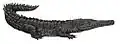
Theriosuchus

Theriosuchus
Ocorrência: Jurássico Superior - Cretáceo Inferior, 145,5–140,2 Ma[1]
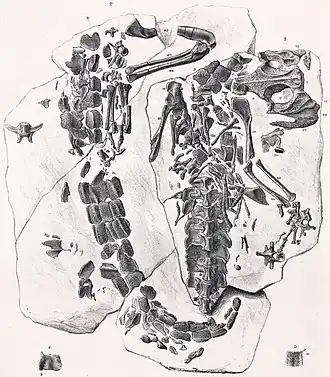
Fóssil de T. pusillus
Classificação científica
Reino: Animalia
Filo: Cordados
Classe: Répteis
Género: Theriosuchus
Owen, 1879
Espécies
  • T. pusillus Owen, 1879 (tipo)
  • T. grandinaris Lauprasert et al., 2011 [en]
  • T. morrisonensis Foster, 2018 [en]

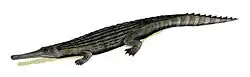
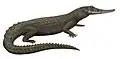
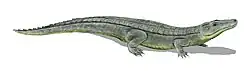
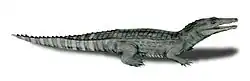
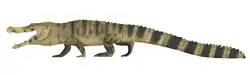
Theriosuchus é um gênero extinto de neossúquio atopossaurídeo do Jurássico Superior ao Cretáceo Inferior da Europa (Hungria e sul da Inglaterra), Sudeste Asiático (Tailândia) e oeste da América do Norte (Wyoming), com registros fragmentários de sítios do Jurássico Médio e Cretáceo Inferior na China, Marrocos e Escócia.[2]

Taxonomia

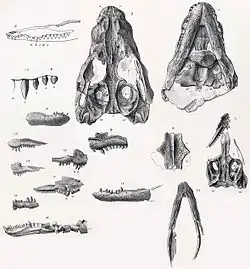
Elementos do crânio do T. pusillus

Atualmente, três espécies válidas são reconhecidas: Theriosuchus pusillus do sul da Inglaterra,[3] Theriosuchus grandinaris da Tailândia[4] e Theriosuchus morrisonensis da formação Morrison, na América do Norte.[5] Theriosuchus foi anteriormente atribuído a Atoposauridae, mas uma análise cladística de 2016 o recuperou como um neossúquio mais aparentado com membros da família Paralligatoridae do que com atopossaurídeos.[2]

Duas espécies anteriormente atribuídas a este gênero, Theriosuchus ibericus[6] e Theriosuchus symplesiodon,[7] foram reatribuídas ao novo gênero Sabresuchus.[2] Por outro lado, Theriosuchus guimarotae de Portugal[8] foi reatribuído a Knoetschkesuchus.[9]

Referências

  1. Rio, Jonathan P.; Mannion, Philip D. (6 de setembro de 2021). «Phylogenetic analysis of a new morphological dataset elucidates the evolutionary history of Crocodylia and resolves the long-standing gharial problem». PeerJ. 9: e12094. PMC 8428266Acessível livremente. PMID 34567843. doi:10.7717/peerj.12094Acessível livremente 
  2. a b c Tennant Jonathan P., Mannion Philip D., Upchurch Paul (2016). «Evolutionary relationships and systematics of Atoposauridae (Crocodylomorpha: Neosuchia): implications for the rise of Eusuchia». Zoological Journal of the Linnean Society. 177 (4): 854–936. doi:10.1111/zoj.12400Acessível livremente. hdl:10044/1/29026Acessível livremente 
  3. Owen, R. (1879). «Monograph on the fossil Reptilia of the Wealden and Purbeck Formations. Supplement IX, Crocodilia (Goniopholis, Brachydectes, Nannosuchus, Theriosuchus, and Nuthetes)». Palaeontographical Society of London Monograph. 33: 1–19. doi:10.1080/02693445.1879.12027958 
  4. Lauprasert Komsorn, Laojumpon Chalida, Saenphala Wanitchaphat, Cuny Gilles, Thirakhupt Kumthorn, Suteethorn Varavudh (2011). «Atoposaurid crocodyliforms from the Khorat Group of Thailand: first record of Theriosuchus from Southeast Asia». Paläontologische Zeitschrift. 85 (1): 37–47. doi:10.1007/s12542-010-0071-z 
  5. Foster, J. (2018). «A new atoposaurid crocodylomorph from the Morrison Formation (Upper Jurassic) of Wyoming, USA». Geology of the Intermountain West (em inglês). 5: 287–295. ISSN 2380-7601. doi:10.31711/giw.v5i0.32Acessível livremente 
  6. Brinkmann, W. (1992). «Die Krokodilier-Fauna aus der Unter-Kreide (Ober-Barremium) von Uña (Provinz Cuenca, Spanien)». Berliner Geowissenschaftliche Abhandlungen E. 5: 1–123 
  7. Martin Jeremy, Rabi Márton, Csiki Zoltán (2010). «Survival of Theriosuchus (Mesoeucrocodylia: Atoposauridae) in a Late Cretaceous archipelago: a new species from the Maastrichtian of Romania». Naturwissenschaften. 97 (9): 845–854. Bibcode:2010NW.....97..845M. PMID 20711558. doi:10.1007/s00114-010-0702-y 
  8. Schwarz, Daniela; Salisbury, Steven W. (2005). «A new species of Theriosuchus (Atoposauridae, Crocodylomorpha) from the Late Jurassic (Kimmeridgian) of Guimarota, Portugal». Geobios. 38 (6): 779–802. ISSN 0016-6995. doi:10.1016/j.geobios.2004.04.005  PDF
  9. Schwarz Daniela, Raddatz Maik, Wings Oliver (2017). «Knoetschkesuchus langenbergensis gen. nov. sp. nov., a new atoposaurid crocodyliform from the Upper Jurassic Langenberg Quarry (Lower Saxony, northwestern Germany), and its relationships to Theriosuchus». PLOS ONE. 12 (2): e0160617. Bibcode:2017PLoSO..1260617S. PMC 5310792Acessível livremente. PMID 28199316. doi:10.1371/journal.pone.0160617Acessível livremente