| Ronald Ross |
|---|
 |
| Nascimento | 13 de maio de 1857
Almora |
|---|
| Morte | 16 de setembro de 1932 (75 anos)
Londres |
|---|
| Residência | Escócia |
|---|
| Sepultamento | Putney Vale Cemetery |
|---|
| Nacionalidade | Britânico |
|---|
| Cidadania | Reino Unido |
|---|
| Progenitores | - Sir Campbell Claye Grant Ross
- Matilda Elderton
|
|---|
| Cônjuge | Rosa Bessie Bloxam |
|---|
| Filho(a)(s) | Charles Campbell Ross of that Ilk, younger |
|---|
| Irmão(ã)(s) | Charles Ross |
|---|
| Alma mater | - Barts e a Escola de Medicina e Odontologia de Londres
|
|---|
| Ocupação | médico, matemático, epidemiologista, poeta, romancista, malariólogo, microbiologista, zoólogo, patologista, botânico |
|---|
| Distinções | Prêmio Cameron (1902),  Nobel de Fisiologia ou Medicina (1902), Medalha Real (1909) Nobel de Fisiologia ou Medicina (1902), Medalha Real (1909) |
|---|
| Empregador(a) | King's College de Londres |
|---|
|
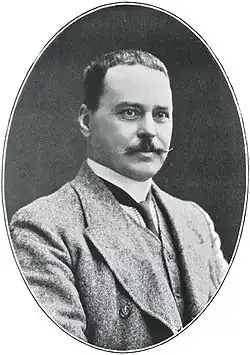
Ronald Ross KCB FRS (Almora, 13 de maio de 1857 — Londres, 16 de setembro de 1932) foi um médico britânico.[1]
Foi agraciado com o Nobel de Fisiologia ou Medicina de 1902, pela descoberta do processo de contaminação do organismo humano pela malária. Sua descoberta do parasita da malária no trato gastrointestinal do mosquito Anopheles levou à percepção de que a malária foi transmitido por Anopheles, e lançou as bases para o combate à doença.
Em 1901, Ross foi eleito membro da Real Colégio de Cirurgiões e também um companheiro da Royal Society,[2] de que ele se tornou vice-presidente de 1911-1913. Em 1926, foi homenageado pelo governo inglês com a construção do Instituto e Hospital Ross de Doenças Tropicais.[3]
Biografia
Filho de um general do exército inglês, Ross se formou em medicina em Londres, na escola de Saint Bartholomew. Em seguida entrou para o serviço médico na Índia. Em 1892 iniciou seus estudos sobre a malária e, dois anos depois, começou a pesquisar a hipóteses de Charles Louis Alphonse Laveran e Patrick Manson de que os mosquitos são responsáveis pela propagação da doença. Na África Ocidental descobriu as espécies de mosquitos que transmitem a malária.[1]
Ross também pesquisou as formas de prevenção à malária na região do Canal de Suez, Grécia e Chipre e nas áreas atingidas pela Primeira Guerra Mundial (1914 a 1918).[1] Morreu em Londres em 16 de dezembro de 1932.[4]
Livros
- Report on Cholera, General Sanitation, and the Sanitary Department and Regulations, in the C. & M. Station of Bangalore (1896)
- Versão digitalizada disponível na Biblioteca Nacional da Escócia
- Report on the Nature of Kala-azar (1899). Versão digitalizada disponível na Biblioteca Nacional da Escócia
- Malarial Fever: Its Cause, Prevention and Treatment; Containing Full Details for the Use of Travellers, Sportsmen, Soldiers, and Residents in Malarious Places (1902)
- First Progress Report of the Campaign Against Mosquitoes in Sierra Leone (com Charles Wilberforce Daniels) (1902)
- Notes on the Parasites of Mosquitoes Found in India Between 1895 and 1899
- Hygiene for Indian Scholar
- Note on the Bodies Recently Described by Leishman and Donovan (1903)
- Further Notes on Leishman's Bodies (1903)
- Report on Malaria at Ismailia and Suez (1903)
- Leishmania Donovani Found in Kala-azar (1904)
- Researches on Malaria (1905)
- Note on a Flagellate Parasite Found in Culex Fatigans (1906)
- Malaria in Greece (1909)
- Missionaries and the Campaign Against Malaria (1910)
- A Case of Sleeping Sickness Studied by Precise Enumerative Methods: Regular Periodical Increase of the Parasites Disclosed (com David Thomson) (1910)
- Discussion on the Treatment of Malaria (1918)
- Mosquitoes and Malaria in Britain (1918)
- Suggestions for the Care of Malaria Patients (1919)
- Observations on malaria (1919)
- Memoirs, with a Full Account of the Great Malaria Problem and Its Solution (1923)
- Malaria-control in Ceylon Plantations (1926)
- Solid Space-algebra: The Systems of Hamilton and Grassmann Combined (1929)
- A Summary of Facts Regarding Malaria Suitable for Public Instruction (com Malcolm Watson) (1930)
- Memories of Sir Patrick Manson (1930)
- The solution of equations by iteration (com William Stott) (1930)
- A Priori Pathometry (com Hilda Phoebe Hudson) (1931)
- Mosquito Brigades and How to Organise Them ISBN 978-1-2905-5311-7
Referências
Ligações externas
|
|---|
|
1951–2000 |
|---|
1951: Max Theiler
1952: Selman Waksman
1953: Hans Krebs e Fritz Lipmann
1954: John Enders, Thomas Weller e Frederick Robbins
1955: Hugo Theorell
1956: André Cournand, Werner Forßmann e Dickinson Richards
1957: Daniel Bovet
1958: George Beadle, Edward Tatum e Joshua Lederberg
1959: Severo Ochoa e Arthur Kornberg
1960: Frank Burnet e Peter Brian Medawar
1961: Georg von Békésy
1962: Francis Crick, James Watson e Maurice Wilkins
1963: John Eccles, Alan Hodgkin e Andrew Huxley
1964: Konrad Bloch e Feodor Lynen
1965: François Jacob, André Lwoff e Jacques Monod
1966: Francis Rous e Charles Huggins
1967: Ragnar Granit, Haldan Hartline e George Wald
1968: Robert Holley, Har Khorana e Marshall Nirenberg
1969: Max Delbrück, Alfred Hershey e Salvador Luria
1970: Bernard Katz, Ulf Svante von Euler e Julius Axelrod
1971: Earl Sutherland Jr.
1972: Gerald Edelman e Rodney Porter
1973: Karl von Frisch, Konrad Lorenz e Nikolaas Tinbergen
1974: Albert Claude, Christian de Duve e George Palade
1975: David Baltimore, Renato Dulbecco e Howard Temin
1976: Baruch Blumberg e Daniel Gajdusek
1977: Roger Guillemin, Andrzej Schally e Rosalyn Yalow
1978: Werner Arber, Daniel Nathans e Hamilton Smith
1979: Allan Cormack e Godfrey Hounsfield
1980: Baruj Benacerraf, Jean Dausset e George Snell
1981: Roger Sperry, David Hubel e Torsten Wiesel
1982: Sune Bergström, Bengt Samuelsson e John Vane
1983: Barbara McClintock
1984: Niels Jerne, Georges Köhler e César Milstein
1985: Michael Stuart Brown e Joseph Goldstein
1986: Stanley Cohen e Rita Levi-Montalcini
1987: Susumu Tonegawa
1988: James Black, Gertrude Elion e George Hitchings
1989: John Michael Bishop e Harold Varmus
1990: Joseph Murray e Edward Donnall Thomas
1991: Erwin Neher e Bert Sakmann
1992: Edmond Fischer e Edwin Krebs
1993: Richard Roberts e Phillip Sharp
1994: Alfred Gilman e Martin Rodbell
1995: Edward Lewis, Christiane Nüsslein-Volhard e Eric Wieschaus
1996: Peter Doherty e Rolf Zinkernagel
1997: Stanley Prusiner
1998: Robert Furchgott, Louis Ignarro e Ferid Murad
1999: Günter Blobel
2000: Arvid Carlsson, Paul Greengard e Eric Kandel
|
|
2001–2025 |
|---|
2001: Leland Hartwell, Richard Timothy Hunt e Paul Nurse
2002: Sydney Brenner, Robert Horvitz e John Sulston
2003: Paul Lauterbur e Peter Mansfield
2004: Richard Axel e Linda Buck
2005: Barry Marshall e Robin Warren
2006: Andrew Fire e Craig Mello
2007: Mario Capecchi, Martin Evans e Oliver Smithies
2008: Harald zur Hausen, Françoise Barré-Sinoussi e Luc Montagnier
2009: Elizabeth Blackburn, Carol Greider e Jack Szostak
2010: Robert Geoffrey Edwards
2011: Bruce Beutler, Jules Hoffmann e Ralph Steinman
2012: John Gurdon e Shinya Yamanaka
2013: James Rothman, Randy Schekman e Thomas Südhof
2014: John O'Keefe, May-Britt Moser e Edvard Moser
2015: William Cecil Campbell, Satoshi Ōmura e Tu Youyou
2016: Yoshinori Ohsumi
2017: Jeffrey C. Hall, Michael Rosbash e Michael W. Young
2018: James Patrick Allison e Tasuku Honjo
2019: William Kaelin Jr., Peter J. Ratcliffe e Gregg L. Semenza
2020: Harvey J. Alter, Michael Houghton e Charles M. Rice
2021: David Julius e Ardem Patapoutian
2022: Svante Pääbo
2023: Katalin Karikó e Drew Weissman
2024: Victor Ambros e Gary Ruvkun
2025: Fred Ramsdell, Mary E. Brunkow e Shimon Sakaguchi
|
|
|
|---|
1901: William Edward Ayrton e William Thomas Blanford • 1902: Edward Albert Sharpey-Schafer e Horace Lamb • 1903: David Gill e Horace Brown • 1904: David Bruce e William Burnside • 1905: Charles Scott Sherrington e John Henry Poynting • 1906: Alfred George Greenhill e Dukinfield Henry Scott • 1907: Ernest William Hobson e Ramsay Heatley Traquair • 1908: Henry Head e John Milne • 1909: Augustus Edward Hough Love e Ronald Ross • 1910: Frederick Orpen Bower e John Joly • 1911: George Chrystal e William Bayliss • 1912: Grafton Elliot Smith e William Mitchinson Hicks • 1913: Ernest Starling e Harold Baily Dixon • 1914: Ernest William Brown e William Johnson Sollas • 1915: Joseph Larmor e William Halse Rivers Rivers • 1916: Hector Munro Macdonald e John Scott Haldane • 1917: Arthur Smith Woodward e John Aitken • 1918: Alfred Fowler e Frederick Gowland Hopkins • 1919: James Hopwood Jeans e John Bretland Farmer • 1920: Godfrey Harold Hardy e William Bateson • 1921: Frank Dyson e Frederick Frost Blackman • 1922: Charles Thomson Rees Wilson e Joseph Barcroft • 1923: Charles James Martin e Napier Shaw • 1924: Dugald Clerk e Henry Dale • 1925: Albert Charles Seward e William Henry Perkin, Jr. • 1926: Archibald Vivian Hill e William Bate Hardy • 1927: John Cunningham McLennan e Thomas Lewis • 1928: Arthur Stanley Eddington e Robert Broom • 1929: John Edensor Littlewood e Robert Muir • 1930: John Edward Marr e Owen Willans Richardson • 1931: Richard Glazebrook e William Henry Lang • 1932: Edward Mellanby e Robert Robinson • 1933: Geoffrey Ingram Taylor e Patrick Laidlaw • 1934: Edgar Douglas Adrian e Sydney Chapman • 1935: Alfred Harker e Charles Galton Darwin • 1936: Edwin Stephen Goodrich e Ralph Howard Fowler • 1937: Arthur Henry Reginald Buller e Nevil Sidgwick • 1938: Francis William Aston e Ronald Fisher • 1939: David Keilin e Paul Dirac • 1940: Francis Marshall e Patrick Maynard Stuart Blackett • 1941: Ernest Kennaway e Edward Arthur Milne • 1942: William Whiteman Carlton Topley e Walter Norman Haworth • 1943: Edward Battersby Bailey e Harold Spencer Jones • 1944: Charles Robert Harington e David Brunt • 1945: Edward James Salisbury e John Desmond Bernal • 1946: Cyril Dean Darlington e William Lawrence Bragg • 1947: Frank Burnet e Cyril Norman Hinshelwood • 1948: James Gray e Harold Jeffreys • 1949: Rudolph Peters e George Paget Thomson • 1950: Carl Pantin e Edward Appleton |
