| Joseph Larmor |
|---|
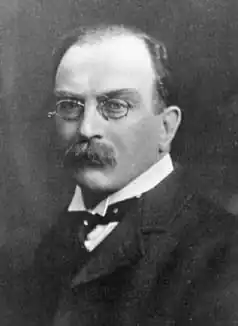 circa 1920 |
| Nascimento | 11 de julho de 1857
Magheragall |
|---|
| Morte | 19 de maio de 1942 (84 anos)
Holywood |
|---|
| Nacionalidade |  Irlandês Irlandês |
|---|
| Alma mater | Queen's University of Belfast, Universidade de Cambridge |
|---|
| Prêmios | Prêmio Smith (1880), Prêmio Adams (1899), Professor lucasiano (1903), Medalha De Morgan (1914), Medalha Real (1915), Prêmio Poncelet (1919), Medalha Copley (1921) |
|---|
|
| Orientado(a)(s) | Kwan-ichi Terazawa |
|---|
| Instituições | St John's College (Cambridge), Universidade Nacional da Irlanda, Galway |
|---|
| Campo(s) | Física, matemática |
|---|
Joseph Larmor (Magheragall, 11 de julho de 1857 — Holywood, 19 de maio de 1942) foi um físico e matemático irlandês.
De 1903 a 1932 foi professor lucasiano do Trinity College da Universidade de Cambridge. Seu antecessor foi George Gabriel Stokes e seu sucessor Paul Dirac.
Obra
Larmor foi o primeiro a publicar a transformação de Lorentz, em 1897,[1] dois anos antes de Hendrik Antoon Lorentz e oito anos antes de Albert Einstein.
Publicações
- 1887, „On the direct applications of first principles in the theory of partial differential equations,“ Proceedings of the Royal Society.
- 1891, „On the theory of electrodynamics,“ Proceedings of the Royal Society.
- 1892, „On the theory of electrodynamics, as affected by the nature of the mechanical stresses in excited dielectrics,“ Proceedings of the Royal Society.
- 1893-97, „Dynamical Theory of the Electric and Luminiferous Medium,“ Proceedings of the Royal Society; Philosophical Transactions of the Royal Society. Reihe aus 3 Artikeln mit Larmors physikalischer Theorie des Alls.
- 1894, „Least action as the fundamental formulation in dynamics and physics,“ Proceedings of the London Mathematical Society.
- 1896, „The influence of a magnetic field on radiation frequency,“ Proceedings of the Royal Society.
- 1896, „On the absolute minimum of optical deviation by a prism,“ Proceedings of the Cambridge Philosophical Society.
- J. Larmor (1897). On a Dynamical Theory of the Electric and Luminiferous Medium, Part 3, Relations with material media. Phil. Trans. Roy. Soc. 190. [S.l.: s.n.] p. 205-300 . Enthält die Lorentztransformation.
- 1898, „Note on the complete scheme of electrodymnamic equations of a moving material medium, and electrostriction,“ Proceedings of the Royal Society.
- 1898, „On the origin of magneto-optic rotation,“ Proceedings of the Cambridge Philosophical Society.
- J. Larmor (1900). Aether and Matter. [S.l.]: Cambridge University Press . Enthält ebenfalls die Lorentztransformation.
- 1903, „On the electrodymanic and thermal relations of energy of magnetisation,“ Proceedings of the Royal Society.
- 1907, „Aether“ in Encyclopædia Britannica, 11th ed. London.
- 1908, „William Thomson, Baron Kelvin of Largs. 1824-1907“ (Obituary). Proceedings of the Royal Society.
- 1924, „On Editing Newton,“ Nature.
- 1927, „Newtonion time essential to astronomy,“ Nature.
- 1929, „Mathematical and Physical Papers. Cambridge Univ. Press.
Ver também
Referências
Ligações externas
Precedido por
George Gabriel Stokes |
Professor lucasiano
1903 – 1932 |
Sucedido por
Paul Dirac |
Precedido por
Horace Lamb |
Medalha De Morgan
1914 |
Sucedido por
William Henry Young |
Precedido por
Ernest William Brown e William Johnson Sollas |
Medalha Real
1915
com William Halse Rivers Rivers |
Sucedido por
Hector Munro Macdonald e John Scott Haldane |
Precedido por
Horace Brown |
Medalha Copley
1921 |
Sucedido por
Ernest Rutherford |
Prêmio Adams |
|---|
- 1850 - Robert Peirson
- 1857 - James Clerk Maxwell
- 1865 - Edward Walker
- 1882 - Joseph John Thomson
- 1871 - Isaac Todhunter
- 1877 - Edward Routh
- 1893 - John Henry Poynting
- 1899 - Joseph Larmor e Gilbert Walker
- 1901 - Hector Munro Macdonald
- 1907 - Ernest William Brown
- 1909 - George Adolphus Schott
- 1911 - Augustus Edward Hough Love
- 1913 - Samuel McLaren e John William Nicholson
- 1915 - Geoffrey Ingram Taylor
- 1917 - James Hopwood Jeans
- 1919 - John William Nicholson
- 1920 - William Mitchinson Hicks
- 1922 - Joseph Proudman
- 1924 - Ralph Howard Fowler
- 1926 - Harold Jeffreys
- 1928 - Sydney Chapman
- 1930 - Abram Samoilovitch Besicovitch
- 1932 - Alan Herries Wilson
- 1934 - Sydney Goldstein
- 1936 - William Vallance Douglas Hodge
- 1940 - Harold Davenport
- 1942 - Hormasji Jehangir Bhabha
- 1947 - Desmond B. Sawyer
- 1948 - John Charles Burkill, Subrahmanyan Chandrasekhar, Walter Kurt Hayman e John MacNaughton Whittake
- 1950 - George Batchelor, William Reginald Dean e Leslie Howarth
- 1952 - Bernhard Neumann
- 1955 - Harold Gordon Eggleston
- 1958 - Paul Taunton Matthews, Abdus Salam e John Gerald Taylor
- 1960 - Vasant Shankar Huzurbazar e Walter Laws Smith
- 1962 - John Robert Ringrose
- 1964 - James Gardner Oldroyd e Owen Larkin Phillips
- 1966 - Stephen Hawking e Roger Penrose
- 1967 - Jayant Narlikar
- 1971 - Robert Burridge, Leslie John Walpole e John Raymond Willis
- 1972 - Alan Baker, Christopher Hooley e Hugh Montgomery
- 1973 - Christopher Hooley
- 1975 - John Fitch e David Barton
- 1977 - Tim Pedley
- 1981 - Michael E. McIntyre e Brian Leslie Norman Kennett
- 1982 - Dan Segal
- 1983 - Martin John Taylor, Gordon James, Steve Donkin e Aidan Schofield
- 1987 - Brian David Ripley
- 1992 - Paul Glendinning
- 2001 - Sandu Popescu
- 2002 - Susan Howson
- 2003 - David Hobson
- 2004 - Dominic Joyce
- 2005 - Mihalis Dafermos e David Stuart
- 2006 - Jonathan Sherratt
- 2007 - Paul Fearnhead
- 2008 - Tom Bridgeland e David Tong
- 2009 - Raphaël Rouquier
- 2010 - Jacques Vanneste
- 2011 - Harald Helfgott e Tom Sanders
- 2012 - Sheehan Olver e Françoise Tisseur
- 2013 - Ivan Smith
- 2015 - Arend Bayer, Thomas Coates
- 2016 - Clément Mouhot
- 2017 - Graham Cormode, Richard Samworth
- 2018 - Claudia de Rham, Gustav Holzegel
- 2019 - Heather Harrington, Luitgard Veraart
- 2020 - Konstantin Ardakov, Michael Wemyss
|
Professor lucasiano |
|---|
|
.svg.png) Universidade de Cambridge |
Medalha De Morgan |
|---|
- 1884: Arthur Cayley
- 1887: James Joseph Sylvester
- 1890: John William Strutt
- 1893: Felix Klein
- 1896: Samuel Roberts
- 1899: William Burnside
- 1902: Alfred George Greenhill
- 1905: Henry Frederick Baker
- 1908: James Whitbread Lee Glaisher
- 1911: Horace Lamb
- 1914: Joseph Larmor
- 1917: William Henry Young
- 1920: Ernest William Hobson
- 1923: Percy Alexander MacMahon
- 1926: Augustus Edward Hough Love
- 1929: Godfrey Harold Hardy
- 1932: Bertrand Russell
- 1935: Edmund Taylor Whittaker
- 1938: John Edensor Littlewood
- 1941: Louis Mordell
- 1944: Sydney Chapman
- 1947: George Neville Watson
- 1950: Abram Besicovitch
- 1953: Edward Charles Titchmarsh
- 1956: Geoffrey Ingram Taylor
- 1959: William Vallance Douglas Hodge
- 1962: Max Newman
- 1965: Philip Hall
- 1968: Mary Cartwright
- 1971: Kurt Mahler
- 1974: Graham Higman
- 1977: Claude Ambrose Rogers
- 1980: Michael Atiyah
- 1983: Klaus Friedrich Roth
- 1986: John Cassels
- 1989: David George Kendall
- 1992: Albrecht Fröhlich
- 1995: Walter Hayman
- 1998: Robert Alexander Rankin
- 2001: James Alexander Green
- 2004: Roger Penrose
- 2007: Bryan John Birch
- 2010: Keith William Morton
- 2013: John Griggs Thompson
- 2016: William Timothy Gowers
- 2019: Andrew Wiles
|
Laureados com a Medalha Real (1901 – 1950) |
|---|
1901: William Edward Ayrton e William Thomas Blanford • 1902: Edward Albert Sharpey-Schafer e Horace Lamb • 1903: David Gill e Horace Brown • 1904: David Bruce e William Burnside • 1905: Charles Scott Sherrington e John Henry Poynting • 1906: Alfred George Greenhill e Dukinfield Henry Scott • 1907: Ernest William Hobson e Ramsay Heatley Traquair • 1908: Henry Head e John Milne • 1909: Augustus Edward Hough Love e Ronald Ross • 1910: Frederick Orpen Bower e John Joly • 1911: George Chrystal e William Bayliss • 1912: Grafton Elliot Smith e William Mitchinson Hicks • 1913: Ernest Starling e Harold Baily Dixon • 1914: Ernest William Brown e William Johnson Sollas • 1915: Joseph Larmor e William Halse Rivers Rivers • 1916: Hector Munro Macdonald e John Scott Haldane • 1917: Arthur Smith Woodward e John Aitken • 1918: Alfred Fowler e Frederick Gowland Hopkins • 1919: James Hopwood Jeans e John Bretland Farmer • 1920: Godfrey Harold Hardy e William Bateson • 1921: Frank Dyson e Frederick Frost Blackman • 1922: Charles Thomson Rees Wilson e Joseph Barcroft • 1923: Charles James Martin e Napier Shaw • 1924: Dugald Clerk e Henry Dale • 1925: Albert Charles Seward e William Henry Perkin, Jr. • 1926: Archibald Vivian Hill e William Bate Hardy • 1927: John Cunningham McLennan e Thomas Lewis • 1928: Arthur Stanley Eddington e Robert Broom • 1929: John Edensor Littlewood e Robert Muir • 1930: John Edward Marr e Owen Willans Richardson • 1931: Richard Glazebrook e William Henry Lang • 1932: Edward Mellanby e Robert Robinson • 1933: Geoffrey Ingram Taylor e Patrick Laidlaw • 1934: Edgar Douglas Adrian e Sydney Chapman • 1935: Alfred Harker e Charles Galton Darwin • 1936: Edwin Stephen Goodrich e Ralph Howard Fowler • 1937: Arthur Henry Reginald Buller e Nevil Sidgwick • 1938: Francis William Aston e Ronald Fisher • 1939: David Keilin e Paul Dirac • 1940: Francis Marshall e Patrick Maynard Stuart Blackett • 1941: Ernest Kennaway e Edward Arthur Milne • 1942: William Whiteman Carlton Topley e Walter Norman Haworth • 1943: Edward Battersby Bailey e Harold Spencer Jones • 1944: Charles Robert Harington e David Brunt • 1945: Edward James Salisbury e John Desmond Bernal • 1946: Cyril Dean Darlington e William Lawrence Bragg • 1947: Frank Burnet e Cyril Norman Hinshelwood • 1948: James Gray e Harold Jeffreys • 1949: Rudolph Peters e George Paget Thomson • 1950: Carl Pantin e Edward Appleton |
Medalha Copley. Laureados (1901–1950) |
|---|
|
- Lista Completa
- (1731–1750)
- (1751–1800)
- (1801–1850)
- (1851–1900)
- (1951–2000)
- (2001–2026)
|
