John Henry Poynting
| John Henry Poynting | |
|---|---|
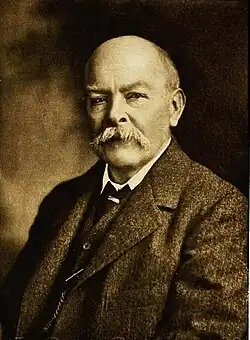 | |
| Teorema de Poynting, vector de Poynting, efeito Poynting, efeito Poynting-Robertson | |
| Nascimento | 9 de setembro de 1852 Manchester |
| Morte | 30 de março de 1914 (61 anos) Birmingham |
| Nacionalidade | inglês |
| Cidadania | Reino Unido da Grã-Bretanha e Irlanda |
| Irmão(ã)(s) | Frank Poynting |
| Alma mater | Universidade de Cambridge, Universidade de Manchester |
| Ocupação | físico, professor universitário |
| Distinções | Prêmio Adams (1893), Medalha Real (1905) |
| Empregador(a) | Universidade de Birmingham |
| Orientador(a)(es/s) | James Clerk Maxwell |
| Instituições | Colégio Científico Mason |
| Obras destacadas | vector de Poynting |
John Henry Poynting (FRS[1]) (Manchester, 9 de setembro de 1852 — Birmingham, 30 de março de 1914) foi um físico inglês.
Carreira
No final da década de 1870, ele trabalhou no Laboratório Cavendish em Cambridge sob James Clerk Maxwell. Em 1880, ele se tornou o primeiro professor de física na Universidade de Birmingham. Ele foi o desenvolvedor e epônimo do vetor de Poynting, que descreve a direção e a magnitude do fluxo de energia eletromagnética e é usado no teorema de Poynting, uma declaração sobre conservação de energia para campos elétricos e magnéticos. Este trabalho foi publicado pela primeira vez em 1884. Ele realizou uma medição da constante gravitacional de Newton por meios inovadores durante 1893. Em 1903, ele foi o primeiro a perceber que a radiação do Sol pode atrair pequenas partículas em sua direção: isso foi mais tarde chamado de efeito Poynting-Robertson.[2]
Ele descobriu o acoplamento torção-extensão na elasticidade de deformação finita. Isso agora é conhecido como o efeito de Poynting (positivo) na torção.
Poynting e o ganhador do Prêmio Nobel J. J. Thomson foram co-autores de um livro didático de física de graduação em vários volumes, que foi impresso por cerca de 50 anos e foi amplamente utilizado durante o primeiro terço do século 20. Poynting escreveu a maior parte.[3][4]
Ele foi premiado com um mestrado honorário em Ciência Pura em 1901 pela Birmingham University.[5]
Morreu de coma diabético, aos 61 anos, em 10.
Legado
Alfred J. Lotka estava entre os alunos mais famosos de Poynting, sendo inspirado por Poynting para aplicar as idéias da físico-química à biologia. Lotka dedicou seu livro clássico sobre biologia matemática de populações a Poynting. Poynting previu o 'efeito Poynting-Robertson', pelo qual uma partícula de poeira orbitando uma estrela experimenta uma força de arrasto que a faz espiralar lentamente para dentro da estrela. Howard P. Robertson mais tarde reafirmou a previsão usando a relatividade geral. Poynting também fundou e é o homônimo da popular sociedade estudantil da Universidade de Birmingham, 'The Poynting Physical Society' ou PPS.[6]

Crateras em Marte e na Lua são nomeadas em sua homenagem, assim como o principal prédio de física da Universidade de Birmingham e a sociedade departamental de lá, a Poynting Physical Society. Ele é creditado por cunhar a expressão "efeito estufa" em 1909 para explicar como os gases residuais de absorção de infravermelho, como o dióxido de carbono na atmosfera, aumentam a temperatura da superfície da Terra e de Marte.[7]
Publicações
- 1884 A Comparison of the Fluctuations in the Price of Wheat and in the Cotton and Silk Imports into Great Britain, Journal of the Royal Statistical Society; 47, 1884, pp. 34–64
- 1894 The Mean Density of the Earth London, C. Griffin[8]
- 1899 (with J. J. Thomson) A Text-Book of Physics: volume I: Sound London, C. Griffin;[9] 2nd edition, 1900
- 1902 (with J. J. Thomson) A Text-Book of Physics: volume II: Properties of Matter London, C. Griffin[10]
- 1904 (with J. J. Thomson) A Text-Book of Physics: volume III: Heat London, C. Griffin
- 1913 The earth; its shape, size, weight and spin Cambridge University Press[11]
- 1914 (with J. J. Thomson) A Text-Book of Physics: volume IV: Electricity and Magnetism. Pts. I and II: Static electricity and magnetism London, C. Griffin
- 1920 Collected Scientific Papers Cambridge University Press

Ver também
Referências
- ↑ Poynting, John Henry" in J. Venn e J. A. Venn, Alumni Cantabrigienses. 10 vols. (Cambridge: Cambridge University Press, 1922–1958) ACAD - A Cambridge Alumni Database
- ↑ Benest, Daniel; Froeschlé, Claude (1992). Interrelations Between Physics and Dynamics for Minor Bodies in the Solar System. [S.l.]: Atlantica Séguier Frontières. p. 437. ISBN 2-86332112-9 Extract of page 437
- ↑ For a lengthy though incomplete listing of the editions of Poynting and Thomson's Text-book of Physics see Worldcat.org.
- ↑ Reported in the biography of JJ Thomson by Davis & Falconer, previewable at Google Book Search Preview.
- ↑ «University campus Blue Plaque Trail». Birmingham University. Cópia arquivada em 2014
- ↑ «Poynting Physical Society». Cópia arquivada em 2022
- ↑ Poynting, J.H. (1907). «LXXIV. On Prof. Lowell's method for evaluating the surface-temperatures of the planets; with an attempt to represent the effect of day and night on the temperature of the earth». The London, Edinburgh, and Dublin Philosophical Magazine and Journal of Science. 14 (84): 749–760. doi:10.1080/14786440709463737
- ↑ Preston, Erasmus D. (1895). «Review of The Mean Density of the Earth by J. H. Poynting». American Physical Society. Physical Review. II: 76–80
- ↑ «Review of A Text-Book of Physics: Sound by J. H. Poynting and J. J. Thomson». Westminster Review. 151: 463–464. 1899
- ↑ «Review of Properties of Matter by J. H. Poynting and J. J. Thomson». The Athenaeum (3939): 534. 1903
- ↑ «Review of The Earth: its Shape, Size, Weight, and Spin by J. H. Poynting». The Geological Magazine. New Series. X: 318. 1913
Ligações externas
| Precedido por David Bruce e William Burnside |
Medalha Real 1905 com Charles Scott Sherrington |
Sucedido por Alfred George Greenhill e Dukinfield Henry Scott |
| Controle de autoridade |
|
|---|
