Receptor de fator de crescimento endotelial vascular 1
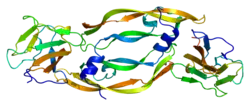

Receptor de fator de crescimento endotelial vascular 1 (VEGFR1) é uma proteína que em humanos é codificada pelo gene FLT1.[4]
Função
FLT1 é um membro da família de genes do receptor VEGF [en]. Ele codifica uma tirosina quinase receptora [en] que é ativada por VEGF-A [en], VEGF-B [en] e fator de crescimento placentário [en]. A estrutura da sequência do gene FLT1 assemelha-se à do gene FMS (agora CSF1R [en]); portanto, Yoshida et al. (1987) propuseram o nome FLT como um acrônimo para tirosina quinase semelhante a FMS (FMS-like tyrosine kinase).[5]
A ablação de VEGFR1 por meios químicos e genéticos também foi recentemente encontrada para aumentar a conversão de tecido adiposo branco em tecido adiposo marrom, bem como aumentar a angiogênese adiposa marrom em camundongos.[6]
Uma variação genética funcional em FLT1 (rs9582036) foi encontrada afetando a sobrevivência em câncer de pulmão de células não pequenas.[7]
Interações
FLT1 mostrou interagir com PLCG1 [en][8] e fator de crescimento endotelial vascular B [en] (VEGF-B).[9][10]
Referências
- ↑ «Doenças geneticamente associadas a FLT1 ver/editar referências no wikidata»
- ↑ «Drogas que interagem fisicamente com Fms related receptor tyrosine kinase 1 ver/editar referências no wikidata»
- ↑ «Human PubMed Reference:»
- ↑ Shibuya M, Yamaguchi S, Yamane A, Ikeda T, Tojo A, Matsushime H, Sato M (Abril de 1990). «Nucleotide sequence and expression of a novel human receptor-type tyrosine kinase gene (flt) closely related to the fms family». Oncogene. 5 (4): 519–24. PMID 2158038
- ↑ «FLT1 fms related receptor tyrosine kinase 1 [ Homo sapiens (human) ]». National Center for Biotechnology Information
- ↑ Seki T, Hosaka K, Fischer C, Lim S, Andersson P, Abe M, Iwamoto H, Gao Y, Wang X, Fong GH, Cao Y (Fevereiro de 2018). «Ablation of endothelial VEGFR1 improves metabolic dysfunction by inducing adipose tissue browning». The Journal of Experimental Medicine. 215 (2): 611–626. PMC 5789413
 . PMID 29305395. doi:10.1084/jem.20171012
- ↑ Glubb DM, Paré-Brunet L, Jantus-Lewintre E, Jiang C, Crona D, Etheridge AS, Mirza O, Zhang W, Seiser EL, Rzyman W, Jassem J, Auman T, Hirsch FR, Owzar K, Camps C, Dziadziuszko R, Innocenti F (Julho de 2015). «Functional FLT1 Genetic Variation is a Prognostic Factor for Recurrence in Stage I-III Non-Small-Cell Lung Cancer». Journal of Thoracic Oncology. 10 (7): 1067–75. PMC 4494119. PMID 26134224. doi:10.1097/JTO.0000000000000549
- ↑ Cunningham SA, Arrate MP, Brock TA, Waxham MN (Novembro de 1997). «Interactions of FLT-1 and KDR with phospholipase C gamma: identification of the phosphotyrosine binding sites». Biochemical and Biophysical Research Communications. 240 (3): 635–9. Bibcode:1997BBRC..240..635C. PMID 9398617. doi:10.1006/bbrc.1997.7719
- ↑ Olofsson B, Korpelainen E, Pepper MS, Mandriota SJ, Aase K, Kumar V, Gunji Y, Jeltsch MM, Shibuya M, Alitalo K, Eriksson U (Setembro de 1998). «Vascular endothelial growth factor B (VEGF-B) binds to VEGF receptor-1 and regulates plasminogen activator activity in endothelial cells». Proceedings of the National Academy of Sciences of the United States of America. 95 (20): 11709–14. Bibcode:1998PNAS...9511709O. PMC 21705. PMID 9751730. doi:10.1073/pnas.95.20.11709
- ↑ Makinen T, Olofsson B, Karpanen T, Hellman U, Soker S, Klagsbrun M, Eriksson U, Alitalo K (Julho de 1999). «Differential binding of vascular endothelial growth factor B splice and proteolytic isoforms to neuropilin-1». The Journal of Biological Chemistry. 274 (30): 21217–22. PMID 10409677. doi:10.1074/jbc.274.30.21217
Leitura adicional
- Petrova TV, Makinen T, Alitalo K (Novembro de 1999). «Signaling via vascular endothelial growth factor receptors». Experimental Cell Research. 253 (1): 117–30. PMID 10579917. doi:10.1006/excr.1999.4707
- Sato Y, Kanno S, Oda N, Abe M, Ito M, Shitara K, Shibuya M (Maio de 2000). «Properties of two VEGF receptors, Flt-1 and KDR, in signal transduction». Annals of the New York Academy of Sciences. 902 (1): 201–5; discussion 205–7. Bibcode:2000NYASA.902..201S. PMID 10865839. doi:10.1111/j.1749-6632.2000.tb06314.x
- Boyd AW, Lackmann M (Dezembro de 2001). «Signals from Eph and ephrin proteins: a developmental tool kit». Science's STKE. 2001 (112): re20. PMID 11741094. doi:10.1126/stke.2001.112.re20
- Luttun A, Tjwa M, Carmeliet P (Dezembro de 2002). «Placental growth factor (PlGF) and its receptor Flt-1 (VEGFR-1): novel therapeutic targets for angiogenic disorders». Annals of the New York Academy of Sciences. 979: 80–93. PMID 12543719. doi:10.1111/j.1749-6632.2002.tb04870.x
- Maynard SE, Venkatesha S, Thadhani R, Karumanchi SA (Maio de 2005). «Soluble Fms-like tyrosine kinase 1 and endothelial dysfunction in the pathogenesis of preeclampsia». Pediatric Research. 57 (5 Pt 2): 1R–7R. PMID 15817508. doi:10.1203/01.PDR.0000159567.85157.B7
- Shibuya M (2007). «Vascular endothelial growth factor receptor-1 (VEGFR-1/Flt-1): a dual regulator for angiogenesis». Angiogenesis. 9 (4): 225–30; discussion 231. PMID 17109193. doi:10.1007/s10456-006-9055-8
- Widmer M, Villar J, Benigni A, Conde-Agudelo A, Karumanchi SA, Lindheimer M (Janeiro de 2007). «Mapping the theories of preeclampsia and the role of angiogenic factors: a systematic review». Obstetrics and Gynecology. 109 (1): 168–80. PMID 17197602. doi:10.1097/01.AOG.0000249609.04831.7c
- López-Novoa JM (Março de 2007). «Soluble endoglin is an accurate predictor and a pathogenic molecule in pre-eclampsia». Nephrology, Dialysis, Transplantation. 22 (3): 712–4. PMID 17210583. doi:10.1093/ndt/gfl768
- Poesen K, Lambrechts D, Van Damme P, Dhondt J, Bender F, Frank N, Bogaert E, Claes B, Heylen L, Verheyen A, Raes K, Tjwa M, Eriksson U, Shibuya M, Nuydens R, Van Den Bosch L, Meert T, D'Hooge R, Sendtner M, Robberecht W, Carmeliet P (Outubro de 2008). «Novel role for vascular endothelial growth factor (VEGF) receptor-1 and its ligand VEGF-B in motor neuron degeneration». The Journal of Neuroscience. 28 (42): 10451–9. PMC 6671326. PMID 18923022. doi:10.1523/JNEUROSCI.1092-08.2008
- Joukov V, Kaipainen A, Jeltsch M, Pajusola K, Olofsson B, Kumar V, Eriksson U, Alitalo K (Novembro de 1997). «Vascular endothelial growth factors VEGF-B and VEGF-C». Journal of Cellular Physiology. 173 (2): 211–5. PMID 9365524. doi:10.1002/(SICI)1097-4652(199711)173:2<211::AID-JCP23>3.0.CO;2-H
- Kaplan RN, Riba RD, Zacharoulis S, Bramley AH, Vincent L, Costa C, MacDonald DD, Jin DK, Shido K, Kerns SA, Zhu Z, Hicklin D, Wu Y, Port JL, Altorki N, Port ER, Ruggero D, Shmelkov SV, Jensen KK, Rafii S, Lyden D (Dezembro de 2005). «VEGFR1-positive haematopoietic bone marrow progenitors initiate the pre-metastatic niche». Nature. 438 (7069): 820–7. Bibcode:2005Natur.438..820K. PMC 2945882. PMID 16341007. doi:10.1038/nature04186