| John Presper Eckert |
|---|
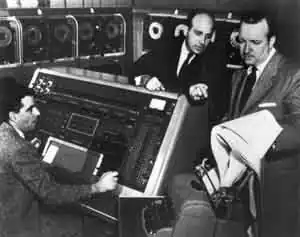
 John Presper Eckert (ao centro) demonstra o computador UNIVAC para um jornalista |
| Nascimento | John Adam Presper Eckert, Jr. 9 de abril de 1919 Filadélfia |
|---|
| Morte | 3 de junho de 1995 (76 anos) Bryn Mawr |
|---|
| Nacionalidade | estadunidense |
|---|
| Cidadania | Estados Unidos |
|---|
| Alma mater | - University of Pennsylvania School of Engineering and Applied Science
|
|---|
| Ocupação | engenheiro eletrotécnico, inventor, cientista de computação, engenheiro, físico |
|---|
| Distinções | Medalha Howard N. Potts (1949), Prêmio Memorial Harry H. Goode (1966), Medalha Nacional de Ciências (1968), Prêmio Harold Pender (1973), Prêmio Emanuel R. Piore IEEE (1978) |
|---|
| Empregador(a) | Moore School of Electrical Engineering, Eckert-Mauchly Computer Corporation, Remington Rand, Sperry Rand, Unisys |
|---|
| Causa da morte | leucemia |
|---|
|
John Adam Presper Eckert Jr (Filadélfia, 9 de abril de 1919 — Bryn Mawr, 3 de junho de 1995) foi um engenheiro elétrico norte-americano e pioneiro da computação. Ajudou a construir o primeiro computador eletrônico (ENIAC).[1]
Carreira
Com John Mauchly, ele projetou o primeiro computador digital eletrônico de uso geral (ENIAC), apresentou o primeiro curso em tópicos de computação (as Palestras da Escola Moore), fundou a Eckert–Mauchly Computer Corporation e projetou o primeiro computador comercial nos Estados Unidos, o UNIVAC, que incorporou a invenção de Eckert a Delay-line memory agora em desuso.
Desenvolvimento do ENIAC
John Mauchly, então presidente do departamento de física do vizinho Ursinus College, era aluno do curso de verão de eletrônica e, no outono seguinte, conseguiu um cargo de professor na Moore School. A proposta de Mauchly de construir um computador digital eletrônico usando tubos de vácuo, muitas vezes mais rápido e preciso do que o analisador diferencial para calcular tabelas de balística para artilharia , despertou o interesse do contato do Exército da Escola Moore, tenente Herman Goldstine, e em 9 de abril de 1943, foi formalmente apresentado em uma reunião no Aberdeen Proving Ground ao diretor Coronel Leslie Simon , Oswald Veblen, e outros. Um contrato foi concedido para a construção da máquina de computação proposta pela Moore School, que seria chamada de ENIAC, e Eckert foi nomeado engenheiro-chefe do projeto. O ENIAC foi concluído no final de 1945 e foi apresentado ao público em fevereiro de 1946.[2][3]
Ver também
Referências
Ligações externas
- Oral history interview with J. Presper Eckert, Charles Babbage Institute, University of Minnesota. Eckert, a co-inventor of the ENIAC, discusses its development at the University of Pennsylvania's Moore School of Electrical Engineering; describes difficulties in securing patent rights for the ENIAC and the problems posed by the circulation of John von Neumann's 1945 First Draft of the Report on EDVAC, which placed the ENIAC inventions in the public domain. Interview by Nancy Stern, October 28, 1977.
- Oral history interview with Carl Chambers, Charles Babbage Institute, University of Minnesota. Describes the interactions among the ENIAC staff, and focuses on the personalities and working relationships of Mauchly and Eckert.
- A Tribute to Dr. J. Presper Eckert Co-Inventor of ENIAC. 2000 Daniel F. McGrath Jr.
- ENIAC museum at the University of Pennsylvania
- Q&A: A lost interview with ENIAC co-inventor J. Presper Eckert
- 1989 interview of Eckert by Alexander Randall 5th, published February 23, 2006 on KurzweilAI.net. Includes Eckert's reflections on the creation of ENIAC.
- Interview with Eckert Transcript of a video interview with Eckert by David Allison for the National Museum of American History, Smithsonian Institution on February 2, 1988. An in-depth, technical discussion on the ENIAC, including the thought process behind the design.
|
|---|
Ciência do Comportamento e Social |
|---|
| Década de 1960 | |
|---|
| Década de 1980 | |
|---|
| Década de 1990 | |
|---|
| Década de 2000 | |
|---|
| Década de 2010 | |
|---|
|
|
Ciências Biológicas |
|---|
| Década de 1960 | |
|---|
| Década de 1970 | 1970: Barbara McClintock e Albert Sabin · 1973: Daniel Arnon e Earl Sutherland · 1974: Britton Chance, Erwin Chargaff, James Neel e James Hannon · 1975: Hallowell Davis, Paul Gyorgy, Sterling Hendricks e Orville Vogel · 1976: Roger Guillemin, Keith Roberts Porter, Efraim Racker e Edward Osborne Wilson · 1979: Robert H. Burris, Elizabeth C. Crosby, Arthur Kornberg, Severo Ochoa, Earl Stadtman, George Ledyard Stebbins e Paul Weiss |
|---|
| Década de 1980 | 1981: Philip Handler · 1982: Seymour Benzer, Glenn Burton e Mildred Cohn · 1983: Howard Bachrach, Paul Berg, Wendell Lee Roelofs e Berta Scharrer · 1986: Stanley Cohen, Donald Henderson, Vernon Mountcastle, George Palade e Joan A. Steitz · 1987: Michael DeBakey, Theodor Otto Diener, Harry Eagle, Har Khorana e Rita Levi-Montalcini · 1988: Michael Stuart Brown, Stanley Norman Cohen, Joseph Goldstein, Maurice Hilleman, Eric Kandel e Rosalyn Yalow · 1989: Katherine Esau, Viktor Hamburger, Philip Leder, Joshua Lederberg, Roger Sperry e Harland Goff Wood |
|---|
| Década de 1990 | 1990: Baruj Benacerraf, Herbert Boyer, Daniel Koshland, Edward Lewis, David Nathan e Edward Donnall Thomas · 1991: Mary Ellen Avery, George Evelyn Hutchinson, Elvin Kabat, Robert Kates, Salvador Luria, Paul Marks, Folke Skoog e Paul Zamecnik · 1992: Maxine Singer e Howard Martin Temin · 1993: Daniel Nathans e Salome G. Waelsch · 1994: Thomas Eisner e Elizabeth Neufeld · 1995: Alexander Rich · 1996: Ruth Patrick · 1997: James Watson e Robert Allan Weinberg · 1998: Bruce Ames e Janet Rowley · 1999: David Baltimore, Jared Diamond e Lynn Margulis |
|---|
| Década de 2000 | 2000: Nancy Coover Andreasen, Peter H. Raven e Carl Woese · 2001: Francisco José Ayala, George Bass, Mario Capecchi, Ann Graybiel, Gene Likens, Victor A. McKusick e Harold Varmus · 2002: James E. Darnell e Evelyn M. Witkin · 2003: John Michael Bishop, Solomon Halbert Snyder e Charles Yanofsky · 2004: Norman Borlaug, Phillip Allen Sharp e Thomas Starzl · 2005: Anthony Fauci e Torsten Wiesel · 2006: Rita Colwell, Nina Fedoroff e Lubert Stryer · 2007: Robert Lefkowitz e Bert William O’Malley · 2008: Francis Collins, Elaine Fuchs, Craig Venter · 2009: Susan Lindquist, Stanley Prusiner |
|---|
| Década de 2010 | |
|---|
|
|
Química |
|---|
| Década de 1960 | |
|---|
| Década de 1980 | |
|---|
| Década de 1990 | |
|---|
| Década de 2000 | |
|---|
| Década de 2010 | |
|---|
|
|
Ciências da Engenharia |
|---|
| Década de 1960 | |
|---|
| Década de 1970 | |
|---|
| Década de 1980 | |
|---|
| Década de 1990 | |
|---|
| Década de 2000 | |
|---|
| Década de 2010 | |
|---|
|
|
Ciências Matemáticas, Estatísticas e Computacionais |
|---|
| Década de 1960 | |
|---|
| Década de 1970 | |
|---|
| Década de 1980 | |
|---|
| Década de 1990 | |
|---|
| Década de 2000 | |
|---|
| Década de 2010 | |
|---|
|
|
Ciências Físicas |
|---|
| Década de 1960 | 1963: Luis Walter Alvarez · 1964: Julian Schwinger, Harold Clayton Urey e Robert Burns Woodward · 1965: John Bardeen, Peter Debye, Leon Max Lederman e William Walden Rubey · 1966: Jacob Bjerknes, Subrahmanyan Chandrasekhar, Henry Eyring, John Hasbrouck Van Vleck e Vladimir Zworykin · 1967: Jesse Beams, Francis Birch, Gregory Breit · Louis Plack Hammett e George Kistiakowsky · 1968: Paul Doughty Bartlett, Herbert Friedman, Lars Onsager e Eugene Paul Wigner · 1969: Herbert Charles Brown e Wolfgang Panofsky |
|---|
| Década de 1970 | 1970: Robert Henry Dicke, Allan Rex Sandage, John Clarke Slater, John Archibald Wheeler e Saul Winstein · 1973: Carl Djerassi, William Maurice Ewing, Arie Jan Haagen-Smit, Vladimir Haensel, Frederick Seitz e Robert Rathbun Wilson · 1974: Nicolaas Bloembergen, Paul John Flory, William Alfred Fowler, Linus Pauling e Kenneth Sanborn Pitzer · 1975: Hans Bethe, Joseph Hirschfelder, Lewis Hastings Sarett, Edgar Bright Wilson e Chien-Shiung Wu · 1976: Samuel Abraham Goudsmit, Herbert S. Gutowsky, Frederick Rossini, Verner Suomi, Henry Taube e George Eugene Uhlenbeck · 1979: Richard Feynman, Hermann Mark, Edward Mills Purcell, John Sinfelt, Lyman Spitzer e Victor Weisskopf |
|---|
| Década de 1980 | 1982: Philip Warren Anderson, Yoichiro Nambu, Edward Teller e Charles Hard Townes · 1983: Margaret Burbidge, Maurice Goldhaber, Helmut Landsberg, Walter Munk, Frederick Reines, Bruno Rossi e John Robert Schrieffer · 1986: Solomon Buchsbaum, Horace Crane, Herman Feshbach, Robert Hofstadter e Chen Ning Yang · 1987: Philip Abelson, Walter Elsasser, Paul Christian Lauterbur, George Pake e James Van Allen · 1988: David Allan Bromley, Chu Ching-wu, Walter Kohn, Norman Foster Ramsey, Jack Steinberger · 1989: Arnold Orville Beckman, Eugene Parker, Robert Sharp e Henry Stommel |
|---|
| Década de 1990 | |
|---|
| Década de 2000 | |
|---|
| Década de 2010 | |
|---|
|
|