Vida
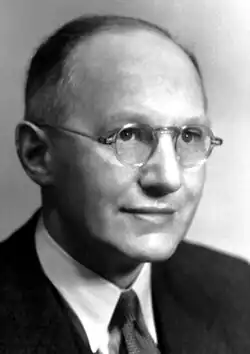
Ernest Walton era filho de um ministro metodista. Depois de se formar em uma faculdade metodista em Belfast, ele começou a estudar matemática e física experimental no Trinity College em Dublin em 1922 e se formou em ambas as disciplinas em 1926/27. Ele então se mudou para uma bolsa de pesquisa para o Laboratório Cavendish na Universidade de Cambridge, que era chefiado por Ernest Rutherford. Após receber seu doutorado em 1931, ele permaneceu em Cambridge até 1934 e então retornou ao Trinity College. Em 1946 ele se tornou professor de filosofia natural e física experimental.[1]
Walton casou-se com Freda Wilson, filha de um pároco metodista em 1934, e tem dois filhos (Alan e Philip) e duas filhas (Marian e Jean). Ele morreu em Belfast em 1995.[1]
Está sepultado no Cemitério Deans Grange.[1]
Trabalho
Walton já fazia pesquisas em Cambridge sobre a aceleração de íons por meio da tensão direta e também de elétrons de acordo com o princípio do betatron. Junto com John Cockcroft, ele desenvolveu o acelerador Cockcroft-Walton. Com ele, conversões (reações nucleares) poderiam ser acionadas e detectadas pelo bombardeio de vários núcleos atômicos leves com prótons rápidos.[1]
Em 1951, Ernest Walton e John Cockcroft receberam o Prêmio Nobel de Física “por seu trabalho pioneiro no campo da conversão do núcleo atômico por partículas atômicas aceleradas artificialmente”.[2]
Referências
- 1 2 3 4 Boylan, Henry (1998). A Dictionary of Irish Biography, 3rd Edition. Dublin: Gill and MacMillan. p. 262. ISBN 0-7171-2945-4
- ↑ Brian Cathcart: The Fly in the Cathedral. How a small group of Cambridge scientists won the race to split the atom. Viking, 2004, ISBN 0-670-88321-2
Ligações externas
Medalha Hughes (1902 — 2020) |
|---|
1902: Joseph John Thomson
1903: Johann Wilhelm Hittorf
1904: Joseph Wilson Swan
1905: Augusto Righi
1906: Hertha Marks Ayrton
1907: Ernest Howard Griffiths
1908: Eugen Goldstein
1909: Richard Glazebrook
1910: John Ambrose Fleming
1911: Charles Thomson Rees Wilson
1912: William Duddell
1913: Alexander Graham Bell
1914: John Sealy Townsend
1915: Paul Langevin
1916: Elihu Thomson
1917: Charles Glover Barkla
1918: Irving Langmuir
1919: Charles Chree
1920: Owen Willans Richardson
1921: Niels Bohr
1922: Francis William Aston
1923: Robert Andrews Millikan
1924: —
1925: Frank Edward Smith
1926: Henry Bradwardine Jackson
1927: William David Coolidge
1928: Maurice de Broglie
1929: Hans Geiger
1930: Chandrasekhara Venkata Raman
1931: William Lawrence Bragg
1932: James Chadwick
1933: Edward Appleton
1934: Karl Siegbahn
1935: Clinton Davisson
1936: Walter Hermann Schottky
1937: Ernest Lawrence
1938: John Cockcroft e Ernest Walton
1939: George Paget Thomson
1940: Arthur Holly Compton
1941: Nevill Francis Mott
1942: Enrico Fermi
1943: Marcus Oliphant
1944: George Finch
1945: Basil Schonland
1946: John Randall
1947: Frédéric Joliot-Curie
1948: Robert Watson-Watt
1949: Cecil Powell
1950: Max Born
1951: Hendrik Anthony Kramers
1952: Philip Dee
1953: Edward Bullard
1954: Martin Ryle
1955: Harrie Massey
1956: Frederick Lindemann
1957: Joseph Proudman
1958: Edward Andrade
1959: Brian Pippard
1960: Joseph Pawsey
1961: Alan Cottrell
1962: Brebis Bleaney
1963: Frederic Calland Williams
1964: Abdus Salam
1965: Denys Wilkinson
1966: Nicholas Kemmer
1967: Kurt Mendelssohn
1968: Freeman Dyson
1969: Nicholas Kurti
1970: David Bates
1971: Robert Hanbury Brown
1972: Brian David Josephson
1973: Peter Hirsch
1974: Peter Fowler
1975: Richard Dalitz
1976: Stephen Hawking
1977: Antony Hewish
1978: William Cochran
1979: Robert Williams
1980: Francis Farley
1981: Peter Higgs, Tom Kibble
1982: Drummond Hoyle Matthews e Frederick Vine
1983: John Clive Ward
1984: Roy Kerr
1985: Tony Skyrme
1986: Michael Woolfson
1987: Michael Pepper
1988: Archibald Howie e Michael John Whelan
1989: John Stewart Bell
1990: Thomas George Cowling
1991: Philip Burton Moon
1992: Michael Seaton
1993: George Isaak
1994: Robert G. Chambers
1995: David Shoenberg
1996: Amyand Buckingham
1997: Andrew Lang
1998: Raymond Hide
1999: Alexander Boksenberg
2000: Chintamani Rao
2001: John Pethica
2002: Alexander Dalgarno
2003: Peter Edwards
2004: John Clarke
2005: Keith Moffatt
2006: Michael Kelly
2007: Artur Ekert
2008: Michele Dougherty
2010: Andre Geim
2011: Matthew Rosseinsky
2013: Henning Sirringhaus
2015: George Efstathiou
2017: Peter Bruce
2018: James Durrant
2019: Andrew Cooper
2020: Clare Grey
|
|
|---|
| 1901–1925 | |
|---|
| 1926–1950 | |
|---|
| 1951–1975 | |
|---|
| 1976–2000 |
- 1976: Richter e Ting
- 1977: P. W. Anderson, Mott e Van Vleck
- 1978: Kapitsa, Penzias e Wilson
- 1979: Glashow, Salam e Weinberg
- 1980: Cronin e Fitch
- 1981: Bloembergen, Schawlow e Siegbahn
- 1982: Wilson
- 1983: Chandrasekhar e Fowler
- 1984: Rubbia e Van der Meer
- 1985: Klitzing
- 1986: Ruska, Binnig e Rohrer
- 1987: Bednorz e Müller
- 1988: Lederman, Schwartz e Steinberger
- 1989: Ramsey, Dehmelt e Paul
- 1990: Friedman, Kendall e R. E. Taylor
- 1991: de Gennes
- 1992: Charpak, Hulse e J. H. Taylor
- 1993: Brockhouse e Shull
- 1994: Perl e Reines
- 1995: D. Lee, Osheroff e R. Richardson
- 1996: Chu, Cohen-Tannoudji e Phillips
- 1997: Laughlin, Störmer e Tsui
- 1998: Hooft e Veltman
- 1999: Alferov, Kroemer e Kilby
|
|---|
| 2001–2024 |
- 2001: Cornell, Wieman e Ketterle
- 2002: Davis, Koshiba e Giacconi
- 2003: Abrikosov, Ginzburg e Leggett
- 2004: Gross, Politzer e Wilczek
- 2005: Glauber|, Hall e Hänsch
- 2006: Mather e Smoot
- 2007: Fert e Grünberg
- 2008: Nambu, Kobayashi e Masukawa
- 2009: Kao, Boyle e G. Smith
- 2010: Geim e Novoselov
- 2011: Perlmutter, Riess e Schmidt
- 2012: Haroche e Wineland
- 2013: Englert e Higgs
- 2014: Akasaki, Amano e Nakamura
- 2015: Kajita e McDonald
- 2016: Haldane, Thouless e Kosterlitz
- 2017: Weiss, Barish e Thorne
- 2018: Ashkin, Mourou e Strickland
- 2019: Peebles, Mayor e Queloz
- 2020: Penrose, Genzel e Ghez
- 2021: Manabe, Hasselmann e Parisi
- 2022: Aspect, Clauser e Zeilinger
- 2023: Agostini, Krausz e L'Huillier
- 2024: Hopfield e Hinton
|
|---|
 Nobel de Física (1951)