Limites e continuidade
Sejam  e
e  Escrevemos:
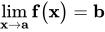 ,
,- ou ainda,
 cuando
- para expressar o seguinte:
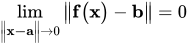
onde  é a norma euclideana de
  .
.
Expresando-o em função das componentes de 

ou, de forma equivalente,
Dizemos que uma função  é contínua em
  .
.

- a)
![{\displaystyle \lim _{\mathbf {x} \to \mathbf {a} }{\big [}\mathbf {f} +\mathbf {g} {\big ]}{\big (}\mathbf {x} {\big )}=\mathbf {b} +\mathbf {c} }](./_assets_/eb734a37dd21ce173a46342d1cc64c92/97e7d295bd1d5497f0c98c4d16c52d2720d749d0.svg)
- b)

- c)

- (produto escalar de
 com
com  ).
).
- d)
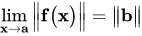
Sabemos que a) e b) no teorema se verificam se  e
e  são funções escalares. Portanto, se
 temos
temos![{\displaystyle {\begin{array}{rl}a)&\mathbf {f} {\big (}\mathbf {x} )={\big [}f_{1}{\big (}\mathbf {x} {\big )},\ldots ,f_{m}{\big (}\mathbf {x} {\big )}{\big ]},\mathbf {g} {\big (}\mathbf {x} )={\Big [}g_{1}{\big (}\mathbf {x} {\big )},\ldots ,g_{m}{\big (}\mathbf {x} {\big )}{\Big ]}\\&\lim _{\mathbf {x} \to \mathbf {a} }{\big (}\mathbf {f} +\mathbf {g} {\big )}{\big (}\mathbf {x} {\big )}=\lim _{\mathbf {x} \to \mathbf {a} }{\Big [}{\big (}f_{1}+g_{1}{\big )}{\big (}\mathbf {x} {\big )},\ldots ,{\big (}f_{m}+g_{m}{\big )}{\big (}\mathbf {x} {\big )}{\Big ]}=\\&{\Big [}\lim _{\mathbf {x} \to \mathbf {a} }{\big (}f_{1}+g_{1}{\big )}{\big (}\mathbf {x} {\big )},\ldots ,\lim _{\mathbf {x} \to \mathbf {a} }{\big (}f_{m}+g_{m}{\big )}{\big (}\mathbf {x} {\big )}{\Big ]}=\\&{\Big [}\lim _{\mathbf {x} \to \mathbf {a} }f_{1}{\big (}\mathbf {x} {\big )}+\lim _{\mathbf {x} \to \mathbf {a} }g_{1}(\mathbf {x} {\big )},\ldots ,\lim _{\mathbf {x} \to \mathbf {a} }f_{m}{\big (}\mathbf {x} {\big )}+\lim _{\mathbf {x} \to \mathbf {a} }g_{m}{\big (}\mathbf {x} {\big )}{\Big ]}=\\&{\big (}b_{1}+c_{1},\ldots ,b_{m}+c_{m}{\big )}={\big (}b_{1},\ldots ,b_{m}{\big )}+{\big (}c_{1},\ldots ,c_{m}{\big )}=\mathbf {b} +\mathbf {c} \end{array}}}](./_assets_/eb734a37dd21ce173a46342d1cc64c92/95faf263a1baf0db2c17757d92d4652b8000a3c0.svg)
![{\displaystyle {\begin{array}{rl}b)&\lim _{\mathbf {x} \to \mathbf {a} }\lambda \mathbf {f} {\big (}\mathbf {x} {\big )}=\lim _{\mathbf {x} \to \mathbf {a} }\lambda {\Big [}f_{1}{\big (}\mathbf {x} {\big )},\ldots ,f_{m}{\big (}\mathbf {x} {\big )}{\Big ]}=\lim _{\mathbf {x} \to \mathbf {a} }{\Big [}\lambda f_{1}{\big (}\mathbf {x} {\big )},\ldots ,\lambda f_{m}{\big (}\mathbf {x} {\big )}{\Big ]}=\\&{\Big [}\lim _{\mathbf {x} \to \mathbf {a} }\lambda f_{1}{\big (}\mathbf {x} {\big )},\ldots ,\lim _{\mathbf {x} \to \mathbf {a} }\lambda f_{m}{\big (}\mathbf {x} {\big )}{\Big ]}={\Big [}\lambda \lim _{\mathbf {x} \to \mathbf {a} }f_{1}{\big (}\mathbf {x} {\big )},\ldots ,\lambda \lim _{\mathbf {x} \to \mathbf {a} }f_{m}{\big (}\mathbf {x} {\big )}{\Big ]}=\\&\lambda {\Big [}\lim _{\mathbf {x} \to \mathbf {a} }f_{1}{\big (}\mathbf {x} {\big )},\ldots ,\lim _{\mathbf {x} \to \mathbf {a} }f_{m}{\big (}\mathbf {x} {\big )}{\Big ]}=\lambda {\big (}b_{1},\ldots ,b_{m}{\big )}=\lambda \mathbf {b} \end{array}}}](./_assets_/eb734a37dd21ce173a46342d1cc64c92/10fef6b37ec01f2a38f73284854a3e4d6b80462c.svg)
![{\displaystyle c)\quad {\big (}\mathbf {f} \cdot \mathbf {g} {\big )}{\big (}\mathbf {x} {\big )}-\mathbf {b} \cdot \mathbf {c} ={\Big [}\mathbf {f} {\big (}\mathbf {x} {\big )}-\mathbf {b} {\Big ]}\cdot {\Big [}\mathbf {g} {\big (}\mathbf {x} {\big )}-\mathbf {c} {\Big ]}+\mathbf {b} \cdot {\Big [}\mathbf {g} {\big (}\mathbf {x} {\big )}-\mathbf {c} {\Big ]}+\mathbf {c} \cdot {\Big [}\mathbf {f} {\big (}\mathbf {x} {\big )}-\mathbf {b} {\Big ]}}](./_assets_/eb734a37dd21ce173a46342d1cc64c92/66af9fd2140f9780543400554816ae1043fbe68f.svg)
- Aplicando a desigualdade triangular e a desigualdade de Cauchy-Schwarz temos
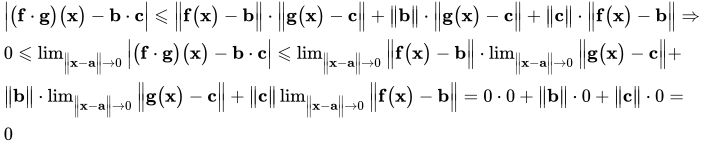
- , como queríamos demonstrar.
 , como queríamos demonstrar.
Sejam e  duas funções tais que a função composta
  está definida em
  , sendo
![{\displaystyle {\big (}\mathbf {f} \circ \mathbf {g} {\big )}{\big (}\mathbf {x} {\big )}=\mathbf {f} {\Big [}\mathbf {g} {\big (}\mathbf {x} {\big )}{\Big ]}}](./_assets_/eb734a37dd21ce173a46342d1cc64c92/6e050e088fa87cd14516180f245242f9c90b4d73.svg)
- é contínua em e é contínua em
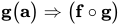 é contínua em .
Sejam  e
e  . Então,
![{\displaystyle {\begin{array}{l}\lim _{{\big \|}\mathbf {x} -\mathbf {a} {\big \|}\to 0}{\Big \|}\mathbf {f} {\Big [}\mathbf {g} {\big (}\mathbf {x} {\big )}{\Big ]}-\mathbf {f} {\Big [}\mathbf {g} {\big (}\mathbf {a} {\big )}{\Big ]}{\Big \|}=\lim _{{\big \|}\mathbf {y} -\mathbf {b} {\big \|}\to 0}{\Big \|}\mathbf {f} {\big (}\mathbf {y} {\big )}-\mathbf {f} {\big (}\mathbf {b} {\big )}{\Big \|}=0\Rightarrow \\\lim _{\mathbf {x} \to \mathbf {a} }\mathbf {f} {\Big [}\mathbf {g} {\big (}\mathbf {x} {\big )}{\Big ]}=\mathbf {f} {\Big [}\mathbf {g} {\big (}\mathbf {a} {\big )}{\Big ]}\end{array}}}](./_assets_/eb734a37dd21ce173a46342d1cc64c92/9e0972f84a181ff7e0e1de0688a2b517a3becc0b.svg)
- como queríamos demostrar.
A diferencial
Teorema de unicidade da diferencial
é diferenciável em com diferencial 
- a) ;\mathbf {y} {\big )}\quad \forall \mathbf {y} \in \mathbb {R} ^{n}}

- b) ;\mathbf {y} {\big )}=\sum _{k=1}^{n}y_{k}{\cfrac {\partial f}{\partial x_{k}}}}
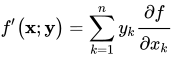
;\mathbf {y} {\big )}=f_{L}{\big (}\mathbf {y} {\big )}\end{array}}}
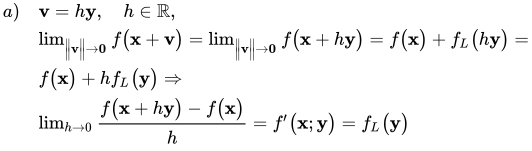
- como queríamos demonstrar.
 Expressando
  em função de seus componentes na base
- ;\mathbf {e} _{k}{\big )}=\\\sum _{k=1}^{n}y_{k}{\cfrac {\partial f}{\partial x_{k}}}\end{array}}}

- como queríamos demonstrar.
Diferenciabilidade implica continuidade
Se um campo vetorial é diferenciável em  é contínuo em .
- Se deduze facilmente da fórmula de Taylor de primeira ordem já vista.








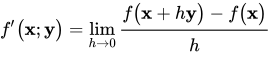









![{\displaystyle g(t)=f{\Big [}\mathbf {x} {\big (}t{\big )}{\Big ]}}](./_assets_/eb734a37dd21ce173a46342d1cc64c92/c24d0a6ebe6f93545e22280032f94396d0320cf9.svg)
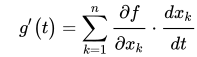


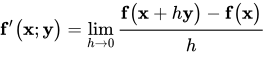

![{\displaystyle \mathbf {f'} {\big (}\mathbf {x} ;\mathbf {y} {\big )}={\Big [}f'_{1}{\big (}\mathbf {x} ;\mathbf {y} {\big )},\ldots ,f'_{m}{\big (}\mathbf {x} ;\mathbf {y} {\big )}{\Big ]}}](./_assets_/eb734a37dd21ce173a46342d1cc64c92/b886201a23ee2c88781d76fe6abf5585db77bc24.svg)






![{\displaystyle \mathbf {h} '{\big (}\mathbf {x} {\big )}=\mathbf {f} '{\Big [}\mathbf {g} {\big (}\mathbf {x} {\big )}{\Big ]}\circ \mathbf {g} '{\big (}\mathbf {x} {\big )}}](./_assets_/eb734a37dd21ce173a46342d1cc64c92/7ee4c8d71f25c0b0392d15f41ec44fa1b485ee56.svg)