Novos Países Baixos
| Nieuw-Nederland Novos Países Baixos | |||||||||||||||||||
| |||||||||||||||||||
| |||||||||||||||||||
 | |||||||||||||||||||
| Continente | América | ||||||||||||||||||
| Capital | Nova Amsterdã | ||||||||||||||||||
| Língua oficial | Língua neerlandesa | ||||||||||||||||||
| Governo | Capitania geral | ||||||||||||||||||
| História | |||||||||||||||||||
| • 1614 | Fundação | ||||||||||||||||||
| • 1674 | Dissolução | ||||||||||||||||||
| Moeda | Táler | ||||||||||||||||||
| |||||||||||||||||||
| Atualmente parte de |  Estados Unidos Estados Unidos | ||||||||||||||||||

.svg.png)
.svg.png)
.jpg)
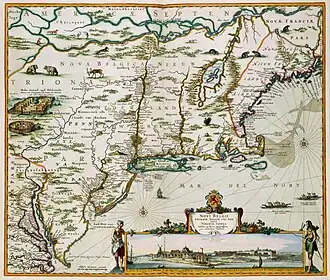
Os Novos Países Baixos (em neerlandês: Nieuw Nederland; em latim:Nova Belgica[1] ou Novum Belgium[2]) foi um território reivindicado e colonizado pelos Países Baixos na costa nordeste da América do Norte, no século XVII, e que fez parte da colonização neerlandesa do continente americano. A região havia sido explorada anteriormente pelo explorador italiano Giovanni da Verrazzano, em 1524. A expedição de Verrazzano fora financiada por cidadãos de Lyon, França, e autorizada pelo Rei francês, Francisco I de França. Apesar disso, a área foi ignorada pelos europeus por um longo tempo.
Histórico
Em 1609, o inglês Henry Hudson foi comissionado pela corte neerlandesa para achar um caminho às Índias, navegando em direção ao norte, pelo Oceano Ártico. Hudson mudou sua rota ao ver que a rota original estava coberta de gelo, e navegou em direção a oeste, e eventualmente chegou à costa norte da América do Norte, navegando o Rio Hudson acima, até a altura onde fica atualmente a cidade de Albany, a capital do Estado americano de Nova Iorque.
Os Países Baixos reivindicaram a área descoberta, entre as latitudes 40 e 45 Norte, e muitas empresas neerlandesas instalaram-se na região, comerciando peles com os nativos indígenas da localidade. Fort Nassau foi fundada em 1614, próximo à atual Albany, e foi abandonada em 1618. Em 1621, a Companhia Neerlandesa das Índias Ocidentais foi criada, assumindo o monopólio do comércio nos Novos Países Baixos. Em 1624, a empresa inaugurou Forte Orange, onde Albany está atualmente localizada. Também em 1624, a empresa fundou Nova Amsterdã, na ilha de Manhattan.
Nova Amsterdão foi capturado pela Inglaterra em 1664, e em 10 de novembro de 1674, os Novos Países Baixos passaram de vez a controle inglês, sob os termos do Tratado de Breda e do Tratado de Westminster.
Ver também
- Neerlando-americano
Referências
- ↑ Janszoon Blaeu, Nova Belgica et Anglia Nova, 1635 Arquivado em 19 de abril de 2018, no Wayback Machine.
- ↑ Jogues, Isaac; Shea, John Gilmary. Novum Belgium: An Account Of New Netherland In 1643-4
Leitura adicional
- Archdeacon, Thomas J. New York City 1664–1710. Conquest and Change (1976).
- Bachman, V.C. Peltries or Plantations. The Economic Policies of the Dutch West India Company in New Netherland 1633–1639 (1969).
- Balmer, Randall H. "The Social Roots of Dutch Pietism in the Middle Colonies," Church History Volume: 53. Issue: 2. 1984. pp 187+ online edition
- Barnouw, A.J. "The Settlement of New Netherland," in A.C. Flick ed., History of the State of New York (10 vols., New York 1933), 1:215–258.
- Burrows, Edward G. and Michael Wallace. Gotham. A History of New York City to 1898 (1999).
- Condon, Thomas J. New York Beginnings. The Commercial Origins of New Netherland (1968).
- Fabend, Firth Haring. 2012. New Netherland in a nutshell: a concise history of the Dutch colony in North America. Albany, N.Y.: New Netherland Institute; 139pp
- Griffis, William E. The Story of New Netherland. The Riverside Press Cambridge, 1909
- Jacobs, Jaap. The Colony of New Netherland: A Dutch Settlement in Seventeenth-Century America (2nd ed. Cornell U.P. 2009) 320pp; scholarly history to 1674 online 1st edition
- Jacobs, Jaap, L. H. Roper, eds. The Worlds of the Seventeenth-Century Hudson Valley. An American Region (State University of New York Press, 2014), 277 pp. specialized essays by scholars. online review
- McKinley, Albert E. "The English and Dutch Towns of New Netherland." American Historical Review (1900) 6#1 pp 1–18 in JSTOR
- McKinley, Albert E. "The Transition from Dutch to English Rule in New York: A Study in Political Imitation." American Historical Review (1901) 6#4 pp: 693-724. in JSTOR
- Merwick, Donna. The Shame and the Sorrow: Dutch-Amerindian Encounters in New Netherland (2006) 332 pages
- Rink, Oliver A. Holland on the Hudson. An Economic and Social History of Dutch New York (Cornell University Press, 1986)
- Scheltema, Gajus and Westerhuijs, Heleen (eds.), Exploring Historic Dutch New York. Museum of the City of New York/Dover Publications, New York (2011). ISBN 978-0-486-48637-6
- Schmidt, Benjamin, Innocence Abroad: The Dutch Imagination and the New World, 1570-1670, Cambridge: University Press, 2001. ISBN 978-0-521-80408-0
- Shorto, Russell. 2004. The island at the center of the world: the epic story of Dutch Manhattan and the forgotten colony that shaped America. New York: Doubleday.
- Venema, Janny, Beverwijck: a Dutch village on the American frontier, 1652-1664, Albany: State University of New York Press, 2003.
- Venema, Janny, Kiliaen van Rensselaer (1586-1643): designing a new world. Albany: State University of New York Press, 2010.
Ligações externas
- The Mannahatta Project
- Slavery in New York
- The New Netherland Museum and the Half Moon
- The New Netherland Institute
- Dutch Portuguese Colonial History
- New Netherland and Beyond
- A Brief Outline of the History of New Netherland at the University of Notre Dame
- Old New York: Hear Dutch names of New York
Relações entre Estados Unidos e Países Baixos  | |
|---|---|
| Postos diplomáticos |
|
| Diplomacia |
|
| Incidentes |
|
| Relações militares |
|
| Artigos relacionados |
|
 Categoria:Relações entre Estados Unidos e Países Baixos Categoria:Relações entre Estados Unidos e Países Baixos | |
| Ameríndios | Anasazi · Cultura Clóvis · Cultura mississipiana · Hohokam · Cultura Mogollon · Mound Builders · Apaches · Cherokees · Comanches · Creek · Cheyennes · Lenapes · Paiutes · Pueblo · Seminoles · Shawnees · Sioux | .jpg)  atelys_Clothiers_(3093693368).jpg)  |
|---|---|---|
| Colonial (1492–1754) |
| |
| Treze Colônias (1754–1783) |
| |
| Independência (1783–1815) |
| |
| Expansão Territorial (1815–1865) |
| |
| Reconstrução (1865–1918) |
| |
| Entreguerras (1918–1945) |
| |
| Ascensão (1945–1964) |
| |
| Guerra Fria (1964–1991) |
| |
| Nova Ordem (1991–2008) |
| |
| (2008–presente) |
| |
| ||

