Tolypeutinae
Tolypeutinae[1]
| |||||||||||||
|---|---|---|---|---|---|---|---|---|---|---|---|---|---|
| Ocorrência: Oligoceno Superior até o presente | |||||||||||||
| Classificação científica | |||||||||||||
| |||||||||||||
| Distribuição geográfica | |||||||||||||
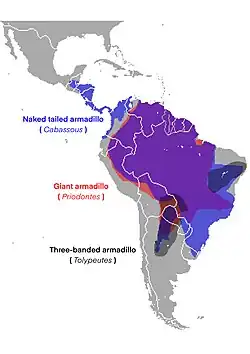 | |||||||||||||
| Gêneros | |||||||||||||
| |||||||||||||
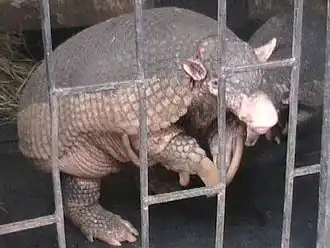
Tolypeutinae é uma subfamília de tatus pertencente à família Chlamyphoridae, que inclui o tatu-canastra, o tatu-bola e o tatu-de-rabo-mole.[2][3][4]
Taxonomia
A subfamília inclui os seguintes gêneros:[5]
- Cabassous
- †Kuntinaru [en][6]
- Priodontes
- Tolypeutes
- †Vetelia[7]
Filogenia
Tolypeutinae é o grupo-irmão de Chlamyphorinae, conforme mostrado abaixo.
|
Referências
- ↑ Gardner, A. (2005). Wilson, D. E.; Reeder, D. M, eds. Mammal Species of the World 3rd ed. [S.l.]: Johns Hopkins University Press. pp. 94–95. ISBN 978-0-8018-8221-0. OCLC 62265494
- ↑ Moller-Krull, M.; Delsuc, F.; Churakov, G.; Marker, C.; Superina, M.; Brosius, J.; Douzery, E. J. P.; Schmitz, J. (novembro de 2007). «Retroposed Elements and Their Flanking Regions Resolve the Evolutionary History of Xenarthran Mammals (Armadillos, Anteaters, and Sloths)». Mol. Biol. Evol. 24 (11): 2573–2582. PMID 17884827. doi:10.1093/molbev/msm201

- ↑ Gibb, G. C.; Condamine, F. L.; Kuch, M.; Enk, J.; Moraes-Barros, N.; Superina, M.; Poinar, H. N.; Delsuc, F. (9 de novembro de 2015). «Shotgun Mitogenomics Provides a Reference Phylogenetic Framework and Timescale for Living Xenarthrans». Molecular Biology and Evolution. 33 (3): 621–642. PMC 4760074. PMID 26556496. doi:10.1093/molbev/msv250
- ↑ Delsuc, F.; Gibb, G. C.; Kuch, M.; Billet, G.; Hautier, L.; Southon, J.; Rouillard, J.-M.; Fernicola, J. C.; Vizcaíno, S. F.; MacPhee, R. D. E.; Poinar, H. N. (22 de fevereiro de 2016). «The phylogenetic affinities of the extinct glyptodonts». Current Biology. 26 (4): R155–R156. PMID 26906483. doi:10.1016/j.cub.2016.01.039. hdl:11336/49579
- ↑ «Tolypeutinae» (em inglês). ITIS (www.itis.gov). Consultado em 18 de março de 2011
- ↑ Guillaume Billet; Lionel Hautier; Christian de Muizon; Xavier Valentin (2011). «Oldest cingulate skulls provide congruence between morphological and molecular scenarios of armadillo evolution». Proceedings of the Royal Society. 278 (1719): 2791–2797. PMC 3145180. PMID 21288952. doi:10.1098/rspb.2010.2443
- ↑ Barasoain, Daniel; González Ruiz, Laureano; Tomassini, Rodrigo; Zurita, Alfredo; Contreras, Víctor; Montalvo, Claudia (2021). «First phylogenetic analysis of the Miocene armadillo Vetelia reveals novel affinities with Tolypeutinae». Acta Palaeontologica Polonica. 66 (3). doi:10.4202/app.00829.2020. hdl:11336/136645