Chlamyphorinae
Chlamyphorinae
| |||||||||
|---|---|---|---|---|---|---|---|---|---|
| Ocorrência: Mioceno Superior-Recente[1] | |||||||||
| Classificação científica | |||||||||
| |||||||||
| Distribuição geográfica | |||||||||
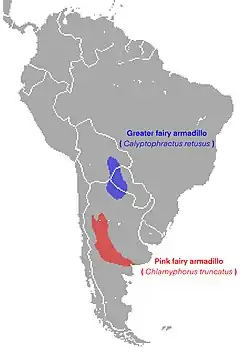 | |||||||||
| Gêneros | |||||||||
| |||||||||
_(cropped).jpg)
Chlamyphorinae é uma subfamília de tatus sul-americanos da família Chlamyphoridae. Os membros desta subfamília, os clamiforíneos, são em grande parte fossoriais e têm olhos reduzidos e antebraços robustos com garras grandes para cavar.[2]
Taxonomia
A subfamília tem dois gêneros monotípicos:[2][3][4]
- Calyptophractus, pichiciego-maior
- Chlamyphorus, pichiciego-menor
Filogenia
Chlamyphorinae é o grupo-irmão de Tolypeutinae (tatus-canastra, tatus-bola e tatus-de-rabo-mole), como mostrado abaixo.
| Cladograma[4][5][3] | |||||||||||||||||||||||||||||||||||||||||||||||||||||||||||||||||||||||||||||||||||||||||||||
|
Referências
- ↑ Daniel Barasoain; Rodrigo L. Tomassini; Alfredo E. Zurita; Claudia I. Montalvo; Mariella Superina (2020). «A new fairy armadillo (Cingulata, Chlamyphorinae) from the upper Miocene of Argentina: first fossil record of the most enigmatic Xenarthra». Journal of Vertebrate Paleontology. 39 (5): e1716778. doi:10.1080/02724634.2019.1716778
- ↑ a b Moller-Krull, M.; Delsuc, F.; Churakov, G.; Marker, C.; Superina, M.; Brosius, J.; Douzery, E. J. P.; Schmitz, J. (novembro de 2007). «Retroposed Elements and Their Flanking Regions Resolve the Evolutionary History of Xenarthran Mammals (Armadillos, Anteaters, and Sloths)». Mol. Biol. Evol. 24 (11): 2573–2582. PMID 17884827. doi:10.1093/molbev/msm201

- ↑ a b Gibb, G. C.; Condamine, F. L.; Kuch, M.; Enk, J.; Moraes-Barros, N.; Superina, M.; Poinar, H. N.; Delsuc, F. (9 de novembro de 2015). «Shotgun Mitogenomics Provides a Reference Phylogenetic Framework and Timescale for Living Xenarthrans». Molecular Biology and Evolution. 33 (3): 621–642. PMC 4760074. PMID 26556496. doi:10.1093/molbev/msv250
- ↑ a b Delsuc, F.; Gibb, G. C.; Kuch, M.; Billet, G.; Hautier, L.; Southon, J.; Rouillard, J.-M.; Fernicola, J. C.; Vizcaíno, S. F.; MacPhee, R. D. E.; Poinar, H. N. (22 de fevereiro de 2016). «The phylogenetic affinities of the extinct glyptodonts». Current Biology. 26 (4): R155–R156. Bibcode:2016CBio...26.R155D. PMID 26906483. doi:10.1016/j.cub.2016.01.039. hdl:11336/49579
- ↑ Upham, Nathan S.; Esselstyn, Jacob A.; Jetz, Walter (2019). «Inferring the mammal tree: Species-level sets of phylogenies for questions in ecology, evolution and conservation». PLOS Biol. 17 (12): e3000494. PMC 6892540. PMID 31800571. doi:10.1371/journal.pbio.3000494