Receptor de androgénio
| Receptor de androgénio | |
|---|---|
| Ficheiro:2h9.png |
| Receptor de androgénio | |
|---|---|
 | |
| Indicadores | |
| Pfam | PF02166 |
| InterPro | IPR001103 |
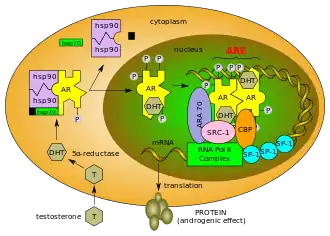
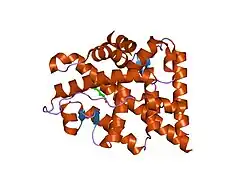
O receptor de androgénio'' (AR), também designado por NR3C4 (subfamília 3 do receptor nuclear, grupo C, membro 4), é um tipo de receptor nuclear[5] que é ativado no citoplasma pela ligação de qualquer um dos hormonas androgénios, como a testosterona e a di-hidrotestosterona[6] e depois transportado para o núcleo da célula. O receptor de androgénio humano é codificado pelo gene AR no cromossoma X. O recetor de androgénio está intimamente relacionado com o recetor de progesterona, pelo que as progestinas em doses mais elevadas podem bloquear o recetor de androgénio.[7][8]
A principal função do recetor de androgénio é atuar como um fator de transcrição que se liga ao ADN e regula a expressão génica;[9] no entanto, ele também tem outras funções.[10] Os genes regulados por androgénios são cruciais para o desenvolvimento e manutenção do fenótipo sexual masculino.
Função
Efeitos no Desenvolvimento
Em alguns tipos de células, a testosterona interage diretamente com os recetores de androgénios, enquanto que noutros, a testosterona é convertida pela 5-alfa-redutase em di-hidrotestosterona, um agonista ainda mais potente da ativação androgénica.[11] A testosterona parece ser a principal hormona ativadora do recetor de androgénios no ducto de Wolff, enquanto a di-hidrotestosterona é a principal hormona androgénica no seio urogenital, tubérculo urogenital e folículos pilosos.[12] A testosterona é, portanto, a principal responsável pelo desenvolvimento das características sexuais primárias masculinas, enquanto a dihidrotestosterona é responsável pelas características sexuais secundárias.
Os androgénios provocam a maturação lenta dos ossos, mas a maioria dos efeitos potentes na maturação provém dos estrogénios produzidos pela aromatização dos androgénios. Os adolescentes consumidores de esteróides podem ter o seu crescimento prejudicado pelo excesso de androgénios e/ou estrogénios. As pessoas com baixos níveis de hormonas sexuais podem ser baixas durante a puberdade, mas acabam por ficar mais altas na idade adulta, como na síndrome de insensibilidade androgénica ou na síndrome de insensibilidade estrogénica.[13]
Estudos com ratos knockout indicam que o recetor de androgénio é essencial para a fertilidade feminina normal, sendo necessário para o desenvolvimento e plena funcionalidade do folículos ováricos e ovulação, funcionando através de mecanismos intraováricos e neuroendócrinos.[14]
Manutenção da integridade esquelética nos homens
Através do recetor de androgénio, os androgénios desempenham um papel fundamental na manutenção da integridade esquelética nos homens. A regulação desta integridade pela sinalização do recetor de androgénio pode ser atribuída aos osteoblastos e aos osteócitos.[15]
Papel nas fêmeas
O recetor de androgénio desempenha um papel na regulação das funções sexuais, somáticas e comportamentais femininas. Dados experimentais obtidos utilizando ratinhos fêmeas knockout para o receptor de androgénio fornecem evidências de que a promoção do crescimento cardíaco, a hipertrofia renal, o crescimento ósseo cortical e a regulação da estrutura óssea trabecular são o resultado de ações dependentes da ligação do ADN do recetor de androgénio nas fêmeas.
Além disso, a importância de compreender os recetores de androgénios nas fêmeas deve-se ao seu papel em diversas doenças genéticas, como a síndrome de insensibilidade androgénica. As síndrome de insensibilidade androgénica parcial|síndrome de insensibilidade androgénica parcial são o resultado de mutações nos genes que codificam o recetor de androgénios. Estas mutações provocam a inativação do recetor de androgénio, conferindo resistência à testosterona circulante, sendo conhecidas mais de 400 mutações diferentes no recetor de androgénio.[16]
Mecanismo de ação
Genómica
O principal mecanismo de ação dos recetores de androgénios é a regulação direta da transcrição genética. A ligação de um androgénio ao recetor de androgénio resulta numa alteração conformacional no recetor que, por sua vez, provoca a dissociação da proteína de choque térmico, o transporte do citosol para o núcleo e a dimerização. O dímero do recetor de androgénio liga-se a uma sequência específica de ADN chamada elemento de resposta hormonal. Os recetores de androgénios interagem com outras proteínas do núcleo, resultando na regulação positiva ou negativa da transcrição de um gene específico.[17] A regulação positiva ou ativação da transcrição resulta no aumento da síntese de certos RNA mensageiros, que por sua vez são traduzidos pelos ribossomas para produzir proteínas específicas. Um dos genes-alvo conhecidos da ativação do recetor de androgénio é o receptor do fator de crescimento semelhante à insulina 1 (IGF-1R).[18] Assim, as alterações nos níveis de proteínas específicas nas células são uma das formas através das quais os recetores de androgénio controlam o comportamento celular.
Uma função do recetor de androgénio que é independente da ligação direta à sua sequência de ADN alvo é facilitada pelo recrutamento através de outras proteínas de ligação ao ADN. Um exemplo é o fator de resposta ao soro, uma proteína que ativa vários genes que provocam o crescimento muscular.[19]
O recetor de androgénio é modificado por modificação pós-traducional por acetilação,[20] que promove diretamente a transativação mediada pelo recetor de androgénio, apoptose[21] e crescimento independente de contacto de células de cancro da próstata.[22] A acetilação do recetor de androgénio é induzida por androgénios[23] e determina o recrutamento para a cromatina.[24] A acetilação do sítio do recetor de androgénio é um alvo fundamental das NAD+-dependentes histona desacetilases e TSA[25] e RNAs longos não codificantes.[26]
Não genómico
Mais recentemente, demonstrou-se que os recetores de androgénios possuem um segundo modo de ação. Tal como também foi observado para outros receptores de hormonas esteróides, como os receptores de estrogénio, os recetores de androgénios podem ter ações independentes das suas interações com o ADN.[10][27] Os recetores de androgénios interagem com certas proteínas de transdução de sinal no citoplasma. A ligação dos androgénios aos recetores de androgénios citoplasmáticos pode causar alterações rápidas na função celular, independentemente de alterações na transcrição genética, como alterações no transporte iónico. A regulação das vias de transdução de sinal pelos recetores de androgénios citoplasmáticos pode levar indiretamente a alterações na transcrição genética, por exemplo, levando à fosforilação de outros fatores de transcrição.
Genética
Gene
Nos humanos, o recetor de androgénio é codificado pelo gene ‘’AR’’, localizado no cromossoma X na posição Xq11–12.[28][29]
Interações
O receptor de andrógenos presenta interações com:
- AKT1,[30]
- BAG1,[31][32][33]
- Beta-catenina,[34][35][36][37][38][39]
- BRCA1,[40][41]
- C-jun,[42]
- Calmodulina 1,[43]
- Caveolina 1,[44]
- CDK9,[45]
- COX5B,[46]
- Proteína que se une a CREB,[47][48][49][50]
- Ciclina D1,[51][52][53][54]
- Quinase dependente de ciclina 7,[55]
- DACH1,[56]
- Proteína associada á morte 6,[57]
- L-DOPA,[58]
- EFCAB6,[59]
- Receptor do factor de crescimento epidérmico,[60][61]
- FOXO1,[62]
- GAPDH,[63]
- Gelsolina,[64]
- GNB2L1,[65]
- GSK3B,[66]
- HDAC1,[67]
- HSP90AA1,[68][69]
- HTATIP,[67]
- MAGEA11,[70][71]
- MED1,[72]
- MYST2,[73]
- NCOA1,[35][74][75]
- NCOA2,[34][49][70][76][77]
- NCOA3,[76][78][79]
- NCOA4,[30][77][80][81][82][83][84][85][86]
- NCOA6,[87]
- NCOR2,[34][88][89]
- NONO,[49]
- p300,[90]
- PA2G4,[91]
- PAK6,[92][93]
- PATZ1,[94]
- PIAS2,[95][96]
- PRPF6,[97]
- PTEN,[98]
- RAD9A,[99]
- RANBP9,[100]
- RCHY1,[101]
- Proteína do retinoblastoma,[102][103]
- RNF14,[77][80][104][105]
- RNF4,[94][106][107]
- SART3,[108]
- SIRT1,[25]
- SMAD3,[109][110][111]
- Companheiro de pequeno heterodímero (SHP, Small Heterodimer Partner),[112]
- Src,[98][113][114]
- SRY,[115]
- STAT3,[116][117]
- SVIL,[118]
- Receptor testicular 2,[119]
- Receptor testicular 4,[120]
- TGFB1I1,[80][121]
- TMF1,[122]
- TRIM68,[123]
- UBE2I,[34][35][124][125][126][127]
- UXT,[128] e
- ZMIZ1.[129]
Referências
- ↑ Quigley CA, De Bellis A, Marschke KB, el-Awady MK, Wilson EM, French FS (junho de 1995). «Androgen receptor defects: historical, clinical, and molecular perspectives». Endocrine Reviews. 16 (3): 271–321. PMID 7671849. doi:10.1210/edrv-16-3-271
- ↑ Gottlieb B, Lombroso R, Beitel LK, Trifiro MA (janeiro de 2005). «Molecular pathology of the androgen receptor in male (in)fertility». Reproductive Biomedicine Online. 10 (1): 42–8. PMID 15705293. doi:10.1016/S1472-6483(10)60802-4
- ↑ Choong CS, Wilson EM (dezembro de 1998). «Trinucleotide repeats in the human androgen receptor: a molecular basis for disease». Journal of Molecular Endocrinology. 21 (3): 235–57. PMID 9845666. doi:10.1677/jme.0.0210235
- ↑ Meehan KL, Sadar MD (maio de 2003). «Androgens and androgen receptor in prostate and ovarian malignancies». Frontiers in Bioscience. 8 (1–3): d780–800. PMID 12700055. doi:10.2741/1063
- ↑ Lu NZ, Wardell SE, Burnstein KL, Defranco D, Fuller PJ, Giguere V, Hochberg RB, McKay L, Renoir JM, Weigel NL, Wilson EM, McDonnell DP, Cidlowski JA (dezembro de 2006). «International Union of Pharmacology. LXV. The pharmacology and classification of the nuclear receptor superfamily: glucocorticoid, mineralocorticoid, progesterone, and androgen receptors». Pharmacological Reviews. 58 (4): 782–97. PMID 17132855. doi:10.1124/pr.58.4.9
- ↑ Roy AK, Lavrovsky Y, Song CS, Chen S, Jung MH, Velu NK, Bi BY, Chatterjee B (1999). Regulation of androgen action. Col: Vitamins & Hormones. 55. [S.l.: s.n.] pp. 309–52. ISBN 978-0-12-709855-5. PMID 9949684. doi:10.1016/S0083-6729(08)60938-3
- ↑ Bardin CW, Brown T, Isomaa VV, Jänne OA (1983). «Progestins can mimic, inhibit and potentiate the actions of androgens». Pharmacology & Therapeutics. 23 (3): 443–59. PMID 6371845. doi:10.1016/0163-7258(83)90023-2
- ↑ Raudrant D, Rabe T (2003). «Progestogens with antiandrogenic properties». Drugs. 63 (5): 463–92. PMID 12600226. doi:10.2165/00003495-200363050-00003
- ↑ Mooradian AD, Morley JE, Korenman SG (fevereiro de 1987). «Biological actions of androgens». Endocrine Reviews. 8 (1): 1–28. PMID 3549275. doi:10.1210/edrv-8-1-1
- ↑ a b Heinlein CA, Chang C (outubro de 2002). «The roles of androgen receptors and androgen-binding proteins in nongenomic androgen actions». Molecular Endocrinology. 16 (10): 2181–7. PMID 12351684. doi:10.1210/me.2002-0070
- ↑ Davison SL, Bell R (abril de 2006). «Androgen physiology». Seminars in Reproductive Medicine. 24 (2): 71–7. PMID 16633980. doi:10.1055/s-2006-939565
- ↑ Sinisi AA, Pasquali D, Notaro A, Bellastella A (2003). «Sexual differentiation». Journal of Endocrinological Investigation. 26 (3 Suppl): 23–28. PMID 12834017
- ↑ Frank GR (setembro de 2003). «Role of estrogen and androgen in pubertal skeletal physiology». Medical and Pediatric Oncology. 41 (3): 217–21. PMID 12868122. doi:10.1002/mpo.10340
- ↑ Walters KA, Simanainen U, Handelsman DJ (março de 2010). «Molecular insights into androgen actions in male and female reproductive function from androgen receptor knockout models». Human Reproduction Update. 16 (5): 543–58. PMID 20231167. doi:10.1093/humupd/dmq003
- ↑ Sinnesael M, Claessens F, Laurent M, Dubois V, Boonen S, Deboel L, Vanderschueren D (dezembro de 2012). «Androgen receptor (AR) in osteocytes is important for the maintenance of male skeletal integrity: evidence from targeted AR disruption in mouse osteocytes». Journal of Bone and Mineral Research. 27 (12): 2535–43. PMID 22836391. doi:10.1002/jbmr.1713
- ↑ Galani A, Kitsiou-Tzeli S, Sofokleous C, Kanavakis E, Kalpini-Mavrou A (2008). "Androgen insensitivity syndrome: clinical features and molecular defects". Hormones (Athens). 7 (3): 217–29. doi:10.14310/horm.2002.1201. PMID 18694860 .
- ↑ Heemers HV, Tindall DJ (dezembro de 2007). «Androgen receptor (AR) coregulators: a diversity of functions converging on and regulating the AR transcriptional complex». Endocrine Reviews. 28 (7): 778–808. PMID 17940184. doi:10.1210/er.2007-0019
- ↑ Pandini G, Mineo R, Frasca F, Roberts CT, Marcelli M, Vigneri R, Belfiore A (março de 2005). «Androgens up-regulate the insulin-like growth factor-I receptor in prostate cancer cells». Cancer Research. 65 (5): 1849–57. PMID 15753383. doi:10.1158/0008-5472.CAN-04-1837
- ↑ Vlahopoulos S, Zimmer WE, Jenster G, Belaguli NS, Balk SP, Brinkmann AO, Lanz RB, Zoumpourlis VC, Schwartz RJ (marzo de 2005). «Recruitment of the androgen receptor via serum response factor facilitates expression of a myogenic gene». The Journal of Biological Chemistry. 280 (9): 7786–92. PMID 15623502. doi:10.1074/jbc.M413992200 Verifique data em:
|data=(ajuda) - ↑ Fu M, Wang C, Reutens AT, Wang J, Angeletti RH, Siconolfi-Baez L, Ogryzko V, Avantaggiati ML, Pestell RG (julho de 2000). «p300 and p300/cAMP-response element-binding protein-associated factor acetylate the androgen receptor at sites governing hormone-dependent transactivation». The Journal of Biological Chemistry. 275 (27): 20853–60. PMID 10779504. doi:10.1074/jbc.M000660200
- ↑ Fu M, Wang C, Wang J, Zhang X, Sakamaki T, Yeung YG, Chang C, Hopp T, Fuqua SA, Jaffray E, Hay RT, Palvimo JJ, Jänne OA, Pestell RG (maio de 2002). «Androgen receptor acetylation governs trans activation and MEKK1-induced apoptosis without affecting in vitro sumoylation and trans-repression function». Molecular and Cellular Biology. 22 (10): 3373–88. PMC 133781
 . PMID 11971970. doi:10.1128/mcb.22.10.3373-3388.2002
- ↑ Fu M, Rao M, Wang C, Sakamaki T, Wang J, Di Vizio D, Zhang X, Albanese C, Balk S, Chang C, Fan S, Rosen E, Palvimo JJ, Jänne OA, Muratoglu S, Avantaggiati ML, Pestell RG (decembro de 2003). «Acetylation of androgen receptor enhances coactivator binding and promotes prostate cancer cell growth». Molecular and Cellular Biology. 23 (23): 8563–75. PMC 262657. PMID 14612401. doi:10.1128/mcb.23.23.8563-8575.2003 Verifique data em:
|data=(ajuda) - ↑ Gong J, Zhu J, Goodman OB, Pestell RG, Schlegel PN, Nanus DM, Shen R (março de 2006). «Activation of p300 histone acetyltransferase activity and acetylation of the androgen receptor by bombesin in prostate cancer cells». Oncogene. 25 (14): 2011–21. PMID 16434977. doi:10.1038/sj.onc.1209231
- ↑ Fu M, Rao M, Wu K, Wang C, Zhang X, Hessien M, Yeung YG, Gioeli D, Weber MJ, Pestell RG (julho de 2004). «The androgen receptor acetylation site regulates cAMP and AKT but not ERK-induced activity». The Journal of Biological Chemistry. 279 (28): 29436–49. PMID 15123687. doi:10.1074/jbc.M313466200
- ↑ a b Fu M, Liu M, Sauve AA, Jiao X, Zhang X, Wu X, Powell MJ, Yang T, Gu W, Avantaggiati ML, Pattabiraman N, Pestell TG, Wang F, Quong AA, Wang C, Pestell RG (novembro de 2006). «Hormonal control of androgen receptor function through SIRT1». Molecular and Cellular Biology. 26 (21): 8122–35. PMC 1636736. PMID 16923962. doi:10.1128/MCB.00289-06
- ↑ Yang L, Lin C, Jin C, Yang JC, Tanasa B, Li W, Merkurjev D, Ohgi KA, Meng D, Zhang J, Evans CP, Rosenfeld MG (agosto de 2013). «lncRNA-dependent mechanisms of androgen-receptor-regulated gene activation programs». Nature. 500 (7464): 598–602. Bibcode:2013Natur.500..598Y. PMC 4034386. PMID 23945587. doi:10.1038/nature12451
- ↑ Fix C, Jordan C, Cano P, Walker WH (julho de 2004). «Testosterone activates mitogen-activated protein kinase and the cAMP response element binding protein transcription factor in Sertoli cells». Proceedings of the National Academy of Sciences of the United States of America. 101 (30): 10919–24. Bibcode:2004PNAS..10110919F. PMC 503720. PMID 15263086. doi:10.1073/pnas.0404278101
- ↑ Chang CS, Kokontis J, Liao ST (abril de 1988). «Molecular cloning of human and rat complementary DNA encoding androgen receptors». Science. 240 (4850): 324–6. Bibcode:1988Sci...240..324C. PMID 3353726. doi:10.1126/science.3353726
- ↑ Trapman J, Klaassen P, Kuiper GG, van der Korput JA, Faber PW, van Rooij HC, Geurts van Kessel A, Voorhorst MM, Mulder E, Brinkmann AO (maio de 1988). «Cloning, structure and expression of a cDNA encoding the human androgen receptor». Biochemical and Biophysical Research Communications. 153 (1): 241–8. PMID 3377788. doi:10.1016/S0006-291X(88)81214-2
- ↑ a b Lin HK, Yeh S, Kang HY, Chang C (junho de 2001). «Akt suppresses androgen-induced apoptosis by phosphorylating and inhibiting androgen receptor». Proceedings of the National Academy of Sciences of the United States of America. 98 (13): 7200–5. Bibcode:2001PNAS...98.7200L. PMC 34646. PMID 11404460. doi:10.1073/pnas.121173298
- ↑ Shatkina L, Mink S, Rogatsch H, Klocker H, Langer G, Nestl A, Cato AC (outubro de 2003). «The cochaperone Bag-1L enhances androgen receptor action via interaction with the NH2-terminal region of the receptor». Molecular and Cellular Biology. 23 (20): 7189–97. PMC 230325. PMID 14517289. doi:10.1128/MCB.23.20.7189-7197.2003
- ↑ Knee DA, Froesch BA, Nuber U, Takayama S, Reed JC (abril de 2001). «Structure-function analysis of Bag1 proteins. Effects on androgen receptor transcriptional activity». The Journal of Biological Chemistry. 276 (16): 12718–24. PMID 11278763. doi:10.1074/jbc.M010841200
- ↑ Froesch BA, Takayama S, Reed JC (maio de 1998). «BAG-1L protein enhances androgen receptor function». The Journal of Biological Chemistry. 273 (19): 11660–6. PMID 9565586. doi:10.1074/jbc.273.19.11660
- ↑ a b c d Song LN, Coghlan M, Gelmann EP (janeiro de 2004). «Antiandrogen effects of mifepristone on coactivator and corepressor interactions with the androgen receptor». Molecular Endocrinology. 18 (1): 70–85. PMID 14593076. doi:10.1210/me.2003-0189
- ↑ a b c Masiello D, Chen SY, Xu Y, Verhoeven MC, Choi E, Hollenberg AN, Balk SP (outubro de 2004). «Recruitment of beta-catenin by wild-type or mutant androgen receptors correlates with ligand-stimulated growth of prostate cancer cells». Molecular Endocrinology. 18 (10): 2388–401. PMID 15256534. doi:10.1210/me.2003-0436
- ↑ Yang F, Li X, Sharma M, Sasaki CY, Longo DL, Lim B, Sun Z (marzo de 2002). «Linking beta-catenin to androgen-signaling pathway». The Journal of Biological Chemistry. 277 (13): 11336–44. PMID 11792709. doi:10.1074/jbc.M111962200 Verifique data em:
|data=(ajuda) - ↑ Amir AL, Barua M, McKnight NC, Cheng S, Yuan X, Balk SP (agosto de 2003). «A direct beta-catenin-independent interaction between androgen receptor and T cell factor 4». The Journal of Biological Chemistry. 278 (33): 30828–34. PMID 12799378. doi:10.1074/jbc.M301208200
- ↑ Mulholland DJ, Read JT, Rennie PS, Cox ME, Nelson CC (agosto de 2003). «Functional localization and competition between the androgen receptor and T-cell factor for nuclear beta-catenin: a means for inhibition of the Tcf signaling axis». Oncogene. 22 (36): 5602–13. PMID 12944908. doi:10.1038/sj.onc.1206802
- ↑ Pawlowski JE, Ertel JR, Allen MP, Xu M, Butler C, Wilson EM, Wierman ME (junho de 2002). «Liganded androgen receptor interaction with beta-catenin: nuclear co-localization and modulation of transcriptional activity in neuronal cells». The Journal of Biological Chemistry. 277 (23): 20702–10. PMID 11916967. doi:10.1074/jbc.M200545200
- ↑ Park JJ, Irvine RA, Buchanan G, Koh SS, Park JM, Tilley WD, Stallcup MR, Press MF, Coetzee GA (novembro de 2000). «Breast cancer susceptibility gene 1 (BRCAI) is a coactivator of the androgen receptor». Cancer Research. 60 (21): 5946–9. PMID 11085509
- ↑ Yeh S, Hu YC, Rahman M, Lin HK, Hsu CL, Ting HJ, Kang HY, Chang C (outubro de 2000). «Increase of androgen-induced cell death and androgen receptor transactivation by BRCA1 in prostate cancer cells». Proceedings of the National Academy of Sciences of the United States of America. 97 (21): 11256–61. Bibcode:2000PNAS...9711256Y. PMC 17187. PMID 11016951. doi:10.1073/pnas.190353897
- ↑ Sato N, Sadar MD, Bruchovsky N, Saatcioglu F, Rennie PS, Sato S, Lange PH, Gleave ME (xullo de 1997). «Androgenic induction of prostate-specific antigen gene is repressed by protein-protein interaction between the androgen receptor and AP-1/c-Jun in the human prostate cancer cell line LNCaP». The Journal of Biological Chemistry. 272 (28): 17485–94. PMID 9211894. doi:10.1074/jbc.272.28.17485 Verifique data em:
|data=(ajuda) - ↑ Cifuentes E, Mataraza JM, Yoshida BA, Menon M, Sacks DB, Barrack ER, Reddy GP (janeiro de 2004). «Physical and functional interaction of androgen receptor with calmodulin in prostate cancer cells». Proceedings of the National Academy of Sciences of the United States of America. 101 (2): 464–9. Bibcode:2004PNAS..101..464C. PMC 327170. PMID 14695896. doi:10.1073/pnas.0307161101
- ↑ Lu ML, Schneider MC, Zheng Y, Zhang X, Richie JP (abril de 2001). «Caveolin-1 interacts with androgen receptor. A positive modulator of androgen receptor mediated transactivation». The Journal of Biological Chemistry. 276 (16): 13442–51. PMID 11278309. doi:10.1074/jbc.M006598200
- ↑ Lee DK, Duan HO, Chang C (março de 2001). «Androgen receptor interacts with the positive elongation factor P-TEFb and enhances the efficiency of transcriptional elongation». The Journal of Biological Chemistry. 276 (13): 9978–84. PMID 11266437. doi:10.1074/jbc.M002285200
- ↑ Beauchemin AM, Gottlieb B, Beitel LK, Elhaji YA, Pinsky L, Trifiro MA (2001). «Cytochrome c oxidase subunit Vb interacts with human androgen receptor: a potential mechanism for neurotoxicity in spinobulbar muscular atrophy». Brain Research Bulletin. 56 (3–4): 285–97. PMID 11719263. doi:10.1016/S0361-9230(01)00583-4
- ↑ Kim J, Jia L, Stallcup MR, Coetzee GA (fevereiro de 2005). «The role of protein kinase A pathway and cAMP responsive element-binding protein in androgen receptor-mediated transcription at the prostate-specific antigen locus». Journal of Molecular Endocrinology. 34 (1): 107–18. PMID 15691881. doi:10.1677/jme.1.01701
- ↑ Frønsdal K, Engedal N, Slagsvold T, Saatcioglu F (novembro de 1998). «CREB binding protein is a coactivator for the androgen receptor and mediates cross-talk with AP-1». The Journal of Biological Chemistry. 273 (48): 31853–9. PMID 9822653. doi:10.1074/jbc.273.48.31853
- ↑ a b c Ishitani K, Yoshida T, Kitagawa H, Ohta H, Nozawa S, Kato S (julho de 2003). «p54nrb acts as a transcriptional coactivator for activation function 1 of the human androgen receptor». Biochemical and Biophysical Research Communications. 306 (3): 660–5. PMID 12810069. doi:10.1016/S0006-291X(03)01021-0
- ↑ Aarnisalo P, Palvimo JJ, Jänne OA (março de 1998). «CREB-binding protein in androgen receptor-mediated signaling». Proceedings of the National Academy of Sciences of the United States of America. 95 (5): 2122–7. Bibcode:1998PNAS...95.2122A. PMC 19270. PMID 9482849. doi:10.1073/pnas.95.5.2122
- ↑ Reutens AT, Watanabe G, Albanese C, McPhaul MJ, Balk SP, Pestell RG (1998). «Cyclin D1 binds activating mutants of the androgen receptor». US Endocrine Society Meeting (P1–528)
- ↑ Reutens AT, Fu M, Wang C, Albanese C, McPhaul MJ, Sun Z, Balk SP, Jänne OA, Palvimo JJ, Pestell RG (maio de 2001). «Cyclin D1 binds the androgen receptor and regulates hormone-dependent signaling in a p300/CBP-associated factor (P/CAF)-dependent manner». Molecular Endocrinology. 15 (5): 797–811. PMID 11328859. doi:10.1210/mend.15.5.0641
- ↑ Petre-Draviam CE, Williams EB, Burd CJ, Gladden A, Moghadam H, Meller J, Diehl JA, Knudsen KE (janeiro de 2005). «A central domain of cyclin D1 mediates nuclear receptor corepressor activity». Oncogene. 24 (3): 431–44. PMID 15558026. doi:10.1038/sj.onc.1208200
- ↑ Knudsen KE, Cavenee WK, Arden KC (maio de 1999). «D-type cyclins complex with the androgen receptor and inhibit its transcriptional transactivation ability». Cancer Research. 59 (10): 2297–301. PMID 10344732
- ↑ Lee DK, Duan HO, Chang C (março de 2000). «From androgen receptor to the general transcription factor TFIIH. Identification of cdk activating kinase (CAK) as an androgen receptor NH(2)-terminal associated coactivator». The Journal of Biological Chemistry. 275 (13): 9308–13. PMID 10734072. doi:10.1074/jbc.275.13.9308
- ↑ Wu K, Katiyar S, Witkiewicz A, Li A, McCue P, Song LN, Tian L, Jin M, Pestell RG (abril de 2009). «The cell fate determination factor dachshund inhibits androgen receptor signaling and prostate cancer cellular growth». Cancer Research. 69 (8): 3347–55. PMC 2669850. PMID 19351840. doi:10.1158/0008-5472.CAN-08-3821
- ↑ Lin DY, Fang HI, Ma AH, Huang YS, Pu YS, Jenster G, Kung HJ, Shih HM (decembro de 2004). «Negative modulation of androgen receptor transcriptional activity by Daxx». Molecular and Cellular Biology. 24 (24): 10529–41. PMC 533990. PMID 15572661. doi:10.1128/MCB.24.24.10529-10541.2004 Verifique data em:
|data=(ajuda) - ↑ Wafa LA, Cheng H, Rao MA, Nelson CC, Cox M, Hirst M, Sadowski I, Rennie PS (outubro de 2003). «Isolation and identification of L-dopa decarboxylase as a protein that binds to and enhances transcriptional activity of the androgen receptor using the repressed transactivator yeast two-hybrid system». The Biochemical Journal. 375 (Pt 2): 373–83. PMC 1223690. PMID 12864730. doi:10.1042/BJ20030689
- ↑ Niki T, Takahashi-Niki K, Taira T, Iguchi-Ariga SM, Ariga H (fevereiro de 2003). «DJBP: a novel DJ-1-binding protein, negatively regulates the androgen receptor by recruiting histone deacetylase complex, and DJ-1 antagonizes this inhibition by abrogation of this complex». Molecular Cancer Research. 1 (4): 247–61. PMID 12612053
- ↑ Bonaccorsi L, Carloni V, Muratori M, Formigli L, Zecchi S, Forti G, Baldi E (outubro de 2004). «EGF receptor (EGFR) signaling promoting invasion is disrupted in androgen-sensitive prostate cancer cells by an interaction between EGFR and androgen receptor (AR)» (PDF). International Journal of Cancer. 112 (1): 78–86. PMID 15305378. doi:10.1002/ijc.20362. hdl:2158/395766
- ↑ Bonaccorsi L, Muratori M, Carloni V, Marchiani S, Formigli L, Forti G, Baldi E (agosto de 2004). «The androgen receptor associates with the epidermal growth factor receptor in androgen-sensitive prostate cancer cells». Steroids. 69 (8–9): 549–52. PMID 15288768. doi:10.1016/j.steroids.2004.05.011. hdl:2158/395763
- ↑ Li P, Lee H, Guo S, Unterman TG, Jenster G, Bai W (janeiro de 2003). «AKT-independent protection of prostate cancer cells from apoptosis mediated through complex formation between the androgen receptor and FKHR». Molecular and Cellular Biology. 23 (1): 104–18. PMC 140652. PMID 12482965. doi:10.1128/MCB.23.1.104-118.2003
- ↑ Koshy B, Matilla T, Burright EN, Merry DE, Fischbeck KH, Orr HT, Zoghbi HY (setembro de 1996). «Spinocerebellar ataxia type-1 and spinobulbar muscular atrophy gene products interact with glyceraldehyde-3-phosphate dehydrogenase». Human Molecular Genetics. 5 (9): 1311–8. PMID 8872471. doi:10.1093/hmg/5.9.1311
- ↑ Nishimura K, Ting HJ, Harada Y, Tokizane T, Nonomura N, Kang HY, Chang HC, Yeh S, Miyamoto H, Shin M, Aozasa K, Okuyama A, Chang C (agosto de 2003). «Modulation of androgen receptor transactivation by gelsolin: a newly identified androgen receptor coregulator». Cancer Research. 63 (16): 4888–94. PMID 12941811
- ↑ Rigas AC, Ozanne DM, Neal DE, Robson CN (novembro de 2003). «The scaffolding protein RACK1 interacts with androgen receptor and promotes cross-talk through a protein kinase C signaling pathway». The Journal of Biological Chemistry. 278 (46): 46087–93. PMID 12958311. doi:10.1074/jbc.M306219200
- ↑ Wang L, Lin HK, Hu YC, Xie S, Yang L, Chang C (junho de 2004). «Suppression of androgen receptor-mediated transactivation and cell growth by the glycogen synthase kinase 3 beta in prostate cells». The Journal of Biological Chemistry. 279 (31): 32444–52. PMID 15178691. doi:10.1074/jbc.M313963200
- ↑ a b Gaughan L, Logan IR, Cook S, Neal DE, Robson CN (junho de 2002). «Tip60 and histone deacetylase 1 regulate androgen receptor activity through changes to the acetylation status of the receptor». The Journal of Biological Chemistry. 277 (29): 25904–13. PMID 11994312. doi:10.1074/jbc.M203423200
- ↑ Veldscholte J, Berrevoets CA, Brinkmann AO, Grootegoed JA, Mulder E (março de 1992). «Anti-androgens and the mutated androgen receptor of LNCaP cells: differential effects on binding affinity, heat-shock protein interaction, and transcription activation». Biochemistry. 31 (8): 2393–9. PMID 1540595. doi:10.1021/bi00123a026
- ↑ Nemoto T, Ohara-Nemoto Y, Ota M (setembro de 1992). «Association of the 90-kDa heat shock protein does not affect the ligand-binding ability of androgen receptor». The Journal of Steroid Biochemistry and Molecular Biology. 42 (8): 803–12. PMID 1525041. doi:10.1016/0960-0760(92)90088-Z
- ↑ a b Bai S, He B, Wilson EM (fevereiro de 2005). «Melanoma antigen gene protein MAGE-11 regulates androgen receptor function by modulating the interdomain interaction». Molecular and Cellular Biology. 25 (4): 1238–57. PMC 548016. PMID 15684378. doi:10.1128/MCB.25.4.1238-1257.2005
- ↑ Bai S, Wilson EM (março de 2008). «Epidermal-growth-factor-dependent phosphorylation and ubiquitinylation of MAGE-11 regulates its interaction with the androgen receptor». Molecular and Cellular Biology. 28 (6): 1947–63. PMC 2268407. PMID 18212060. doi:10.1128/MCB.01672-07
- ↑ Wang Q, Sharma D, Ren Y, Fondell JD (novembro de 2002). «A coregulatory role for the TRAP-mediator complex in androgen receptor-mediated gene expression». The Journal of Biological Chemistry. 277 (45): 42852–8. PMID 12218053. doi:10.1074/jbc.M206061200
- ↑ Sharma M, Zarnegar M, Li X, Lim B, Sun Z (novembro de 2000). «Androgen receptor interacts with a novel MYST protein, HBO1». The Journal of Biological Chemistry. 275 (45): 35200–8. PMID 10930412. doi:10.1074/jbc.M004838200
- ↑ Ueda T, Mawji NR, Bruchovsky N, Sadar MD (outubro de 2002). «Ligand-independent activation of the androgen receptor by interleukin-6 and the role of steroid receptor coactivator-1 in prostate cancer cells». The Journal of Biological Chemistry. 277 (41): 38087–94. PMID 12163482. doi:10.1074/jbc.M203313200
- ↑ Bevan CL, Hoare S, Claessens F, Heery DM, Parker MG (dezembro de 1999). «The AF1 and AF2 domains of the androgen receptor interact with distinct regions of SRC1». Molecular and Cellular Biology. 19 (12): 8383–92. PMC 84931. PMID 10567563. doi:10.1128/mcb.19.12.8383
- ↑ a b Wang Q, Udayakumar TS, Vasaitis TS, Brodie AM, Fondell JD (abril de 2004). «Mechanistic relationship between androgen receptor polyglutamine tract truncation and androgen-dependent transcriptional hyperactivity in prostate cancer cells». The Journal of Biological Chemistry. 279 (17): 17319–28. PMID 14966121. doi:10.1074/jbc.M400970200
- ↑ a b c He B, Wilson EM (março de 2003). «Electrostatic modulation in steroid receptor recruitment of LXXLL and FXXLF motifs». Molecular and Cellular Biology. 23 (6): 2135–50. PMC 149467. PMID 12612084. doi:10.1128/MCB.23.6.2135-2150.2003
- ↑ Tan JA, Hall SH, Petrusz P, French FS (setembro de 2000). «Thyroid receptor activator molecule, TRAM-1, is an androgen receptor coactivator». Endocrinology. 141 (9): 3440–50. PMID 10965917. doi:10.1210/endo.141.9.7680
- ↑ Gnanapragasam VJ, Leung HY, Pulimood AS, Neal DE, Robson CN (dezembro de 2001). «Expression of RAC 3, a steroid hormone receptor co-activator in prostate cancer». British Journal of Cancer. 85 (12): 1928–36. PMC 2364015. PMID 11747336. doi:10.1054/bjoc.2001.2179
- ↑ a b c He B, Minges JT, Lee LW, Wilson EM (março de 2002). «The FXXLF motif mediates androgen receptor-specific interactions with coregulators». The Journal of Biological Chemistry. 277 (12): 10226–35. PMID 11779876. doi:10.1074/jbc.M111975200
- ↑ Alen P, Claessens F, Schoenmakers E, Swinnen JV, Verhoeven G, Rombauts W, Peeters B (janeiro de 1999). «Interaction of the putative androgen receptor-specific coactivator ARA70/ELE1alpha with multiple steroid receptors and identification of an internally deleted ELE1beta isoform». Molecular Endocrinology. 13 (1): 117–28. PMID 9892017. doi:10.1210/mend.13.1.0214
- ↑ Yeh S, Chang C (maio de 1996). «Cloning and characterization of a specific coactivator, ARA70, for the androgen receptor in human prostate cells». Proceedings of the National Academy of Sciences of the United States of America. 93 (11): 5517–21. Bibcode:1996PNAS...93.5517Y. PMC 39278. PMID 8643607. doi:10.1073/pnas.93.11.5517
- ↑ Miyamoto H, Yeh S, Wilding G, Chang C (junho de 1998). «Promotion of agonist activity of antiandrogens by the androgen receptor coactivator, ARA70, in human prostate cancer DU145 cells». Proceedings of the National Academy of Sciences of the United States of America. 95 (13): 7379–84. Bibcode:1998PNAS...95.7379M. PMC 22623. PMID 9636157. doi:10.1073/pnas.95.13.7379
- ↑ Yeh S, Lin HK, Kang HY, Thin TH, Lin MF, Chang C (maio de 1999). «From HER2/Neu signal cascade to androgen receptor and its coactivators: a novel pathway by induction of androgen target genes through MAP kinase in prostate cancer cells». Proceedings of the National Academy of Sciences of the United States of America. 96 (10): 5458–63. Bibcode:1999PNAS...96.5458Y. PMC 21881. PMID 10318905. doi:10.1073/pnas.96.10.5458
- ↑ Zhou ZX, He B, Hall SH, Wilson EM, French FS (fevereiro de 2002). «Domain interactions between coregulator ARA(70) and the androgen receptor (AR)». Molecular Endocrinology. 16 (2): 287–300. PMID 11818501. doi:10.1210/mend.16.2.0765
- ↑ Gao T, Brantley K, Bolu E, McPhaul MJ (outubro de 1999). «RFG (ARA70, ELE1) interacts with the human androgen receptor in a ligand-dependent fashion, but functions only weakly as a coactivator in cotransfection assays». Molecular Endocrinology. 13 (10): 1645–56. PMID 10517667. doi:10.1210/mend.13.10.0352
- ↑ Goo YH, Na SY, Zhang H, Xu J, Hong S, Cheong J, Lee SK, Lee JW (fevereiro de 2004). «Interactions between activating signal cointegrator-2 and the tumor suppressor retinoblastoma in androgen receptor transactivation». The Journal of Biological Chemistry. 279 (8): 7131–5. PMID 14645241. doi:10.1074/jbc.M312563200
- ↑ Liao G, Chen LY, Zhang A, Godavarthy A, Xia F, Ghosh JC, Li H, Chen JD (fevereiro de 2003). «Regulation of androgen receptor activity by the nuclear receptor corepressor SMRT». The Journal of Biological Chemistry. 278 (7): 5052–61. PMID 12441355. doi:10.1074/jbc.M206374200
- ↑ Dotzlaw H, Moehren U, Mink S, Cato AC, Iñiguez Lluhí JA, Baniahmad A (abril de 2002). «The amino terminus of the human AR is target for corepressor action and antihormone agonism». Molecular Endocrinology. 16 (4): 661–73. PMID 11923464. doi:10.1210/me.16.4.661
- ↑ Fu M, Wang C, Reutens AT, Wang J, Angeletti RH, Siconolfi-Baez L, et al. (julho 2000). «p300 and p300/cAMP-response element-binding protein-associated factor acetylate the androgen receptor at sites governing hormone-dependent transactivation». The Journal of Biological Chemistry. 275 (27): 20853–60. PMID 10779504. doi:10.1074/jbc.M000660200
- ↑ Zhang Y, Fondell JD, Wang Q, Xia X, Cheng A, Lu ML, Hamburger AW (agosto de 2002). «Repression of androgen receptor mediated transcription by the ErbB-3 binding protein, Ebp1». Oncogene. 21 (36): 5609–18. PMID 12165860. doi:10.1038/sj.onc.1205638
- ↑ Yang F, Li X, Sharma M, Zarnegar M, Lim B, Sun Z (maio de 2001). «Androgen receptor specifically interacts with a novel p21-activated kinase, PAK6». The Journal of Biological Chemistry. 276 (18): 15345–53. PMID 11278661. doi:10.1074/jbc.M010311200
- ↑ Lee SR, Ramos SM, Ko A, Masiello D, Swanson KD, Lu ML, Balk SP (janeiro de 2002). «AR and ER interaction with a p21-activated kinase (PAK6)». Molecular Endocrinology. 16 (1): 85–99. PMID 11773441. doi:10.1210/mend.16.1.0753
- ↑ a b Pero R, Lembo F, Palmieri EA, Vitiello C, Fedele M, Fusco A, Bruni CB, Chiariotti L (fevereiro de 2002). «PATZ attenuates the RNF4-mediated enhancement of androgen receptor-dependent transcription». The Journal of Biological Chemistry. 277 (5): 3280–5. PMID 11719514. doi:10.1074/jbc.M109491200
- ↑ Kotaja N, Aittomäki S, Silvennoinen O, Palvimo JJ, Jänne OA (dezembro de 2000). «ARIP3 (androgen receptor-interacting protein 3) and other PIAS (protein inhibitor of activated STAT) proteins differ in their ability to modulate steroid receptor-dependent transcriptional activation». Molecular Endocrinology. 14 (12): 1986–2000. PMID 11117529. doi:10.1210/mend.14.12.0569
- ↑ Moilanen AM, Karvonen U, Poukka H, Yan W, Toppari J, Jänne OA, Palvimo JJ (fevereiro de 1999). «A testis-specific androgen receptor coregulator that belongs to a novel family of nuclear proteins». The Journal of Biological Chemistry. 274 (6): 3700–4. PMID 9920921. doi:10.1074/jbc.274.6.3700
- ↑ Zhao Y, Goto K, Saitoh M, Yanase T, Nomura M, Okabe T, Takayanagi R, Nawata H (agosto de 2002). «Activation function-1 domain of androgen receptor contributes to the interaction between subnuclear splicing factor compartment and nuclear receptor compartment. Identification of the p102 U5 small nuclear ribonucleoprotein particle-binding protein as a coactivator for the receptor». The Journal of Biological Chemistry. 277 (33): 30031–9. PMID 12039962. doi:10.1074/jbc.M203811200
- ↑ a b Lin HK, Hu YC, Lee DK, Chang C (outubro de 2004). «Regulation of androgen receptor signaling by PTEN (phosphatase and tensin homolog deleted on chromosome 10) tumor suppressor through distinct mechanisms in prostate cancer cells». Molecular Endocrinology. 18 (10): 2409–23. PMID 15205473. doi:10.1210/me.2004-0117
- ↑ Wang L, Hsu CL, Ni J, Wang PH, Yeh S, Keng P, Chang C (março de 2004). «Human checkpoint protein hRad9 functions as a negative coregulator to repress androgen receptor transactivation in prostate cancer cells». Molecular and Cellular Biology. 24 (5): 2202–13. PMC 350564. PMID 14966297. doi:10.1128/MCB.24.5.2202-2213.2004
- ↑ Rao MA, Cheng H, Quayle AN, Nishitani H, Nelson CC, Rennie PS (dezembro de 2002). «RanBPM, a nuclear protein that interacts with and regulates transcriptional activity of androgen receptor and glucocorticoid receptor». The Journal of Biological Chemistry. 277 (50): 48020–7. PMID 12361945. doi:10.1074/jbc.M209741200
- ↑ Beitel LK, Elhaji YA, Lumbroso R, Wing SS, Panet-Raymond V, Gottlieb B, Pinsky L, Trifiro MA (agosto de 2002). «Cloning and characterization of an androgen receptor N-terminal-interacting protein with ubiquitin-protein ligase activity». Journal of Molecular Endocrinology. 29 (1): 41–60. PMID 12200228. doi:10.1677/jme.0.0290041
- ↑ Lu J, Danielsen M (novembro de 1998). «Differential regulation of androgen and glucocorticoid receptors by retinoblastoma protein». The Journal of Biological Chemistry. 273 (47): 31528–33. PMID 9813067. doi:10.1074/jbc.273.47.31528
- ↑ Yeh S, Miyamoto H, Nishimura K, Kang H, Ludlow J, Hsiao P, Wang C, Su C, Chang C (julho de 1998). «Retinoblastoma, a tumor suppressor, is a coactivator for the androgen receptor in human prostate cancer DU145 cells». Biochemical and Biophysical Research Communications. 248 (2): 361–7. PMID 9675141. doi:10.1006/bbrc.1998.8974
- ↑ Miyamoto H, Rahman M, Takatera H, Kang HY, Yeh S, Chang HC, Nishimura K, Fujimoto N, Chang C (fevereiro de 2002). «A dominant-negative mutant of androgen receptor coregulator ARA54 inhibits androgen receptor-mediated prostate cancer growth». The Journal of Biological Chemistry. 277 (7): 4609–17. PMID 11673464. doi:10.1074/jbc.M108312200
- ↑ Kang HY, Yeh S, Fujimoto N, Chang C (março de 1999). «Cloning and characterization of human prostate coactivator ARA54, a novel protein that associates with the androgen receptor». The Journal of Biological Chemistry. 274 (13): 8570–6. PMID 10085091. doi:10.1074/jbc.274.13.8570
- ↑ Moilanen AM, Poukka H, Karvonen U, Häkli M, Jänne OA, Palvimo JJ (setembro de 1998). «Identification of a novel RING finger protein as a coregulator in steroid receptor-mediated gene transcription». Molecular and Cellular Biology. 18 (9): 5128–39. PMC 109098. PMID 9710597. doi:10.1128/mcb.18.9.5128
- ↑ Poukka H, Aarnisalo P, Santti H, Jänne OA, Palvimo JJ (janeiro de 2000). «Coregulator small nuclear RING finger protein (SNURF) enhances Sp1- and steroid receptor-mediated transcription by different mechanisms». The Journal of Biological Chemistry. 275 (1): 571–9. PMID 10617653. doi:10.1074/jbc.275.1.571
- ↑ Liu Y, Kim BO, Kao C, Jung C, Dalton JT, He JJ (maio de 2004). «Tip110, the human immunodeficiency virus type 1 (HIV-1) Tat-interacting protein of 110 kDa as a negative regulator of androgen receptor (AR) transcriptional activation». The Journal of Biological Chemistry. 279 (21): 21766–73. PMID 15031286. doi:10.1074/jbc.M314321200
- ↑ Chipuk JE, Cornelius SC, Pultz NJ, Jorgensen JS, Bonham MJ, Kim SJ, Danielpour D (janeiro de 2002). «The androgen receptor represses transforming growth factor-beta signaling through interaction with Smad3». The Journal of Biological Chemistry. 277 (2): 1240–8. PMID 11707452. doi:10.1074/jbc.M108855200
- ↑ Hayes SA, Zarnegar M, Sharma M, Yang F, Peehl DM, ten Dijke P, Sun Z (março de 2001). «SMAD3 represses androgen receptor-mediated transcription». Cancer Research. 61 (5): 2112–8. PMID 11280774
- ↑ Kang HY, Huang KE, Chang SY, Ma WL, Lin WJ, Chang C (novembro de 2002). «Differential modulation of androgen receptor-mediated transactivation by Smad3 and tumor suppressor Smad4». The Journal of Biological Chemistry. 277 (46): 43749–56. PMID 12226080. doi:10.1074/jbc.M205603200
- ↑ Gobinet J, Auzou G, Nicolas JC, Sultan C, Jalaguier S (dezembro de 2001). «Characterization of the interaction between androgen receptor and a new transcriptional inhibitor, SHP». Biochemistry. 40 (50): 15369–77. PMID 11735420. doi:10.1021/bi011384o
- ↑ Unni E, Sun S, Nan B, McPhaul MJ, Cheskis B, Mancini MA, Marcelli M (outubro de 2004). «Changes in androgen receptor nongenotropic signaling correlate with transition of LNCaP cells to androgen independence». Cancer Research. 64 (19): 7156–68. PMID 15466214. doi:10.1158/0008-5472.CAN-04-1121
- ↑ Powell SM, Christiaens V, Voulgaraki D, Waxman J, Claessens F, Bevan CL (março de 2004). «Mechanisms of androgen receptor signalling via steroid receptor coactivator-1 in prostate». Endocrine-Related Cancer. 11 (1): 117–30. PMID 15027889. doi:10.1677/erc.0.0110117
- ↑ Yuan X, Lu ML, Li T, Balk SP (dezembro de 2001). «SRY interacts with and negatively regulates androgen receptor transcriptional activity». The Journal of Biological Chemistry. 276 (49): 46647–54. PMID 11585838. doi:10.1074/jbc.M108404200
- ↑ Matsuda T, Junicho A, Yamamoto T, Kishi H, Korkmaz K, Saatcioglu F, Fuse H, Muraguchi A (abril de 2001). «Cross-talk between signal transducer and activator of transcription 3 and androgen receptor signaling in prostate carcinoma cells». Biochemical and Biophysical Research Communications. 283 (1): 179–87. PMID 11322786. doi:10.1006/bbrc.2001.4758
- ↑ Ueda T, Bruchovsky N, Sadar MD (março de 2002). «Activation of the androgen receptor N-terminal domain by interleukin-6 via MAPK and STAT3 signal transduction pathways». The Journal of Biological Chemistry. 277 (9): 7076–85. PMID 11751884. doi:10.1074/jbc.M108255200
- ↑ Ting HJ, Yeh S, Nishimura K, Chang C (janeiro de 2002). «Supervillin associates with androgen receptor and modulates its transcriptional activity». Proceedings of the National Academy of Sciences of the United States of America. 99 (2): 661–6. Bibcode:2002PNAS...99..661T. PMC 117362. PMID 11792840. doi:10.1073/pnas.022469899
- ↑ Mu X, Chang C (outubro de 2003). «TR2 orphan receptor functions as negative modulator for androgen receptor in prostate cancer cells PC-3». The Prostate. 57 (2): 129–33. PMID 12949936. doi:10.1002/pros.10282
- ↑ Lee YF, Shyr CR, Thin TH, Lin WJ, Chang C (dezembro de 1999). «Convergence of two repressors through heterodimer formation of androgen receptor and testicular orphan receptor-4: a unique signaling pathway in the steroid receptor superfamily». Proceedings of the National Academy of Sciences of the United States of America. 96 (26): 14724–9. Bibcode:1999PNAS...9614724L. PMC 24715. PMID 10611280. doi:10.1073/pnas.96.26.14724
- ↑ Wang X, Yang Y, Guo X, Sampson ER, Hsu CL, Tsai MY, Yeh S, Wu G, Guo Y, Chang C (maio de 2002). «Suppression of androgen receptor transactivation by Pyk2 via interaction and phosphorylation of the ARA55 coregulator». The Journal of Biological Chemistry. 277 (18): 15426–31. PMID 11856738. doi:10.1074/jbc.M111218200
- ↑ Hsiao PW, Chang C (agosto de 1999). «Isolation and characterization of ARA160 as the first androgen receptor N-terminal-associated coactivator in human prostate cells». The Journal of Biological Chemistry. 274 (32): 22373–9. PMID 10428808. doi:10.1074/jbc.274.32.22373
- ↑ Miyajima N, Maruyama S, Bohgaki M, Kano S, Shigemura M, Shinohara N, Nonomura K, Hatakeyama S (maio de 2008). «TRIM68 regulates ligand-dependent transcription of androgen receptor in prostate cancer cells». Cancer Research. 68 (9): 3486–94. PMID 18451177. doi:10.1158/0008-5472.CAN-07-6059
- ↑ Poukka H, Aarnisalo P, Karvonen U, Palvimo JJ, Jänne OA (julho de 1999). «Ubc9 interacts with the androgen receptor and activates receptor-dependent transcription». The Journal of Biological Chemistry. 274 (27): 19441–6. PMID 10383460. doi:10.1074/jbc.274.27.19441
- ↑ Müller JM, Isele U, Metzger E, Rempel A, Moser M, Pscherer A, Breyer T, Holubarsch C, Buettner R, Schüle R (fevereiro de 2000). «FHL2, a novel tissue-specific coactivator of the androgen receptor». The EMBO Journal. 19 (3): 359–69. PMC 305573. PMID 10654935. doi:10.1093/emboj/19.3.359
- ↑ Cheng S, Brzostek S, Lee SR, Hollenberg AN, Balk SP (julho de 2002). «Inhibition of the dihydrotestosterone-activated androgen receptor by nuclear receptor corepressor». Molecular Endocrinology. 16 (7): 1492–501. PMID 12089345. doi:10.1210/mend.16.7.0870
- ↑ Hodgson MC, Astapova I, Cheng S, Lee LJ, Verhoeven MC, Choi E, Balk SP, Hollenberg AN (fevereiro de 2005). «The androgen receptor recruits nuclear receptor CoRepressor (N-CoR) in the presence of mifepristone via its N and C termini revealing a novel molecular mechanism for androgen receptor antagonists». The Journal of Biological Chemistry. 280 (8): 6511–9. PMID 15598662. doi:10.1074/jbc.M408972200
- ↑ Markus SM, Taneja SS, Logan SK, Li W, Ha S, Hittelman AB, Rogatsky I, Garabedian MJ (fevereiro 2002). «Identification and characterization of ART-27, a novel coactivator for the androgen receptor N terminus». Molecular Biology of the Cell. 13 (2): 670–82. PMC 65658. PMID 11854421. doi:10.1091/mbc.01-10-0513
- ↑ Sharma M, Li X, Wang Y, Zarnegar M, Huang CY, Palvimo JJ, Lim B, Sun Z (novembro de 2003). «hZimp10 is an androgen receptor co-activator and forms a complex with SUMO-1 at replication foci». The EMBO Journal. 22 (22): 6101–14. PMC 275443. PMID 14609956. doi:10.1093/emboj/cdg585