Phanerochaete
Phanerochaete
| |||||||||||||
|---|---|---|---|---|---|---|---|---|---|---|---|---|---|
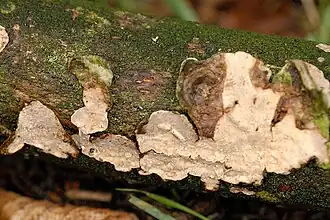 Phanerochaete velutina | |||||||||||||
| Classificação científica | |||||||||||||
| |||||||||||||
| Espécie-tipo | |||||||||||||
| Phanerochaete alnea (Fr.) P.Karst. (1889) | |||||||||||||
| Sinónimos[1] | |||||||||||||
| |||||||||||||
Phanerochaete é um gênero de fungos corticioides da família Phanerochaetaceae [en].[2]
Taxonomia
O gênero foi circunscrito pelo micologista finlandês Petter Adolf Karsten em 1889.[2] Marinus Anton Donk [en] redefiniu os limites do gênero em duas publicações, em 1957 e 1962.[3][4] Tradicionalmente, Phanerochaete tem sido delimitado com base na morfologia geral do basidiocarpo, bem como em características microscópicas, incluindo a natureza da estrutura hifal, dos cistídios e dos basidiósporos. Análises de filogenética molecular demonstram que o gênero é polifilético, contendo membros distribuídos por todo o clado dos Polyporales.[5][6]
O nome do gênero deriva das palavras do grego antigo φανεφός ("distinto") e χαίτη ("cabelo").[3]
Descrição
As espécies de Phanerochaete possuem basidiocarpos membranáceos e corticioides. O sistema hifal é monomítico, com hifas generativas de septos simples; fíbulas simples ou múltiplas podem estar presentes no subículo. Os basídios (células portadoras de esporos) são clavados e lisos. Os basidiósporos do gênero têm paredes finas, são inamiloidais, hialinos e apresentam forma cilíndrica a elipsoide. As espécies de Phanerochaete causam podridão branca tanto em coníferas quanto em árvores com madeira de lei.[5]
Química
Phanerochaete inclui fungos de podridão branca capazes de degradar o polímero lenhoso lignina até dióxido de carbono. Isso é conseguido, em parte, por peroxidase de lignina [en] e peroxidase de manganês [en]. Essas peroxidases também conseguem mediar a oxidação de uma ampla variedade de poluentes orgânicos. O genoma de P. chrysosporium foi sequenciado e revela o potencial genético para produzir mais de 100 mono-oxigenases do citocromo P450.[7] Fungos de podridão branca têm sido utilizados em esforços de biorremediação para degradar substâncias químicas potencialmente nocivas no solo e na água.[8] Por exemplo, a resina fenol-formaldeído é degradada por P. chrysosporium,[9] enquanto P. sordida degrada o pesticida neonicotinoide clotianidina.[10]
Espécies
Até março de 2025, o Index Fungorum aceitava 101 espécies de Phanerochaete:[11]
- Phanerochaete aculeata Hallenb. (1978)
- Phanerochaete affinis (Burt) Parmasto (1968)
- Phanerochaete alba Sang H.Lin & Z.C.Chen (1990)[12] – Taiwan
- Phanerochaete albida Sheng H.Wu (1990)
- Phanerochaete allantospora [en] Burds. & Gilb. (1974)[13]
- Phanerochaete alnea [en] (Fr.) P.Karst. (1889)
- Phanerochaete aluticolor (Bres. & Torrend) Melo, J.Cardoso, M.Dueñas, Salcedo & Tellería (2012)
- Phanerochaete andreae Burds., Beltrán-Tej., & Rodr.-Armas (1995)[14]
- Phanerochaete angustocystidiata Sheng H.Wu (2000)[15] – Taiwan
- Phanerochaete arenata (P.H.B.Talbot) Jülich (1979)
- Phanerochaete areolata (G.Cunn.) Hjortstam & Ryvarden (1990)
- Phanerochaete argillacea Sheng H.Wu (1998)[16] – Taiwan
- Phanerochaete arizonica [en] Burds. & Gilb. (1974)[13]
- Phanerochaete aurantiobadia (Ghobad-Nejhad, S.L.Liu & E.Langer (2015)[17]
- Phanerochaete australis Jülich (1980)
- Phanerochaete avellanea [en] (Bres.) J.Erikss. & Hjortstam (1981)
- Phanerochaete bambucicola Sheng H.Wu (2018)[18]
- Phanerochaete binucleospordida Boidin, Lanq. & Gilles (1993)
- Phanerochaete brunnea Sheng H.Wu (1990)
- Phanerochaete bubalina Burds. (1985)
- Phanerochaete burtii [en] (Romell ex Burt) Parmasto (1967)
- Phanerochaete cacaina (Bourdot & Galzin) Burds. & Gilb. (1974)[13]
- Phanerochaete cana (Burt) Burds. (1985)
- Phanerochaete capitata Sheng H.Wu (1998)[16] – Taiwan
- Phanerochaete carnosa [en] (Burt) Parmasto (1967)
- Phanerochaete caucasica (Parmasto) Burds. (1985)
- Phanerochaete citri A.B.De (1991)[19] – Índia
- Phanerochaete citrinosanguinea D.Floudas & Hibbett (2015)[6]
- Phanerochaete commixtoides Sang H.Lin & Z.C.Chen (1990)
- Phanerochaete conifericola D.Floudas & D.S.Hibbett (2015)[6]
- Phanerochaete cordylines (G.Cunn.) Burds. (1985)
- Phanerochaete cremeo-ochracea (Bourdot & Galzin) Hjortstam (1987)
- Phanerochaete crescentispora Gilb. & Hemmes (2001)
- Phanerochaete cryptocystidiata Nakasone (2008)
- Phanerochaete deflectens (P.Karst.) Hjortstam (1987)
- Phanerochaete eburnea Sheng H.Wu (1998)[16] – Taiwan
- Phanerochaete eichleriana Bres. (1903)[20]
- Phanerochaete emplastra (Berk. & Broome) Hjortstam (1989)
- Phanerochaete exigua (Burt) Nakasone, Burds. & Lodge (1998)
- Phanerochaete exilis (Burt) Burds. (1985)
- Phanerochaete flava (Burt) Nakasone, Burds. & Lodge (1998)
- Phanerochaete flavidogrisea Sheng H.Wu (1998)[16] – Taiwan
- Phanerochaete flavocarnea (Petch) Hjortstam (1995)
- Phanerochaete fulva Sheng H.Wu (1998)[16] – Taiwan
- Phanerochaete furfuraceovelutinus (Rick) Rajchenb. (1987)
- Phanerochaete globosa Sang H.Lin & Z.C.Chen (1990)[12] – Taiwan
- Phanerochaete granulata Sheng H.Wu (2007)
- Phanerochaete hiulca (Burt) A.L.Welden (1980)
- Phanerochaete hyphocystidiata Sheng H.Wu (1998)[16] – Taiwan
- Phanerochaete incarnata Sheng H.Wu (2017)[18] – Taiwan
- Phanerochaete incrustans (Speg.) Rajchenb. & J.E.Wright (1987)
- Phanerochaete infuscata Hjortstam & Ryvarden (2004)[21]
- Phanerochaete intertexta Sheng H.Wu (1990)
- Phanerochaete investiens (Berk.) P.Roberts (2009)
- Phanerochaete jose-ferreirae (D.A.Reid) D.A.Reid (1975)
- Phanerochaete laevis (Fr.) J.Erikss. & Ryvarden (1978)
- Phanerochaete leptoderma Sheng H.Wu (1990)
- Phanerochaete lutea (Sheng H.Wu) Hjortstam (1995)
- Phanerochaete luteoaurantiaca (Wakef.) Burds. (1985)
- Phanerochaete macrocystidiata Hallenb. (1978)
- Phanerochaete martelliana (Bres.) J.Erikss. & Ryvarden (1978)
- Phanerochaete mauiensis Gilb. & Adask. (1993)
- Phanerochaete odontoidea Sheng H.Wu (2000)[15] – Taiwan
- Phanerochaete oreophila Gilb. & Hemmes (2004)
- Phanerochaete pallida Parmasto (1967)
- Phanerochaete parmastoi Sheng H.Wu (1990)
- Phanerochaete parvispora Sheng H.Wu & Losi (1995)[22] – Europa
- Phanerochaete percitrina P.Roberts & Hjortstam (2000)[23] – África
- Phanerochaete phosphorescens (Burt) A.L.Welden (1980)
- Phanerochaete porostereoides S.L.Liu & S.H.He (2016)[24] – China
- Phanerochaete pseudosanguinea D.Floudas & D.S.Hibbett (2015)[6]
- Phanerochaete queletii (Bres.) Nakasone (2008)
- Phanerochaete radulans Hallenb. (1978)[25]
- Phanerochaete reflexa Sheng H.Wu (1998)[16] – Taiwan
- Phanerochaete rhodella (Peck) D.Floudas & D.S.Hibbett (2015)[6]
- Phanerochaete robusta Parmasto (1968)
- Phanerochaete rubescens Sheng H.Wu (1998)[16] – Taiwan
- Phanerochaete sacchari (Burt) Burds. (1985)
- Phanerochaete salmoneolutea Burds. & Gilb. (1974)[13]
- Phanerochaete sanguineocarnosa D.Floudas & Hibbett (2015)[6]
- Phanerochaete sanwicensis Gilb. & Hemmes (2004)
- Phanerochaete sordida (P.Karst.) J.Erikss. & Ryvarden (1978)
.jpg)
- Phanerochaete stereoides Sheng H.Wu (1995)
- Phanerochaete suballantoidea Sheng H.Wu (1998)[16] – Taiwan
- Phanerochaete subceracea (Burt) Burds. (1985)
- Phanerochaete subcrassispora P.Roberts & Hjortstam (2009)
- Phanerochaete subglobosa Sheng H.Wu (1990)
- Phanerochaete subiculosa (Burt) Burds. (1985)
- Phanerochaete taiwaniana Sheng H.Wu (1990)
- Phanerochaete tamariciphila Boidin, Lanq. & Gilles (1993)
- Phanerochaete thailandica Kout & Sádlíková (2017)[26] – Tailândia
- Phanerochaete tropica (Sheng H.Wu) Hjortstam (1995)
- Phanerochaete tuberculascens Hjortstam (2000)[27]
- Phanerochaete tuberculata [en] (P.Karst.) Parmasto (1968)
- Phanerochaete velutina [en] (DC.) P.Karst. (1898)
- Phanerochaete vesiculosa S.Martínez & Nakasone (2005)[28] – Uruguai
- Phanerochaete xerophila Burds. (1985)[29]
Referências
- ↑ «Phanerochaete P. Karst. 1889». MycoBank. International Mycological Association. Consultado em 2 de maio de 2012
- ↑ a b Karsten, Petter (1889). «Kritisk öfversigt af Finlands Basidsvampar (Basidiomycetes; Gastero- & Hymenomycetes)». Bidrag till Kännedom of Finlands Natur Folk (em finlandês). 48: 1–470 (see p. 426)
- ↑ a b Donk, M.A. (1957). «The proposed names for Hymenomycetes. VII: "Thelephoraceae" (Conclusion)». Taxon. 6 (4): 106–123. JSTOR 1217754. doi:10.2307/1217754
- ↑ Donk, M.A. (1962). «Notes on resupinate Hymenomycetes-VI». Persoonia. 2: 217–238
- ↑ a b Wu, Sheng-Hua; Nilsson, Henrik R.; Chen, Cheng-Tao; Yu, Shi-Yi; Hallenberg, Nils (2010). «The white-rotting genus Phanerochaete is polyphyletic and distributed throughout the phleboid clade of the Polyporales (Basidiomycota)». Fungal Diversity. 42 (1): 107–118. doi:10.1007/s13225-010-0031-7
- ↑ a b c d e f Floudas, D; Hibbett, D.S. (2015). «Revisiting the taxonomy of Phanerochaete (Polyporales, Basidiomycota) using a four gene dataset and extensive ITS sampling». Fungal Biology. 119 (8): 679–719. Bibcode:2015FunB..119..679F. PMID 26228559. doi:10.1016/j.funbio.2015.04.003
- ↑ Martinez, Diego; Larrondo, Luis F.; Putnam, Nik; Gelpke, Maarten D Sollewijn; Huang, Katherine; Chapman, Jarrod; Helfenbein, Kevin G.; Ramaiya, Preethi; Detter, J. Chris; Larimer, Frank; Coutinho, Pedro M.; Henrissat, Bernard; Berka, Randy; Cullen, Dan; Rokhsar, Daniel (2004). «Genome sequence of the lignocellulose degrading fungus Phanerochaete chrysosporium strain RP78». Nature Biotechnology. 22 (6): 695–700. PMID 15122302. doi:10.1038/nbt967

- ↑ Syed, K.; Yadav, J.S. (2012). «P450 monooxygenases (P450ome) of the model white rot fungus Phanerochaete chrysosporium». Critical Reviews in Microbiology. 38 (4): 339–363. PMC 3567848. PMID 22624627. doi:10.3109/1040841X.2012.682050
- ↑ Gusse, A.C.; Miller, P.D.; Volk, T.J. (2006). Environmental Science and Technology. 40 (13): 4196–9. Bibcode:2006EnST...40.4196G
- ↑ Mori, T.; Wang, J.; Tanaka, Y.; Nagai, K.; Kawagishi, H.; Hirai, H. (2017). «Bioremediation of the neonicotinoid insecticide clothianidin by the white-rot fungus Phanerochaete sordida». Journal of Hazardous Materials. 321: 586–590. Bibcode:2017JHzM..321..586M. PMID 27694022. doi:10.1016/j.jhazmat.2016.09.049
- ↑ «Phanerochaete | COL»
- ↑ a b Lin, S.H.; Chen, Z.C. (1990). «The Corticiaceae and the resupinate Hydnaceae of Taiwan». Taiwania. 35 (2): 69–111
- ↑ a b c d Burdsall, H.H. Jr.; Gilbertson, R.L. (1974). «Three new species of Phanerochaete (Aphyllophorales, Corticiaceae)». Mycologia. 66 (5): 780–790. JSTOR 3758198. doi:10.2307/3758198
- ↑ Burdsall, H.H.; Beltrán-Tejera, E.; Rodríguez-Armas, J.L. (1995). «Phanerochaete andreae sp. nov. (Aphyllophorales, Basidiomycotina), from the Canary Islands». Mycotaxon. 54: 295–298
- ↑ a b Wu, S.H. (2000). «Six new species of Phanerochaete from Taiwan». Botanical Bulletin of the Academia Sinica (Taipei). 41: 165–174
- ↑ a b c d e f g h i Wu, Sheng-Hua (1998). «Nine new species of Phanerochaete from Taiwan». Mycological Research. 102 (9): 1126–1132. doi:10.1017/S0953756298006091
- ↑ Ghobad-Nejhad, Masoomeh; Liu, Shi-Liang; Dai, Yu-Cheng (2015). «Molecular and morphological evidence reveal a new non-cystidiate species belonging to the core Phanerochaete (Polyporales)». Mycological Progress. 14 (9): 69. Bibcode:2015MycPr..14...68G. doi:10.1007/s11557-015-1072-9
- ↑ a b Sheng-Hua Wu; Yu-Ping Chen; Chia-Ling Wei; Dimitrios Floudas; Yu-Cheng Dai (2018). «Two new species of Phanerochaete (Basidiomycota) and redescription of P. robusta». Mycological Progress. 17 (4): 425–435. Bibcode:2018MycPr..17..425W. doi:10.1007/s11557-017-1368-z
- ↑ De, A.B. (1991). «A new species of Phanerochaete (Aphyllophorales, Corticiaceae) from India». Mycotaxon. 42: 29–34
- ↑ Bresadola, G. (1903). «Fungi Polonici a cl. Viro B. Eichler lecti». Annales Mycologici. 1 (1): 65–96
- ↑ Hjortstam, K.; Ryvarden, L. (2004). «Some new tropical genera and species of corticioid fungi (Basidiomycotina, Aphyllophorales)». Synopsis Fungorum. 18: 20–32
- ↑ Wu, S.H.; Losi, C. (1995). «Phanerochaete parvispora sp. nov. (Aphyllophorales) from Venetian Lagoon, Italy». Mycotaxon. 55: 543–545
- ↑ Roberts, P. (2000). «Corticioid fungi from Korup National Park, Cameroon». Kew Bulletin. 55 (4): 803–842. Bibcode:2000KewBu..55..803R. JSTOR 4113628. doi:10.2307/4113628
- ↑ Liu, S.L.; He, S.H. (2016). «Phanerochaete porostereoides, a new species in the core clade with brown generative hyphae from China» (PDF). Mycosphere. 7 (5): 648–655. doi:10.5943/mycosphere/7/5/10
- ↑ Hallenberg, N. (1978). «Wood-Fungi (Corticiaceae, Coniophoraceae, Lachnocladiaceae, Thelephoraceae) in N. Iran. I». Iranian Journal of Plant Pathology. 14: 38–87
- ↑ Sádlíková, M.; Kout, J. (2017). «A new Phanerochaete (Polyporales, Basidiomycota) with brown subicular hyphae from Thailand» (PDF). Mycosphere. 8 (1): 1124–1030. doi:10.5943/mycosphere/8/6/4

- ↑ Hjortstam, K. (2000). «Two new species of Phanerochaete (Basidiomycotina, Aphyllophorales), and a key to species from subtropical and tropical areas». Karstenia. 40 (1–2): 53–62. doi:10.29203/ka.2000.352
- ↑ Martínez, Sebastian; Nakasone, Karen K. (2005). «The genus Phanerochaete (Corticiaceae, Basidiomycotina) sensu lato in Uruguay» (PDF). Sydowia. 57 (1): 94–101
- ↑ Burdsall, H.H. (1985). «A contribution to the taxonomy of the genus Phanerochaete». Mycologia Memoirs. 10: 1–165
Leitura adicional
- Spirin, Viacheslav; Volobuev, Sergey; Okun, Mikhail; Miettinen, Otto; Larsson, Karl-Henrik (2016). «What is the type species of Phanerochaete (Polyporales, Basidiomycota)?». Mycological Progress. 16 (2): 171–183. doi:10.1007/s11557-016-1267-8