Migrações indo-europeias
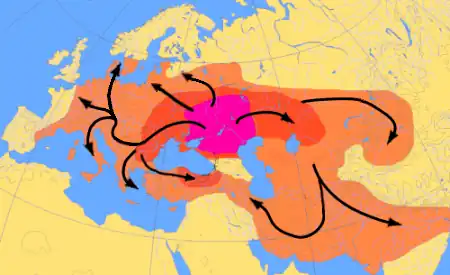
Migrações Indo-Europeias foram as migrações dos povos pastoris que falavam a língua protoindo-europeia. Relacionados aos Yamnaya e outros povos, partiram da estepe pôntica, no leste europeu, por volta dos anos 4000 a.C. Seus descendentes espalharam-se por toda Europa e partes da Ásia, formando novas culturas com as comunidades locais, incluindo a cultura da cerâmica cordada no norte da Europa e a cultura védica no subcontinente indiano. Essas migrações, em última instância, semearam as culturas e língua de grande parte da Europa, do Irã, e do subcontinente Indiano. Posteriormente, resultou na maior e mais fala família linguística no mundo.
O conhecimento moderno destas migrações é baseado em dados de diversas ciências, como linguística, arqueologia, antropologia e genética. A linguística descreve as similaridades entre diversas línguas e as leis da linguísticas presentes nas alterações dessas línguas. A arqueologia descreve a migração da cultura protoindo-europeia e sua língua em variados estágios: da região originário do protoindo-europeu a Europa Ocidental, Central e Meridional e, especialmente, à Asia Oriental por migrações e mudanças linguísticas decorrentes de recrutamento de elite, como descrevem algumas pesquisas.[2][3] Pesquisas genéticas recentes, por sua vez, possuem uma crescente contribuição ao entendimento das relações históricas entre diferentes culturas.
As línguas e culturas indo-europeias espalharam-se durante vários períodos. Migrações iniciais de 4200-3000 a.C. trouxeram o protoindo-europeu arcaico para o vale do Rio Danúbio,[4] Anatólia e a região do Altai.[5]
O protocéltico e o protoitálico provavelmente desenvolveram-se e espalharam-se a partir da Europa Central para a Europa Ocidental após novas migrações Yamnaya para o vale do Rio Danúbio, [6][7]enquanto o protogermânico e o protobalto-eslávico podem ter se desenvolvido a leste dos Cárpatos, na atual Ucrânia, migrando em direção a norte e espalhando-se com a cultura da cerâmica cordada na Europa Central, por voltado de 2000 a.C.[8][9] Alternativamente, um ramo europeu dos dialetos indo-europeus, denominado "indo-europeu noroeste" e associado à cultura beaker, podem possuir ancestrais não somente célticos e itálicos, mas também germânicos e balto-eslávicos.
As culturas e línguas indo-iranianas emergiram a partir da Cultura de Sintashta (2100-1800 a.C.), na fronteira leste da cultura Yamnaya e da cultura da cerâmica cordada, crescendo para a cultura Andronova (1800-800 a.C.). Indo-arianos migraram para o Complexo Arqueológico Báctria-Margiana (2300-1700 a.C.) e migraram para o Levante (Mitani), Índia do Norte (povo Vedic, 1500 a.C.) e China (Usun).[3] As línguas iranianas espalharam-se pelas estepes com os citas e para o Irã com os medos, partas e persas a partir de 800 a.C.[3]
Referências
- ↑ Beckwith 2009, p. 30.
- ↑ Anthony 2007.
- ↑ a b c Beckwith 2009.
- ↑ Anthony 2007, p. 133.
- ↑ Mallory & Adams 1997, p. 4.
- ↑ Mallory 1999, pp. 108 f..
- ↑ Anthony 2007, pp. 345, 361–367.
- ↑ Mallory 1999, pp. 108, 244–250.
- ↑ Anthony 2007, p. 360.
Bibliografia
- Allentoft; Sikora; et al. (2015), «Population genomics of Bronze Age Eurasia», Nature, 522 (7555): 167–172, Bibcode:2015Natur.522..167A, PMID 26062507, doi:10.1038/nature14507
- Anthony, David W. (2007), The Horse The Wheel And Language. How Bronze-Age Riders From the Eurasian Steppes Shaped The Modern World, Princeton University Press
- Anthony, David; Ringe, Don (2015), «The Indo-European Homeland from Linguistic and Archaeological Perspectives», Annual Review of Linguistics, 1: 199–219, doi:10.1146/annurev-linguist-030514-124812

- Anthony, David (2017), «Archaeology and Language: Why Archaeologists Care About the Indo-European Problem», in: Crabtree, P. J.; Bogucki, P., European Archaeology as Anthropology: Essays in Memory of Bernard Wailes, University of Pennsylvania Press
- Anthony, D. W. (2019), «Archaeology, Genetics, and Language in the Steppes: A Comment on Bomhard», Journal of Indo-European Studies, pp. 1–23
- Anthony, David (2020), «Ancient DNA, Mating Networks, and the Anatolian Split», in: Serangeli, Matilde; Olander, Thomas, Dispersals and Diversification: Linguistic and Archaeological Perspectives on the Early Stages of Indo-European, Brill
- Basu; Mukherjee, Namita; Roy, Sangita; Sengupta, Sanghamitra; Banerjee, Sanat; Chakraborty, Madan; Dey, Badal; Roy, Monami; Roy, Bidyut; Bhattacharyya, Nitai P.; Roychoudhury, Susanta; Majumder, Partha P. (2003), «Ethnic India: A Genomic View, With Special Reference to Peopling and Structure», Genome Research, 13 (10): 2277–2290, PMC 403703, PMID 14525929, doi:10.1101/gr.1413403
- Beckwith, Christopher I. (16 de março de 2009), Empires of the Silk Road: A History of Central Eurasia from the Bronze Age to the Present, ISBN 978-1-400-82994-1, Princeton University Press, consultado em 30 de dezembro de 2014
- Boardman, John (1982), The Cambridge Ancient History: The Prehistory of the Balkans; the Middle East and the Aegean World, Tenth to Eighth Centuries B.C., ISBN 978-0-521-22496-3, III:1, Cambridge University Press
- Boardman, John; Hammond, Nicholas Geoffrey Lemprière (1982), The Cambridge Ancient History: The Expansion of the Greek World, Eighth to Six Centuries B.C, ISBN 978-0-521-23447-4, Cambridge University Press
- Bojtár, Endre (1999), Foreword to the Past: A Cultural History of the Baltic People, ISBN 978-9-639-11642-9, Central European University Press
- Bomhard, Allan (2019), «The Origins of Proto-Indo-European: The Caucasian Substrate Hypothesis», Journal of Indo-European Studies, 47 (1–2)
- Bradley, Richard (2007), The Prehistory of Britain and Ireland, ISBN 978-0-521-84811-4, Cambridge University Press
- Bresnan, Patrick S. (2017), Awakening: An Introduction to the History of Eastern Thought 6th ed. , Routledge
- Bryant, Edwin (2001), The Quest for the Origins of Vedic Culture: The Indo-Aryan Migration Debate, ISBN 978-0-195-13777-4, Oxford University Press
- Bryant, Edwin F.; Patton, Laurie L. (2005), The Indo-Aryan Controversy: Evidence and Inference in Indian History, Routledge
- Burrow, T. (1973), «The Proto-Indoaryans», Journal of the Royal Asiatic Society of Great Britain and Ireland, 105 (2): 123–140, JSTOR 25203451, doi:10.1017/S0035869X00130837
- Cavalli-Sforza, Luigi Luca (2000), Genes, peoples, and languages, ISBN 978-0-865-47529-8, Farrar, Straus & Giroux
- Clackson, James (1995), The Linguistic Relationship Between Armenian and Greek, ISBN 978-0-631-19197-1, Oxford: Wiley-Blackwell
- Coleman, John E. (2000), «An Archaeological Scenario for the 'Coming of the Greeks' ca. 3200 B.C.», The Journal of Indo-European Studies, 28 (1–2), pp. 101–153
- Damgaard, Peter de Barros (2018), «The First Horse herders and the Impact of Early Bronze Age Steppe expansions into Asia», Science, 360 (6396), PMC 6748862, PMID 29743352, doi:10.1126/science.aar7711
- Demkina, T. S. (2017), «Paleoecological Crisis in the Steppes of the Lower Volga Region in the Middle of the Bronze Age (III–II centuries BC)», Eurasian Soil Science, 50 (7): 791–804, Bibcode:2017EurSS..50..791D, doi:10.1134/S1064229317070018
- Diakonoff, Igor M. (1995), «Two Recent Studies of Indo-Iranian Origins», American Oriental Society, Journal of the American Oriental Society, 115 (3): 473–477, JSTOR 606224, doi:10.2307/606224
- Dumitrescu, Vlad; Boardman, John; Hammond, N. G. L; Kollberger, E (1982), «The prehistory of Romania from the earliest times to 1000 BC», The Prehistory of the Balkans, the Middle East and the Aegean World, Tenth to Eighth Centuries BC, ISBN 978-0-521-22496-3, The Cambridge Ancient History, Cambridge University Press
- Ellis, Robert (1861), The Armenian Origin of the Etruscans, Parker, Son and Bourn
- Enoki, K.; Koshelenko, G. A.; Haidary, Z. (1994), «The Yu'eh-chih and their migrations» (PDF), in: Harmatta, János, History of Civilizations of Central Asia: The Development of Sedentary and Nomadic Civilizations, 700 B. C. to A. D. 250, ISBN 978-9-231-02846-5, Paris: UNESCO, pp. 165–184
- Erdosy (2012), The Indo-Aryans of Ancient South Asia: Language, Material Culture and Ethnicity, ISBN 978-3-110-81643-3, Walter de Gruyter
- Flood, Gavin D. (1996), An Introduction to Hinduism, Cambridge University Press
- Fortson, IV, Benjamin W. (2011), Indo-European Language and Culture: An Introduction, ISBN 978-1-444-35968-8, John Wiley & Sons, consultado em 30 de outubro de 2012
- Fosse, Lars Martin (2005), «Aryan Past and Post-colonial Present: The Polemics and Politics of Indigenous Aryanism», in: Bryant, Edwin; Patton, Laurie L., The Indo-Aryan Controversy: Evidence and Inference in Indian History, Routledge
- Frazee, Charles A. (1997), World History: Ancient and Medieval Times to A.D. 1500, ISBN 978-0-812-09765-8, Barron's Educational Series
- Furtwängler, Anja; et al. (2020), «Ancient genomes reveal social and genetic structure of Late Neolithic Switzerland», Nature Communications, 11 (1), Bibcode:2020NatCo..11.1915F, PMC 7171184, PMID 32313080, doi:10.1038/s41467-020-15560-x Parâmetro desconhecido
|article-number=ignorado (ajuda) - Georgiev, Vladimir Ivanov (1981), Introduction to the History of the Indo-European Languages, ISBN 978-9-535-17261-1, Sofia: Bulgarian Academy of Sciences
- Gimbutas, Marija (1997), Dexter, Miriam Robbins; Jones-Bley, Karlene, eds., The Kurgan Culture and the Indo-Europeanization of Europe: Selected Articles From 1952 to 1993, ISBN 978-0-941-69456-8, Journal of Indo-European Studies Monograph Series, 18, Institute for the Study of Man
- Grigoriev, Stanislav (2002). "Ancient Indo-Europeans". Chelyabinsk. Rifei.
- Grolle, Johann (12 de maio de 2018), «Invasion aus der Steppe», Der Spiegel
- Haak, Wolfgang (2015), «Massive migration from the steppe was a source for Indo-European languages in Europe», Nature, 522 (7555): 207–211, Bibcode:2015Natur.522..207H, PMC 5048219, PMID 25731166, arXiv:1502.02783, doi:10.1038/nature14317
- Haak, W.; Lazaridis, I.; Patterson, N.; Rohland, N.; Mallick, S.; Llamas, B.; Brandt, G.; Nordenfelt, S.; Harney, E.; Stewardson, K.; Fu, Q.; Mittnik, A.; Bánffy, E.; Economou, C.; Francken, M.; Friederich, S.; Pena, R. G.; Hallgren, F.; Khartanovich, V.; Khokhlov, A.; Kunst, M.; Kuznetsov, P.; Meller, H.; Mochalov, O.; Moiseyev, V.; Nicklisch, N.; Pichler, S. L.; Risch, R.; Rojo Guerra, M. A.; et al. (2015a), «Massive migration from the steppe was a source for Indo-European languages in Europe. Supplementary Information», Nature, 522 (7555): 207–211, Bibcode:2015Natur.522..207H, PMC 5048219, PMID 25731166, arXiv:1502.02783, doi:10.1038/nature14317
- Hanks, B. (2009), «Late Prehistoric Mining, Metallurgy, and Social Organization in North Central Eurasia», in: Hanks, B.; Linduff, K., Social Complexity in Prehistoric Eurasia: Monuments, Metals, and Mobility, ISBN 978-0-511-60537-6, Cambridge University Press, pp. 146–167, doi:10.1017/CBO9780511605376.005
- Harmatta, János (1992), «The Emergence of the Indo-Iranians: The Indo-Iranian Languages» (PDF), in: Dani, A. H.; Masson, V. M., History of Civilizations of Central Asia: The Dawn of Civilization: Earliest Times to 700 B.C., ISBN 978-9-231-02719-2, UNESCO, pp. 346–370, consultado em 29 de maio de 2015
- Heyd, Volker (2017), «Kossinna's smile», Antiquity, 91 (356): 348–359, doi:10.15184/aqy.2017.21, hdl:10138/255652
- Hiltebeitel, Alf (2002), «Hinduism», in: Joseph Kitagawa, The Religious Traditions of Asia: Religion, History, and Culture, ISBN 978-1-136-87597-7, Routledge
- Hock, Hans Heinrich; Joseph, Brian Daniel (1996), Language History, Language Change, and Language Relationship: An Introduction to Historical and Comparative Linguistics, ISBN 978-3-110-14784-1, Walter de Gruyter, consultado em 30 de outubro de 2012
- Hollar, Sherman (2011), Mesopotamia, ISBN 978-1-615-30575-9, Britannica Educational Publishing, consultado em 15 de fevereiro de 2015
- Husovská, Ludmilá (1998), Slovakia: walking through centuries of cities and towns, ISBN 978-8-007-01041-3, Príroda
- Ivanova, M. (2012), «Kaukasus und Orient: Die Entstehung des 'Maikop-Phänomens' im 4. Jahrtausend v. Chr» (PDF), Praehistorische Zeitschrift, 87 (1): 1–28, doi:10.1515/pz-2012-0001
- Jamison, Stephanie W. (2006), «The Indo-Aryan Controversy: Evidence and Inference in Indian History» (PDF), Journal of Indo-European Studies (Book Review), 34, pp. 255–261
- Jones, Eppie R. (2016), «Upper Palaeolithic genomes reveal deep roots of modern Eurasians», Nature Communications, 6, Bibcode:2015NatCo...6.8912J, PMC 4660371, PMID 26567969, doi:10.1038/ncomms9912 Parâmetro desconhecido
|article-number=ignorado (ajuda) - Kassian, Alexei S., Mikhail Zhivlov, George Starostin, Artem A. Trofimov, Petr A. Kocharov, Anna Kuritsyna and Mikhail N. Saenko (2021). "Rapid radiation of the inner Indo-European languages: an advanced approach to Indo-European lexicostatistics". Linguistics, Volume 59 Issue 4.
- Kidner, Frank; Bucur, Maria; Mathisen, Ralph; McKee, Sally; Weeks, Theodore (27 de dezembro de 2007), Making Europe: People, Politics, and Culture, ISBN 978-0-618-00479-9, Cengage Learning, consultado em 14 de fevereiro de 2015
- Kochhar, Rajesh (2000), The Vedic People: Their History and Geography, Sangam Books
- Kohl, Philip L. (2007), The Making of Bronze Age Eurasia, ISBN 978-1-139-46199-3, Cambridge University Press
- Kortlandt, Frederik (2010), An outline of proto-indo-european (working paper) (PDF)
- Koryakova, L. (1998a), Sintashta-Arkaim Culture, The Center for the Study of the Eurasian Nomads (CSEN), consultado em 16 de setembro de 2010, Arquivado do original em 9 de fevereiro de 1999
- Koryakova, L. (1998b), An Overview of the Andronovo Culture: Late Bronze Age Indo-Iranians in Central Asia, The Center for the Study of the Eurasian Nomads (CSEN), consultado em 16 de setembro de 2010, Arquivado do original em 1 de dezembro de 1998
- Kozintsev, Alexander (outono–inverno de 2019), «Proto-Indo-Europeans: The Prologue» (PDF), The Journal of Indo-European Studies, 47 (3–4)
- Krech, Volkhard; Steinicke, Marian (2011), Dynamics in the History of Religions between Asia and Europe: Encounters, Notions, and Comparative Perspectives, ISBN 978-9-004-22535-0, Brill, consultado em 30 de dezembro de 2014
- Kristiansen, Kristian (2020), «The Archaeology of Proto-Indo-European and Proto-Anatolian: Locating the Split», in: Serangeli; Olander, Dispersals and Diversification: Linguistic and Archaeological Perspectives on the Early-Stages of Indo-European, Brill, p. 157
- Iversen, Rune; Kroonen, Guus (2017), «Talking Neolithic: Linguistic and Archaeological Perspectives on how Indo-European was Implemented in Southern Scandinavia» (PDF), American Journal of Archaeology, 121 (4): 511–525, doi:10.3764/aja.121.4.0511, hdl:1887/72458
- Kroonen, Guus; Barjamovic, Gojko; Peyrot, Michael (2018), Linguistic supplement to Damgaard et al. 2018: Early Indo-European languages, Anatolian, Tocharian and Indo-Iranian
- Kuzmina, Elena E. (2007), The Origin of the Indo-Iranians, Brill
- Kuznetsov, P. F. (2006), «The emergence of Bronze Age chariots in eastern Europe», Antiquity, 80 (309): 638–645, doi:10.1017/S0003598X00094096, arquivado do original em 7 de julho de 2012 Verifique o valor de
|url-access=subscription(ajuda) - Lazaridis, Iosif; Haak, Wolfgang; Patterson, Nick; Anthony, David; Reich, David (2015), «Massive migration from the steppe is a source for Indo-European languages in Europe. Supplementary Information 11. Relevance of ancient DNA to the problem of Indo-European language dispersals», Nature, 522 (7555): 207–211, Bibcode:2015Natur.522..207H, PMC 5048219, PMID 25731166, arXiv:1502.02783, doi:10.1038/nature14317
- Lazaridis, Iosif (2016), The genetic structure of the world's first farmers, bioRxiv 10.1101/059311 Verifique
|biorxiv=value (ajuda), doi:10.1101/059311 Parâmetro desconhecido |biorxiv=ignorado (ajuda) - Linderholm, Anna (2020), «Corded Ware cultural complexity uncovered using genomic and isotopic analysis from south-eastern Poland», Scientific Reports, 10 (1), Bibcode:2020NatSR..10.6885L, PMC 7165176, PMID 32303690, doi:10.1038/s41598-020-63138-w Parâmetro desconhecido
|article-number=ignorado (ajuda) - Loewe, Michael; Shaughnessy, Edward L. (1999), The Cambridge History of Ancient China: From the Origins of Civilization to 221 BC, ISBN 978-0-521-47030-8, Cambridge University Press, consultado em 1 de novembro de 2013
- Mallory, J. P. (1989), In Search of the Indo-Europeans: Language, Archaeology, and Myth, ISBN 978-0-500-27616-7, London: Thames & Hudson Verifique o valor de
|url-access=registration(ajuda) - Mallory, J. P. (1999), In Search of the Indo-Europeans: Language, Archaeology, and Myth, ISBN 978-0-500-27616-7 reprint ed. , London: Thames & Hudson Verifique o valor de
|url-access=registration(ajuda) - Mallory, J. P.; Adams, D. Q. (1997), Encyclopedia of Indo-European Culture, ISBN 978-1-884-96498-5, Taylor & Francis
- Mallory, J. P. (2002), «Archaeological models and Asian Indo-Europeans», in: Sims-Williams, Nicholas, Indi-Iranian languages and peoples, Oxford University Press
- Mallory, J. P.; Adams, D. Q. (2006), The Oxford introduction to Proto-Indo-European and the Proto-Indo-European world, ISBN 978-0-199-28791-8 Repr. ed. , Oxford University Press
- Mallory, J. P.; Mair, Victor H. (2008), The Tarim Mummies: Ancient China and the Mystery of the Earliest Peoples from the West, ISBN 978-0-500-28372-1, Thames & Hudson
- Mallory, J. P. (2013), «Twenty-first century clouds over Indo-European homelands» (PDF), Journal of Language Relationship, 9: 145–154, doi:10.31826/jlr-2013-090113
- Malmström, Helena (9 de outubro de 2019), «The genomic ancestry of the Scandinavian Battle Axe Culture people and their relation to the broader Corded Ware horizon», Royal Society, Proceedings of the Royal Society B, 286 (1912), PMC 6790770, PMID 31594508, doi:10.1098/rspb.2019.1528
- Mathieson; et al. (2018), «The Genomic History of Southeastern Europe», Nature, 555 (7695): 197–203, Bibcode:2018Natur.555..197M, PMC 6091220, PMID 29466330, bioRxiv 10.1101/135616 Verifique
|biorxiv=value (ajuda), doi:10.1038/nature25778 Parâmetro desconhecido|biorxiv=ignorado (ajuda) - Mountain, Harry (1998), The Celtic Encyclopedia, ISBN 978-1-581-12890-1, Universal
- Nandris, John (1976), Friesinger, Herwig; Kerchler, Helga; Pittioni, Richard; Mitscha-Märheim, Herbert, eds., «The Dacian Iron Age – A Comment in a European Context», ISBN 978-3-700-54420-3 Festschrift für Richard Pittioni zum siebzigsten Geburtstag ed. , Vienna: Deuticke, Archaeologia Austriaca, ISSN 0003-8008, 13 (13–14)
- Narain, A. K. (1990), «Indo-Europeans in Central Asia», in: Sinor, Denis, The Cambridge History of Early Inner Asia, ISBN 978-1-139-05489-8, 1, Cambridge University Press, pp. 151–177
- Narasimhan, Vagheesh M.; Anthony, David; Mallory, James; Reich, David (2018), The Genomic Formation of South and Central Asia, bioRxiv 10.1101/292581 Verifique
|biorxiv=value (ajuda), doi:10.1101/292581, hdl:21.11116/0000-0001-E7B3-0 Parâmetro desconhecido |biorxiv=ignorado (ajuda) - Nichols, Johanna (1997), «The Epicenter of the Indo-European Linguistic Spread», in: Blench, Roger; Spriggs, Matthew, Archaeology and Language Vol. I: Theoretical and Methodological Orientations, London: Routledge
- Nichols, Johanna (1999), «The Eurasian Spread Zone and the Indo-European Dispersal», in: Blench, Roger; Spriggs, Matthew, Archaeology and Language II: Correlating archaeological and Linguistic Hypotheses, Routledge
- Nordqvist, Kerkko; Heyd, Volker (2020), «The Forgotten Child of the Wider Corded Ware Family: Russian Fatyanovo Culture in Context», Proceedings of the Prehistoric Society, 86: 65–93, doi:10.1017/ppr.2020.9 Verifique o valor de
|url-access=subscription(ajuda) - Parpola, Asko (1998), «Aryan Languages, Archaeological Cultures, and Sinkiang: Where Did Proto-Iranian Come into Being and How Did It Spread?», in: Mair, The Bronze Age and Early Iron Age Peoples of Eastern and Central Asia, ISBN 978-0-941-69463-6, Washington, D.C.: Institute for the Study of Man
- Parpola, Asko (2015), The Roots of Hinduism. The Early Aryans and the Indus Civilization, Oxford University Press
- Parpola, Asko (2017), «Finnish vatsa – Sanskrit vatsá – and the formation of Indo-Iranian and Uralic languages», Journal de la Société Finno-Ougrienne, 2017 (96), doi:10.33340/susa.70229, hdl:10138/311944
- Parpola, Asko (2020), «Royal "Chariot" Burials of Sanauli near Delhi and Archaeological Correlates of Prehistoric Indo-Iranian Languages», Studia Orientalia Electronica, 8, doi:10.23993/store.98032
- Pereltsvaig, Asya; Lewis, Martin W. (2015), The Indo-European Controversy, Cambridge University Press
- Piggot, Stuart (1965), Ancient Europe from the Beginnings of Agriculture to Classical Antiquity: a Survey, Chicago: Aldine
- Plotkin, Vulf (2008), The Evolution of Germanic Phonological Systems: Proto-Germanic, Gothic, West Germanic, and Scandinavian, Lewiston: Edwin Mellen
- Polomé, Edgar C. (1992), Lippi-Green, Rosina, ed., Recent Developments in Germanic Linguistics, ISBN 978-9-027-23593-0, John Benjamins
- Polomé, Edgar Charles; Fee, Christopher R.; Leeming, David Adams (2006), «Germanic mythology», in: Leeming, David Adams, The Oxford Companion to World Mythology, ISBN 978-0-199-91648-1, Oxford University Press, consultado em 3 de janeiro de 2020
- Pulleyblank, Edwin G. (1966), Chinese and Indo-Europeans, University of British Columbia, Department of Asian Studies, consultado em 14 de fevereiro de 2015
- Ravinutala, Abhijith (2013), Politicizing the Past: Depictions of Indo-Aryans in Indian Textbooks from 1998–2007
- Reich, David (2018), Who We Are and How We Got Here: Ancient DNA and the New Science of the Human Past, Knopf Doubleday
- Renfrew, Colin (1990) [1987], Archaeology and Language: The Puzzle of Indo-European Origins, ISBN 978-0-521-38675-3, Cambridge University Press
- Renfrew, Colin (2003), «Time Depth, Convergence Theory, and Innovation in Proto-Indo-European: 'Old Europe' as a PIE Linguistic Area», in: Bammesberger, Alfred; Vennemann, Theo, Languages in Prehistoric Europe, ISBN 978-3-825-31449-1, Heidelberg: Universitätsverlag Winter, pp. 17–48
- Ringe, Don (2006). From Proto-Indo-European to Proto-Germanic (PDF). ISBN 978-0-19-928413-9. A Linguistic History of English (em inglês) 1 ed. Nova Iorque: Oxford University Press. OCLC 64554645. OL 7405151M. Wikidata Q131605459
- Roisman, Joseph; Worthington, Ian, eds. (2010), A Companion to Ancient Macedonia, ISBN 978-1-405-17936-2, John Wiley & Sons, consultado em 1 de maio de 2016
- Salmons, Joseph (2015), «Language shift and the Indo-Europanization of Europe», in: Mailhammer, Robert; Vennemann, Theo; Olsen, Birgit Anette, Origin and Development of European Languages, Museum Tusculanum Press
- Samuel, Geoffrey (2010), The Origins of Yoga and Tantra. Indic Religions to the Thirteenth Century, Cambridge University Press
- Serangeli, Matilede (2020), «Introduction: Dispersals and Diversification of the Indo-European Languages», in: Serangeli, Matilde; Olander, Thomas, Dispersals and Diversification: Linguistic and Archaeological Perspectives on the Early Stages of Indo-European, Brill
- Singh, Upinder (2008), A History of Ancient and Early Medieval India: From the Stone Age to the 12th Century, ISBN 978-8-131-71677-9, Pearson Education India, consultado em 7 de março de 2021
- Sjögren, Karl-Göran (2020), «Kinship and social organization in Copper Age Europe. A cross-disciplinary analysis of archaeology, DNA, isotopes, and anthropology from two Bell Beaker cemeteries», PLOS ONE, 15 (11): e0241278, Bibcode:2020PLoSO..1541278S, PMC 7668604, PMID 33196640, doi:10.1371/journal.pone.0241278
- Strabo (2014), The Geography of Strabo: An English Translation, with Introduction and Notes, ISBN 978-1-139-95249-1, traduzido por Duane W. Roller, Cambridge University Press
- Strazny, Philipp, ed. (2000), Dictionary of Historical and Comparative Linguistics, ISBN 978-1-579-58218-0 1 ed. , Routledge
- Thapar, Romila (2006), India: Historical Beginnings and the Concept of the Aryan, ISBN 978-8-123-74779-8, National Book Trust
- Thomas, Homer L. (1992), «Archaeology And Indo-European Comparative Linguistics», in: Polomé, Edgar C., Reconstructing Languages and Cultures, ISBN 978-3-110-12671-6, 1, Walter de Gruyter, pp. 281–315
- Treptow, Kurt W. (1996), A History of Romania, ISBN 978-0-880-33345-0, Polygon
- Underhill, Peter A. (2010), «Separating the post-Glacial coancestry of European and Asian Y chromosomes within haplogroup R1a», Eur J Hum Genet, 18 (4), pp. 479–484, PMC 2987245, PMID 19888303, doi:10.1038/ejhg.2009.194
- Underhill, Peter A. (2014), «The phylogenetic and geographic structure of Y-chromosome haplogroup R1a», European Journal of Human Genetics, 23 (1): 124–131, PMC 4266736, PMID 24667786, doi:10.1038/ejhg.2014.50
- Vybornov, Aleksandr (2016), «Initial stages of two Neolithisation models in the Lower Volga basin», Documenta Praehistorica, 43: 161–166, doi:10.4312/dp.43.7
- Wang, Chuan-Chao (2018), The genetic prehistory of the Greater Caucasus
- Wells, Spencer; Read, Mark (2002), The journey of man: a genetic odyssey, ISBN 978-0-691-11532-0, Princeton University Press, p. 168 Verifique o valor de
|url-access=registration(ajuda) - Wang, Chuan-Chao; Reinhold, Sabine; Kalmykov, Alexey; Wissgott, Antje; et al. (2019), «Ancient human genome-wide data from a 3000-year interval in the Caucasus corresponds with eco-geographic regions», Nature Communications, 10 (1): 590, Bibcode:2019NatCo..10..590W, PMC 6360191, PMID 30713341, doi:10.1038/s41467-018-08220-8
- Wilkes, J. J. (1995), The Illyrians, ISBN 978-0-631-19807-9, Oxford: Blackwell
- Witzel, Michael (1989), «Tracing the Vedic dialects», Dialectes dans les Littératures Indo-Aryennes, pp. 97–265
- Witzel, Michael E. J. (2001), «Autochthonous Aryans? The Evidence from Old Indian and Iranian Texts» (PDF), Electronic Journal of Vedic Studies, 7 (3), pp. 1–115
- Witzel, Michael (1995), «Early Sanskritization: Origin and Development of the Kuru state» (PDF), Electronic Journal of Vedic Studies, 1 (4), pp. 1–26, arquivado do original (PDF) em 11 de junho de 2007
- Witzel, Michael (1998), «The Home of the Aryans», in: A. Hinze; E. Tichy, Anusantatyi: Festschrift fuer Johanna Narten zum 70. Geburtstag (PDF), Münchener Studien zur Sprachwissenschaft, Dettelbach: J. H. Roell, pp. 1–53, (Beihefte NF 19)
- Witzel, Michael (dezembro de 2003), «Linguistic Evidence for Cultural Exchange in Prehistoric Western Central Asia» (PDF), Sino-Platonic Papers, 129, pp. 1–70
- Young, Steven (2009), «Balto-Slavic languages», Concise Encyclopedia of Languages of the World, ISBN 978-0-080-87774-7, pp. 135–136
- Zvelebil, Marek (1997), «Pitted Ware And Related Cultures Of Neolithic Northern Europe», in: Bogucki, Peter I.; Crabtree, Pam J., Ancient Europe 8000 B.C.- A.D. 1000, ISBN 0-684-80669-X, Encyclopedia of the Barbarian World, 1, Scribner, pp. 431–435