Instrumentalização do antissemitismo
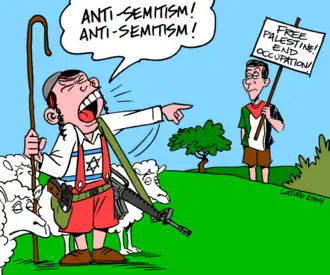
A exploração de acusações de antissemitismo, especialmente para combater o antissionismo e as críticas a Israel, é por vezes chamada de "instrumentalização do antissemitismo"[1][2] (termo em inglês: weaponization of antisemitism).[3] Alegações de "instrumentalização" do antissemitismo surgiram em vários contextos, incluindo o conflito árabe-israelense e debates sobre o conceito de novo antissemitismo e a definição de antissemitismo da IHRA.[4][5]
Acusações de antissemitismo feitas de má-fé foram descritas como uma tática difamatória[6] e comparadas a "jogar a carta racial"[7] e, quando usadas contra judeus, assumem a forma de rotulá-los como "judeus que odeiam a si mesmos".[8]
História
Em 1943, o futuro primeiro-ministro israelense David Ben-Gurion chamou um tribunal britânico de antissemita após este "ter implicado líderes sionistas no tráfico de armas".[9][10] Christopher Sykes disse que o incidente deu início a "uma nova fase na propaganda sionista" na qual "ser antissionista era ser antissemita".[9][11] O teórico da propaganda Noam Chomsky escreveu que, embora Sykes tenha rastreado as origens do antissemitismo como arma até este episódio, foi somente "no período pós-1967 [após a Guerra Árabe-Israelense de 1967] que a tática foi aprimorada até se tornar uma arte elevada, cada vez mais, à medida que as políticas defendidas se tornavam cada vez menos defensáveis".[11] Em 1973, após a Guerra do Yom Kippur, o ministro das Relações Exteriores israelense, Abba Eban, escreveu: "Uma das principais tarefas de qualquer diálogo com o mundo gentio é provar que a distinção entre antissemitismo e antissionismo não é uma distinção. O antissionismo é apenas o novo antissemitismo."[12] Sobre a declaração de Eban, Chomsky disse: "Essa é uma posição conveniente. Ela elimina apenas 100% dos comentários críticos!"[13][14]
No início da década de 1950, a jornalista norte-americana Dorothy Thompson, ex-defensora do sionismo, foi chamada de antissemita após começar a criticá-lo e, como resultado dessas acusações, "ela perdeu amigos, trabalho e influência política".[15] A transição de Thompson para o antissionismo e a defesa dos refugiados palestinos começaram após uma viagem à Palestina em 1945.[16] A professora Lyndsey Stonebridge escreveu: "hoje, muitos veem o silenciamento de uma ousada defensora humanitária em sua história, e não é difícil entender porquê", mas também que "não pode haver dúvida de que o antissemitismo foi um tema nos escritos posteriores de Thompson".[17]
Em suas memórias de 1956, o oficial militar britânico John Bagot Glubb negou as acusações de antissemitismo por suas críticas a Israel, escrevendo: "Não me parece justo nem conveniente que críticas semelhantes dirigidas ao governo israelense marquem o orador com o estigma moral geralmente associado ao antissemitismo."[18][19] O historiador israelense Benny Morris afirmou que isso se devia a uma "tendência entre israelenses e judeus no exterior de identificar críticas severas a Israel como equivalentes a, ou pelo menos derivadas de, antissemitismo", embora Morris também tenha afirmado que o antissionismo de Glubb era "tingido por um grau de antissemitismo".[19]
De acordo com Cheryl Rubenberg, na década de 1980, os jornalistas Anthony Lewis, Nicholas von Hoffman, Joseph C. Harsch, Richard Cohen e Alfred Friendly; os autores Gore Vidal, Joseph Sobran e John le Carré; e os políticos americanos Charles Mathias e Pete McCloskey estavam entre aqueles a quem grupos pró-Israel chamavam de antissemitas.[20] Em 1989, Rubenberg escreveu sobre Mathias e McCloskey: "A rotulação de indivíduos que discordam das posições do lobby como 'antissemitas' é uma prática comum entre os defensores de Israel."[20]
Em seu livro de 1992, The Passionate Attachment: America's involvement with Israel , o diplomata emérito norte-americano George Ball escreveu que o AIPAC e outros grupos pró-Israel "empregam a acusação de 'antissemitismo' de forma tão descuidada a ponto de banalizá-la", sugerindo que isso se devia à falta de qualquer "argumento racional" para defender as ações estatais.[21]
Críticos como o pesquisador israelense-palestino Suraya Dadoo, o jornalista Ben White e o acadêmico britânico Matthew Abraham sugeriram que grupos internacionais de defesa israelense acusaram indivíduos proeminentes que expressam sentimentos pró-palestinos, como Jimmy Carter e Desmond Tutu, de antissemitismo. Abraham diz que esta é uma forma de "correção política" que prejudica "uma maior compreensão sobre as condições que produzem o conflito no conflito Israel-Palestina".[22][23][24]
Chomsky e outros acadêmicos, como John Mearsheimer, Stephen Walt e Norman Finkelstein, afirmaram que as acusações de antissemitismo aumentam após Israel agir agressivamente, por exemplo, após a Guerra dos Seis Dias, a Guerra do Líbano de 1982, a Primeira e a Segunda Intifadas e os bombardeios de Gaza.[25][26][27]
Mearsheimer e Walt, coautores de The Israel Lobby e U.S. Foreign Policy, escreveram em 2008 que a acusação de antissemitismo pode desencorajar outros de defender em público aqueles contra quem a acusação foi feita.[28] Eles disseram que as acusações retóricas de antissemitismo colocam um ônus da prova sobre a pessoa acusada, colocando-a na posição "difícil" de ter que provar uma negativa.[29] Além disso, expressaram que "todos nós deveríamos ficar perturbados com a presença de antissemitismo genuíno", mas sugeriram que "jogar a carta do antissemitismo sufoca a discussão" e "permite que os mitos sobre Israel sobrevivam sem contestação".[30] Em 2010, Kenneth L. Marcus escreveu que, embora Mearsheimer e Walt tenham chamado tais acusações de "o Grande Silenciador", eles próprios não foram silenciados, tendo recebido um amplo público por seu livro e aparições. Marcus também escreveu que muitos comentaristas pró-Israel também se esforçaram para afirmar que nem todas as críticas a Israel são antissemitas.[31]
Abraham escreveu: "a resposta tradicional [aos judeus antisionistas que se opõem à noção de que o antisionismo é antissemita] tem sido rotular os judeus antisionistas como 'judeus que odeiam a si mesmos', o que requer a suspensão da racionalidade e do bom senso". Chomsky escreveu: "agora é necessário identificar as críticas às políticas israelenses como antissemitismo — ou, no caso dos judeus, como 'ódio a si mesmos', para que todos os casos possíveis sejam abrangidos".[8]
Ver também
Nota
- Este artigo foi inicialmente traduzido, total ou parcialmente, do artigo da Wikipédia em inglês cujo título é «Weaponization of antisemitism».
Referências
- ↑ Sophie Bessis (1 de dezembro de 2023). «A instrumentalização do antissemitismo». Le Monde Diplomatique Brasil
- ↑ Volker Türk. «Resistir à instrumentalização da luta contra o antissemitismo». Expresso
- ↑ Exemplos ilustrativos:
- Landy, Lentin & McCarthy 2020, p. 15: "The weaponizing of antisemitism against US critics of Israel was evidenced in 2019 when Florida's upper legislative chamber unanimously passed a bill that classifies certain criticism of Israel as antisemitic"
- Consonni, Manuela (1 de março de 2023). «Memory, Memorialization, and the Shoah After 'the End of History'». In: Keren Eva Fraiman, Dean Phillip Bell. The Routledge Handbook of Judaism in the 21st Century. [S.l.]: Taylor & Francis. 170 páginas. ISBN 9781000850321.
In 2013, the Committee on Antisemitism addressing the troubling resurgence of antisemitism and Holocaust denial produced two important political achievements: the 'Working Definition of Holocaust Denial and Distortion'...and the 'Working Definition of Antisemitism'....The last motion raised much criticism by some scholars as too broad in its conflation of anti-Zionism with antisemitism. The exploitation, the instrumentalization, the weaponization of antisemitism, a concomitant of its de-historicization and de-textualization, became a metonymy for speaking of the Jewish genocide and of anti-Zionism in a way that confined its history to the court's benches and research library and its memory to a reconstruction based mostly on criteria of memorial legitimacy for and against designated social groups.
- Medico International; Rothberg, Michael (15 de fevereiro de 2024). «The Interview :We need an ethics of comparison». Medico International.
'I do not doubt that antisemitism exists across German society, including among Muslims, but the politicization of the definition of antisemitism—for example, the way that the IHRA definition is used to stifle criticism of Israeli policies—makes it very difficult to reach consensus on what is and what is not antisemitic.' 'The far-right instrumentalization of antisemitism and solidarity with Israel is one of the most disturbing developments of recent years.'
- Roth-Rowland, Natasha (28 de julho de 2020). «False charges of antisemitism are the vanguard of cancel culture». +972 Magazine.
Increasingly, however, those canards coexist with right-wing actors — above all those in power — increasingly labeling Jews as perpetual victims who must be protected, even as these same actors invoke well-worn antisemitic tropes elsewhere. By and large, these charges of antisemitism — especially as they relate to Israel — are made in order to gain political currency, even if the controversy at hand has no bearing on actual threats to Jews. Using the antisemitism label so vaguely and liberally not only stunts free speech, but also makes actual threats to Jewish people harder to identify and combat. This weaponizing of antisemitism is not only 'cancelling' Palestinian rights advocates and failing to make Jews any safer; it's also using Jews to cancel others.
- Abraham 2014, p. 171
- ↑ Waxman, Schraub & Hosein 2022.
- ↑ Hernon, I. (2020). Anti-Semitism and the Left. [S.l.]: Amberley Publishing. ISBN 978-1-3981-0224-8. Consultado em 25 de outubro de 2024.
The Jewish Socialists Group said that anti-Semitism accusations were being 'weaponised' in order to attack the Jeremy Corbyn–led Labour party
- ↑ Exemplos de críticas como táticas de difamação:
- White 2020: "Delegitimizing Solidarity: Israel Smears Palestine Advocacy as Anti-Semitic"
- Mearsheimer & Walt 2008, pp. 9–11: "THE LOBBY'S MODUS OPERANDI... Yet because [former U.S. President Jimmy Carter] suggests that Israel's policies in the Occupied Territories resemble South Africa's apartheid regime and said publicly that pro-Israel groups make it hard for U.S. leaders to pressure Israel to make peace, a number of these same groups launched a vicious smear campaign against him. Not only was Carter publicly accused of being an anti-Semite and a 'Jew-hater,' some critics even charged him with being sympathetic to Nazis."
- Amor 2022: "...if the UN were to endorse the IHRA WDA, the harm would be exponentially greater... human rights defenders and organizations challenging Israel's violations would be fully exposed to smear campaigns based on bad-faith allegations of antisemitism"
- Steinberg 2023: "Smearing one's opponents is rarely a tactic employed by those confident that justice is on their side. If Israel's case requires branding its critics antisemites, it is already conceding defeat."
- ↑ Exemplos do termo "carta do antissemitismo":
- Quigley 2021, p. 251-252
- Finkelstein 2008, pp. 15–16
- Hirsh 2010
- Bronfman, Roman (19 de novembro de 2003). «Fanning the Flames of Hatred». Haaretz.
...when the waves of hatred spread and appeared on all the media networks around the world and penetrated every home, the new-old answer surfaced: anti-Semitism. After all, anti-Semitism has always been the Jews' trump card because it is easy to quote some crazy figure from history and seek cover. This time, too, the anti-Semitism card has been pulled from the sleeve of explanations by the Israeli government and its most faithful spokespeople have been sent to wave it. But the time has come for the Israeli public to wake up from the fairy tale being told by its elected government.
- Marcus 2010, pp. 68–69
- ↑ a b Ver:
- Abraham 2014, pp. 67–68: "To draw this equation between anti-Semitism and anti-Zionism, Israel's supporters have sought to make the argumentative leap that criticism of Israel as the Jewish state is anti-Semitic precisely because Israel is the home of all Jews for all time. However, this argument does not work since there are many anti-Zionist Jews who reject Israel's attempts to speak in the name of Judaism. The traditional response to this problem has been to label anti-Zionist Jews as 'self-hating Jews,' which requires a suspension of rationality and sound judgement."
- Chomsky 1989, p. 433: "There have long been efforts to identify anti-Semitism and anti-Zionism in an effort to exploit anti-racist sentiment for political ends; 'one of the chief tasks of any dialogue with the Gentile world is to prove that the distinction between anti-Semitism and anti-Zionism is not a distinction at all,' Israeli diplomat Abba Eban argued, in a typical expression of this intellectually and morally disreputable position. But that no longer suffices. It is now necessary to identify criticism of Israeli policies as anti-Semitism—or in the case of Jews, as 'self-hatred,' so that all possible cases are covered."
- Goodman 2025: "Chomsky (1989) shows how Zionists have endeavoured 'to identify criticism of Israeli policies as anti-Semitism—or in the case of Jews, as "self-hatred"' (1989, 433), a point echoed by Butler (2012)."
- ↑ a b Sykes, Christopher (1965). Cross Roads to Israel. Col: Mentor books. [S.l.]: Collins. p. 247.
This provoked Ben-Gurion, understandably exasperated by the publicity organized by British information services, to a violent counterattack in which he asserted that the court had acted under anti-Semitic influence. In keeping with the new spirit of absolute uncompromise, he opened a new phase in Zionist propaganda which lasted to the end of the mandate: henceforth to be anti-Zionist was to be anti-Semitic; to disapprove of Jewish territorial nationalism was to be a Nazi.
- ↑ Chomsky 1983, p. 18
- ↑ a b Chomsky 1983, p. 18: "The Perlmutters deride those who voice 'criticism of Israel while fantasizing countercharges of anti-Semitism,' but their comment is surely disingenuous. The tactic is standard. Christopher Sykes, in his excellent study of the pre-state period, traces the origins of this device ('a new phase in Zionist propaganda') to a 'violent counterattack' by David Ben-Gurion against a British court that had implicated Zionist leaders in arms-trafficking in 1943: 'henceforth to be anti-Zionist was to be anti-Semitic'. It is, however, primarily in the post-1967 period that the tactic has been honed to a high art, increasingly so, as the policies defended became less and less defensible."
- ↑ Dencik, Lars. "13. Antisemitisms in the Twenty-First Century: Sweden and Denmark as Forerunners?" In Antisemitism in the North: History and State of Research, editado por Jonathan Adams e Cordelia Heß, 233-268. Berlin, Boston: De Gruyter, 2020. https://doi.org/10.1515/9783110634822-015. "Writing in 1973 in the publication of the American Jewish Congress, Congress Bi-Weekly, the Foreign Minister of Israel, Abba Eban [...]"
- ↑ Citado por by Menachem Wecker, "In Defense of Self-Hating Jews", Maio de 2007, Jewish Currents, online em [1] Arquivado em 2017-03-12 no Wayback Machine
- ↑ Chomsky 2002: "With regard to anti-Semitism, the distinguished Israeli statesman Abba Eban pointed out the main task of Israeli propaganda (they would call it exclamation, what's called 'propaganda' when others do it) is to make it clear to the world there's no difference between anti-Semitism and anti-Zionism. By anti-Zionism he meant criticisms of the current policies of the State of Israel. So there's no difference between criticism of policies of the State of Israel and anti-Semitism, because if he can establish 'that' then he can undercut all criticism by invoking the Nazis and that will silence people. We should bear it in mind when there's talk in the US about anti-Semitism."
- ↑ Ver:
- Stonebridge 2017
- Robins 2022
- American Cassandra: The Life of Dorothy Thompson (1990), Peter Kurth. "Dorothy became so widely identified with the opposition to Israel in America that it was not unusual to hear her described as "a traitor" in the Jewish press. She was "a Goebbels-minded publicity agent," according to Rabbi Baruch Korff [...], "a mercenary, ill-motivated agent for the heirs of Nazism." A correspondent for the Jewish Advocate in Boston went so far as to call Dorothy a "Jezebel," "a haggard witch," a "Lady Macbeth." For her part, Dorothy believed that she had been made the victim of "a campaign of character assassination" unexampled in her thirty years of journalism." (páginas 222-223) — "Her mail, which had once been filled with right-wing frothing about her "Jew-loving" tendencies, was now replete with accusations that she had turned traitor, that she was "anti-Semitic," that she had become, in the words of one hysterical reader, "the apostle of the Hitlerian technique," whose "filthy incitements to pogroms" would no longer be tolerated by New York's Jews. It was an organized campaign, and Dorothy knew it." (página 383)
- Maguire, Gil (28 de abril de 2015) Obama's role model to journalists – Dorothy Thompson – turned against Zionism and was silenced US Politics". Mondoweiss. Citações: "As Thompson began to increase her criticism of Zionist policies, she was shunned by the Jewish community and by many of her life-long Jewish friends [...]" - "Thompson’s editors warned her that in the American press a hostility toward Israel was 'almost a definition of professional suicide.' Nonetheless, she would not be intimidated and said, 'I refuse to become an anti-Semite by appointment', and refused 'to yield to this type of blackmail.' The campaign against her strengthened and she began to be dropped from other papers. Her once-lucrative speaking career began to dry up because of the organized campaign to label her as an anti-Semite, a label that stuck for the rest of her career."
- ↑ ver:
- ↑ Stonebridge 2017
- ↑ Sir John Bagot Glubb, A Soldier With the Arabs (1956), p.7: "In the course of this narrative, I have voiced criticisms of the actions of various governments, notably those of Britain, the United States, France, the Arab countries and Israel... Criticism of the Israeli government does, however, require a particular explanation. A number of people, both Jews and Gentiles, are apt to refer to any criticism of Israeli policy as 'offensive anti-Semitism', an accusation implying a definite moral lapse. I wish to defend myself against such a charge. 'Anti-Semitism', I assume, is an emotion of hatred or dislike towards Jews as a whole, whether considered from the point of view of race or religion. I can state categorically and with all sincerity that I feel no such emotion. But it is of the essence of Western democracy to allow free criticism of the government, a right freely exercised against the governments of the U.S.A., Britain, France and other free countries. It does not seem to me to be either just or expedient that similar criticisms directed against the Israeli government should brand the speaker with the moral stigma generally associated with anti-Semitism."
- ↑ a b Benny Morris (3 de outubro de 2003). The Road to Jerusalem: Glubb Pasha, Palestine and the Jews. [S.l.]: I.B.Tauris. pp. 19–. ISBN 978-1-86064-989-9.
Over the decades there has been a tendency among Israelis and Jews abroad to identify strong criticism of Israel as tantamount to, or as at least stemming from, anti-Semitism. Zionists routinely branded Glubb an 'anti semite', and he was keenly aware of this.
- ↑ a b Rubenberg 1989, p. 358: "The labeling of individuals who disagree with the lobby's positions as 'anti-Semitic' is a common practice among Israel's advocates. For example, when Senator Charles Mathias [R., Maryland] voted in favor of the AWACs sale to Saudi Arabia, a Jewish newspaper in New York commented: 'Mr. Mathias values the importance of oil over the well-being of Jews and the State of Israel. The Jewish people cannot be fooled by such a person, no matter what he said, because his act proved who he was.' Former Congressman Paul 'Pete' McCloskey [R., California] also has had the charge of anti-Semitism leveled at him: 'When I ran for reelection in 1980, I was asked a question about peace in the Middle East, and I said if we were going to have peace in the Middle East we members of Congress were going to have to stand up to our Jewish constituents and respectfully disagree with them on Israel. Well, the next day the Anti-Defamation League of the B'nai B'rith accused me of fomenting anti-Semitism, saying that my remarks were patently anti-Semitic.' Indeed, it may be that the weapon of greatest power possessed by the pro-Israeli lobby is its accusation of anti-Semitism. George Ball comments: 'They've got one great thing going for them. Most people are terribly concerned not to be accused of being anti-Semitic, and the lobby so often equates criticism of Israel with anti-Semitism. They keep pounding away at that theme, and people are deterred from speaking out.' In Ball's view, many Americans feel a 'sense of guilt' over the Holocaust, and the result of their guilt is that the fear of being called anti-Semitic is 'much more effective in silencing candidates and public officials than threats about campaign money or votes.'"
- ↑ Ball & Ball 1992, pp. 217–218: "Efforts to Suppress Independent Opinion... AIPAC and other groups have assiduously claimed that opposition to Israeli policy equals anti-Zionism, and anti-Zionism is anti-Semitism. Viewed objectively, it seems astonishing that Jewish organizations and Israeli spokesmen should employ the charge of 'anti-Semitism' so carelessly as to trivialize it. 'Anti-Semitism' is a term freighted with a long and ugly history. It conjures up images of vicious civic discrimination, the religious persecutions of the Inquisition, the Russian pogroms, and the ultimate horror of the Holocaust. Any Jewish American who equates that term with critical comments on transient Israeli policy implicitly acknowledges that he cannot defend Israel's practices by rational argument. Is it anti-Semitic, for example, to point out repeated Israeli violations of the 1949 Geneva Conventions? Or to suggest, as the State Department did from 1979 to 1981, that the implanting of settlements in the Occupied Areas was illegal? The overuse of the term 'anti-Semitism' gives the practitioners of real anti-Semitism a quasi-respectability, just as Joseph McCarthy devalued the term 'Communist' by recklessly applying it to anyone whose views deviated from his own. In addition, the haphazard use of this odious term is clearly intended to stifle criticism of American policies in the Middle East."
- ↑ White 2020, p. 67: "Israeli officials, as well as Israel advocacy organizations internationally, have a long history of charging Palestinians and their allies, as well as Israel's critics and human-rights campaigners, with anti-Semitism. Prominent individuals are not exempted."
- ↑ Abraham 2014, p. 179: "If to state that 'Israel is in violation of international law' is beyond the pale, reflecting that one harbors anti-Semitic animus, then it is completely understandable why public figures such as Jimmy Carter and Desmond Tutu are so often accused of engaging in anti-Israel rhetoric. This tendency to condemn criticism and critics of Israeli policy as anti-Semites enforces a type of political correctness at the cost of refusing to promote greater understanding about the conditions producing conflict in the Israel-Palestine conflict."
- ↑ Dadoo, Suraya (30 de dezembro de 2021). «Desmond Tutu's inconvenient pro-Palestine legacy». The New Arab.
Almost as enduring as Tutu's support of the Palestinian liberation struggle has been smear campaigns against him, accusing the Archbishop of anti-Semitism. Tutu took on the pro-Israel lobby and the weaponisation of anti-Semitism head-on. Tutu wrote plainly: '...the Israeli government is placed on a pedestal and to criticise it is to be immediately dubbed anti-Semitic. People are scared in the US to say 'wrong is wrong' because the pro-Israeli lobby is powerful - very powerful. Well, so what?...' In doing so, Tutu angered the pro-Israel lobby in the US and in South Africa. In 2009, Alan Dershowitz referred to Tutu as 'a bigot and a racist' ... .
- ↑ Mearsheimer & Walt 2008, pp. 190–191
- ↑ Muzher, Sherri (27 de outubro de 2005). «Beyond Chutzpah: An Interview with Professor Norman Finkelstein». Campus Watch.
Whenever Israel faces a public relations debacle such as the Intifada or international pressure to resolve the Israel-Palestine conflict, American Jewish organizations orchestrate this extravaganza called the 'new anti-Semitism.'
- ↑ Chomsky 2002, p. 1.
- ↑ Mearsheimer & Walt 2008, p. 191b
- ↑ Mearsheimer & Walt 2008, p. 191-192: "Third, this tactic works because it is difficult for anyone to prove beyond all doubt that he or she is not anti-Semitic, especially when criticizing Israel or the lobby"
- ↑ Mearsheimer & Walt 2008, p. 196a.
- ↑ Marcus 2010, p. 73: "Indeed, Stephen Walt and John Mearsheimer recently called anti-Semitism allegations the 'Great Silencer'."
Bibliografia
- Abraham, Matthew (2014). Out of Bounds: Academic Freedom and the Question of Palestine. Col: EBL-Schweitzer. [S.l.]: Bloomsbury Publishing. ISBN 978-1-4411-9802-0
- Adalah; et al. (4 de abril de 2023). «Human Rights and other Civil Society Groups Urge United Nations to Respect Human Rights in the Fight Against Antisemitism». Human Rights Watch
- Allington, Daniel (1 de agosto de 2018). «'Hitler had a valid argument against some Jews': Repertoires for the denial of antisemitism in Facebook discussion of a survey of attitudes to Jews and Israel». Discourse, Context & Media. 24: 129–136. ISSN 2211-6958. doi:10.1016/j.dcm.2018.03.004. hdl:2381/41960

- Amor, Meir; et al. (3 de novembro de 2022). «Scholars to UN: Don't adopt 'weaponised' antisemitism definition» (PDF). EUobserver. Consultado em 1 de janeiro de 2024
- Arnold, S.; Blumenfeld, J. (2022). From Occupation to Occupy: Antisemitism and the Contemporary American Left. Col: Studies in Antisemitism. [S.l.]: Indiana University Press. ISBN 978-0-253-06314-4. Consultado em 25 de outubro de 2024
- Ball, George W.; Ball, D.B. (1992). The Passionate Attachment: America's Involvement with Israel, 1947 to the Present. [S.l.]: W.W. Norton. ISBN 978-0-393-02933-8
- Beinin, Joel (2004). «The New American McCarthyism: Policing Thought about the Middle East». Race & Class. 46 (1): 101–115. ISSN 0306-3968. doi:10.1177/0306396804045517
- Brownfeld, Allan (1987). «Anti-Semitism: Its Changing Meaning». Institute for Palestine Studies, University of California Press. Journal of Palestine Studies. 16 (3): 53–67. ISSN 1533-8614. JSTOR 2536789. doi:10.2307/2536789
- Chomsky, Noam (1983). The Fateful Triangle: The United States, Israel, and the Palestinians. Col: Politics/Mideast. [S.l.]: South End Press. ISBN 978-0-89608-187-1
- Chomsky, Noam (1989). Necessary Illusions. [S.l.]: Pluto Press. ISBN 978-0-7453-0380-2
- Chomsky, Noam (2002). «Anti-Semitism, Zionism, and the Palestinians» (PDF). Variant. 2 (16)
- Feldman, D.; Volovici, M. (2023). Antisemitism, Islamophobia and the Politics of Definition. Col: Palgrave Critical Studies of Antisemitism and Racism. [S.l.]: Springer International Publishing. ISBN 978-3-031-16266-4. Consultado em 26 de outubro de 2024
- Findley, Paul (1987). They Dare to Speak Out 2nd ed. [S.l.]: Lawrence Hill & Company. ISBN 978-0-88208-180-9
- Finlay, W. M. L. (2005). «Pathologizing dissent: Identity politics, Zionism and the self-hating Jew». British Journal of Social Psychology. 44 (2): 201–222. ISSN 0144-6665. PMID 16004646. doi:10.1348/014466604X17894. Consultado em 21 de maio de 2025
- Finkelstein, Norman G. (2008). Beyond Chutzpah: On the Misuse of Anti-Semitism and the Abuse of History. Berkeley, CA: University of California Press. ISBN 978-0-520-24989-9
- Goodman, Simon (2025). «Managing Jewish Identity in Arguments Over Jewish Support for Palestine». Journal of Community & Applied Social Psychology. 35 (1). ISSN 1052-9284. doi:10.1002/casp.70039
- Hirsh, David (2007). Anti-Zionism and Antisemitism: Cosmopolitan Reflections (em inglês). [S.l.]: Yale Initiative for the Interdisciplinary Study of Antisemitism. ISBN 978-0-9819058-0-8
- Hirsh, David (2010). «Accusations of malicious intent in debates about the Palestine-Israel conflict and about antisemitism The Livingstone Formulation, 'playing the antisemitism card' and contesting the boundaries of antiracist discourse». Transversal. 11: 44–77. Consultado em 1 de janeiro de 2024
- Hirsh, David (2013). «Struggles over the Boundaries of Legitimate Discourse: Antizionism, Bad-Faith Allegations and The Livingstone Formulation». In: Small, Charles Asher. Global Antisemitism: A Crisis of Modernity. V: Reflections. [S.l.]: Institute for the Study of Global Antisemitism and Policy
- Hirsh, David (2018). Contemporary left antisemitism. London ; New York: Routledge Taylor & Francis Group. ISBN 978-1-138-23530-4
- Hirsh, David (2020). «The 'Livingstone formula' is dead». www.thejc.com (em inglês) (publicado em 30 de outubro de 2020). Consultado em 31 de janeiro de 2024
- Hirsh, David (2021). «Fathom Long Read | The Meaning of David Miller». Fathom. Consultado em 2 de março de 2025
- Hirsh, David (2024). «It was the new phenomenon of Israel-focused antisemitism that required the new definition. David Hirsh responds to a recent 'call to reject' the IHRA». Fathom
- Landy, David; Lentin, Ronit; McCarthy, Conor (15 de Maio de 2020). Enforcing Silence: Academic Freedom, Palestine and the Criticism of Israel. [S.l.]: Zed Books Ltd. ISBN 978-1-78699-653-4
- Lerman, A. (2022). Whatever Happened to Antisemitism?: Redefinition and the Myth of the 'collective Jew'. [S.l.]: Pluto Press. ISBN 978-0-7453-3877-4. Consultado em 26 de outubro de 2024
- Marcus, Kenneth L. (2010). «Anti-Semitism Denial and Minimisation». Jewish Identity and Civil Rights in America. [S.l.]: Cambridge University Press. pp. 67–69. ISBN 978-1-139-49119-8. Consultado em 1 de janeiro de 2024
- Mearsheimer, John; Walt, Stephen (2008). «The Great Silencer». The Israel Lobby and U.S. Foreign Policy. [S.l.]: Penguin Books Limited. pp. 191–196. ISBN 978-0-14-192066-5
- Melki, J. (2024). Media Literacy of the Oppressed: An Emancipatory Pedagogy for/with the Marginalized. Col: Routledge Research in Media Literacy and Education. [S.l.]: Taylor & Francis. ISBN 978-1-04-015755-8. Consultado em 24 de outubro de 2024
- Plitnick, Mitchell; Aziz, Sahar F. (23 de novembro de 2023). Presumptively Antisemitic: Islamophobic Tropes in the Palestine Israel Discourse (PDF). [S.l.]: Rutgers University Law School Center for Security, Race, and Rights
- Quigley, John (2021). The Legality of a Jewish State: A Century of Debate over Rights in Palestine. [S.l.]: Cambridge University Press. ISBN 978-1-316-51924-0
- Rensmann, Lars (2019). «The Peculiar Appeal of the "Jewish Question": The Case of Left Antisemitism». Antisemitism Studies. 3 (2): 343–371. ISSN 2474-1817. doi:10.2979/antistud.3.2.07
- Riemer, Nick (2022). Boycott Theory and the Struggle for Palestine: Universities, Intellectualism and Liberation. Col: Off the Fence: Morality, Politics and Society. [S.l.]: Rowman & Littlefield Publishers. ISBN 978-1-5381-7588-0
- Robins, Walker (2022). «"Weizmann to her was God": Dorothy Thompson's Journey to and from Zionism». American Jewish History (em inglês). 106 (1): 55–80. ISSN 1086-3141. doi:10.1353/ajh.2022.0003
- Rubenberg, Cheryl (1989). Israel and the American National Interest: A Critical Examination. [S.l.]: University of Illinois Press. ISBN 978-0-252-06074-8
- Schraub, David (2016). «Playing with Cards: Discrimination Claims and the Charge of Bad Faith». Social Theory and Practice. 42 (2): 285–303. ISSN 0037-802X. JSTOR 24871344. doi:10.5840/soctheorpract201642216
- Schirch, Lisa (2025). «Winning Coexistence: Six New Nonviolent Tactics for Palestine and Israel». Toda Peace Institute (em inglês). Consultado em 23 de fevereiro de 2025
- Segal, Raz (2024a). «Settler Antisemitism, Israeli Mass Violence, and the Crisis of Holocaust and Genocide Studies» (publicado em 15 de agosto de 2024). Journal of Palestine Studies. 53 (2): 50–73. doi:10.1080/0377919X.2024.2384385
- Segal, Raz (2024b). «How Weaponizing Antisemitism Puts Jews at Risk». TIME (publicado em 14 de maio de 2024)
- Steinberg, Bernie (2023). «For the Safety of Jews and Palestinians, Stop Weaponizing Antisemitism». The Harvard Crimson (publicado em 29 de dezembro de 2023)
- Stonebridge, Lyndsey (2017). «Humanitarianism Was Never Enough: Dorothy Thompson, Sands of Sorrow, and the Arabs of Palestine». Humanity (em inglês). 8 (3): 441–465. ISSN 2151-4372. doi:10.1353/hum.2017.0027
- Thompson, Jon (2012). No Debate: The Israel Lobby and Free Speech at Canadian Universities. Col: Canadian Association of University Teachers. [S.l.]: Lorimer. ISBN 978-1-55277-657-5. Consultado em 9 de janeiro de 2024
- Ury, S.; Miron, G.; Miron, G. (2023). Antisemitism and the Politics of History. Col: The Tauber Institute Series for the Study of European Jewry. [S.l.]: Brandeis University Press. ISBN 978-1-68458-180-1. Consultado em 24 de outubro de 2024
- Waxman, Dov; Schraub, David; Hosein, Adam (4 de julho de 2022). «Arguing about antisemitism: why we disagree about antisemitism, and what we can do about it». Ethnic and Racial Studies. 45 (9): 1803–1824. ISSN 0141-9870. doi:10.1080/01419870.2021.1960407
- Wecker, Menachem (1 de maio de 2007). «In Defense of 'Self-Hating' Jews». Jewish Currents. Consultado em 21 de maio de 2025
- White, Ben (1 de fevereiro de 2020). «Delegitimizing Solidarity: Israel Smears Palestine Advocacy as Anti-Semitic» (PDF). Journal of Palestine Studies. 49 (2): 65–79. ISSN 0377-919X. doi:10.1525/jps.2020.49.2.65