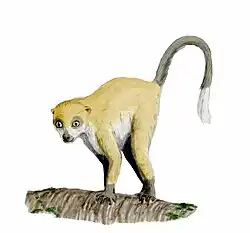
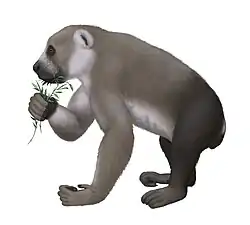
Hoanghonius
| Hoanghonius Intervalo temporal: Eoceno Médio
| |
|---|---|

| |
| Parátipo de mandíbula inferior (IVPP V10220) | |
Classificação científica 
| |
| Reino: | Animalia |
| Filo: | Chordata |
| Classe: | Mammalia |
| Ordem: | Primates |
| Subordem: | Strepsirrhini |
| Família: | †Sivaladapidae |
| Gênero: | †Hoanghonius Zdansky, 1930 |
| Espécies: | †H. stehlini
|
| Nome binomial | |
| †Hoanghonius stehlini Zdansky, 1930
| |
Hoanghonius é um género extinto de primatas adapiformes, que viveu no eoceno médio. O género é representado por uma espécie: Hoanghonius stehlini, encontrada na Formação Heti, China.[1]
Referências
Bibliografia
- Bearda, K. C., L. Marivaux, Soe Thura Tun, Aung Naing Soe, Y. Chaimanee, W. Htoon, B. Marandat, Htun Htun Aung, and J.-J. Jaegeri (2007).New Sivaladapid Primates from the Eocene Pondaung Formation of Myanmar and the Anthropoid Status of Amphipithecidae. Bulletin of Carnegie Museum of Natural History 39 :67-76. 2007
- Chaimanee, Y., Yamee, C., Tian, P., Chavasseau, O. & Jaeger, J.-J. Jaeger (2007). First middle Miocene sivaladapid primate from Thailand. Journal of Human Evolution, Novembro de 2007.
- Marivaux, L., Welcomme, J-L., Ducrocq, S. & Jaeger, J.-J. (2002). Oligocene sivaladapid primate from the Bugti Hills (Balochistan, Pakistan) bridges the gap between Eocene and Miocene adapiform communities in Southern Asia. Journal of Human Evolution, Volume 42, 4, Abril de 2002, pgs 379-388
- Gebo, D.L. (2002). «Adapiformes: Phylogeny and adaptation». In: Hartwig, W.C. The Primate Fossil Record. [S.l.]: Cambridge University Press. ISBN 978-0-521-08141-2. OCLC 47254191
| |||||||||||||||||||||||||||||||||||||
| |||||||||||||||||||||||||||||||||||||
| |||||||||||||||||||||||||||||||||||||