Dusios
Na língua gaulesa, Dusios[1] foi um ser divino[2] entre os celtas continentais,[3] identificado com o deus Pã da religião grega antiga e com os deuses Fauno, Ínuo, Silvano, e Íncubo da religião romana antiga. Como essas divindades, ele[4] pode ser visto como de natureza múltipla,[5] e referido no plural (dusioi), mais comumente em latim como dusii. Embora o Dusios celta não seja descrito em fontes da antiguidade tardia independentemente das divindades gregas e romanas, a funcionalidade comum dos outros residia na sua capacidade de engravidar animais e mulheres, muitas vezes de surpresa ou à força. Os Dusii continuam a desempenhar um papel nos sistemas de crenças mágico-religiosos da Gália e da Frância como um tipo de íncubo no paganismo e no cristianismo do início da Idade Média.
Em Agostinho e Isidoro
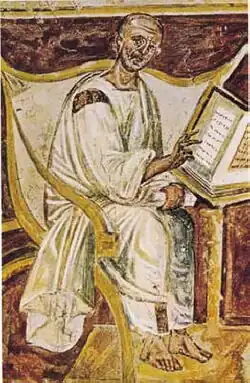
Referências aos dusii aparecem nos escritos dos Padres da Igreja, onde são tratados como demônios.[6] Os primeiros escritores cristãos ainda consideravam as religiões tradicionais da antiguidade como poderosos sistemas de crenças concorrentes. Em vez de negar a existência de deuses rivais, frequentemente buscavam demonstrar sua natureza inferior por meio de argumentos teológicos, ridículo, ou demonização.[7] Santo Agostinho menciona os dusii em uma passagem que critica a crença de que, no início da história da humanidade, anjos pudessem ter relações sexuais com mulheres mortais, gerando a raça de gigantes ou heróis. Agostinho redefine as crenças tradicionais dentro de uma estrutura cristã e, nessa passagem, não faz uma distinção clara entre a natureza essencial dos anjos e dos demônios:[8]
Frequentemente se ouve falar, cuja confiabilidade não deve ser questionada, pois é confirmada por diversas pessoas que sabem por experiência própria ou alheia, que Silvani e Pans, comumente chamados de íncubos, frequentemente apareciam para as mulheres como homens perversos, tentando dormir com elas e conseguindo. Esses mesmos demônios, a quem os gauleses chamam de Dusii, estão implacavelmente comprometidos com essa corrupção, tentando e conseguindo tantas coisas desse tipo que negá-las pareceria descarado. Com base nisso, não ouso arriscar uma afirmação definitiva sobre se pode haver alguns espíritos, de substância aérea (pois essa substância, quando posta em movimento por um leque, é percebida como sensação dentro do corpo e como tato), que tomam forma corporal e até mesmo experimentam esse desejo sexual, de modo que, por quaisquer meios possíveis, eles se misturam sensualmente com as mulheres. Mas os santos anjos de Deus não caíram de maneira semelhante durante aquela era — que eu acreditaria.[9]
Isidoro de Sevilha ecoa de perto Agostinho, mas expande as identificações com outras figuras divinas:
Os 'peludos' (pilosi)[10] são chamados em grego de Pans, em latim de Incubi, ou Inui por causa de sua entrada (ineundo) com animais por toda parte.[11] Por isso também os Incubi são assim chamados porque o sexo ilícito[12] é incumbente sobre eles.[13] Pois muitas vezes os perversos também se apresentam às mulheres e conseguem dormir com elas. Os gauleses chamam esses demônios de Dusii, porque seduzem[14] implacavelmente.[15]
Isidoro parece estar tentando derivar dusius do advérbio adsidue, "persistentemente, diligentemente, constantemente". A palavra pode estar relacionada ao escandinavo Tusse, "fada".[16] Mais provavelmente, está relacionado a um campo semântico de palavras indo-europeias, algumas significando "fantasma, vapor", como por exemplo o lituano dvãse, "espírito, fantasma"[17] e dùsas, "vapor"; e outras significando "fúria" (Irlandês Antigo, dás-, "estar furioso"), particularmente no sentido divino, como o grego thuia, "bacante" e o latim furiae (as Fúrias). Também é possível, mas menos provável, que a palavra seja uma nominalização do prefixo gaulês dus-, "mau" (cf. grego dys-).[18] Whitley Stokes conectou o dusii ao eslavo dusi ("espíritos"), dusa ("alma"), dusmus ("diabo").[19] A palavra bretã duz, um tipo de fada, goblin, ou changeling, é derivada por muitos estudiosos de dusios.[20] Duz às vezes é citado como a origem de deuce como um nome para "diabo" na expressão "What the Deuce!".[21]
Associações agrícolas
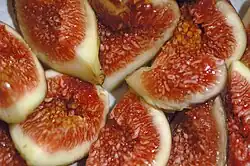
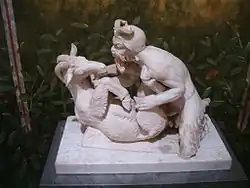
O lexicógrafo Papias, escrevendo na década de 1040, diz que os Dusii são aqueles a quem os romanos chamam de Fauni ficarii.[22] O adjetivo ficarius vem de ficus, "figo", e é aplicado a Fauno com frequência suficiente para sugerir um epíteto divino. "Figo" pode se referir ao poder de frutificação do deus,[23] ou pode ser uma referência obscena aos hábitos bem conhecidos dos faunos de penetração aleatória[24] (veja também Ínuo), já que "figo" era uma gíria grega para "ânus" e uma gíria latina para "ânus dolorido"[25] e mais tarde "vagina".[26] Um ritual de fertilidade envolvendo galhos e seiva da figueira macho era realizado por matronas romanas para Juno Caprotina, mais tarde identificada com Juno Sóspita, que vestia pele de cabra.[27]
Plínio observa que o figo selvagem (chamado caprificus, "figo-cabra, caprifigo", porque era alimento para cabras) gera "moscas" ou vespas-do-figo chamadas ficarii (ficarios culices caprificus generat).[28] O adjetivo ficarius caracteriza os "faunos-figos" e seus equivalentes, os dusii, por seus atos seriais e dispersos de fertilização.[29]
Na Vida de São Ricardo, do século VIII, dusii hemaones ou dusii manes[30] também ocorrem em ambientes hortícolas. Ricardo, nascido por volta de 560 em Amiens, Picardia, foi convertido ao cristianismo por missionários galeses. Sua vita registra uma crença entre seus companheiros picardos no norte da Gália de que os dusi, chamados de maones em algumas recensões, roubam colheitas e danificam pomares.[31] Esses seres perigosos para a agricultura aparecem em outros autores medievais como Mavones, maones, manes e "Magonianos", sendo estes últimos invasores aéreos de plantações de uma terra mítica localizada nas nuvens.[32]
É pouco evidente como os dusii poderiam ser uma forma sobrevivente dos Manes romanos, deuses infernais que eram sombras dos mortos, ou serem considerados piratas aéreos. Isidoro oferece uma pista quando diz que os manes são deuses dos mortos, mas seu poder está localizado entre a Lua e a Terra, a mesma região de nuvens por onde os magonianos viajavam.[33] Essa existência aérea lembra a caracterização dos Dusii feita por Agostinho como "aéreos em substância" e aponta para as "histórias" arturianas envolvendo incubi daemones, "criaturas que misturam o angelical e o demoníaco, habitando o espaço incerto entre o sol e a lua". Narrativas de romances medievais sugerem que as mulheres fantasiam sobre esses encontros sexuais, embora uma visitação provavelmente seja representada por autores homens como assustadora, violenta, e diabólica.[34]
Tradição sobrevivente
Dusii estão entre as influências sobrenaturais e práticas mágicas que ameaçam os casamentos, como observado por Incmaro em seu tratado do século IX, De divortio Lotharii ("Sobre o divórcio de Lotário"): "Certas mulheres foram encontradas se submetendo a dormir com Dusii na forma de homens que estavam ardendo de amor."[35] Na mesma passagem, Incmaro alerta sobre feiticeiras (sorciariae), bruxas (strigae), vampiras (lamiae) e magia na forma de "objetos enfeitiçados por feitiços, compostos de ossos de mortos, cinzas e brasas mortas, cabelos retirados da cabeça e da área púbica de homens e mulheres, pequenos fios multicoloridos, várias ervas, conchas de caracóis e pedaços de cobra".[36]

A forma Dusiolus, um diminutivo, aparece em um sermão com os seres aquatiquus (de aqua, "água") e Geniscus, possivelmente uma forma do Gênio romano ou do gaulês Genius Cucullatus, cuja forma encapuzada sugeria ou representava um falo.[37] De acordo com os "camponeses" (rustici homines), estes e as bruxas (striae) ameaçam crianças e gado.[38]
Gervásio de Tilbury (ca. 1150-1228) aborda os dusii em seu capítulo sobre lâmias e "larvas noturnas". Embora se baseie diretamente em Agostinho, chamando os dusii de íncubos e comparando-os a Silvanos e Pans, ele os considera sexualmente ameaçadores tanto para homens quanto para mulheres.[39]
O dusios funde-se posteriormente com o conceito do homem selvagem; ainda no século XIII, Thomas Cantipratensis afirmava que os dusii ainda eram uma parte ativa da prática e crença do culto. Em sua alegoria sobre as abelhas,[40] Thomas declara que "vemos as muitas obras do demônio Dusii, e é para elas que o povo costumava consagrar os bosques cultivados da antiguidade". O povo da Prússia ainda acredita que as florestas são consagradas a eles; eles não ousam cortá-las e nunca colocam os pés nelas, exceto quando desejam fazer sacrifícios aos seus próprios deuses".[41] No século XVII, Johannes Praetorius conjecturou de forma bastante descontrolada que dusios deveria ser drusios, conectado ao deus Silvano e às florestas e à palavra "druida".[42] O folclorista irlandês do século XIX, Thomas Crofton Croker, pensava que os dusii eram uma forma de espíritos da floresta ou domésticos e trata deles em um capítulo sobre elfos.[43]
Referências
- ↑ Xavier Delamarre, Dictionnaire de la langue gauloise (Éditions Errance, 2003), p. 158. The Latinized form would be dusius, most often in the plural dusii.
- ↑ Perhaps a deus. As late as the 13th century, Thomas Cantipratensis asserted that some people still regard groves as consecrated to dusii and entered them to sacrifice to "their own gods" (suis diis, dative plural of deus); see discussion under Surviving tradition below. The 19th-century Celiticist Henri d'Arbois de Jubainville regarded the dusii as divinities who might be compared to aquatic deities of the Homeric tradition in Greece as lovers who begat children with mortal women; see "Esus, Tarvos trigaranus," Revue Celtique 19 (1898), pp. 228, 234–235, 251 online. With reference to a highly speculative etymological connection between dusios and the English word "dizzy," Arbois de Jubainville saw the effects of these spirits as comparable to those of the Greek nymphs or Italic lymphae. J.A. MacCulloch, The Religion of the Ancient Celts (Forgotten Books edition 2007, originally pub. 1911), p. 232 online thought that the dusii "do not appear to represent the higher gods reduced to the form of demons by Christianity, but rather a species of lesser divinities, once the object of popular devotion."
- ↑ Galli as designated by Augustine and Isidore (see following). In antiquity, Galli refers both to inhabitants of the geographical region Gallia as it was delineated by the Greeks and Romans, and to peoples who spoke a form of Celtic (that is, who spoke gallice, "in Gaulish") or who were perceived by the Greeks and Romans as ethnically "Celtic." See J.H.C. Williams, Beyond the Rubicon: Romans and Gauls in Republican Italy (Oxford University Press, 2001), pp. 1–17 et passim.
- ↑ Both ancient Greek and Latin categorize nouns within three grammatical genders: masculine, feminine, and neuter. Although grammatical gender is distinguished from biological gender, Latin places humans (homines), animals (animalia), and anthropomorphic beings perceived as having sexual characteristics in their gender-specific category. Some "monsters" are neuter (the sea monster ketos in Greek, for instance). The dusii are masculine in both grammatical gender and in their sexual behavior in all the sources in which they appear, with the possible exception of Gervase of Tilbury, who seems to think they can also be female; see below. The Greco-Roman deities to whom they are compared are aggressively masculine, often depicted as ithyphallic.
- ↑ The multiplicity of the group of deities to which the dusii belong — Pan/panes, Faunus/fauni, Inuus/inui, Silvanus/silvani, Incubus/incubi — is related to the question of monotheistic tendencies in ancient religion: "Lower gods were executors or manifestations of the divine will rather than independent principles of reality. Whether they are called gods, demons, angels, or numina, these immortal beings are emanations of the One": Michele Renee Salzman, "Religious koine in Private Cult and Ritual: Shared Religious Traditions in Roman Religion in the First Half of the Fourth Century CE," in A Companion to Roman Religion (Blackwell, 2007), p. 113. The name of Pan was sometimes etymologized as meaning "All"; although scientific linguistics has shown this derivation to be incorrect, it appears in the Homeric Hymn to Pan (6th century BC) and influenced theological interpretations in antiquity, including the speculations of Plato: see H.J. Rose and Robin Hard, The Routledge Handbook of Greek Mythology (Routledge, 2004), p. 215 online, and David Sedley, Plato's Cratylus (Cambridge University Press) pp. 96–97 online, where Pan as "all" is connected to the logos: "This is the climax of the divine etymologies." The "all-ness" of Pan accounted for his multiple manifestations, reflected by nominal plurals. On the distinction between modern scientific and ancient theological etymology, see Davide Del Bello, Forgotten Paths: Etymology and the Allegorical Mindset (Catholic University of America Press, 2007).
- ↑ For further discussion, see Christianity and Paganism.
- ↑ For an extended discussion, see Carlos A. Contreras, "Christian Views of Paganism," Aufstieg und Niedergang der römischen Welt II.23.1 (1980) 974–1022, noting, for instance, the Church Fathers' habit of "applying Christian conceptions to pagan ideas in order to condemn them" (p. 1010 online). "Our knowledge of such things comes from Christian writers who are openly concerned to discredit all aspects of pagan idolatry," states Peter Stewart, Statues in Roman Society: Representation and Response (Oxford University Press, 2003), p. 266, note 24 online.
- ↑ Corinne J. Saunders, "'Symtyme the fende': Questions of Rape in Sir Gowther," in Studies in English Language and Literature. 'Doubt Wisely': Papers in Honour of E.G. Stanley (Routledge, 1996), p. 296 online.
- ↑ Augustine of Hippo, De civitate Dei 15.23: Et quoniam creberrima fama est multique se expertos uel ab eis, qui experti essent, de quorum fide dubitandum non esset, audisse confirmant, Siluanos et Panes, quos uulgo incubos uocant, inprobos saepe extitisse mulieribus et earum appetisse ac peregisse concubitum; et quosdam daemones, quos Dusios Galli nuncupant, adsidue hanc inmunditiam et temptare et efficere, plures talesque adseuerant, ut hoc negare inpudentiae uideatur: non hinc aliquid audeo definire, utrum aliqui spiritus elemento aerio corporati (nam hoc elementum etiam cum agitatur flabello sensu corporis tactuque sentitur) possint hanc etiam pati libidinem, ut, quo modo possunt, sentientibus feminis misceantur. Dei tamen angelos sanctos nullo modo illo tempore sic labi potuisse crediderim; for an alternative English translation by Marcus Dods, from Nicene and Post-Nicene Fathers, first series, vol. 2 (Buffalo, NY: Christian Literature Publishing Co., 1887), revised and edited by Kevin Knight, see New Advent.
- ↑ For a discussion of "hairy demons", in early sources sometimes translated as satyrs, see Unclean spirit.
- ↑ "Everywhere" = Latin passim; as with the theological interpretation of Pan's name as "All," the ubiquity of this type of divinity is emphasized.
- ↑ Latin stuprandum, gerund from stupro, stuprare, refers to illicit sexual activity, including adultery and other sex outside marriage, participation in which renders the woman impure; consent is not at issue. The word is not a synonym for "rape," but does not exclude forced sex; Oxford Latin Dictionary (Oxford: Clarendon Press, 1982, 1985 reprinting), entries on stuprum (noun) and stupro (verb), p. 1832. See also discussion by Elaine Fantham, "Stuprum: Public Attitudes and Penalties for Sexual Offences in Republican Rome," in Roman Readings: Roman Response to Greek Literature from Plautus to Statius and Quintilian (Walter de Gruyter, 2011); and Victoria Emma Pagán, Conspiracy Narratives in Roman History (University of Texas Press, 2004), p. 58 online, where the penetration of the male as an act of stuprum is an emphasis.
- ↑ A literal translation fails to capture the etymological echoes of incubi and incumbendo: "Hence also the Incubi are named from 'lying on,' that is, from having wrongful sex."
- ↑ Again Isidore's etymological echoes between Dusios and adsidue are lost in a literal translation; "because they relentlessly achieve this defilement."
- ↑ Isidore of Seville, Etymologiae 8.11.103: Pilosi, qui Graece Panitae, Latine Incubi appellantur, sive Inui ab ineundo passim cum animalibus. Unde et Incubi dicuntur ab incumbendo, hoc est stuprando. Saepe enim inprobi existunt etiam mulieribus, et earum peragunt concubitum: quos daemones Galli Dusios vocant, quia adsidue hanc peragunt immunditiam; Katherine Nell MacFarlane, "Isidore of Seville on the Pagan Gods (Origines VIII. 11)," Transactions of the American Philosophical Society 70 (1980), pp. 36–37.
- ↑ MacFarlane, "Isidore of Seville on the Pagan Gods," p. 37.
- ↑ Ken Dowden, European Paganism: The Realities of Cult from Antiquity to the Middle Ages (Routledge, 2000), p. 306, note 57, finds the Lithuanian only "coincidentally similar," contra Delamarre following.
- ↑ Delamarre, entry on dusios, Dictionnaire de la langue gauloise, p. 158.
- ↑ Whitley Stokes, Transactions of the Philological Society (1867), p. 261, as cited by A. Smythe Palmer, Folk-Etymology, A Dictionary (London, 1882), p. 623. Additional etymological conjecture not necessarily premised on modern scientific linguistics include George Henderson, Survivals in Belief among the Celts (1911), p. 46; Charles Godfrey Leland, Etruscan Roman Remains in Popular Tradition pp. 126–129, with amusing anecdotes.
- ↑ Dowden, European Paganism, p. 306, note 57; Édouard Le Héricher, Glossaire etymologique Anglo-Normand (Paris, 1884), p. 43 online.
- ↑ Palmer, Folk-Etymology, p. 623; Henderson, Survivals in Belief, p. 73.
- ↑ Papias, Elementarium: Dusios nominant quos romani Faunos ficarios vocant, as quoted by Du Cange in his 1678 Glossarium mediae et infimae latinitatis (Niort: Favre, 1883–1887), vol. 3, online.
- ↑ Katherine Nell MacFarlane, "Isidore of Seville on the Pagan Gods," p. 36, citing W.F. Otto's entry on Faunus in PW.
- ↑ Egidio Forcellini, Totius latinitatis lexicon (1831), vol. 2, p. 287.
- ↑ Ficus was a medical term for hemorrhoids or anal sores, but the imperial-era poet Martial makes jokes that depend on understanding the sore anus as resulting from too much penetration (for example, 12.96ff.); see Adams, Sexual Vocabulary following.
- ↑ J.N. Adams, The Latin Sexual Vocabulary (Johns Hopkins University Press, 1982). p. 113.
- ↑ Sarolta A. Takács, Vestal Virgins, Sibyls, and Matrons: Women in Roman Religion (University of Texas Press, 2008), pp. 51–53.
- ↑ Pliny, Natural History 11.41.
- ↑ MacFarlane, "Isidore of Seville on the Pagan Gods," p. 36. For the dual meanings of ficarius, see also Forcellini's Lexicon online and Du Cange's Glossarium online. The fauni ficarii are adduced in the entry on the adjective unfæle, "evil, bad," in An Anglo-Saxon Dictionary Based on the Manuscript Collections of the Late Joseph Bosworth, edited by T. Northcote Toller (Oxford: Clarendon Press, 1882), p. 1103 online, citing Thomas Wright's privately published Vocabularies (1857), p. 17, gloss 20 (unfæle men, wudewásan, unfæle wihtu) and p. 60, glosses 23–24. In listing ficarii or inuii (for inui, plural of Inuus) with the Anglo-Saxon gloss wudewasan (woodwose), following (due to a probable transposition error with the previous Satyri or fauni, glossed as unfæle men), Wright notes that the entry "furnishes us with a very curious and instructive example of the long preservation of words connected with popular superstitions": "Supplement to Alfric's Vocabulary of the Tenth or Eleventh Century," p. 188 online. Among the interests evidenced in this particular vocabulary are "a few words connected with the ancient religious belief" (p. 168). Discursive treatment of this group of beings, including the dusii, with remarks on the meaning of "fig," in Richard Payne Knight's "On the Worship of the Generative Powers During the Middle Ages of Western Europe" in Two Essays on the Worship of Priapus (London, 1865), pp. 149–153 online, a work that should be consulted with an awareness of the biases and preoccupations of its own era.
- ↑ In other recensions, the dusi(i) appear as maones, which may be equivalent to manes.
- ↑ Vita Richarii I, 2, MGH SRM 7, 445, as cited by Bernadotte Filotas, Pagan Survivals, Superstitions and Popular Cultures in Early Medieval Pastoral Literature (Pontifical Institute of Mediaeval Studies, 2005), p. 80.
- ↑ Filotas, Pagan Survivals, pp. 80–81.
- ↑ Pagan Survivals pp. 80–81, noting that "unknown peculiarities of Iberoceltic or Visigothic belief brought into Gaul by Spaniards fleeing the Moorish onslaught may lie behind such tales," and pp. 220, 272–273.
- ↑ Corinne J. Saunders, "'Symtyme the fende': Questions of Rape in Sir Gowther," in Studies in English Language and Literature. 'Doubt Wisely': Papers in Honour of E.G. Stanley (Routledge, 1996), pp. 295–296 online et passim. Legendary heroes were sometimes thought to have been begotten by such encounters; Henderson, Survivals in Belief, p. 73.
- ↑ Quaedam etiam faeminae a Dusis in specie virorum, quorum amore ardebant, concubitum pertulisse inventae sunt: De divortio, XV Interrogatio, MGH Concilia 4 Supplementum, 205, as cited by Filotas, Pagan Survivals, p. 305.
- ↑ Filotas, Pagan Survivals, p. 305.
- ↑ Although characteristic of Gaul, these figures also appear elsewhere in the Roman Empire. See, for instance, the bronze lamp in the form of a phallic cucullatus described by Clairève Grandjouan, "Terracottas and Plastic Lamps of the Roman Period," in The Athenian Agora 6 (1961), p. 72, and two examples described as "negroid" pp. 80–81. See also Telesphoros.
- ↑ Filotas, Pagan Survivals, pp. 78–79; Sunt aliqui rustici homines, qui credunt aliquas mulieres, quod vulgum dicitur strias esse debeant, et ad infantes vel pecora nocere possint, vel Dusiolus, vel aquatiquus, vel geniscus esse debeat, cited by Du Cange as Homel. ex Cod. reg. 5600. fol. 101. See also Mythology in the Low Countries.
- ↑ Gervase of Tilbury, Otia Imperialia, tertia decisio LXXXVI, p. 41 in the edition of Liebrecht online.
- ↑ On the dusii as fig wasps, see above.
- ↑ Dusiorum daemonum opera multa percepimus, et hi sunt quibus gentiles lucos plantatos antiquitus consecrabant. his adhuc Prussiae gentiles silvas aestimant consecratas et eas incidere non audentes, numquam ingrediuntur easdem, nisi cum in eis diis suis voluerint immolare; cited by Du Cange as Thomas Cantipratensis, Bonum universale de apibus lib. 2 cap. 57 n. 17. Passage quoted and discussed by J.W. Wolf, "Lichtelben," Beiträge zur deutschen mythologie (Göttingen, 1852), p. 279. See also Dowden, European Paganism, p. 109.
- ↑ Johannes Praetorius, Blockes-Berges Verrichtung (1668),[1] as cited by Leland, Etruscan Roman Remains, pp. 128–129.
- ↑ Thomas Crofton Croker, Fairy Legends and Traditions of the South of Ireland (London, 1828), p. 127.