Dialeto albanês cham
| Cham Çamërisht | ||
|---|---|---|
| Falado(a) em: |  Albânia Albânia Grécia Grécia | |
| Região: | Chameria | |
| Total de falantes: | — | |
| Família: | Línguas indo-europeias Albanoide Língua albanesa Tosk Cham | |
| Escrita: | ||
| Códigos de língua | ||
| ISO 639-1: | --
| |
| ISO 639-2: | --- | |
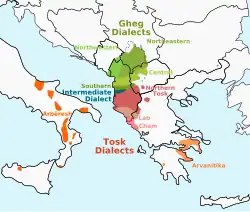 Distribuição de dialetos da língua albanesa | ||
O Dialeto Albanês Cham (em albanês: Çamërisht ou Dialekti çam), também chamado de Cham Tosk ou Arvanitika,[1][nota 1] é o dialeto da língua albanesa falado pelos albaneses Cham, um subgrupo étnico albanês nativo da região da Chameria, no sul da Albânia e noroeste da Grécia.
História
Albaneses na região do Epiro são atestados em fontes históricas desde o início do século XIII. Um documento veneziano (1210) menciona que "o continente voltado para a ilha de Corfu é habitado por albaneses" e uma carta de João Apokaukos, Metropolita de Naupaktos, a George Dysipati (ancestral da família Shpata).[2] Tribos albanesas se mudaram para o sul em grande número no início do século XIV e estabeleceram territórios como o Despotado de Arta.[3]
Durante grande parte do período otomano, a maior parte da escrita em Chameria era feita em grego ou turco, e o albanês Cham era um dialeto falado apenas, enquanto os albaneses achavam difícil encontrar educação em sua língua nativa. Os albaneses cristãos podiam frequentar escolas gregas e os albaneses muçulmanos escolas turcas, mas as escolas de língua albanesa eram altamente desencorajadas.[4] Os sentimentos nacionalistas durante o final da era otomana eram fracos na região, com os albaneses muçulmanos Chams se referindo a si mesmos como Myslyman (muçulmanos) ou turcos, enquanto os cristãos ortodoxos locais de língua albanesa se referiam a si mesmos como Kaur (ou seja, infiéis) e não achavam o termo ofensivo.[5] Durante o Despertar Nacional Albanês, vários albaneses locais estabeleceriam escolas privadas de língua albanesa não reconhecidas. Em 1870, o déspota de Paramítia, Grygorios, traduziu o Novo Testamento para o albanês, pois seus seguidores não entendiam bem a língua grega.[6] Enquanto isso, em 1879, a primeira escola albanesa da região foi criada em Sagiada pelo padre Stathi Melani. Naquela época, a região estava sob o breve governo da Liga de Prizren.[7]

A expulsão dos albaneses cham após a Segunda Guerra Mundial foi um evento traumático que pressionou o dialeto cham e, por fim, tanto na Grécia quanto na Albânia, os chams foram pressionados a abandonar seu dialeto em favor do grego padrão e do albanês padrão, respectivamente.
Características
O albanês cham faz parte do albanês tosk e é a segunda variedade mais meridional da língua albanesa, sendo a outra a arvanitika, que também faz parte do albanês tosk. Como tal, o arvanitika e o dialeto cham mantêm uma série de características comuns.[8] Portanto, também está intimamente relacionado ao Arbëresh e ao lab.
O dialeto foi afetado pelo contato linguístico dos dialetos gregos próximos muito mais do que qualquer outro dialeto albanês adjacente.[9]
Conservadorismo linguístico
Linguistas afirmam que o dialeto Cham possui um caráter conservador, devido à proximidade e aos contatos contínuos com a língua grega. Eles argumentam que esse caráter conservador, refletido em uma série de características peculiares do dialeto, está ameaçado, assim como os topônimos albaneses da região, que não são mais usados e que forneceram material valioso para pesquisas sobre a evolução histórica do albanês.[10]
Fonologia
Como Arvanitika no sul da Grécia e Arbëresh na Itália, o albanês Cham mantém algumas características conservadoras do albanês, como os antigos grupos consonantais /kl/, /gl/, que no albanês padrão são q e gj, e a retenção de /l/ em vez de /j/.[11]
| Albanês Cham | Albanês Padrão | Albanês Tosk | Arvanitika | Arberesh | Tradução |
|---|---|---|---|---|---|
| Klumësht | Qumësht | Qumësht | Kljumsht | Klumshit | "Leite" |
| Gluhë | Gjuhë | Gjuhë/Guhë | Gljuhë | Gluhë | "Linguagem", "língua" |
| Gola | Goja | Goja | Golja | Gojë | "Boca" |
Assim como o Lab, a língua Arbëresh e também os dialetos Gheg de Debar e Ulqin, o Cham desfaz o arredondamento do /y/ albanês para /i/. Ele também coloca o schwa ë (língua albanesa) na frente e o funde com o e — o oposto de certos dialetos Lab, que tendem a colocar o schwa atrás em /ʌ/ (como em "nut" em inglês).
Morfologia e sintaxe
As declinações de verbos e substantivos podem variar em Cham Albanês:
- O presente perfeito pode ser escrito de forma diferente para verbos reflexivos e se assemelha ao imperfeito: u kam bërë instead of jam bërë.
- Devido à preservação do "l" intervocálico, o morfema -je de alguns substantivos verbais é, em vez disso, -ele, então marrje pode ser pronunciado (arcaicamente) como marrele.
- A terminação -eshe também é substituída por -ele.
Fontes escritas
O primeiro livro em língua albanesa escrito na região de Chameria foi o dicionário grego-albanês de Markos Botsaris, um capitão suliota e figura proeminente da Guerra da Independência Grega. Este dicionário foi o maior dicionário albanês cham de sua época, com 1.484 lexemas.[12] De acordo com o albanólogo Robert Elsie, não possui nenhum significado literário específico, mas é importante para o nosso conhecimento do extinto dialeto suliota-albanês,[13] um sub-ramo do dialeto cham.[12] O dicionário está preservado na Bibliothèque Nationale de Paris.[13]
Durante o século XIX, Chams começou a criar bejtes, um novo tipo de poema, principalmente no sul da Albânia. O bejtexhi mais conhecido foi Muhamet Kyçyku (Çami), nascido em Konispol. Ele é o único poeta na Albânia que escreveu no dialeto Cham e aparentemente foi também o primeiro autor albanês a escrever poesia mais longa. A obra pela qual ele é mais lembrado é um conto romântico em verso conhecido como Erveheja (Ervehe), originalmente intitulado Ravda ("Jardim"), escrito por volta de 1820. Kyçyku é o primeiro poeta do Renascimento Nacional Albanês.[14]
Sociolinguística e sobrevivência
Onde os chams se concentram na Albânia moderna, o dialeto ainda pode ser forte, especialmente nas gerações mais velhas, embora seja cada vez mais influenciado pelo albanês padrão. Konispol e Markat são dois municípios tradicionalmente falantes de cham que ficam dentro das fronteiras da Albânia e, portanto, não sofreram a expulsão.
Na Grécia, enquanto isso, o albanês cham pode ser mantido pelas comunidades albanesas cham ortodoxas que não foram expulsas. De acordo com um estudo do projeto Euromosaic da União Europeia, comunidades de língua albanesa vivem ao longo da fronteira com a Albânia na prefeitura de Thesprotia, na parte norte da prefeitura de Preveza na região chamada Thesprotiko, e algumas aldeias na unidade regional de Ioannina.[8] O dialeto arvanita ainda é falado por uma minoria de habitantes em Igoumenitsa.[15] No norte da prefeitura de Preveza, essas comunidades também incluem a região de Fanari,[16] em aldeias como Ammoudia[17] e Agia.[18] Em 1978, alguns dos habitantes mais velhos nessas comunidades eram monolíngues albaneses.[19] A língua também é falada por jovens, porque quando a população local em idade ativa migra em busca de emprego em Atenas ou no exterior, as crianças ficam com os avós, criando assim uma continuidade de falantes.[19]
Hoje, essas comunidades ortodoxas de língua albanesa se referem a si mesmas como arvanitas na língua grega[20] e sua língua como Arvanitika, mas a chamam de Shqip enquanto falam albanês.[21][22] Em contraste com os arvanitas, alguns mantiveram uma identidade linguística[23] e étnica distinta.[24] Na presença de estrangeiros, há uma relutância maior entre os falantes ortodoxos de albanês em falar albanês, em comparação com os arvanitas em outras partes da Grécia.[25] Uma relutância também foi notada por aqueles que ainda se consideram Chams em se declararem como tal.[26] Pesquisadores como Tom Winnifirth, em estadias curtas na área, portanto, acharam difícil encontrar falantes de albanês em áreas urbanas[27] e concluíram nos anos posteriores que o albanês havia "praticamente desaparecido" na região.[28] De acordo com o Ethnologue, a população de língua albanesa do Épiro grego e da Macedônia Ocidental grega era de 10.000 em 2002.[1] De acordo com Miranda Vickers em 1999, os Chams Ortodoxos hoje são aproximadamente 40.000.[29]
See also
- Albaneses Cham
- Suliotas
- Albanês Tosk
- Arvanitika
Notas
- ↑ Na Grécia, o albanês cham é chamado de Arvanitika, que significa "albanês" em grego. É diferente do Arvanitika propriamente dito.
Bibliografia
- Baltsiotis, Lambros (2009). The Muslim Chams from their entry into the Greek state until the start of the Greco-Italian war (1913-1940): the story of a community from millet to nation [Οι μουσουλμάνοι Τσάμηδες από την είσοδό τους στο ελληνικό κράτος μέχρι την έναρξη του ελληνοϊταλικού πολέμου (1913-1940): η ιστορία μιας κοινότητας από το millet στο έθνος] (Tese). University of Panteion
- ↑ a b «Albanian, Tosk». Ethnologue. 2022
- ↑ Giakoumis, Konstantinos (2003). «Fourteenth-century Albanian migration and the 'relative autochthony' of the Albanians in Epeiros. The case of Gjirokastër». Byzantine and Modern Greek Studies. 27 (1): 176. doi:10.1179/byz.2003.27.1.171.
The presence of Albanians in the Epeirote lands from the beginning of the thirteenth century is also attested by two documentary sources: the first is a Venetian document of 1210, which states that the continent facing the island of Corfu is inhabited by Albanians;" and the second is letters of the Metropolitan of Naupaktos John Apokaukos to a certain George Dysipati, who was considered to be an ancestor of the famous Shpata family. Furthermore, I suggest that names that appear in two acts of the Angevins of Naples dated 130422 using the forms, Albos, Spatos, Catarucos, Bischesini, Aranitos, Lecenis, Turbaceos, Marchaseos, Scuras, Zeneuias, Bucceseos, Logoresc and Mateseos are either well-known, less-known or totally unknown names of Albanian clan leaders at that time. Are we obliged to see in this a possible earlier Albanian immigration in the Epeirote lands, as Kostas Komis did in the case of the etymology of the toponym Preveza'?" I believe that the use of hypothetical immigrations as a basis to interpret sources that indicate the presence of Albanians in the Epeirote lands prior to the thirteenth-fourteenth century is somewhat arbitrary. For it serves the concept of national purity in zones with clear lines of communication, mutual relations (as linguistic research has proved) and common traditions, religion as well as principal language of communication. It is evident that this was the case in a period when co-existence and understanding among people of different nations (in the modern sense of the term) were far better than they are today.
- ↑ Giakoumis 2003, pp. 177-178.
- ↑ Somel, Selçuk Akşin (2001). The Modernization of Public Education in the Ottoman Empire, 1839-1908: Islamization, Autocracy, and Discipline. Istanbul, Turkey: BRILL. p. 414. ISBN 9789004119031. Consultado em 18 de março de 2009
- ↑ Tsoutsoumpis: p. 122: "However, until the eve of the Balkan Wars and indeed long after the incorporation of the area in Greece national feeling was weak among the peasantry. "Although nationalist feeling might have been weak among the local peasantry, local societies were seldom free from strife."
- ↑ Mouselimis, Spyros (1976). Ιστορικοί περίπατοι ανά τη Θεσπρωτία (em grego). Thessaloniki, Greece: [s.n.] p. 128
- ↑ Anamali, Skënder and Prifti, Kristaq. Historia e popullit shqiptar në katër vëllime. Botimet Toena, 2002, ISBN 99927-1-622-3.
- ↑ a b L'étude Euromosaic. "L'arvanite/albanais en Grèce", 2006.
- ↑ Spyrou, Aristotelis (2008). «Foreign loanword in the Idioms of Saranda and Delvine Region». Albanohellenica. 3: 99
- ↑ Shkurtaj, Gjovalin. The Dialectological and Ethno-linguistic Values of the Language of Chameria, ISBN 99943-688-2-6, pp. 242-245.
- ↑ Shkurtaj, Gjovalin. The Dialectological and Ethno-linguistic Values of the Language of Chameria, ISBN 99943-688-2-6, pp. 242-245.
- ↑ a b Jochalas, Titos P. (1980). Το Ελληνο-αλβανικόν λεξικόν του Μάρκου Μπότσαρη : φιλολογική έκδοσις εκ του αυτογράφου [The Greek-Albanian dictionary of Markos Botsaris: filologhic edition of the original] (em grego). Athens, Greece: Academy of Athens
- ↑ a b Elsie, Robert (1986). Dictionary of Albanian Literature. London, UK: Greenwood Press. p. 17. ISBN 9780313251863. Consultado em 31 de março de 2009
- ↑ Elsie, Robert (2005). Centre for Albanian Studies, ed. Albanian Literature: A short history. London, UK: I.B.Tauris. p. 41. ISBN 9781845110314. Consultado em 31 de março de 2009
- ↑ Vickers, Miranda and Petiffer, James. The Albanian Question. I.B. Tauris, 2007, ISBN 1-86064-974-2, p. 238.
- ↑ Οδηγός Περιφέρειας Ηπείρου (10 December 2007). "Πρόσφυγες, Σαρακατσάνοι, Αρβανίτες Arquivado em 2015-04-18 no Wayback Machine". cultureportalweb. Retrieved 18-4-2015.
- ↑ Georgoulas, Sokratis D.(1964). Λαογραφική Μελέτη Αμμουδιάς Πρεβέζης Arquivado em 2013-11-27 no Wayback Machine. Κέντρων Ερεύνης της Ελληνικής Λαογραφίας. pp. 2, 15.
- ↑ Tsitsipis, Lukas (1981). Language change and language death in Albanian speech communities in Greece: A sociolinguistic study. (Thesis). University of Wisconsin. Ann Arbor. 124. "The Epirus Albanian speaking villages use a dialect of Tosk Albanian, and they are among the most isolated areas in Greece. In the Epiriotic village of Aghiá I was able to spot even a few monolingual Albanian speakers."
- ↑ a b Foss, Arthur (1978). Epirus. Botston, United States of America: Faber. p. 224. ISBN 9780571104888 "There are still many Greek Orthodox villagers in Threspotia who speak Albanian among themselves. They are scattered north from Paramithia to the Kalamas River and beyond, and westward to the Margariti Plain. Some of the older people can only speak Albanian, nor is the language dying out. As more and more couples in early married life travel away to Athens or Germany for work, their children remain at home and are brought up by their Albania-speaking grandparents. It is still sometimes possible to distinguish between Greek- and Albanian-speaking peasant women. Nearly all of them wear traditional black clothes with a black scarf round their neck heads. Greek-speaking women tie their scarves at the back of their necks, while those who speak primarily Albanian wear their scarves in a distinctive style fastened at the side of the head."
- ↑ Hart, Laurie Kain (1999). «Culture, Civilization, and Demarcation at the Northwest Borders of Greece». American Ethnologist. 26: 196. doi:10.1525/ae.1999.26.1.196. Consultado em 9 de setembro de 2017. Arquivado do original em 12 de novembro de 2014.
Speaking Albanian, for example, is not a predictor with respect to other matters of identity .. There are also long standing Christian Albanian (or Arvanitika speaking) communities both in Epirus and the Florina district of Macedonia with unquestioned identification with the Greek nation. .. The Tschamides were both Christians and Muslims by the late 18th century [in the 20th century, Cham applies to Muslim only]
Verifique o valor de|url-access=subscription(ajuda) - ↑ Moraitis, Thanassis. "publications as a researcher". thanassis moraitis: official website. Retrieved 18-4-2015. "Οι Αρβανίτες αυτοί είναι σε εδαφική συνέχεια με την Αλβανία, με την παρεμβολή του ελληνόφωνου Βούρκου (Vurg) εντός της Αλβανίας, και η Αλβανική που μιλιέται εκεί ακόμα, η Τσάμικη, είναι η νοτιότερη υποδιάλεκτος του κεντρικού κορμού της Αλβανικής, αλλά έμεινε ουσιαστικά εκτός του εθνικού χώρου όπου κωδικοποιήθηκε η Αλβανική ως επίσημη γλώσσα του κράτους..... Οι αλβανόφωνοι χριστιανοί θεωρούν τους εαυτούς τους Έλληνες. Στα Ελληνικά αποκαλούν τη γλώσσα τους «Αρβανίτικα», όπως εξ άλλου όλοι οι Αρβανίτες της Ελλάδας, στα Αρβανίτικα όμως την ονομάζουν «Σκιπ»"..... "The Albanian idiom still spoken there, Çamërisht, is the southernmost sub-dialect of the main body of the Albanian language, but has remained outside the national space where standard Albanian has been standardized as official language of the state..... Ethnic Albanophone Christians perceive themselves as national Greeks. When speaking Greek, members of this group call their idiom Arvanitic, just as all other Arvanites of Greece; yet, when conversing in their own idiom, they call it "Shqip"."
- ↑ Tsitsipis. Language change and language death. 1981. p. 2. "The term Shqip is generally used to refer to the language spoken in Albania. Shqip also appears in the speech of the few monolinguals in certain regions of Greek Epirus, north-western Greece, while the majority of the bilingual population in the Epirotic enclaves use the term Arvanitika to refer to the language when talking in Greek, and Shqip when talking in Albanian (see Çabej 1976:61-69, and Hamp 1972: 1626-1627 for the etymological observations and further references)."
- ↑ Baltsiotis. The Muslim Chams of Northwestern Greece. 2011 "The Albanian language, and the Christian population who spoke it- and still do- had to be concealed also, since the language was perceived as an additional threat to the Greekness of the land. It could only be used as a proof of their link with the Muslims, thus creating a continuum of non-Greekness."
- ↑ Banfi, Emanuele (6 de junho de 1994). Minorités linguistiques en Grèce: Langues cachées, idéologie nationale, religion. (em francês). Paris: Mercator Program Seminar. p. 27
- ↑ Adrian Ahmedaja (2004). "On the question of methods for studying ethnic minorities' music in the case of Greece's Arvanites and Alvanoi." in Ursula Hemetek (ed.). Manifold Identities: Studies on Music and Minorities. Cambridge Scholars Press. p. 59. "Among the Alvanoi the reluctance to declare themselves as Albanians and to speak to foreigners in Albanian was even stronger than among the Arvanites. I would like to mention just one example. After several attempts we managed to get the permission to record a wedding in Igoumenitsa. The participants were people from Mavrudi, a village near Igoumenitsa. They spoke to us only German or English, but to each other Albanian. There were many songs in Greek which I knew because they are sung on the other side of the border, in Albanian. I should say the same about a great part of the dance music. After a few hours, we heard a very well known bridal song in Albanian. When I asked some wedding guests what this kind of song was, they answered: You know, this is an old song in Albanian. There have been some Albanians in this area, but there aren’t any more, only some old people". Actually it was a young man singing the song, as can he heard in audio example 5.9. The lyrics are about the bride’s dance during the wedding. The bride (swallow" in the song) has to dance slowly — slowly as it can be understood in the title of the song Dallëndushe vogël-o, dale, dale (Small swallow, slow — slow) (CD 12)."
- ↑ Sarah Green (2005). Notes from the Balkans: Locating Marginality and Ambiguity on the Greek-Albanian border. Princeton University Press. pp. 74-75. "In short, there was a continual production of ambiguity in Epirus about these people, and an assertion that a final conclusion about the Tsamides was impossible. The few people I meet in Thesprotia who agreed that they were Tsamides were singularly reluctant to discuss anything to do with differences between themselves and anyone else. One older man said, ‘Who told you I’m a Tsamis? I’m no different from anyone else.’ That was as far as the conversation went. Another man, Having heard me speaking to some people in a Kafeneio in Thesprotia on the subject, followed me out of the shop as I left, to explain to me why people would not talk about Tsamides; he did not was to speak to me about it in the hearing of others: They had a bad reputation, you see. They were accused of being thieves and armatoloi. But you can see for yourself, there not much to live on around here. If some of them did act that way, it was because they had to, to survive. But there were good people too, you know; in any population, you get good people and bad people. My grandfather and my father after him were barrel makers, they were honest men. They made barrels for oil and tsipouro. I’m sorry that people have not been able to help you do your work. It’s just very difficult; it’s a difficult subject. This man went on to explain that his father was also involved in distilling tsipouro, and he proceeded to draw a still for me in my notebook, to explain the process of making this spirit. But he would not talk about any more about Tsamides and certainly never referred to himself as being Tsamis."
- ↑ Winnifrith, Tom (1995). "Southern Albania, Northern Epirus: Survey of a Disputed Ethnological Boundary." Society Farsharotu. Retrieved 18-4-2015. "I tried unsuccessfully in 1994 to find Albanian speakers in Filiates, Paramithia and Margariti. The coastal villages near Igoumenitsa have been turned into tourist resorts. There may be Albanian speakers in villages inland, but as in the case with the Albanian speakers in Attica and Boeotia the language is dying fast. It receives no kind of encouragement. Albanian speakers in Greece would of course be almost entirely Orthodox."
- ↑ Winnifrith, Tom (2002). Badlands, Borderlands: A History of Northern Epirus/Southern Albania. Duckworth. pp. 25-26, 53. "Some Orthodox speakers remained, but the language was not encouraged or even allowed, and by the end of the twentieth century it had virtually disappeared..... And so with spurious confidence Greek historians insist that the inscriptions prove that the Epirots of 360, given Greek names by their fathers and grandfathers at the turn of the century, prove the continuity of Greek speech in Southern Albania since their grandfathers whose names they might bear would have been living in the time of Thucydides. Try telling the same story to some present-day inhabitants of places like Margariti and Filiates in Southern Epirus. They have impeccable names, they speak only Greek, but their grandparents undoubtedly spoke Albanian."
- ↑ Miranda Vickers, The Albanians: A Modern History, I.B.Tauris, 1999, ISBN 978-1-86064-541-9