Deccanolestes
Deccanolestes
| |||||||||||
|---|---|---|---|---|---|---|---|---|---|---|---|
| Ocorrência: Maastrichtiano–Paleoceno | |||||||||||
| Classificação científica | |||||||||||
| |||||||||||
| Espécies | |||||||||||
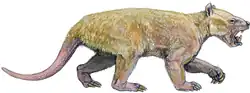
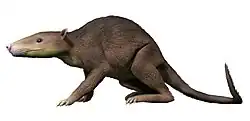
Deccanolestes é um Euarchonta basal e escansorial dos leitos intertrapeanos [en] do Cretáceo Superior (Maastrichtiano) e do Paleoceno de Andra Pradexe, na Índia. Pode ser aparentado a Sahnitherium [en]. Deccanolestes foi atribuído a Palaeoryctidae no passado, mas evidências recentes mostraram que ele é o Euarchonta mais basal,[1] o mais antigo Adapisoriculidae conhecido,[2] ou um afrothério basal.[3]
Espécies
Deccanolestes hislopi baseia-se em um primeiro molar superior isolado (VPL/JU/NKIM/10). Um terceiro molar, um terceiro pré-molar inferior, vários outros dentes isolados e alguns restos pós-cranianos foram-lhe atribuídos.[4]
Deccanolestes robustus baseia-se em um primeiro molar inferior isolado. Dentes isolados e alguns restos do tornozelo também lhe foram atribuídos.[5]
Deccanolestes narmadensis baseia-se em um molar posterior isolado.[6]
Juntamente com Bharattherium [en], Deccanolestes está entre os dois táxons de mamíferos que sobreviveram ao evento KT na Índia.[7]
Referências
- ↑ Boyer, Doug M.; Prasad, Guntupalli V. R.; Krause, David W.; Godinot, Marc; Goswami, Anjali; Verma, Omkar; Flynn, John J. (2010). «New postcrania of Deccanolestes from the Late Cretaceous of India and their bearing on the evolutionary and biogeographic history of euarchontan mammals». Naturwissenschaften. 97 (4): 365–77. Bibcode:2010NW.....97..365B. PMID 20130827. doi:10.1007/s00114-010-0648-0
- ↑ Smith, Thierry; Bast, Eric; Sigé, Bernard (2010). «Euarchontan affinity of Paleocene Afro-European adapisoriculid mammals and their origin in the late Cretaceous Deccan Traps of India». Naturwissenschaften. 97 (4): 417–22. Bibcode:2010NW.....97..417S. PMID 20174778. doi:10.1007/s00114-010-0651-5
- ↑ Erik R. Seiffert, The Oldest and Youngest Records of Afrosoricid Placentals from the Fayum Depression of Northern Egypt
- ↑ Prasad GVR, Sahni A (1988) First Cretaceous mammal from India. Nature 332:638–640.
- ↑ G. V. R. Prasad, J. J. Jaeger, A. Sahni, E. Gheerbrant, & C. K. Khajuria. 1994. Eutherian mammals from the Upper Cretaceous (Maastrichtian) inter-trappean beds of Naskal, Andhra Pradesh, India. Journal of Vertebrate Paleontology 14(2):260-277
- ↑ G. V. R. Prasad, O. Verma, E. Gheerbrant, A. Goswami, A. Khosla, V. Parmar, e A. Sahni. 2010. First mammal evidence from the Late Cretaceous of India for biotic dispersal between India and Africa at the KT transition. Comptes Rendus Palevol 9:63-71
- ↑ WILSON, Gregory P, NEW MAMMALIAN FOSSILS FROM THE INTERTRAPPEAN BEDS OF THE SOUTHERN PART OF THE DECCAN VOLCANIC PROVINCE AND THE CRETACEOUS–PALEOGENE TRANSITION IN INDIA, 27 de Outubro de 2016
| ||||||||||||||||||||||||||||||||||||||||||||||||||||||
| ||||||||||||||||||||||||||||||||||||||||||||||||||||||
.png)