Cyclolepis
Cyclolepis
Cyclolepis genistoides | |||||||||||||||||||||
|---|---|---|---|---|---|---|---|---|---|---|---|---|---|---|---|---|---|---|---|---|---|
| Classificação científica | |||||||||||||||||||||
| |||||||||||||||||||||
| Nome binomial | |||||||||||||||||||||
| Cyclolepis genistoides D.Don | |||||||||||||||||||||
| Sinónimos | |||||||||||||||||||||
| |||||||||||||||||||||
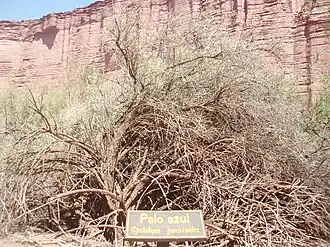
Cyclolepis é um género monotípico de plantas com flor pertencente à família Asteraceae,[2][3] cuja única espécie é Cyclolepis genistoides, nativa da América do Sul, onde ocorre na Argentina, Chile, Paraguai e, possivelmente, Bolívia.[4] O seu nome comum mais frequente é matorro negro.[5]
Descrição
A espécie Cyclolepis genistoides é um arbusto halófito dominante em alguns tipos de habitat salino, como o habitat costeiro de salinas próximo de Bahía Blanca[6][7] e nos salgadiços da região central da Argentina.[8]
Referências
- ↑ Cyclolepis genistoides in PlantList
- ↑ «Cyclolepis D. Don». Tropicos. Consultado em 23 de julho de 2019
- ↑ Tellería, M. C., et al. (2013). Pollen morphology and its taxonomic significance in the tribe Gochnatieae (Compositae, Gochnatioideae). Plant Systematics and Evolution 299(5), 935-48.
- ↑ Cyclolepis. Preliminary Checklist of the Compositae of Bolivia. Royal Botanic Gardens, Kew. Version 2, March 2011.
- ↑ «Cyclolepis». Agricultural Research Service (ARS), United States Department of Agriculture (USDA). Germplasm Resources Information Network (GRIN). Consultado em 25 janeiro 2018
- ↑ (em castelhano) Nebbia, A. J. and S. M. Zalba. (2007). Comunidades halófilas de la costa de la Bahía Blanca (Argentina): Caracterización, mapeo y cambios durante los últimos cincuenta años. Arquivado em 2018-05-06 no Wayback Machine Boletín de la Sociedad Argentina de Botánica 42(3-4), 261-71.
- ↑ Krüger, H. R. and N. Peinemann. (1996). Coastal plain halophytes and their relation to soil ionic composition. Vegetatio 122(2), 143-50.
- ↑ Cantero, J. J., et al. (1998). Environmental relationships of vegetation patterns in saltmarshes of central Argentina. Folia Geobotanica 33(2), 133-45.