Conquistas muçulmanas no subcontinente indiano
As conquistas muçulmanas no subcontinente indiano ocorreram principalmente entre os séculos XIII e XVIII, estabelecendo o chamado Período indo-muçulmano.[1] Incursões anteriores no subcontinente incluíram as invasões que começaram no noroeste (atual Paquistão), especialmente as Campanhas omíadas na Índia durante o século VIII. Mahmud de Ghazni, sultão do Império Ghaznavida, invadiu vastas partes do Punjab e Gujarate durante o século XI.[2] Após a queda de Lahore e o fim dos Ghaznavidas, o governante ghurida Maomé de Ghor estabeleceu as bases do domínio muçulmano na Índia em 1192. Em 1202, Muhammad Bakhtiyar Khalji liderou a conquista de Bengala, marcando a expansão islâmica mais a leste na época.
O Império Ghurida evoluiu para o Sultanato de Deli em 1206, sob Qutb ud-Din Aibak, fundador da Dinastia mameluca de Deli. Com o Sultanato estabelecido, o Islão espalhou-se pela maior parte do subcontinente indiano. No século XIV, a Dinastia Khalji, sob Alauddin Khalji, estendeu o domínio muçulmano para o sul até ao Gujarate, Rajastão e o Decão. A sucessora Dinastia Tughlaq expandiu temporariamente o seu alcance territorial até Tamil Nadu.[3] A desintegração do Sultanato de Deli, culminando na invasão de Tamerlão em 1398, permitiu o surgimento de diversos sultanatos regionais, como o Sultanato de Gujarate, Sultanato de Malwa, Sultanato Bahmani e o Sultanato de Bengala.[4] Alguns destes enfrentaram resistência e reconquistas por potências nativas, como o Império Vijayanagara[5] e os Estados Rajput sob o Reino de Mewar.
O Sultanato de Deli foi substituído pelo Império Mogol em 1526, um dos três impérios da pólvora. O imperador Akbar ampliou gradualmente o império, integrando súbditos não muçulmanos na burocracia e no exército. O zénite económico e territorial foi atingido no final do século XVII sob o reinado de Aurangzeb, com o estabelecimento da Sharia através da Fatawa al-Alamgir.
Os Mogóis entraram em declínio súbito após a morte de Aurangzeb em 1707, devido a sucessores incompetentes, às dispendiosas Guerras Mogol-Rajput e às Guerras Mogol-Maratha. A invasão de Nader Shah em 1739 demonstrou a fraqueza do império, permitindo que estados regionais como o Império Maratha, o Império Sikh e os Nizams de Hyderabad declarassem independência. O Império Maratha substituiu os Mogóis como potência dominante entre 1720 e 1818. As conquistas muçulmanas cessaram definitivamente após a Batalha de Plassey (1757) e as Guerras Anglo-Mysore, quando a Companhia Britânica das Índias Orientais assumiu o controlo, levando ao Raj Britânico até 1947.
Primeira fase (séculos VIII a X)
Presença muçulmana inicial
A primeira incursão árabe registada na Índia ocorreu por volta de 636/7 d.C., durante o Califado Rashidun, muito antes de qualquer exército árabe atingir a fronteira da Índia por terra.[6] Uthman ibn Abi al-As al-Thaqafi, o governador do Bahrein e Omã, despachou expedições navais contra a costa sassânida e, mais a leste, até às fronteiras da Índia, conforme confirmado pelo historiador arménio contemporâneo, Sebeos.[7] Uthman, por sua própria iniciativa e sem a sanção do Califa Umar, segundo a história de al-Baladhuri, também lançou dois ataques navais contra portos do subcontinente indiano; o primeiro destes ataques visou Thane[8] (uma pequena cidade perto de Bombaim) e Bharuch (uma cidade no Gujarate). O segundo ataque visou Debal (uma cidade perto de Karachi).[8][9][10]
O assalto a Thane, o primeiro ataque árabe registado na Índia, foi comandado pelo irmão de Uthman, al-Hakam, que também liderou o ataque a Bharuch.[11] O ataque seguinte a Debal foi comandado por outro irmão, al-Mughira.[12] Os ataques foram provavelmente lançados por volta de 636, de acordo com al-Baladhuri.[13] Estas expedições não foram autorizadas pelo Califa Umar e Uthman escapou à punição apenas porque não houve baixas.[14]
Os ataques a Thane e Bharuch podem ter sido bem-sucedidos, uma vez que os árabes não perderam homens, mas al-Baladhuri não afirma especificamente que foram vitórias, pelo que alguns estudiosos opinam que os ataques árabes podem ter sido fracassos[8][15] que forçaram os árabes a retirar.[16] O ataque a Debal pode ter ocorrido em 643 d.C. e tido sucesso, mas é improvável, pois Umar ainda era o Califa e era pouco provável que Uthman desobedecesse à sua diretiva sobre ataques marítimos.[8]
A motivação para estas expedições pode ter sido a busca de pilhagem ou o ataque a piratas para salvaguardar o comércio árabe no Mar Arábico, e não o início da conquista da Índia.[17] Pouco depois da Conquista muçulmana da Pérsia, a ligação entre o Sindh e o Islão foi estabelecida pelas missões muçulmanas iniciais durante o Califado Rashidun.[8]
Califado Rashidun e os reinos de fronteira
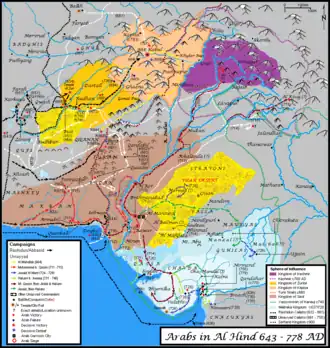
Os reinos de Kapisa-Gandhara no atual Afeganistão, Zabulistão e Sindh (que então detinha Makran) no atual Paquistão, todos culturalmente parte do subcontinente indiano desde os tempos antigos, eram conhecidos pelos árabes como "A Fronteira de Al Hind".[18] Makran tinha sido conquistado por Chach de Aror em 631 d.C., mas dez anos depois foi descrito como "sob o governo da Pérsia" por Xuanzang, que visitou a região em 641.[19]
O primeiro confronto entre um governante de um reino indiano e os árabes ocorreu em 643, quando as forças árabes derrotaram Rutbil, o Rei do Zabulistão, no Sistan.[20] Árabes liderados por Suhail b. Abdi derrotaram mais tarde um exército do Sindh na Batalha de Rasil em 644, na costa do Oceano Índico, atingindo o Rio Indo.[21] O Califa Umar ibn Al-Khattab negou a Suhail permissão para prosseguir através do rio. Al-Hakim ibn Jabalah al-Abdi, que atacou Makran no ano 649 d.C., era um partidário precoce de Ali ibn Abu Talib.[22]
Abdullah ibn Aamir liderou a invasão de Khurasan em 650 d.C., e o seu general Rabi b. Ziyad Al Harithi atacou o Sistan e tomou Zaranj em 651, enquanto Ahnaf ibn Qais conquistou os Heftalitas de Herat e avançou até Balkh por volta de 653. As conquistas árabes faziam agora fronteira com os reinos de Kapisa, Zabul e Sindh. Os árabes cobravam tributos anuais e, após deixarem guarnições de 4.000 homens em Merv e Zaranj, retiraram-se para o Iraque em vez de avançarem contra a fronteira da Índia.[23] O Califa Uthman b. Affan autorizou um ataque contra Makran em 652 e enviou uma missão de reconhecimento ao Sindh em 653. A missão descreveu Makran como inóspita, e o Califa Uthman proibiu novas incursões no subcontinente indiano.[24] Durante o califado de Ali, muitos hindus do Sindh ficaram sob a influência do Xiismo[25] e alguns participaram na Batalha do Camelo.
Sob os Omíadas (661–750 d.C.), muitos xiitas procuraram asilo na região do Sindh para viverem em paz relativa. Ziyad Hindi foi um desses refugiados.[26]
Expansão Omíada em Al Hind
Muawiya I estabeleceu o domínio Omíada após a Primeira Fitna em 661 d.C. e retomou a expansão. Al-Baladhuri escreveu que: "No ano 44 H. (664 d.C.), Muhallib, filho de Abu Safra, fez guerra na mesma fronteira e avançou até Banna (Bannu) e Alahwar (Lahore), que ficam entre Multan e Cabul."[27]
Após 663-665 d.C., os árabes lançaram uma invasão contra Kapisa, Zabul e o atual Baluchistão paquistanês. Abdur Rahman b. Samurra cercou Cabul em 663, enquanto Haris b Marrah avançou contra Kalat através do Passo de Bolan. O Rei Chach do Sindh enviou um exército contra os árabes; estes foram encurralados nos passos de montanha, Haris foi morto e o seu exército aniquilado. [carece de fontes] Al-Muhallab ibn Abi Sufra levou um destacamento pelo Passo Khyber em direção a Multan em 664 d.C. Turki Shah e Zunbil expulsaram os árabes dos seus respetivos reinos por volta de 670 d.C.
Este foi o início de uma luta prolongada entre os governantes de Cabul e Zabul contra os governadores árabes do Sistan e Makran. Os reis Kabul Shahi e os seus parentes Zunbil bloquearam com sucesso o acesso às rotas dos passos Khyber e Gomal para a Índia de 653 a 870 d.C.[28] Os árabes lançaram vários ataques, mas rebeliões repetidas no Sistan e Khurasan desviaram os seus recursos militares. A resistência feroz estagnou o progresso árabe na "zona de fronteira"[29][30] e os árabes tiveram de se focar na extração de tributos em vez da conquista sistemática.
Batalhas em Makran e Zabulistão
Os árabes lançaram várias campanhas no leste do Baluchistão entre 661 e 681 d.C. Quatro comandantes árabes foram mortos nestas campanhas; no entanto, Sinan b. Salma conseguiu conquistar partes de Makran e estabeleceu uma base permanente por volta de 673 d.C.[31] Zunbil repeliu as campanhas árabes de 668, 672 e 673 através do pagamento de tributo. Embora os árabes tenham ocupado áreas a sul de Helmand em 673 permanentemente, Zunbil derrotou o exército de Yazid b. Salm em 681 d.C. em Junzah, e os árabes tiveram de pagar 500.000 dirrãs de resgate pelos seus prisioneiros.[32]
Aqui tens a tradução e adaptação do restante conteúdo para o formato Wikitexto, mantendo a fidelidade às referências e à nomenclatura da Wikipédia em português:
Al-Hajjaj e o Oriente
Al-Hajjaj ibn Yusuf Al Thaqifi, que desempenhou um papel crucial durante a Segunda Fitna pela causa omíada, foi nomeado governador do Iraque em 694 d.C. Hajjaj recebeu o governo de Khurasan e Sistan em 697 e patrocinou a expansão muçulmana em Makran, Sistan, Transoxiana e Sindh.[33][34]
Campanhas em Makran e Zabul
O controlo árabe sobre Makran enfraqueceu quando rebeldes árabes tomaram a província, obrigando Hajjaj a enviar expedições sob três governadores entre 694 e 707 d.C. Hajjaj também lutou contra Zunbil em 698 e 700 d.C. O exército de 20.000 homens liderado por Ubaidullah ibn Abu Bakra foi encurralado pelas forças de Zunbil e Turki Shah perto de Cabul em 698 d.C., perdendo 15.000 homens devido à sede e à fome, o que rendeu a esta força o título de "Exército Condenado".[35] Abd al-Rahman ibn Muhammad ibn al-Ash'ath liderou em seguida o "Exército do Pavão", assim chamado pelo esplendor do seu equipamento. Após sucessos iniciais em 699 d.C., Ibn al-Ash'ath revoltou-se contra as exigências de Hajjaj. A mutinhagem foi suprimida em 704 d.C., e Hajjaj concedeu uma trégua de sete anos a Zunbil.
Expansão Omíada no Sind e Multan
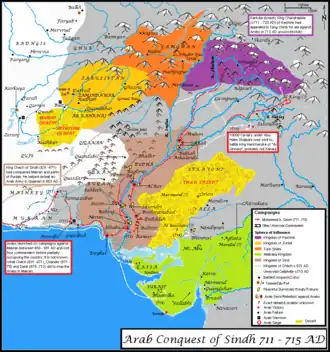
Piratas da tribo Meds, operando a partir de Kutch e Debal, raptaram mulheres muçulmanas que viajavam do Sri Lanka para a Arábia, fornecendo o casus belli[36] contra o Raja Dahir do Sindh. Hajjaj equipou um exército de 6.000 cavaleiros sírios e 6.000 camelos sob o comando do seu sobrinho, Muhammad bin Qasim.
Conquista do Sindh
Bin Qasim partiu de Xiraz em 710 d.C., marchando pela costa até Makran. Ele subjugou as cidades de Fannazbur e Armabil antes de tomar Debal através de um assalto com o uso de catapultas (manjaniks).[37] Os árabes avançaram para norte ao longo do Indo; cidades como Nerun e Sadusan (Sehwan) renderam-se pacificamente. Bin Qasim cruzou o Indo e derrotou o exército de Dahir, que foi morto em batalha.[38] Brahmanabad, Alor e finalmente Multan foram capturadas. Em 713 d.C., os árabes chegaram ao sopé da Caxemira. Após a morte do Califa Walid em 715, Bin Qasim foi deposto. Jai Singh, filho de Dahir, recapturou Brahmanabad, e o domínio árabe ficou restrito à margem ocidental do Indo.
Últimas campanhas omíadas em Al Hind
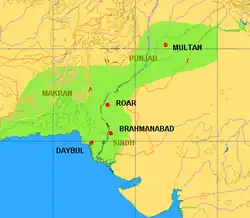
Junaid b. Abd Al Rahman Al Marri tornou-se governador em 723 d.C., reconquistando o Sindh e o sul do Punjab. Ele atacou vários reinos hindus no Rajastão e Gujarate,[39] mas os árabes foram derrotados por Bappa Rawal e Nagabhata I em 725 d.C. perto de Ujjain. Mais tarde, em 739 d.C., uma tentativa de invasão do Decão foi decisivamente travada em Navsari pelo vice-rei Pulakeshin do Império Chalukya. O domínio árabe permaneceu confinado a oeste do deserto de Thar.
Últimos dias do controlo do Califado Abássida
Com a Revolução Abássida em 750 d.C., o Sindh tornou-se independente por um breve período até ser capturado por Musa b. K'ab al Tamimi em 752 d.C.[40] O governador abássida Hisham (768–773) realizou incursões na Caxemira e ataques navais no Gujarate, mas sem ganhos territoriais permanentes. Por volta de 871 d.C., surgiram cinco principados independentes no Sindh, incluindo a dinastia Habbari em Mansurah e os Banu Munabbih em Multan, todos fora do controlo direto do Califado.[41] A dinastia Saffárida ocupou Cabul permanentemente em 871 d.C. Um novo capítulo das conquistas começou quando a Dinastia Samânida tomou o reino Saffárida e Sabuktigin ascendeu em Ghazni.
Invasões muçulmanas posteriores
Após o declínio do Califado, as incursões muçulmanas foram retomadas por dinastias de origem turca e da Ásia Central, como os Saffáridas e Samânidas. Estas potências expandiram-se para leste, levando à perda de estabilidade nos reinos indianos. Após três séculos de esforço, o domínio árabe na Índia limitava-se aos estados de Multan e Mansurah.
Bibliografia
- Adamec, Ludwig W. (2011). Historical Dictionary of Afghanistan. [S.l.]: Scarecrow Press. ISBN 978-0-8108-7957-7
- Aggarwal, Patrap (1978). «Caste hierarchy in a Meo village of Rajasthan». In: Ahmad, Imtiaz. Caste and Social Stratification Among Muslims in India. [S.l.]: Manohar. ISBN 978-0-8364-0050-2
- Ahmad, Mohammad Aziz (1939). «The Foundation of Muslim Rule in India. (1206–1290 A.D.)». Proceedings of the Indian History Congress. 3: 832–841. JSTOR 44252438
- Ahmed, Fouzia Farooq (2016). Muslim Rule in Medieval India: Power and Religion in the Delhi Sultanate. [S.l.]: Bloomsbury. ISBN 978-1-78673-082-4
- Allen, Margaret Prosser (1991). Ornament in Indian Architecture. [S.l.]: University of Delaware Press. ISBN 978-0-87413-399-8
- Anjum, Tanvir (verão de 2007). «The Emergence of Muslim Rule in India: Some Historical Disconnects and Missing Links». Islamic Studies. 46 (2): 217–240. JSTOR 20839068. doi:10.52541/isiri.v46i2.4310
- Aquil, Raziuddin (2008). «On Islam and Kufr in the Delhi Sultanate». In: Datta, Rajat. Rethinking a Millennium: Perspectives on Indian History from the Eighth to the Eighteenth Century. [S.l.]: Aakar Books. ISBN 978-81-89833-36-7
- Asif, Manan Ahmed (2016). A Book of Conquest. [S.l.]: Harvard University Press. ISBN 978-0-674-97243-8
- Atherton, Cynthia P. (1997). The Sculpture of Early Medieval Rajasthan. [S.l.]: Brill. ISBN 978-90-04-10789-2
- Avari, Burjor (2013). Islamic Civilization in South Asia: A History of Muslim Power and Presence in the Indian Subcontinent. [S.l.]: Routledge. ISBN 978-0-415-58061-8
- al-Balādhurī (1924). The Origins of the Islamic State. Part II. Traduzido por Murgotten, Francis Clark. New York: Columbia University. OCLC 6396175
- Baloch, N. A. (1992). «The Rulers of Sind, Baluchistan and Multan (750-1500)». In: Asimov, M.S.; Bosworth, C.E. History of Civilizations of Central Asia. IV.1. [S.l.]: UNESCO. pp. 298–301. ISBN 978-92-3-103467-1
- Baloch, Nabi Bakhsh Khan (1953). «Muhammad ibn al-Qasim: A Study of His Family Background and Personality». Islamic Culture. 1927 (4): 242–271
- Baloch, Nabi Bakhsh Khan (1946). «The Probable Date of the First Arab Expeditions to India». Islamic Culture. 20 (3): 250–266
- Bellew, Henry Walter (1880). The Races of Afghanistan: Being a Brief Account of the Principal Nations Inhabiting that Country. Calcutta: Thacker, Spink, and Co.
- Bhandarkar, D. R. (1929). «Indian Studies No. I: Slow Progress of Islam Power in Ancient India». Annals of the Bhandarkar Oriental Research Institute. 10 (1/2): 25–44. JSTOR 41682407
- Biraben, Jean-Noël (março de 2003). «The rising numbers of humankind» (PDF). Populations & Societies (Editorial) (394)
- al-Biruni (1888). Alberuni's India. I. Traduzido por Sachau, Edward C. London: Trübner & Co.
- Blankinship, Khalid Y. (1994). The End of Jihad State. [S.l.]: State University of New York Press. ISBN 0-7914-1827-8
- Bosworth, Clifford Edmund (1996). The New Islamic Dynasties. [S.l.]: Columbia University Press. ISBN 978-0-231-10714-3
- Bosworth, C. E. (1968). «The Political and Dynastic History of the Iranian World (A.D. 1000–1217)». In: Boyle, J. A. The Cambridge History of Iran. 5. [S.l.]: Cambridge University Press. ISBN 978-0-521-06936-6
- Bradnock, Robert; Bradnock, Roma (2000). India Handbook. [S.l.]: McGraw-Hill. ISBN 978-0-658-01151-1
- Branfoot, Crispin (2003). «The Madurai Nayakas and the Skanda Temple at Tirupparankundram». Ars Orientalis. 33: 156–157. JSTOR 4434276
- Braudel, Fernand (1994). A History of Civilizations. translated by Richard Mayne. [S.l.]: Penguin Books/Allen Lane. ISBN 978-0-713-99022-5
- Brown, James D. (janeiro de 1949). «The History of Islam in India». The Muslim World. 39 (1): 11–25. doi:10.1111/j.1478-1913.1949.tb00991.x
- Browne, Edward G. (1924). A History of Persian Literature in Modern Times (A.D. 1500–1924). [S.l.]: Cambridge University Press
- Chandra, Satish (2007). History of Medieval India:800–1700. [S.l.]: Orient Longman. ISBN 978-81-250-3226-7
- Chandra, Satish (1997). Medieval India: From Sultanat to the Mughals. 1 1st ed. New Delhi: Har-Anand Publications. OCLC 36806798
- Chandra, Satish (1999). Medieval India: From Sultanat to the Mughals. 2 1st ed. New Delhi: Har-Anand Publications. OCLC 36806798
- Chatterji, Angana P. (2009). Violent Gods: Hindu Nationalism in India's Present: Narratives from Orissa. [S.l.]: Three Essays Collective. ISBN 978-81-88789-45-0
- Chaurasia, Radhey Shyam (2002). History of Medieval India:From 1000 A.D. to 1707 A.D. New Delhi: Atlantic Publishers & Distributors. ISBN 81-269-0123-3
- Chaurasia, Radhey Shyam (2004). History of the Marathas. New Delhi: Atlantic Publishers & Distributors. ISBN 978-81-269-0394-8
- Christensen, Asger (1995). Aiding Afghanistan: The Background and Prospects for Reconstruction in a Fragmented Society. Copenhagen: NIAS Books. ISBN 978-87-87062-44-2
- Cole, W. Owen; Sambhi, Piara Singh (2005). A Popular Dictionary of Sikhism: Sikh Religion and Philosophy. [S.l.]: Taylor & Francis. ISBN 978-1-135-79759-1 Verifique o valor de
|url-access=registration(ajuda) - Copland, Ian; Mabbett, Ian; Roy, Asim; et al. (2012). A history of State and Religion in India. [S.l.]: Routledge. ISBN 978-1-138-84465-0
- Crawford, Peter (2014). The War of The Three Gods: Romans, Persians, and the Rise of Islam. [S.l.]: Skyhorse Publishing. ISBN 978-1-62914-512-9
- Davis, Richard (1993). «Indian Art Objects as Loot». Journal of Asian Studies. 52 (1): 22–48. JSTOR 2059143. doi:10.2307/2059143
- De Clercq, Eva (setembro de 2010). «On Jaina ApabhraṂśa Praśastis». Acta Orientalia Academiae Scientiarum Hungaricae. 63 (3): 293–284. JSTOR 23659006. doi:10.1556/AOrient.63.2010.3.4
- Digby, Simon (1975). «Reviews: K. S. Lal: Growth of Muslim population in medieval India (A.D. 1000–1800)». Bulletin of the School of Oriental and African Studies. 38 (1): 176–177. JSTOR 614231. doi:10.1017/S0041977X0004739X Verifique o valor de
|url-access=subscription(ajuda) - Durant, Will (2014) [first published 1935]. The Story of Civilization. I. New York: Simon and Schuster. ISBN 978-1-4767-7971-3
- Dutta, Ranjeeta (novembro–dezembro de 2009). «Review of Demolishing Myths or Mosques and Temples? Readings on History and Temple Desecration in Medieval Indi a». Social Scientist. 37 (11/12): 89–92. ISSN 0970-0293. JSTOR 27748619
- Eaton, Richard M. (2019). India in the Persianate Age: 1000–1765. [S.l.]: Penguin Books. ISBN 978-0-520-97423-4
- Eaton, Richard M. (1993). The Rise of Islam and the Bengal Frontier, 1204–1760. [S.l.]: University of California Press. Consultado em 1 de maio de 2007
- Eaton, Richard Maxwell (2015). The Sufis of Bijapur, 1300–1700. [S.l.]: Princeton University Press. ISBN 978-1-4008-6815-5
- Eaton, Richard M. (setembro de 2000). «Temple Desecration and Indo-Muslim States». Journal of Islamic Studies. 11 (3): 283–319. doi:10.1093/jis/11.3.283

- Eaton, Richard M. (5 de janeiro de 2001). «Temple Desecration and Indo-Muslim States, Part II» (PDF). Frontline. pp. 70–77. Arquivado do original (PDF) em 6 de janeiro de 2014 Alternative link Arquivado em 21 setembro 2020 no Wayback Machine
- Eaton, Richard M. (2004). Temple desecration and Muslim states in medieval India. Gurgaon: Hope India Publications. ISBN 978-81-7871-027-3
- Eaton, Richard M. (9 de dezembro de 2000). «Temple desecration in pre-modern India, Part I». Frontline. 17 (25). pp. 62–70. Cópia arquivada em 11 de dezembro de 2013 Alternative link Arquivado em 29 dezembro 2020 no Wayback Machine
- El Hareir, Idris; M'Baye, Ravene, eds. (2011). The Spread of Islam Throughout the World (PDF). Col: The Different Aspects of Islamic Culture. Three. [S.l.]: UNESCO Publishing. ISBN 978-92-3-104153-2
- Elliot, H. M. (1867). Dowson, John, ed. The History of India, as Told by Its Own Historians: The Muhammadan Period. I. London: Trübner & Co
- Elliot, H. M. (1869). Dowson, John, ed. The History of India, as Told by Its Own Historians: The Muhammadan Period. II. London: Trübner and Co.
- Elliot, H. M. (1871). Dowson, John, ed. The History of India, as Told by Its Own Historians: The Muhammadan Period. III. London: Trübner and Co.
- Elliot, Henry (1853). Appendix to The Arabs in Sind. Col: Historians of India. III, Part 1. [S.l.]: S. Solomon & Co. p. 9
- Elliot, Henry Miers; Ed. John Dowson (1990) [First published 1871]. Dowson, John, ed. The History of India, as Told by Its Own Historians. The Muhammadan Period. New Delhi: Low Price Publications. OCLC 356910
- Elphinstone, Mountstuart; Cowell, Edward Byles (1866). The History of India: The Hindú and Mahometan Periods 5th ed. London: John Murray
- Elst, Koenraad (1995). «The Ayodhya Debate». In: Pollet, Gilbert. Indian Epic Values: Rāmāyaṇa and Its Impact : Proceedings of the 8th International Rāmāyaạ Conference, Leuven, 6–8 July 1991. [S.l.]: Peeters Publishers. ISBN 978-90-6831-701-5
- Eraly, Abraham (2000). Emperors of the Peacock Throne: The Saga of the Great Mughals. [S.l.]: Penguin Books. ISBN 978-0-14-100143-2 Verifique o valor de
|url-access=limited(ajuda) - Ernst, Carl W. (1992). Eternal Garden: Mysticism, History, and Politics at a South Asian Sufi Center. [S.l.]: SUNY Press. ISBN 978-1-4384-0212-3
- Fanselow, Frank S. (janeiro de 1989). «Muslim society in Tamil Nadu (India): an historical perspective». Journal Institute of Muslim Minority Affairs. 10 (1): 264–289. doi:10.1080/02666958908716118
- Ferishta, Mahomed Kasim (1829). History of the Rise of the Mahomedan Power in India, till the year A.D. 1612 Volume III. Traduzido por Briggs, John. London: Longman, Rees, Orme, Brown and Green
- Franco, Eli; Preisendanz, Karin (2007). Beyond Orientalism: The Work of Wilhelm Halbfass and Its Impact on Indian and Cross-cultural Studies. [S.l.]: Motlilal Banarsidass. ISBN 978-81-208-3110-0
- Friedmann, Yohanan (2006). «ČAČ-NĀMA». In: Bearman, P. Encyclopaedia of Islam Second ed. Brill Academic Publishers. ISBN 978-90-04-16121-4. doi:10.1163/1573-3912_islam_sim_8436
- Friedmann, Yohanan (1984). Islam in Asia. 1. [S.l.]: Magnes Press, Jerusalem University. ISBN 978-965-223-521-3
- Friedmann, Yohanan (junho de 1975). «Medieval Muslim Views of Indian Religions». Journal of the American Oriental Society. 95 (2): 214–217. JSTOR 600318. doi:10.2307/600318
- Friedmann, Yohanan (1970). «Minor Problems in al-Baladhuri's Account of the Conquest of Sind». Rivista degli studi orientali. 45 (3): 253–260. JSTOR 41880183
- Gabrieli, Francesco (setembro–dezembro de 1965). «Muḥammad ibn Qāsim ath-Thaqafī and the Arab Conquest of Sind». East and West. 15 (3/4): 281–295. ISSN 0012-8376. JSTOR 29754928
- Gautier, François (1996). Rewriting Indian History. New Delhi: Vikas Pub. House. ISBN 0-7069-9976-2
- Geer, Alexandra van der (2008). Animals in Stone: Indian Mammals Sculptured Through Time. Leiden: Brill. pp. Ixx. ISBN 978-90-04-16819-0
- Gier, Nicholas F. (maio de 2006). From Mongols to Mughals: Religious Violence in India 9th-18th Centuries. Pacific Northwest Regional Meeting American Academy of Religion. Gonzaga University. Cópia arquivada em 8 de novembro de 2012
- Gier, Nicholas F. (2014). The Origins of Religious Violence: An Asian Perspective. [S.l.]: Lexington Books. ISBN 978-0-7391-9223-8
- Glover, William J. (2008). Making Lahore Modern: Constructing and Imagining a Colonial City. [S.l.]: University of Minnesota Press. ISBN 978-0-8166-5021-7
- Gopal, Ram (1994). Hindu culture during and after Muslim rule: survival and subsequent challenges. [S.l.]: M.D. Publications. ISBN 81-85880-26-3
- Granoff, Phyllis (dezembro de 1991). «Tales of Broken Limbs and Bleeding Wounds: Responses to Muslim Iconoclasm in Medieval India». East and West. 41 (1/4): 189–203. ISSN 0012-8376. JSTOR 29756976
- Griffin, Lepel (1905). Ranjit Singh and the Sikh Barrier Between Our Growing Empire and Central Asia. [S.l.]: Clarendon Press
- Gul, Sumeer; Khan, Samina (2008). «Growth and Development of Oriental Libraries in India». Library Philosophy and Practice
- Habib, Irfan (janeiro de 1978). «Economic History of the Delhi Sultanate – An Essay in Interpretation». The Indian Historical Review. IV (2): 287–303
- Habib, Irfan (1997). «Timur in the Political Tradition and Historiography of Mughal India». Cahiers d'Asie centrale. 3/4: 295–312. JSTOR 44133321
- Haidar, Navina Najat; Sardar, Marika (2015). Sultans of Deccan India, 1500–1700: Opulence and Fantasy (em inglês). [S.l.]: Metropolitan Museum of Art. ISBN 978-0-300-21110-8.
Deccan sultanates.
- Haig, Wolseley, ed. (1928). The Cambridge History of India. III. [S.l.]: Cambridge University Press
- Hamilton, Francis (1819). An Account of the Kingdom of Nepal, and the Territories Annexed to this Dominion by the House of Gorkha. [S.l.]: A Constable
- Heathcote, T. A. (1995). The Military in British India: The Development of British Forces in South Asia:1600–1947. [S.l.]: Manchester University Press. ISBN 978-1-78383-064-0
- Hitchcock, John T. (1978). «An Additional Perspective on the Nepali Caste System». In: James F. Fisher. Himalayan Anthropology: The Indo-Tibetan Interface. [S.l.]: Walter de Gruyter. ISBN 978-90-279-7700-7
- Hitti, Philip K. (1994). History of The Arabs 10th Edition. [S.l.]: The MacMillan Press Ltd. ISBN 0-333-09871-4
- Hitti, Philip K. (2002). History of the Arabs: From the Earliest Times to the Present 10th ed. [S.l.]: Palgrave Macmillan. ISBN 978-0-333-63142-3 Verifique o valor de
|url-access=registration(ajuda) - Hoyland, Robert G. (2015). In God's Path: The Arab Conquests and the Creation of An Islamic Empire. [S.l.]: Oxford University Press. ISBN 978-0-19-991636-8 Verifique o valor de
|url-access=registration(ajuda) - Ikram, S. M. (1964). Embree, Ainslie, ed. Muslim Civilization in India. 1. [S.l.]: Columbia University Press. OCLC 409401 – via Frances W. Pritchett
- Ishaq, Mohammad (1945). «A Peep Into the First Arab Expeditions to India under the Companions of the Prophet». Islamic Culture. 19 (2): 109–114
- Islam, Riazul (outubro–dezembro de 2002). «Theory and Practice of Jizyah in the Delhi Sultanate (14th Century)». Journal of the Pakistan Historical Society. 50 (4): 11
- Iyer, S.; Shrivastava, A.; Ticku, R. (23 de janeiro de 2017). «Holy Wars? Temple desecrations in Medieval India». Cambridge-INET Institute. doi:10.17863/cam.7847
- Jackson, Peter (2003). The Delhi Sultanate: A Political and Military History. [S.l.]: Cambridge University Press. ISBN 978-0-521-54329-3
- Jaffrelot, Christophe (1996). The Hindu Nationalist Movement and Indian Politics: 1925 to the 1990s. [S.l.]: C. Hurst & Co. Publishers. ISBN 1-85065-170-1
- Jaques, Tony (2007). «Shupiyan | 1819 | Afghan-Sikh Wars». Dictionary of Battles and Sieges. 3. Greenwood Press. pp. 938–939. ISBN 978-0-313-33539-6
- Johnson, Noel D.; Koyama, Mark (2019). Persecution & Toleration: The Long Road to Religious Freedom. [S.l.]: Cambridge University Press. ISBN 978-1-108-42502-5
- Kaw, M. K., ed. (2004). Kashmir and Its People: Studies in the Evolution of Kashmiri Society. [S.l.]: A.P.H. Publishing Corporation. ISBN 978-81-7648-537-1
- Kennedy, Hugh (2001). The Armies of The Caliphs. [S.l.]: Routledge. ISBN 0-415-25092-7 Verifique o valor de
|url-access=registration(ajuda) - Kennedy, Hugh (2007). The Great Arab Conquests. [S.l.]: Phoenix. ISBN 978-0-7538-2389-7
- Kennedy, Hugh (2004). The Prophet and The Age of The Caliphates. [S.l.]: Pearson Education Limited. ISBN 978-0-582-40525-7
- Khan, A. D. (2021). A History of the Sadarat in Medieval India. I. [S.l.]: K.K. Publications
- Khan, Rana Muhammad Sarvar (2005). The Rajputs: History, Clans, Culture, and Nobility. 1. [S.l.]: Canal View Housing Society. OCLC 225243214
- Khushalani, Gobind (2006). Chachnama Retold: An Account of the Arab Conquests of Sindh. [S.l.]: Promilla & Co. ISBN 81-85002-68-1
- Kulke, Hermann; Rothermund, Dietmar (2004) [First published 1986]. A History of India 4th ed. [S.l.]: Routledge. ISBN 978-0-415-32919-4
- Lal, K. S. (1990). Indian Muslims: Who are They?. New Delhi: Voice of India. ISBN 978-81-85990-10-1
- Lal, Kishori Saran (1999). Theory and Practice of Muslim State in India. [S.l.]: Aditya Prakashan. ISBN 978-81-86471-72-2
- Latif, Shaikh Abdul (1993). «The Indian Elements in the Bureaucracy of the Delhi Sultanate». Proceedings of the Indian History Congress. 54: 158–162. JSTOR 44142942
- Lorenzen, David N. (outubro de 1999). «Who Invented Hinduism?». Comparative Studies in Society and History. 41 (4): 630–659. JSTOR 179424. doi:10.1017/S0010417599003084 Verifique o valor de
|url-access=subscription(ajuda) - Lycett, Mark T.; Morrison, Kathleen D. (2013). «The "Fall" of Vijayanagara Reconsidered: Political Destruction and Historical Construction in South Indian History». Journal of the Economic and Social History of the Orient. 56 (3): 433–470. ISSN 0022-4995. JSTOR 43303558. doi:10.1163/15685209-12341314 Verifique o valor de
|url-access=subscription(ajuda) - Maclean, Derryl N. (1989). Religion and Society in Arab Sind. Leiden: Brill. ISBN 978-90-04-08551-0
- Maddison, Angus (2007). The Contours of the World Economy, 1–2030 AD. [S.l.]: Oxford University Press. ISBN 978-0-19-922721-1 Verifique o valor de
|url-access=registration(ajuda) - Maddison, Angus (2001). The World Economy: A Millennial Perspective (PDF). [S.l.]: OECD Development Centre. ISBN 92-64-02261-9
- Majumdar, R. C. (1977). Ancient India Eighth ed. Delhi: Motilal Banarsidass. ISBN 978-81-208-0436-4
- Majumdar, R. C., ed. (1980) [First published 1960]. The Delhi Sultanate. Col: The History and Culture of the Indian People. VI 3rd ed. Bombay: Bharatiya Vidya Bhavan. OCLC 664485
- Majumdar, R. C., ed. (1973). The History and Culture of the Indian People. VII. Mumbai: G. Allen & Unwin. OCLC 664485
- Malešević, Siniša (2017). The Rise of Organised Brutality. [S.l.]: Cambridge University Press. ISBN 978-1-107-09562-5
- Malik, Jamal (2008). Islam in South Asia: A Short History. [S.l.]: Brill Publishers. ISBN 978-90-04-16859-6
- Manz, Beatrice F. (2006). «Tīmūr Lang». Encyclopaedia of Islam 2nd ed. Brill. doi:10.1163/1573-3912_islam_COM_1223 Verifique o valor de
|url-access=subscription(ajuda) - Marshman, John Clark (2010) [First published 1869]. History of India from the Earliest Period to the Close of the East India Company's Government. [S.l.]: Cambridge University Press. ISBN 978-1-108-02104-3
- McLeod, John (2002). The History of India. Col: Greenwood Press "Daily life through history" series. [S.l.]: Greenwood Press. ISBN 978-0-313-31459-9
- Mehta, Jaswant Lal (1979). Advanced Study in The History of Medieval India. I 1st ed. [S.l.]: Sterling Publishers. OCLC 557595150
- Mehta, Jaswant Lal (1986). Advanced Study in the History of Medieval India. 1 2nd ed. [S.l.]: Sterling Publishers Pvt. ISBN 978-81-207-0617-0
- Mehta, Jaswant Lal (2005). Advanced Study in the History of Modern India, 1707–1813. [S.l.]: New Dawn Press. ISBN 1-932705-54-6
- Meston, James, ed. (1934). Hutchison's Story of the Nations. London: Hutchison & Co.
- Mikaberidze, Alexander, ed. (2011). Conflict and Conquest in the Islamic World: A Historical Encyclopedia. [S.l.]: ABC-Clio. ISBN 978-1-59884-336-1. Consultado em 18 de agosto de 2014
- Miller, Sam (2014). A Strange Kind of Paradise: India Through Foreign Eyes. [S.l.]: Random House. ISBN 978-14-4819-220-5
- Misra, Ram Gopal (1983). Indian Resistance to Early Muslim Invaders, up to 1206 A.D. Meerut City: Anu Books. OCLC 11866350
- Morony, Michael G. (2012). «Iran in the Early Islamic Period». In: Daryaee, Touraj. The Oxford Handbook of Iranian History. [S.l.]: Oxford University Press. ISBN 978-0-19-939042-7
- Murphy, Emon (2013). The Making of Terrorism in Pakistan: Historical and Social Roots of Extremism. [S.l.]: Routledge. ISBN 978-0-415-56526-4
- Ollapally, Deepa M. (2008). The Politics of Extremism in South Asia. [S.l.]: Cambridge University Press. ISBN 978-0-521-87584-4
- Pandey, Ram Niwas (1997). Making of Modern Nepal: A Study of History, Art, and Culture of the Principalities of Western Nepal. [S.l.]: Nirala Publications. ISBN 978-81-85693-37-8
- Pradhan, Kumar L. (2012). Thapa Politics in Nepal: With Special Reference to Bhim Sen Thapa, 1806–1839. New Delhi: Concept Publishing Company. ISBN 978-81-8069-813-2
- Puri, Baij Nath (1986). The History of the Gurjara-Pratiharas. Delhi: Munshiram Manoharlal. OCLC 15164632
- Rahman, Abdur (2002). India's Interaction with China, Central and West Asia. Col: History of Science, Philosophy and Culture in Indian Civilization. 3,2. New Delhi: Oxford University Press. ISBN 978-0-19-565789-0
- Rathod, N. G. (1994). The Great Maratha Mahadaji Scindia. New Delhi: Sarup & Sons. p. 8. ISBN 978-81-85431-52-9
- Ray, Aniruddha (2019). The Sultanate of Delhi (1206–1526): Polity, Economy, Society and Culture. [S.l.]: Routledge. ISBN 978-1-000-00729-9
- Rāya, Panchānana (1939). A Historical Review of Hindu India: 300 B. C. to 1200 A. D. [S.l.]: I. M. H. Press. OCLC 551490926
- Regmi, D.R. (1961). Modern Nepal. Calcutta: Firma K.L. Mukhopadhyay. OCLC 1045947445
- Rezavi, S. A. N. (2006). «The Shia Muslims». In: Grewal, J. S. Religious movements and institutions in Medieval India. Col: History of Science, Philosophy and Culture in Indian Civilization. 7, Part 2. New Delhi: Oxford University Press. ISBN 978-0-19-567703-4
- Rizvi, S. A. A. (1986). A Socio-Intellectual History of Isna Ashari Shi'is in India. Canberra: Mar'ifat Publishing House. OCLC 1071565873
- Sanyal, Sanjeev (2012). Land of Seven Rivers: History of India's Geography. [S.l.]: Penguin Books Limited. ISBN 978-81-8475-671-5
- Sarkar, Jadunath (1988) [First published 1950]. Fall of the Mughal Empire: 1789-1803. 4. [S.l.]: Sangam. ISBN 978-0-86131-749-3
- Sarkar, Jadunath (1928) [First published 1912]. History of Aurangzeb. 3 3rd ed. [S.l.]: M. C. Sarkar and Sons
- Schimmel, Annemarie (1975). Classical Urdu Literature from the Beginning to Iqbāl. Wiesbaden: Otto Harrasowitz. ISBN 978-3-447-01671-1
- Schimmel, Annemarie (1980). Islam in the Indian Subcontinent. Leiden: E.J. Brill. ISBN 978-90-04-06117-0
- Sen, Sailendra Nath (1999). Ancient Indian History and Civilisation Second ed. New Delhi: New Age International Publishers. ISBN 978-81-224-1198-0
- Sen, Sailendra (2013). A Textbook of Medieval Indian History. [S.l.]: Primus Books. ISBN 978-9-38060-734-4
- Sewell, Robert (1884). Lists of Inscriptions, and Sketch of the Dynasties of Southern India. [S.l.]: Archaeological Survey of India. OCLC 85167633
- Shokoohy, Mehrdad (abril de 1991). «Architecture of the Sultanate of Ma'bar in Madura, and Other Muslim Monuments in South India». Journal of the Royal Asiatic Society. Third Series. 1 (1): 31–92. JSTOR 25182270. doi:10.1017/S1356186300000055
- Siddiqi, Yasin Mazhar (fevereiro de 1996). «Hindus in the Administrative Apparatus of the Delhi Sultanate». Islam and the Modern Age. 27 (1): 17–28
- Siddiqi, Yasin Mazhar (1971). «The Office of Kotwal under the Sultans of Delhi». Proceedings of the Indian History Congress. 33: 189–195. JSTOR 44145331
- Sikand, Yoginder Singh (verão de 2004). «Caste in Indian Muslim Society». The Asianists' ASIA. III. ISSN 1298-0358. Cópia arquivada em 17 de janeiro de 2012
- Smith, Vincent A. (1919). The Oxford History of India. [S.l.]: Oxford University Press. OCLC 839048936
- Srivastava, A. L. (1966) [First published 1950]. The Sultanate of Delhi 5th ed. Agra: Shiva Lal Agarwal & Company
- Thakur, Upendra (1959). Sindhi Culture. [S.l.]: University of Bombay. OCLC 3621318
- Truschke, Audrey (2017). Aurangzeb: The Life and Legacy of India's Most Controversial King. [S.l.]: Stanford University Press. ISBN 978-1-5036-0257-1
- Tucker, Spencer C., ed. (2010). A Global Chronology of Conflict: From the Ancient World to the Modern Middle East. Santa Barbara, Calif.: ABC-CLIO. ISBN 978-1-85109-667-1
- van der Veer, Peter (1994). Religious Nationalism: Hindus and Muslims in India. [S.l.]: University of California Press. ISBN 978-0-520-08256-4 Verifique o valor de
|url-access=registration(ajuda) - Welch, Anthony (1993). «Architectural Patronage and the Past: The Tughluq Sultans of India». Muqarnas. 10: 311–322. JSTOR 1523196. doi:10.2307/1523196
- Welch, Anthony; Crane, Howard (1983). «The Tughluqs: Master Builders of the Delhi Sultanate» (PDF). Muqarnas. 1: 123–166. JSTOR 1523075. doi:10.2307/1523075. Arquivado do original (PDF) em 13 de agosto de 2016
- Whelpton, John (2005). A History of Nepal. [S.l.]: Cambridge University Press. ISBN 0-521-80470-1
- White, Matthew (2011). Atrocitology: Humanity's 100 Deadliest Achievements. [S.l.]: Canongate Books. ISBN 978-0-85786-125-2
- Wink, André (2002) [First published 1990]. Al-Hind, the Making of the Indo-Islamic World. II 3rd ed. [S.l.]: Brill Academic Publishers. ISBN 0-391-04174-6
- Wink, André (2002) [First published 1990]. Al-Hind, the Making of the Indo-Islamic World. I 3rd ed. [S.l.]: Brill Academic Publishers. ISBN 0-391-04173-8
- Wink, André (2004) [First published 1990]. Al-Hind, the Making of the Indo-Islamic World. III 3rd ed. [S.l.]: Brill. ISBN 90-04-13561-8
- Wright, Daniel (1877). History of Nepal. [S.l.]: Cambridge University Press
- Yagnik, Achyut; Sheth, Suchitra (2005). The Shaping of Modern Gujarat: Plurality, Hindutva, and Beyond. [S.l.]: Penguin Books India. ISBN 978-0-14-400038-8
- Predefinição:Country study – India Arquivado em 9 dezembro 2022 no Wayback Machine, Pakistan Arquivado em 9 dezembro 2022 no Wayback Machine
Referências
- ↑ Goetz, Hermann (1934). «The Genesis of Indo-Muslim Civilization: Some Archaeological Notes». Ars Islamica. 1 (1): 46–50
- ↑ Heathcote 1995, p. 6
- ↑ Patel, Abhay (27 de agosto de 2024). «The Tughlaq Dynasty's Brief Expansion into Tamil Nadu». Examgain
- ↑ Kulke & Rothermund 2004, pp. 177–178, 181
- ↑ Stein, Burton (1990). The New Cambridge History of India: Vijayanagara. [S.l.]: Cambridge University Press
- ↑ Wink. Vol. I 2002, p. 201
- ↑ Hoyland 2015, p. 85.
- ↑ a b c d e El Hareir & M'Baye 2011, pp. 594, 601–602
- ↑ Baloch 1953, p. 243.
- ↑ Friedmann 1970, p. 253.
- ↑ Baloch 1946, p. 251.
- ↑ Ishaq 1945, p. 109.
- ↑ Ishaq 1945, p. 110.
- ↑ al-Balādhurī 1924, p. 209
- ↑ Avari, Burjor (2013). Islamic Civilization in South Asia: A History of Muslim Power and Presence in the Indian Subcontinent. [S.l.]: Routledge. p. 20
- ↑ Ishaq 1945, pp. 109, 112.
- ↑ Sen 1999, p. 346
- ↑ Mehta 1979, pp. 31–32
- ↑ Wink. Vol. I 2002, pp. 133–134
- ↑ Wink. Vol. I 2002, pp. 119–120
- ↑ Crawford 2014, p. 192
- ↑ Maclean 1989, p. 126
- ↑ Morony 2012, pp. 214–216
- ↑ Elliot 1853, p. 9
- ↑ Rizvi 1986, p. 138
- ↑ Rezavi 2006, p. 283
- ↑ Elliot 1867, p. 116
- ↑ al-Balādhurī 1924, pp. 141–151
- ↑ Erro de citação: Etiqueta
<ref>inválida; não foi fornecido texto para as "refs" nomeadasWinkIp129 - ↑ Kennedy 2007, pp. 194–196
- ↑ Erro de citação: Etiqueta
<ref>inválida; não foi fornecido texto para as "refs" nomeadasBaladhuri p212 - ↑ al-Balādhurī 1924, p. 148
- ↑ Hoyland 2015, p. 150
- ↑ Hitti 2002, p. 209
- ↑ Kennedy 2007, p. 196
- ↑ Wink. Vol. I 2002, pp. 164–165
- ↑ Wink. Vol. I 2002, p. 203
- ↑ Kennedy 2007, p. 301
- ↑ Blankinship 1994, p. 133
- ↑ Elliot 1853, p. 51
- ↑ Baloch 1992, pp. 298–301