| Peter Guthrie Tait |
|---|
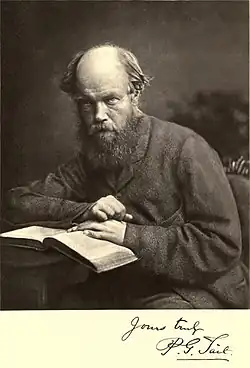 |
| Nascimento | 28 de abril de 1831
Dalkeith |
|---|
| Morte | 4 de julho de 1901 (70 anos)
Edinburgh |
|---|
| Sepultamento | St John's Episcopal Churchyard, Princes Street, Edinburgh |
|---|
| Nacionalidade | Escocês |
|---|
| Cidadania | Reino Unido da Grã-Bretanha e Irlanda |
|---|
| Filho(a)(s) | Frederick Guthrie Tait |
|---|
| Alma mater | Universidade de Edimburgo |
|---|
| Ocupação | matemático, físico |
|---|
| Distinções | Medalha Real (1886), Gunning Victoria Jubilee Prize (1887) |
|---|
| Empregador(a) | Universidade de Edimburgo, Queen's University de Belfast, Peterhouse |
|---|
| Orientador(a)(es/s) | William Hopkins |
|---|
| Obras destacadas | teoria dos nós, conjecturas de Tait, Tait equation, Ménage problem, snark, Tait–Kneser theorem, Tait-Bryan angles, Treatise on Natural Philosophy, On Knots |
|---|
|
Peter Guthrie Tait (Dalkeith, 28 de abril de 1831 — Edinburgh, 4 de julho de 1901) foi um físico matemático escocês.[1]
É conhecido principalmente como autor do livro Treatise on Natural Philosophy, que escreveu juntamente com William Thomson, e por estudos iniciais sobre a teoria dos nós, que contribuiu para o estabelecimento da topologia como ramo da matemática.
Referências
- ↑ O'Connor, John J.; Robertson, Edmund F., «Peter Guthrie Tait», MacTutor History of Mathematics archive (em inglês), Universidade de St. Andrews
Ligações externas
Precedido por
David Edward Hughes e Ray Lankester |
Medalha Real
1886
com Francis Galton |
Sucedido por
Alexander Ross Clarke e Henry Nottidge Moseley |
Medalha Real. Laureados (1851 — 1900) |
|---|
1851: William Parsons e George Newport • 1852: James Prescott Joule e Thomas Henry Huxley • 1853: Charles Darwin e John Tyndall • 1854: August Wilhelm von Hofmann e Joseph Dalton Hooker • 1855: John Obadiah Westwood e John Russell Hind • 1856: John Richardson e William Thomson • 1857: Edward Frankland e John Lindley • 1858: Albany Hancock e William Lassell • 1859: Arthur Cayley e George Bentham • 1860: Augustus Volney Waller e William Fairbairn • 1861: James Joseph Sylvester e William Benjamin Carpenter • 1862: Alexander William Williamson e John Thomas Romney Robinson • 1863: John Peter Gassiot e Miles Joseph Berkeley • 1864: Jacob Lockhart Clarke e Warren De La Rue • 1865: Archibald Smith e Joseph Prestwich • 1866: William Huggins e William Kitchen Parker • 1867: John Bennet Lawes, Joseph Henry Gilbert e William Edmond Logan • 1868: Alfred Russel Wallace e George Salmon • 1869: Augustus Matthiessen e Thomas Maclear • 1870: Thomas Davidson e William Hallowes Miller • 1871: George Busk e John Stenhouse • 1872: Henry John Carter e Thomas Anderson • 1873: George James Allman e Henry Enfield Roscoe • 1874: Henry Clifton Sorby e William Crawford Williamson • 1875: Thomas Oldham e William Crookes • 1876: Charles Wyville Thomson e William Froude • 1877: Frederick Augustus Abel e Oswald Heer • 1878: Albert Carl Ludwig Gotthilf Günther e John Allan Broun • 1879: Andrew Ramsay e William Perkin • 1880: Andrew Noble e Joseph Lister • 1881: John Hewitt Jellett e Francis Maitland Balfour • 1882: John William Strutt e William Henry Flower • 1883: Thomas Archer Hirst e John Scott Burdon-Sanderson • 1884: George Darwin e Daniel Oliver • 1885: David Edward Hughes e Ray Lankester • 1886: Peter Guthrie Tait e Francis Galton • 1887: Alexander Ross Clarke e Henry Nottidge Moseley • 1888: Osborne Reynolds e Ferdinand von Mueller • 1889: Thomas Edward Thorpe e Walter Holbrook Gaskell • 1890: John Hopkinson e David Ferrier • 1891: Arthur William Rucker e Charles Lapworth • 1892: Charles Pritchard e John Newport Langley • 1893: Harry Marshall Ward e Arthur Schuster • 1894: Joseph John Thomson e Victor Horsley • 1895: John Murray e James Alfred Ewing • 1896: Archibald Geikie e Charles Vernon Boys • 1897: Richard Strachey e Andrew Russell Forsyth • 1898: John Kerr e Walter Gardiner • 1899: William Carmichael McIntosh e George FitzGerald • 1900: Alfred Newton e Percy Alexander MacMahon |
