Rumélia
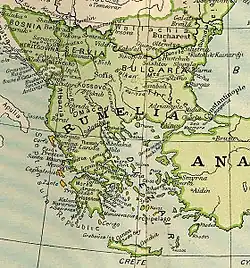
Rumélia (em turco: Rumeli; em albanês: Rumelia; em grego: Poύμελη/Ρούμελη; romaniz.: Roýmelē/Roúmelē; em macedónio: Румелија; romaniz.: Rumelija; em búlgaro: Румелия; romaniz.: Rumeliya)[1] foi um termo histórico que designava a área atualmente referida como Bálcãs ou península Balcânica quando foi administrada pelo Império Otomano.[2][3][4]
Referências
- ↑ Fossier, Robert; Sondheimer, Janet (1997). The Cambridge Illustrated History of the Middle Ages. Cambridge, England: Cambridge University Press. ISBN 978-0-521-26644-4
- ↑ Graubard, Stephen Richards, ed. (1999). A new Europe for the old?. New Brunswick, N.J., U.S.: Transaction Publishers. pp. 70–73. ISBN 978-0-7658-0465-5
- ↑ Juhász, József (2015). «Hungary and the Balkans in the 20th Century — From the Hungarian Perspective». Prague Papers on the History of International Relations. 115 páginas – via CEJSH
- ↑ Reclus, Onésime; Ibáñez, Vicente Blasco; Reclus, Élisée; Doré, Gustave (1907). Novísima Geografía Universal (em espanhol). [S.l.]: Madrid La Edit. Española-Americana. 636 páginas. OCLC 432767489
Bibliografia
- Bronza, Boro (2010). «The Habsburg Monarchy and the Projects for Division of the Ottoman Balkans, 1771–1788». Empires and Peninsulas: Southeastern Europe Between Karlowitz and the Peace of Adrianople, 1699–1829. Berlin: LIT Verlag. pp. 51–62. ISBN 9783643106117