Teoria de representação
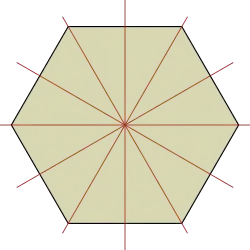
A teoria da representação é um ramo da matemática que estuda estruturas algébricas abstratas por meio de representações de seus elementos como transformações lineares de espaços vetoriais, e estuda módulos sobre essas estruturas algébricas abstratas.[1][2] Em essência, uma representação torna um objeto algébrico abstrato mais concreto ao descrever seus elementos por matrizes e suas operações algébricas (como adição de matrizes, multiplicação de matrizes).
Os objetos algébricos que admitem tal descrição incluem grupos, álgebras associativas e álgebras de Lie. O mais proeminente (e historicamente o primeiro) é a teoria da representação de grupos, em que os elementos de um grupo são representados por matrizes inversíveis de forma que a operação do grupo corresponda à multiplicação de matrizes.[3][4]
A teoria da representação é útil porque reduz problemas de álgebra abstrata a problemas de álgebra linear, um assunto bem compreendido.[5][6] Representações de objetos abstratos em termos da álgebra linear familiar podem elucidar propriedades e simplificar cálculos dentro de teorias mais abstratas. Por exemplo, representar um grupo por um espaço de Hilbert de dimensão infinita permite aplicar métodos de análise matemática à teoria de grupos.[7][8] Além disso, a teoria da representação é importante na física porque pode descrever como o grupo de simetria de um sistema físico afeta as soluções das equações que descrevem esse sistema.[9]
A teoria da representação está presente em diversas áreas da matemática. As aplicações da teoria da representação são diversas.[10] Além de seu impacto na álgebra, a teoria da representação:
- generaliza a análise de Fourier por meio da análise harmônica,[11]
- conecta-se à geometria por meio da teoria dos invariantes e do programa de Erlangen,[12]
- tem impacto na teoria dos números por meio de formas automórficas e do programa de Langlands.[13]
Existem diversas abordagens para a teoria da representação: os mesmos objetos podem ser estudados usando métodos da geometria algébrica, teoria de módulos, teoria analítica dos números, geometria diferencial, teoria dos operadores, combinatória algébrica e topologia.[14]
O sucesso da teoria da representação levou a inúmeras generalizações. Uma das mais gerais encontra-se na teoria das categorias.[15] Os objetos algébricos aos quais a teoria da representação se aplica podem ser vistos como tipos particulares de categorias, e as representações como funtores da categoria do objeto para a categoria dos espaços vetoriais.[4] Essa descrição aponta para duas generalizações naturais: primeiro, os objetos algébricos podem ser substituídos por categorias mais gerais; segundo, a categoria-alvo dos espaços vetoriais pode ser substituída por outras categorias bem compreendidas.
.[16]
Referências
- ↑ Textos clássicos sobre teoria da representação incluem Curtis & Reiner (1962) e Serre (1977). Outras fontes excelentes são Fulton & Harris (1991) e Goodman & Wallach (1998).
- ↑ «representation theory in nLab». ncatlab.org. Consultado em 9 de dezembro de 2019
- ↑ Para a história da teoria da representação de grupos finitos, veja Lam (1998). Para grupos algébricos e de Lie, veja Borel (2001).
- ↑ a b Etingof, Pavel; Golberg, Oleg; Hensel, Sebastian; Liu, Tiankai; Schwendner, Alex; Vaintrob, Dmitry; Yudovina, Elena (10 de janeiro de 2011). «Introduction to representation theory» (PDF). www-math.mit.edu. Consultado em 9 de dezembro de 2019
- ↑ Ronan, Mark Andrew. «linear algebra». Encyclopedia Britannica. Consultado em 8 de julho de 2024.
linear algebra is very well understood
- ↑ Há muitos livros didáticos sobre espaços vetoriais e álgebra linear. Para um tratamento avançado, veja Kostrikin & Manin (1997).
- ↑ Sally & Vogan 1989
- ↑ Teleman, Constantin (2005). «Representation Theory» (PDF). math.berkeley.edu. Consultado em 9 de dezembro de 2019
- ↑ Sternberg 1994
- ↑ Lam 1998, p. 372
- ↑ Folland 1995
- ↑ Goodman & Wallach 1998, Olver 1999, Sharpe 1997
- ↑ Borel & Casselman 1979, Gelbart 1984
- ↑ Veja as referências anteriores.
- ↑ Simson, Skowronski & Assem 2007
- ↑ Textos clássicos sobre teoria da representação incluem Curtis & Reiner (1962) e Serre (1977). Outras fontes excelentes são Fulton & Harris (1991) e Goodman & Wallach (1998).
Bibliografia
- Alperin, J. L. (1986), Local Representation Theory: Modular Representations as an Introduction to the Local Representation Theory of Finite Groups, ISBN 978-0-521-44926-7, Cambridge University Press.
- Bargmann, V. (1947), «Irreducible unitary representations of the Lorenz group», Annals of Mathematics, 48 (3): 568–640, JSTOR 1969129, doi:10.2307/1969129.
- Borel, Armand (2001), Essays in the History of Lie Groups and Algebraic Groups, ISBN 978-0-8218-0288-5, American Mathematical Society.
- Borel, Armand; Casselman, W. (1979), Automorphic Forms, Representations, and L-functions, ISBN 978-0-8218-1435-2, American Mathematical Society.
- Curtis, Charles W.; Reiner, Irving (1962), Representation Theory of Finite Groups and Associative Algebras
 , ISBN 978-0-470-18975-7, John Wiley & Sons (Reedition 2006 by AMS Bookstore).
 - Gelbart, Stephen (1984), «An Elementary Introduction to the Langlands Program», Bulletin of the American Mathematical Society, 10 (2): 177–219, doi:10.1090/S0273-0979-1984-15237-6.
- Folland, Gerald B. (1995), A Course in Abstract Harmonic Analysis, ISBN 978-0-8493-8490-5, CRC Press.
- Fulton, William; Harris, Joe (1991). Representation theory. A first course. Col: Graduate Texts in Mathematics, Readings in Mathematics (em inglês). 129. New York: Springer-Verlag. ISBN 978-0-387-97495-8. MR 1153249. OCLC 246650103. doi:10.1007/978-1-4612-0979-9
- Goodman, Roe; Wallach, Nolan R. (1998), Representations and Invariants of the Classical Groups, ISBN 978-0-521-66348-9, Cambridge University Press.
- James, Gordon; Liebeck, Martin (1993), Representations and Characters of Groups, ISBN 978-0-521-44590-0, Cambridge: Cambridge University Press.
- Hall, Brian C. (2015), Lie Groups, Lie Algebras, and Representations: An Elementary Introduction, ISBN 978-3319134666, Graduate Texts in Mathematics, 222 2nd ed. , Springer
- Helgason, Sigurdur (1978), Differential Geometry, Lie groups and Symmetric Spaces, ISBN 978-0-12-338460-7, Academic Press
- Humphreys, James E. (1972a), Introduction to Lie Algebras and Representation Theory, ISBN 978-0-387-90053-7, Birkhäuser.
- Humphreys, James E. (1972b), Linear Algebraic Groups, ISBN 978-0-387-90108-4, Graduate Texts in Mathematics, 21, Berlin, New York: Springer-Verlag, MR 0396773
- Jantzen, Jens Carsten (2003), Representations of Algebraic Groups, ISBN 978-0-8218-3527-2, American Mathematical Society.
- Kac, Victor G. (1977), «Lie superalgebras», Advances in Mathematics, 26 (1): 8–96, doi:10.1016/0001-8708(77)90017-2.
- Kac, Victor G. (1990), Infinite Dimensional Lie Algebras, ISBN 978-0-521-46693-6 3rd ed. , Cambridge University Press.
- Knapp, Anthony W. (2001), Representation Theory of Semisimple Groups: An Overview Based on Examples, ISBN 978-0-691-09089-4, Princeton University Press.
- Kim, Shoon Kyung (1999), Group Theoretical Methods and Applications to Molecules and Crystals: And Applications to Molecules and Crystals, ISBN 978-0-521-64062-6, Cambridge University Press.
- Kostrikin, A. I.; Manin, Yuri I. (1997), Linear Algebra and Geometry, ISBN 978-90-5699-049-7, Taylor & Francis.
- Lam, T. Y. (1998), «Representations of finite groups: a hundred years», Notices of the AMS, 45 (3,4): 361–372 (Part I), 465–474 (Part II).
- Yurii I. Lyubich. Introduction to the Theory of Banach Representations of Groups. Translated from the 1985 Russian-language edition (Kharkov, Ukraine). Birkhäuser Verlag. 1988.
- Mumford, David; Fogarty, J.; Kirwan, F. (1994), Geometric invariant theory, ISBN 978-3-540-56963-3, Ergebnisse der Mathematik und ihrer Grenzgebiete (2) [Results in Mathematics and Related Areas (2)], 34 3rd ed. , Berlin, New York: Springer-Verlag, MR 0214602; MR0719371 (2nd ed.); MR1304906(3rd ed.)
- Olver, Peter J. (1999), Classical invariant theory, ISBN 978-0-521-55821-1, Cambridge: Cambridge University Press.
- Peter, F.; Weyl, Hermann (1927), «Die Vollständigkeit der primitiven Darstellungen einer geschlossenen kontinuierlichen Gruppe», Mathematische Annalen, 97 (1): 737–755, doi:10.1007/BF01447892, arquivado do original em 19 de agosto de 2014.
- Pontrjagin, Lev S. (1934), «The theory of topological commutative groups», Annals of Mathematics, 35 (2): 361–388, JSTOR 1968438, doi:10.2307/1968438.
- Sally, Paul; Vogan, David A. (1989), Representation Theory and Harmonic Analysis on Semisimple Lie Groups, ISBN 978-0-8218-1526-7, American Mathematical Society.
- Serre, Jean-Pierre (1977), Linear Representations of Finite Groups, ISBN 978-0387901909, Springer-Verlag.
- Sharpe, Richard W. (1997), Differential Geometry: Cartan's Generalization of Klein's Erlangen Program, ISBN 978-0-387-94732-7, Springer.
- Simson, Daniel; Skowronski, Andrzej; Assem, Ibrahim (2007), Elements of the Representation Theory of Associative Algebras, ISBN 978-0-521-88218-7, Cambridge University Press.
- Sternberg, Shlomo (1994), Group Theory and Physics, ISBN 978-0-521-55885-3, Cambridge University Press.
- Tung, Wu-Ki (1985). Group Theory in Physics 1st ed. New Jersey·London·Singapore·Hong Kong: World Scientific. ISBN 978-9971966577
- Weyl, Hermann (1928), Gruppentheorie und Quantenmechanik, ISBN 978-0-486-60269-1 The Theory of Groups and Quantum Mechanics, translated H.P. Robertson, 1931 ed. , S. Hirzel, Leipzig (reprinted 1950, Dover).
- Weyl, Hermann (1946), The Classical Groups: Their Invariants and Representations, ISBN 978-0-691-05756-9 2nd ed. , Princeton University Press (reprinted 1997).
- Wigner, Eugene P. (1939), «On unitary representations of the inhomogeneous Lorentz group», Annals of Mathematics, 40 (1): 149–204, JSTOR 1968551, doi:10.2307/1968551.
