Sudeste da África
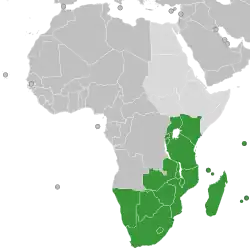
O Sudeste da África[1][2][3] é uma região africana que é intermediária entre a África Oriental e a África Austral[4]. Compreende os países Botsuana, Eswatini, Quénia, Lesoto, Malawi, Moçambique, Namíbia, Ruanda, África do Sul, Tanzânia, Uganda, Zâmbia e Zimbabué no continente, com as nações insulares de Madagáscar, Maurícias, Comores e Seicheles também incluídas.[5][6]
História
Pré-história
A África Oriental e Austral estão entre as primeiras regiões onde se acredita que os humanos modernos (Homo sapiens) viveram. Em setembro de 2019, cientistas reconstruíram via determinação computadorizada, com base em 260 tomografias, um crânio virtual do último ancestral humano comum aos humanos modernos / H. sapiens, representativo dos primeiros humanos modernos, e sugeriram que os humanos modernos surgiram entre 350.000 e 260.000 anos atrás por meio de uma união entre povos do sul e do leste da África. [7] [8]
Referências
- ↑ Axworthy, Mary (2004). Sowell, Teri L., ed. Asking for Eyes: The Visual Voice of Southeast Africa. [S.l.]: University Art Gallery, San Diego State University. ISBN 0-937097-01-2
- ↑ Wieschhoff, H. A. (2013). The Zimbabwe-Monomotapa Culture in Southeast Africa. [S.l.]: Literary Licensing L. L. C. ISBN 978-1-4940-0993-9
- ↑ Schlebusch, C. M.; Prins, F.; Lombard, M.; Jakobsson, M.; Soodyall, H. (2016). «The disappearing San of southeastern Africa and their genetic affinities.». Human Genetics. 135 (12): 1365–1373. PMC 5065584
 . PMID 27651137. doi:10.1007/s00439-016-1729-8
- ↑ Klopper, S.; Conru, K.; Nel, K. (2002). The Art of Southeast Africa: From the Conru Collection. [S.l.]: Harry N. Abrams. ISBN 88-7439-001-7
- ↑ «Bantu Ethnicity in South East Africa: From Kenya to the Southern Tip of Africa». Ancestry.com. Consultado em 29 April 2018 Verifique data em:
|acessodata=(ajuda) - ↑ «Tracing African Roots: Exploring the Ethnic Origins of the Afro-Diaspora». Tracing African Roots. 31 January 2016. Consultado em 29 April 2018 Verifique data em:
|acessodata=, |data=(ajuda) - ↑ Zimmer, Carl (10 September 2019). «Scientists Find the Skull of Humanity's Ancestor — on a Computer – By comparing fossils and CT scans, researchers say they have reconstructed the skull of the last common forebear of modern humans.». The New York Times. Consultado em 10 September 2019 Verifique data em:
|acessodata=, |data=(ajuda) - ↑ Mounier, Aurélien; Lahr, Marta (2019). «Deciphering African late middle Pleistocene hominin diversity and the origin of our species». Nature Communications. 10 (1): 3406. Bibcode:2019NatCo..10.3406M. PMC 6736881. PMID 31506422. doi:10.1038/s41467-019-11213-w