Bulbul-de-garganta-amarela
| Bulbul-de-garganta-amarela | |
|---|---|
| |
Classificação científica 
| |
| Reino: | Animalia |
| Filo: | Chordata |
| Classe: | Aves |
| Ordem: | Passeriformes |
| Família: | Pycnonotidae |
| Gênero: | Pycnonotus |
| Espécies: | P. xantholaemus
|
| Nome binomial | |
| Pycnonotus xantholaemus (Jerdon, 1845)
| |
| |
| Sinónimos | |

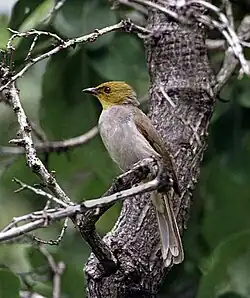
O bulbul-de-garganta-amarela (Pycnonotus xantholaemus)[1] é uma espécie de pássaro canoro da família Pycnonotidae, pertencente à ordem dos Passeriformes. Essa espécie é endêmica do sul da península indiana. Habita áreas de matagal em colinas rochosas e íngremes, muitas das quais estão ameaçadas pela extração de granito. Pode ser confundido apenas com o bulbul-de-sobrancelha-branca [en], com o qual sua distribuição se sobrepõe, mas distingue-se claramente pela cabeça e garganta amarelas, além do ventre também amarelo. Seus chamados são muito semelhantes aos do bulbul-de-sobrancelha-branca.
Taxonomia e sistemática
O bulbul-de-garganta-amarela foi originalmente descrito por Thomas C. Jerdon no gênero Brachypus (sinônimo de Pycnonotus) e posteriormente reclassificado no gênero Ixos.[4] Desde então, foi reclassificado no gênero Pycnonotus. O nome alternativo bulbul-de-orelha-amarela não deve ser confundido com a espécie de mesmo nome, Pycnonotus penicillatus [en]. O termo "bulbul-de-garganta-amarela" também é usado como nome alternativo para o Chlorocichla falkensteini.
Descrição
Essa espécie de bulbul, sem crista, tem o dorso cinza-oliva, garganta amarela, coberteiras inferiores da cauda e pontas da cauda também amarelas. A cabeça é lisa, enquanto o peito e o ventre apresentam um leve tom acinzentado. A espécie mais semelhante é o bulbul-de-sobrancelha-branca, mas este possui uma sobrancelha branca e não tem a garganta amarela. Machos e fêmeas têm plumagem semelhante.[5]
Distribuição e habitat
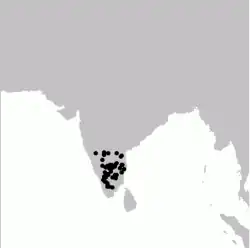
O habitat dessa espécie inclui colinas rochosas cobertas por matagais, principalmente nos Gates Orientais e no centro da península indiana, mas também em algumas áreas dos Gates Ocidentais. Sua distribuição é bastante fragmentada, com populações muito localizadas, o que torna os habitats montanhosos uma preocupação especial para conservação. Muitas dessas florestas de colinas estão ameaçadas por extração de granito, incêndios florestais e pastoreio.[6] A espécie desapareceu de muitos locais onde era anteriormente conhecida.[7]
Locais conhecidos incluem as Colinas Nandi [en],[8] Colinas Horsley [en],[9] Gingee [en],[10] Yercaud [en][11] e as Colinas Biligiriranga [en].[12] Também é observado em partes dos Gates Ocidentais, como os Anamalais.[13][14][15][16][17][18][19] Acredita-se que seu limite norte esteja na cordilheira Nallamala,[20] mas suspeita-se que a espécie possa se estender até os Gates Orientais do norte, em Orissa.[21][22]
Comportamento e ecologia
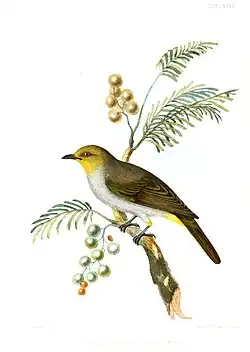
Essa ave é geralmente tímida e fica escondida no matagal, sendo detectada principalmente por suas súbitas explosões de chamados cacarejantes, muito semelhantes aos do bulbul-de-sobrancelha-branca. Alimenta-se de insetos e frutos silvestres de várias espécies de plantas de matagal, como Lantana camara, Flueggea leucopyrus [en], Zanthoxylum asiaticum, Erythroxylon monogynum, Solanum indicum, Santalum album, Ziziphus, Ficus benghalensis, F. nervosa [en], F. montana [en], Psydrax dicoccos [en] e Phyllanthus reticulata.[6]
Durante as tardes quentes e na estação seca, visita poças d'água para beber e se banhar.[23]
A temporada de reprodução ocorre de junho a agosto. O ninho é construído na forquilha de uma pequena árvore. São postos dois ovos, que eclodem em 20 dias, com os filhotes deixando o ninho 13 dias depois.[6][24]
Referências
- ↑ a b BirdLife International (2016). «Pycnonotus xantholaemus». Lista Vermelha de Espécies Ameaçadas. 2016: e.T22712719A94345114. doi:10.2305/IUCN.UK.2016-3.RLTS.T22712719A94345114.en
 . Consultado em 13 de novembro de 2021
- ↑ Jerdon, TC (1844). «Second supplement to the catalogue of the birds of southern India». Madras Journal of Literature and Science. 13 (2): 116–144
- ↑ Sharpe, RB (1881). Catalogue of the birds in the British Museum. Volume 6 Cichlomorphae: Part 3. [S.l.: s.n.] p. 146
- ↑ Jerdon, Thomas Claverhill (1 de janeiro de 1863). The Birds of India: Being a Natural History of All the Birds Known to Inhabit Continental India, with Descriptions of the Species, Genera, Families, Tribes, and Orders, and a Brief Notice of Such Families as are Not Found in India, Making it a Manual of Ornithology Specially Adapted for India (em inglês). [S.l.]: Autor. p. 85.
Ixos xantholaemus.
- ↑ Ali, S; S D Ripley (1996). Handbook of the birds of India and Pakistan. 6 2ª ed. [S.l.]: Oxford University Press. pp. 94–95. ISBN 0-19-562063-1
- ↑ a b c Subramanya, S.; JN Prasad; S. Karthikeyan (2006). «Status, habitat, habits and conservation of Yellow-throated Bulbul Pycnonotus xantholaemus (Jerdon) in South India». Journal of the Bombay Natural History Society. 103 (2–3): 215–226
- ↑ Subramanya,S; Karthikeyan,S; Prasad,JN; Srinivasa,TS; Arun,B (1990). «A trip to Thondebhavi in search of Yellowthroated Bulbul». Newsletter for Birdwatchers. 30 (11–12): 7
- ↑ Subramanya,S; Karthikeyan,S; Prasad,JN (1991). «Yellowthroated Bulbul at Nandi Hill». Newsletter for Birdwatchers. 31 (3&4): 7–8
- ↑ Allen,P Roscoe (1908). «Notes on the Yellow-throated Bulbul Pycnonotus xantholaemus». J. Bombay Nat. Hist. Soc. 18 (4): 905–907
- ↑ Rao,TK (1995). «Yellowthroated Bulbul - Pycnonotus xantholaemus (Jerdon) in Gingee». Blackbuck. 11 (1): 9–11
- ↑ Karthikeyan,S (1995). «Notes on the occurrence of the Yellowthroated Bulbul Pycnonotus xantholaemus (Jerdon) at Shevaroys, Tamil Nadu». J. Bombay Nat. Hist. Soc. 92 (2): 266–267
- ↑ Karthikeyan,S; Prasad,JN; Srinivasa,TS (1995). «Yellowthroated Bulbul Pycnonotus xantholaemus (Jerdon) at Biligirirangan Hills, Karnataka». J. Bombay Nat. Hist. Soc. 92 (1): 123–124
- ↑ Kannan, R. (1992). «The Yellowthroated Bulbul (Pycnonotus xantholaemus) in the Anaimalai Hills». Newsletter for Birdwatchers. 32 (3–4): 19
- ↑ Kannan, R. (1998). «Avifauna of the Anaimalai Hills (Western Ghats) of southern India.». Journal of the Bombay Natural History Society. 95 (2): 193–214
- ↑ Kannan, R.; D. A. James (2010). «On the Yellow-throated Bulbul in Tamil Nadu, and a plea for more self-explanatory titles.» (PDF). Indian Birds. 6 (1): 25
- ↑ Narayanan, S. P.; Boopal, A.; Nanjan, S.; Kurian, J.; Dhanya, R.; Gomahty, N.; Dastidar, D. G.; Rajamamannan, M. A.; Venkitachalam, R.; Mukherjee, D.; Eswaran, R. (2006). «New site for the Yellow-throated Bulbul Pycnonotus xantholaemus from Tamil Nadu» (PDF). Indian Birds. 2 (6): 151–153
- ↑ Beisenherz, W. (2004). «Rediscovery of the Yellow-throated Bulbul Pycnonotus xantholaemus in the Anaimalai Hills, Western Ghats, South India». J. Bombay Nat. Hist. Soc. 101 (1): 160
- ↑ Praveen J; L Namassivayan (2006). «Sighting of Yellow-throated Bulbul Pycnonotus xantholaemus from Chinnar Wildlife Sanctuary, Kerala, Southern India» (PDF). Zoos' Print Journal. 21 (4): 2228. doi:10.11609/jott.zpj.1489.2228
- ↑ Davison, W (1888). «Letters». Ibis. 30 (1): 146–148. doi:10.1111/j.1474-919X.1888.tb07729.x
- ↑ Srinivasulu, C. (2003). «Site records of yellow-throated bulbul Pycnonotus xantholaemus (Jerdon, 1844) in the Nallamala Hills, Eastern Ghats, Andhra Pradesh, India» (PDF). Zoos' Print Journal. 18 (3): 1051–1052. doi:10.11609/jott.zpj.18.3.1051-2
- ↑ Subramanya S. (2004). «Does the Yellow-throated Bulbul Pycnonotus xantholaemus occur in Orissa?». Newsletter for Ornithologists. 1 (3): 39–40
- ↑ Sreekar R, Srinivasulu C (2010). «New site record of Yellow-throated Bulbul Pycnonotus xantholaemus from Andhra Pradesh» (PDF). Indian Birds. 5 (5): 157
- ↑ Karthikeyan S (1991). «On birds frequenting water puddles». Newsletter for Birdwatchers. 31 (11&12): 8–9
- ↑ Collar NJ; A.V. Andreev; S. Chan; M.J. Crosby; S. Subramanya; J.A. Tobias (2001). Threatened Birds of Asia (PDF). [S.l.]: BirdLife International. pp. 1969–1973