Psicodíneos
| Psicodíneos | |
|---|---|
| |
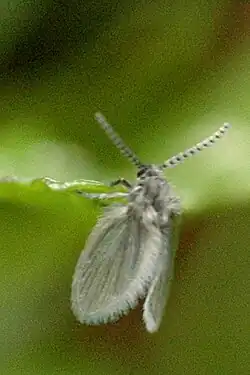
| Psychoda grisescens | |
Classificação científica 
| |
| Predefinição taxonomia em falta (fix): | Psicodíneos |
Os Psicodíneos (Psychodinae) compõem uma subfamília de insetos da família Psychodidae. Assim como outros membros dessa família, os Psychodinae são geralmente encontrados ambientes humidos; alguns até em cavernas. Suas larvas são aquáticas ou semiterrestres podendo sobreviver sob níveis variados de água. Quando no estado de imago algumas espécies se alimentam de seiva de plantas ou nectar.[2][3]
Tribos e gêneros
- Maruinini Enderlein, 1937[4]
- Alloeodidicrum Duckhouse, 1990[5]
- Didicrum Enderlein, 1937[4]
- Eremolobulosa Duckhouse, 1990[5]
- Maruina Müller, 1895[6]
- Paratelmatoscopus Satchell, 1953[7]
- Rotundopteryx Duckhouse, 1990[5]
- Setomimini Vaillant, 1982[8]
- Arisemus Satchell, 1955[9]
- Australopericoma Vaillant, 1975[10]
- Balbagathis Quate, 1996[11]
- Lobulosa Szabo, 1960[12]
- Neoarisemus Botosaneanu & Vaillant, 1970[13]
- Parasetomima Duckhouse, 1968 [14]
- Platyplastinx Enderlein, 1937[4][15]
- Setomima Enderlein, 1937[4]
- Tonnoiriella Vaillant, 1982[8]
- Mormiini Enderlein, 1937[4]
- Atrichobrunettia Satchell, 1953[7]
- Brunettia Annandale, 1910[16]
- Gerobrunettia Quate & Quate, 1967[17]
- Mormia Enderlein, 1935[18]
- Paramormiini Enderlein, 1937[4]
- Clogmia Enderlein, 1937[4]
- Eurygarka Quate, 1959[19]
- Feuerborniella Vaillant, 1971[10]
- Panimerus Eaton, 1913[20]
- Paramormia Enderlein, 1935[18]
- Peripsychoda Enderlein, 1935[18]
- Philosepedon Eaton, 1904[21]
- Telmatoscopus Eaton, 1904[21]
- Threticus Eaton, 1904[21]
- Trichopsychoda Tonnoir, 1922[22]
- Vaillantodes Wagner, 2002[23]
- Pericomaini Enderlein, 1935[18]
- Bazarella Vaillant, 1961[24]
- Berdeniella Vaillant, 1971[10]
- Breviscapus Quate, 1955[25]
- Clytocerus Eaton, 1904[21]
- Lepidiella Enderlein, 1937[4]
- Notiocharis Eaton, 1913[20]
- Pericoma Haliday, in Walker, 1856[26]
- Pneumia Enderlein, 1935[18]
- Saraiella Vaillant, 1981
- Stupkaiella Vaillant, 1973[27]
- Szaboiella Vaillant, 1979
- Thornburghiella Vaillant, 1982[8]
- Ulomyia Haliday, in Walker, 1856[26] (= Saccopterix Haliday, in Curtis, 1839, preoccupied)
- Psychodini Quate, 1959[19]
Referências
- ↑ Newman, E. (1834). «Attempted division of British insects into natural orders». The Entomological Magazine. 2: 379–431. Consultado em 10 de novembro de 2021
- ↑ JEŽEK, JAN; OBOŇA, JOZEF (4 de abril de 2019). «Three new species of moth flies (Diptera, Psychodidae, Psychodinae) from the Afrotropical Region». Zootaxa (1). 73 páginas. ISSN 1175-5334. doi:10.11646/zootaxa.4577.1.4. Consultado em 24 de maio de 2022
- ↑ Bravo, Freddy; Chagas, Cinthia (outubro de 2004). «Espécies novas de Tonnoira Enderlein (Diptera: Psychodidae) do nordeste brasileiro». Neotropical Entomology (5): 601–605. ISSN 1519-566X. doi:10.1590/S1519-566X2004000500009. Consultado em 24 de maio de 2022
- ↑ a b c d e f g h Enderlein, Günther (1937). «Klassifikation der Psychodiden (Dipt.)» (PDF). Entomologische Zeitschrift. 1936 (3–4): 81–112. doi:10.1002/mmnd.193619360301. Consultado em 26 de maio de 2022
- ↑ a b c Duckhouse, D.A. (1990). «The Australasian genera of pericomoid Psychodidae (Diptera) and the status of related Enderlein genera in the Neotropics». Invertebrate Taxonomy. 3: 721–746
- ↑ Müller, Fritz (1895). «Contribution towards the history of a new form of larvae of Psychodidae (Diptera), from Brazil». Transactions of the Royal Entomological Society of London. 1895 (4): 479–482. doi:10.1111/j.1365-2311.1895.tb02109.x. Consultado em 29 de maio de 2022
- ↑ a b Satchell, G.H. (1953). «The Australian Psychodidae (Diptera), Part 1». Australian Journal of Zoology. 1 (3): 357–418. doi:10.1071/ZO9530357
- ↑ a b c Vaillant, F. (1982). «Quelques precisions au sujet de cinq genres de Psychodidae Psychodinae (Diptères)». Trav. Lab. Hydrobiol. Piscic. Univ. Grenoble. 71-73 (1979-1981): 211–217
- ↑ Satchell, G.H. (1955). «Two new subgenera of Psychodidae (Diptera) from Jamaica, with descriptions of five new species». Annals and Magazine of Natural History. 8 (12): 85–93. doi:10.1080/00222935508651831
- ↑ a b c Vaillant, F. (1971). «9d. Psychodidae-Psychodinae. In: Lindner, E. (ed.)». Die Fliegen der Palaearktischen Region. 2[Lfg. 287]: 1–48
- ↑ Quate, L.W. (1996). «Preliminary taxonomy of Costa Rican Psychodidae (Diptera), exclusive of Phlebotominae». Revista de Biología Tropical. 44 (Supplement 1): 1–81. PMID 9161543
- ↑ Szabó, J. (1960). «Neue Pericoma-Arten aus dem Karpathenbecken (Diptera, Psychodidae) 6». Acta Zoologica Hungarica. 6: 167–176
- ↑ Botosaneanu, L.; Vaillant, F. (1970). «Trois Diptères Psychodidae nouveaux de Cuba.». Trav. Lab. Hydrobiol. Piscic. Univ. Grenoble. 61: 173–183
- ↑ Duckhouse, D.A. (1968). «Psychodidae (Diptera, Nematocera) collected by Mr. Plaumann in southern Brazil». Proceedings of the Royal Entomological Society of London B. 37: 29–40
- ↑ Quate, Laurence W.; Brown, Brian Victor (2004). «Revision of Neotropical Setomimini (Diptera: Psychodidae: Psychodinae)». Contributions in Science. 500: 1–117. doi:10.5962/p.210558
 . Consultado em 28 de dezembro de 2021
- ↑ Annandale, T.N. (1910). «A new genus of psychodid Diptera from the Himalayas and Travancore». Records of the Indian Museum. 5: 141–144, 1 pl. doi:10.5962/bhl.part.10497. Consultado em 29 de maio de 2022
- ↑ Quate, L.W.; Quate, S.H. (1967). «A monograph of Papuan Psychodidae, including Phlebotomus (Diptera)». Pacific Insects Monograph. 15: 1–216
- ↑ a b c d e Enderlein, Günther (1935). «Zur Klassifikation der Psychodinen». Sber. Ges. Naturf. Freunde Berl. 1935: 246–249
- ↑ a b Quate, L.W. (1959). «Classification of the Psychodini (Psychodidae: Diptera)». Annals of the Entomological Society of America. 52 (4): 444–451. doi:10.1093/aesa/52.4.444
- ↑ a b Eaton, A.E. (1913). «The Percy Sladen Trust Expedition to the Indian Ocean in 1905. Diptera Psychodidae». Transactions of the Linnean Society of London. 15: 423–432. doi:10.1111/j.1096-3642.1913.tb00110.x. Consultado em 29 de maio de 2022
- ↑ a b c d Eaton, A.E. (1904). «New genera of European Psychodidae». Entomologist's Monthly Magazine. 15 (2): 55–59. Consultado em 29 de maio de 2022
- ↑ Tonnoir, A.L. (1922). «Synopsis des espèces europeennes du genre Psychoda (Diptères)». Bulletin et Annales de la Société Entomologique de Belgique. 62: 49–88
- ↑ Wagner, R.H. (2001). «Contribution to the knowledge of Spanish Psychodidae (Diptera) with description of two new species». Zoologica Baetica. 12: 83–90
- ↑ Vaillant, F. (1961). «Revision des Psychodidae Psychodinae de France». Annales de la Société Entomologique de France. 130: 131–154
- ↑ Quate, L.W. (1955). «A revision of the Psychodidae (Diptera) in America north of Mexico». University of California Publications in Entomology. 10: 103–273
- ↑ a b Walker, F. (1856). Insecta Britannica, Diptera. Volume 3. London: L. Reeve. pp. xxiv + 352 pp., pls. 21–30
- ↑ Vaillant, F. (1973). «Some new Psychodidae Psychodinae from the United States (Diptera)». Annales de la Société Entomologique de France. 9: 345–379
- ↑ Quate, L.W. (1965). «A taxonomic study of Philippine Psychodidae (Diptera)». Pacific Insects. 7: 815–902
- ↑ Latreille, P.A. (1797). Precis des caracteres generiques des insectes, disposes dans un ordre naturel. Bordeaux, Brive: Prevot, Paris. pp. xiv + 201 + [7]. Consultado em 29 de maio de 2022
Ligações externas
 Dados relacionados com Psicodíneos no Wikispecies
 Media relacionados com Psicodíneos no Wikimedia Commons