Khin Nyunt
Khin Nyunt | |
|---|---|
| ခင်ညွန့် | |
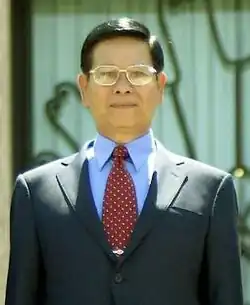 Khin Nyunt em 2004 | |
| Primeiro-ministro de Myanmar | |
| Período | 25 de agosto de 2003–18 de outubro de 2004 |
| Líder | Than Shwe |
| Antecessor(a) | Than Shwe |
| Sucessor(a) | Soe Win |
| Secretário 1 do Conselho de Estado para a Paz e o Desenvolvimento | |
| Período | 15 de novembro de 1997–25 de agosto de 2003 |
| Antecessor(a) | Cargo estabelecido |
| Sucessor(a) | Soe Win |
| Secretário 1 do Conselho de Estado de Restauração da Lei e da Ordem | |
| Período | 18 de setembro de 1988–15 de novembro de 1997 |
| Antecessor(a) | Cargo estabelecido |
| Sucessor(a) | Cargo abolido |
| Diretor de Inteligência do Serviço de Defesa | |
| Período | 1984–18 de outubro de 2004 |
| Antecessor(a) | Kyaw Win |
| Sucessor(a) | Myint Swe |
| Dados pessoais | |
| Nascimento | 23 de outubro de 1939 (86 anos) Município de Kyauktan, Birmânia Britânica (atual Myanmar) |
| Alma mater | Escola de Treinamento de Oficiais de Bahtoo |
| Cônjuge | Khin Win Shwe |
| Filhos(as) | 2 |
| Serviço militar | |
| Lealdade | .svg.png) Myanmar Myanmar |
| Serviço/ramo |  Exército de Mianmar Exército de Mianmar |
| Anos de serviço | 1960–2004 |
| Graduação | General |
Khin Nyunt (em birmanês: ခင်ညွန့်; romaniz.: hkang nywan; Kyauktan, 23 de outubro de 1939) [1][2][3] é um general aposentado do exército birmanês, amplamente reconhecido por seu papel influente na formação da dinâmica política de Mianmar.[4][5][6][7][8][9][10] Servindo como Chefe da Inteligência e Primeiro-Ministro de Mianmar de 25 de agosto de 2003 a 18 de outubro de 2004, ele desempenhou um papel crucial na história da nação.[11][12][13] Durante seu mandato, Khin Nyunt supervisionou desenvolvimentos significativos na inteligência e no aparato de Mianmar, bem como nas políticas governamentais.[14][15][16][17] Ele foi fundamental na implementação de reformas destinadas a modernizar as operações de inteligência e promover os interesses de segurança nacional.[18][19][20][21] No entanto, sua liderança enfrentou desafios e ele acabou sendo destituído do poder em 2004 em meio a mudanças políticas dentro da junta militar governante.[22][23][24] Apesar de sua destituição do cargo, o legado de Khin Nyunt continuou sendo debatido, com alguns o considerando uma figura reformista e outros criticando sua abordagem de governança.[25][26][27]
Nascido em 23 de outubro de 1939 no município de Kyauktan, perto de Rangum, sua infância foi marcada por uma herança cultural única.[28][29][30][31] Vindo de uma família de ascendência chinesa birmanesa, seus pais eram Hacás de Meizhou, Guangdong, China.[32][33][34][35] Khin Nyunt desempenhou um papel significativo no cenário político de Myanmar.[36][37][38] Khin Nyunt se formou na 25ª turma da Escola de Treinamento de Oficiais de Bahtoo, em 1960, depois de abandonar o Colégio Yankin na década de 1950, trilhando um caminho que se entrelaçaria com operações de inteligência e importantes funções políticas.[39][40][41] Sua carreira militar o levou ao cargo de Chefe da Inteligência, onde desempenhou um papel crucial na segurança interna do país.[42][43][44] Sua trajetória política atingiu o ápice quando assumiu o cargo de Primeiro-Ministro de Myanmar em 25 de agosto de 2003, sucedendo o General Than Shwe.[45][46][47][48] No entanto, seu mandato foi curto, durando até 18 de outubro de 2004.[49][50][51] Como Primeiro-Ministro, Khin Nyunt enfrentou desafios e controvérsias, incluindo a proposta de um roteiro de sete pontos para a democracia, criticado por sua aparente falta de clareza e envolvimento militar.[52][53][54][55] Sua liderança supervisionou a revogação da Convenção Nacional suspensa, influenciando a trajetória política de Myanmar.[56][57][58] Destituído do poder em 18 de outubro de 2004 em meio a lutas militares internas, Khin Nyunt enfrentou acusações de corrupção e recebeu uma sentença de 44 anos de prisão.[59][60][61][62][63] Libertado da prisão domiciliar em 13 de janeiro de 2012, ele entrou em uma nova fase, estabelecendo uma presença em Yangon com uma cafeteria, galeria de arte e loja de souvenirs.[64][65][66][67][68][69]
Biografia
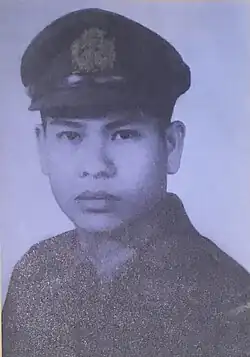
Khin Nyunt nasceu em 23 de outubro de 1939, no município de Kyauktan, perto de Rangum.[70][71][72] Ele é descendente de chineses birmaneses, com pais que eram Hacás de Meizhou, Guangdong, China.[73][74][75]
Khin Nyunt se formou na 25ª turma da Escola de Treinamento de Oficiais, Bahtoo, em 1960, depois de abandonar o Colégio Yankin no final da década de 1950.[76][77][78][79]
Carreira política
Após sua carreira militar, ele foi enviado de volta a Rangoon em 1984, após um ataque a uma delegação sul-coreana em visita.[80][81][82] Vinte e uma pessoas, incluindo três ministros do gabinete sul-coreano, morreram durante o ataque, que ocorreu em 9 de outubro de 1983 e foi perpetrado por terroristas enviados da Coreia do Norte.[83][84][85] Khin Nyunt foi então nomeado Chefe da Inteligência.[86][87][88] De meados da década de 1980 até o final da década de 1990, Khin Nyunt foi considerado um protegido do General Ne Win, que supostamente se aposentou da política em 23 de julho de 1988, mas que se acredita ter continuado a ser uma figura influente nos bastidores até o final da década de 1990.[89][90][91]
A revolta 8888, que ocorreu de março a setembro de 1988, foi sufocada pelos militares quando o Conselho de Restauração da Lei e da Ordem do Estado (CERLO) foi formado em 18 de setembro de 1988.[92][93][94] O CERLO) foi renomeado como Conselho de Estado para a Paz e Desenvolvimento (CEPD) em 15 de novembro de 1997, e Khin Nyunt foi nomeado seu primeiro secretário (Secretário−1), cargo que ocupou até sua nomeação como primeiro-ministro em 25 de agosto de 2003.[95][96][97]
Pouco depois de Khin Nyunt ser nomeado primeiro-ministro, ele anunciou um roteiro de sete pontos para a democracia em 30 de agosto de 2003; este roteiro foi fortemente criticado pela oposição birmanesa, bem como por muitos governos estrangeiros, especialmente ocidentais, pois previa uma participação militar permanente no governo.[98][99][100] A chamada "implementação sistemática e passo a passo do roteiro para a democracia" também não continha um cronograma.[101]
O primeiro "passo" do roteiro foi a convocação da Convenção Nacional suspensa, que se reuniu pela primeira vez em janeiro de 1993. A Convenção Nacional deveria "estabelecer" os princípios básicos para uma nova Constituição.[102][103] A Convenção Nacional reuniu-se esporadicamente até a aprovação de uma nova constituição em 2008, por meio do que muitos observadores consideraram o referendo constitucional fraudulento de 2008.[104][105][106]
Primeiro-ministro
Após a nomeação de Khin Nyunt como primeiro-ministro de Myanmar, seu papel no governo gerou alguma esperança e especulação de que poderia haver alguma "liberalização", já que Khin Nyunt era considerado um pragmático moderado que via a necessidade de um diálogo com a oposição democrática.[107] O presidente do CEPD, General Sênior Than Shwe, e seu vice, o Vice-General Sênior Maung Aye, eram vistos como linha-dura que se opunham a qualquer afrouxamento do controle rígido dos militares sobre o país.[108][109][110]
Controvérsias
De 1988 até sua purga em 2004, Khin Nyunt supervisionou a prisão de cerca de 10.000 pessoas. Muitas foram submetidas a tortura e julgamentos farsescos que resultaram em longas penas de prisão.[111][112][113] Dezenas de suas unidades de inteligência militar intimidaram e detiveram ativistas da oposição.[114] Suas unidades de inteligência militar infiltraram-se em quase todas as organizações do país e mantiveram redes de espiões em quase todos os bairros.[115] Seus agentes foram colocados em departamentos de alfândega, imigração e polícia, e oficiais da inteligência militar chegaram a monitorar outros altos funcionários militares, incluindo generais de alta patente.[116]
Khin Nyunt foi fundamental no fechamento das universidades e na posterior reabertura delas após terem sido realocadas para campi remotos e mal equipados, onde os estudantes não podiam mais organizar protestos ou obter uma educação significativa.[117]
Prisão e libertação
Em 18 de outubro de 2004, num anúncio de uma frase assinado pelo presidente do Conselho de Estado para a Paz e Desenvolvimento (CEPD) Than Shwe, Khin Nyunt foi "autorizado a aposentar-se por motivos de saúde". No entanto, ele foi imediatamente preso e colocado sob custódia protetiva.[118]
As acusações de corrupção contra Khin Nyunt foram formalizadas alguns dias depois. Sua demissão e prisão foram resultado de uma luta pelo poder na qual o homem forte da junta, Than Shwe, conseguiu reduzir o poder da "facção de inteligência" das Forças Armadas de Mianmar, liderada por Khin Nyunt. A maioria dos generais e oficiais militares do CEPD, como o general Than Shwe, não queria negociar com Aung San Suu Kyi e a Liga Nacional para a Democracia (LND).[118]
Em 5 de julho de 2005, Khin Nyunt foi julgado por um Tribunal Especial na prisão de Insein, perto de Rangoon, por várias acusações de corrupção.[119] Em 21 de julho de 2005, ele foi condenado a 44 anos de prisão. Seus filhos também foram condenados a 51 e 68 anos de prisão respectivamente.[120]
Em julho de 2009, um vídeo de Khin Nyunt na casa do ex-ministro birmanês Brigadeiro-General Tint Swe, gravado em 7 de julho de 2009, foi divulgado ao público e houve relatos de que Khin Nyunt e sua esposa conseguiram viajar para fora de casa ocasionalmente desde março de 2008.[121] Em dezembro de 2010, outro vídeo de 16 minutos de Khin Nyunt reunindo-se com o Chefe de Polícia Khin Yi e outros oficiais superiores da polícia foi divulgado no YouTube.[122]
Khin Nyunt foi libertado da prisão domiciliar em 13 de janeiro de 2012 por ordem do presidente Thein Sein.[123]
Vida posterior
Após ser libertado da prisão domiciliar, Khin Nyunt se restabeleceu em uma casa em Yangon. Lá, ele estabeleceu uma cafeteria, uma galeria de arte e uma loja de souvenirs com itens como esculturas em madeira para turistas.[124] Em 2 de março de 2015, Khin Nyunt publicou uma autobiografia de 657 páginas, fornecendo informações sobre vários aspectos de sua vida. Em 5 de dezembro de 2021, o General Min Aung Hlaing, atual Comandante-em-Chefe do Tatmadaw, visitou a casa de Khin Nyunt. Foi relatado que o ex-general está enfrentando problemas de saúde, especificamente devido à doença de Alzheimer.[125]
Vida pessoal
Khin Nyunt é casado com Khin Win Shwe, uma médica, e tem dois filhos.[126]
-
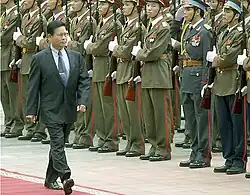 O general Khin Nyunt inspecionando a guarda de honra vietnamita no Palácio Presidencial em Hanói, Vietnã, em 9 de agosto de 2004.
 -
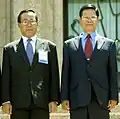 O primeiro-ministro Soe Win (à esquerda) e o ex-primeiro-ministro Khin Nyunt (à direita) em 21 de outubro de 2004.
 -
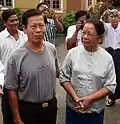 Khin Nyunt pouco depois de ser libertada da prisão domiciliar em 13 de janeiro de 2012.
Referências
- ↑ Hmaw Win Thar U Khin Nyunt (abril de 2015). ကြုံတွေ့ခဲ့ရ ကျွန်တော့ဘဝအထွေထွေ (em birmanês). Yangon: 100 kinds of flowers publishing house (ပန်းမျိုးတစ်ရာစာပေ)
- ↑ Than Win Hlaing (novembro de 2014). ဦးခင်ညွန့် (သို့မဟုတ်) ရက်စက်မှုအပေါင်းသရဖူဆောင်းခဲ့သူ (em birmanês). Yangon: U Lwin Oo (Lwin Oo publishing house)
- ↑ Shah Paung (25 de maio de 2006). «Karen National Union leader Gen Bo Mya and a 20-member delegation brokered an informal ceasefire agreement with then prime minister Khin Nyunt in January 2004.». The Irrawaddy
- ↑ Andrew Selth (2019). «Secrets and Power in Myanmar: Intelligence and the Fall of General Khin Nyunt». ISEAS Publishing
- ↑ «Late in 2000 the SPDC initiated secret talks with Aung San Suu Kyi (during another period of house arrest), and in 2001 it released approximately 200 political prisoners, evidently as a result of its negotiations with her. The potential for further democratic advancement emerged when General Khin Nyunt was named prime minister in 2003. He promised to usher the country toward a new constitution and free elections, but his rule was cut short by allegations of corruption. In late 2004 he too was placed under house arrest and was replaced by General Soe Win.». Britannica
- ↑ «Nyunt, Khin| Sciences Po Violence de masse et Résistance». SciencesPo. 19 de outubro de 2009
- ↑ «'We Restored Order' In a rare interview, Myanmar's General Khin Nyunt goes on the defensive». BBC News. 17 de dezembro de 1999. Arquivado do original em 31 de janeiro de 2011
- ↑ Andrew Selth. «The Fall of General Khin Nyunt». De Gruyter. doi:10.1355/9789814843799-006
- ↑ «The military government in Rangoon has been quick to blame ethnic armed groups the Karen National Union, Karenni National Progressive Party, Shan State Army-South and the exiled National Coalition Government of the Union of Burma. Each of the groups has denied responsibility and in turn blamed the ruling junta. So far no one has claimed responsibility for the blasts, though some observers in Rangoon believe former Military Intelligence members, unhappy with last October's sacking of Military Chief General Khin Nyunt, may be behind the attacks. Meanwhile, some residents believe that the blasts illustrate a lack of effective security systems following the disbanding of MI.». The Irrawaddy. 8 de maio de 2005
- ↑ «Sources said that Reed met with General Maung Aye in 1995 at the UN General Assembly and, in 2002, he attended an event marking United Nations Day in Rangoon as the guest of then Prime Minister General Khin Nyunt.». The Irrawaddy. 29 de setembro de 2009
- ↑ Andrew Selth (maio de 2019). «Myanmar's intelligence apparatus and the fall of General Khin Nyunt». ResearchGate
- ↑ Aung Zaw (janeiro de 2008). «At the same time, Aung San's daughter, Suu Kyi, who had returned from London to nurse her ailing mother, also gave an unforgettable speech, saying: "This national crisis could, in fact, be called the second struggle for national independence." Although Ne Win's "Burmese Way to Socialism" program was thrown out, his dynasty and the military dictatorship went on. Senior General Saw Maung, General Khin Nyunt and Senior General Than Shwe, all emerged, not as saviors of Burma, but as ghosts of Prendergast who had stolen the nation's independence.». The Irrawaddy
- ↑ Wai Moe (9 de janeiro de 2009). «Tens of thousands of Burmese pilgrims crossed into Thailand this week to attend celebrations marking the 46th birthday of a monk who was once a close spiritual adviser of Burma's ousted prime minister and military intelligence chief, General Khin Nyunt.». The Irrawaddy
- ↑ «The Day Myanmar's Military Intelligence Chief was Sacked». The Irrawaddy. 19 de outubro de 2020
- ↑ Aung Zaw (4 de fevereiro de 2011). «Burma's Puppet Show». The Irrawaddy
- ↑ «Three Burmese state-run newspapers on Sunday published the full speech made by Defense Services Chief of Staff General Thura Shwe Mann to a meeting of Burmese businessmen on October 24. The address explained the government's justification for the October 18 palace coup that ousted Prime Minister General Khin Nyunt, who concurrently headed the Office of the Chief of Military Intelligence, or OCMI.». The Irrawaddy. 8 de novembro de 2004
- ↑ «Senior General Than Shwe, head of the junta, has alerted all the country's military command headquarters that his deputy, Vice Senior General Maung Aye, will be unable to visit, according to the BBC. The BBC said that its sources suspect Maung Aye is under house arrest. The sources also speculate that Maung Aye may soon be purged because former Prime Minister General Khin Nyunt was also sacked on grounds of "poor health" last October, although later announcements claimed he was ousted due to corruption.». The Irrawaddy. 2 de fevereiro de 2005
- ↑ «When Burma's former head of military intelligence and prime minister Khin Nyunt was purged from the ruling regime in 2004, his successor, then General Thura Shwe Mann, famously said that in Burma, as in other civilized countries, "no one is above the law."». The Irrawaddy. 28 de janeiro de 2011
- ↑ Wai Moe (5 de novembro de 2009). «A Victim of the Junta's Dog-Eat-Dog World». The Irrawaddy
- ↑ Aung Zaw (21 de outubro de 2004). «The sacking of Prime Minister General Khin Nyunt this week came as no great surprise. What did come as a surprise, however, was that the state-run press simply said that he was "permitted… to retire on health grounds", and that no further news has been reported. As Burma's spymaster for 20 years, the energetic Khin Nyunt showed no signs of slowing down, recently traveling the country and carrying out his daily duties as normal. Rather, the dismissal was the result of a power struggle between Khin Nyunt and Deputy Senior General Maung Aye, who is the vice-chairman of the ruling State Peace and Development Council, or SPDC, and the army chief. Legions of officers associated with the ousted PM have been detained. This is not a matter of health, this is a purge.». The Irrawaddy
- ↑ Aung Zaw (8 de maio de 2006). «Burma's Breakthrough Hijacked». The Irrawaddy
- ↑ Andrew Selth (28 de março de 2019). «Myanmar's intelligence apparatus since the fall of General Khin Nyunt in 2004». Griffith University
- ↑ Wai Moe (agosto de 2010). «Explosive Uncertainty». The Irrawaddy
- ↑ Clive Parker (outubro de 2005). «One year ago the Myanmar Times might have been forgiven for feeling optimistic. The paper was about to relocate to bigger premises in downtown Rangoon to accommodate a swelling team of reporters, while a printing press was making its way from New Zealand that would allow Editor-in-Chief Ross Dunkley and his team to publish in-house for the first time. That was, however, before Monday, October 18, 2004—the day former prime minister and head of Military Intelligence General Khin Nyunt was arrested for corruption.». The Irrawaddy
- ↑ Tianlei Huang (5 de novembro de 2019). «Secrets and Power in Myanmar: Intelligence and the Fall of General Khin Nyunt». New Mandala
- ↑ Andrew Selth, May 2019. «Myanmar's intelligence apparatus and the fall of General Khin Nyunt». ResearchGate
- ↑ «Burmese PM 'removed from office'». The Guardian. 19 de outubro de 2004
- ↑ Myint Shwe (8 de abril de 2012). «In his own words: the rise and fall of Khin Nyunt». Bangkok Post
- ↑ Donald M. Seekins (2002). «MYANMAR: Secret Talks and Political Paralysis». Southeast Asian Affairs: 199–212. JSTOR 27913209
- ↑ «Khin Nyunt: Free, but Still Deeply Unpopular». The Irrawaddy. 13 de janeiro de 2012
- ↑ «Heroes and Villains – When asked by a foreign journalist if the NLD would require putting the military on trial for past crimes, Kyi Maung said: "Here in Burma, we do not need any Nuremberg-style tribunal." Then Military Intelligence Chief Lt-Gen Khin Nyunt took exception to the remark. Kyi Maung was arrested and sentenced to 17 years in prison. After his early release in 1995, Kyi Maung characterized his approach to politics in this way: "Look, it's a game, and we're players in the game. So, let's play it without so much ego and without nonsense." He retired from the NLD two years later, but remained active in politics and conducted research on the Burmese military for the rest of his life. He died at his home on August 19, 2004, at age 85.». The Irrawaddy. Março de 2007
- ↑ Barbara Victor (21 de novembro de 1996). «Q & A / General Khin Nyunt : Burma:An Inside View Of the Military's Control». The New York Times
- ↑ Hannah Beech (30 de maio de 2013). «Burma's Feared Ex-Spy Chief Finds a New Life as a Gallery Owner». TIME
- ↑ Aung Zaw (março de 2010). «The Simple Soldier – In the early 1980s, a bitter power struggle between the intelligence wing and the army forced Ne Win to make a dramatic reshuffle in the cabinet and armed forces. Some top commanders who were locked into the fight were removed and many mid-level officers, including Than Shwe, were promoted. This was when a number of future leading lights began to move into prominence. Gen Saw Maung, the first chairman of the current military regime before he was succeeded by Than Shwe in 1992, and Col Khin Nyunt, who later became military intelligence chief, were among the beneficiaries of Ne Win's last big shakeup before he fell from power in the 1988 pro-democracy uprising.». The Irrawaddy
- ↑ Wai Moe (19 de julho de 2011). «Military Intelligence's Ethnic Affairs Experts Released». The Irrawaddy
- ↑ «As number three in the hierarchy of a regime known best for its brutality, General Khin Nyunt, Myanmar's prime minister and head of military intelligence, was no cuddly liberal. But his ousting on October 19th, to be replaced by General Soe Win, a martinet identified with the army's hardliners, leaves a sense of deep foreboding about the country's future». The Economist. 21 de outubro de 2004
- ↑ «Ex PM Khin Nyunt sentenced to a 44 years suspended prison term». AsiaNews. 25 de julho de 2005
- ↑ Andy Wong (19 de outubro de 2004). «Myanmar prime minister ousted, Thais report». NBC News
- ↑ «Burma Intelligence Chief Visits Thailand - 2001-09-03». VOA News. 31 de outubro de 2009
- ↑ Zaw Oo (23 de outubro de 2004). «Power struggle : Is history repeating itself in Myanmar». The New York Times
- ↑ Ko Htwe (10 de agosto de 2010). «Former Military Intelligence chief and Prime Minister Gen Khin Nyunt built an enclosure for the elephants on Min Dhamma hill in Rangoon's Insein Township. A male elephant is now 18 years old, and two females are 32 and 15. The elephants brought Khin Nyunt no good fortune, however. He was ousted in 2004 and is now under house arrest.». The Irrawaddy
- ↑ William Barnes (19 de outubro de 2004). «Burma's prime minister replaced by hardliner». Financial Times
- ↑ Ronnie Liu Tian Khiew (21 de outubro de 2004). «Malaysia should obtain a direct explanation from Burma military government over the arrest of its Prime Minister General Khin Nyunt». DAP Malaysia
- ↑ Shawn L. Nance (fevereiro de 2005). «Tough at the Top – Prime Minister Soe Win may follow predecessor Khin Nyunt into the wilderness. While reported differences between the Burmese regime's top two leaders, Snr-Gen Than Shwe and Dep Snr-Gen Maung Aye, remain the focus of speculation in Rangoon, the fate of Prime Minister Lt-Gen Soe Win is also intriguing. Rumors also abound about what exactly is happening to his disgraced predecessor, Gen Khin Nyunt.». The Irrawaddy
- ↑ «Burma Announces Dismissal of Prime Minister». VOA News. 29 de outubro de 2009
- ↑ «Myanmar's new PM to tackle Suu Kyi». Al Jazeera News. 27 de agosto de 2003
- ↑ «Full Support for Ex-Spy Chief's Social Work: MP». The Irrawaddy. 29 de fevereiro de 2012
- ↑ «Former MI chief spurns politics, calls for national intelligence agency». Burma News International. 29 de novembro de 2013
- ↑ Andrew Selth (11 de agosto de 2023). «Are Western intelligence agencies "fuelling an armed rebellion" in Myanmar». Griffith University
- ↑ «Burma's prime minister 'arrested' Conservative elements in Burma's military junta have ousted Prime Minister Khin Nyunt and put him under house arrest, Thai officials say.». BBC News. 19 de outubro de 2004
- ↑ Harn Yawnghwe (15 de novembro de 2004). «Corruption—'That's Where The Problem Arose'. In October, Burma's junta removed prime minister Gen Khin Nyunt. Analysts predict that the country's future is bleak with even more hard-line army leaders now in control. Looking at the recent purge and political events, The Irrawaddy spoke to Harn Yawnghwe, director of the Brussels-based Euro-Burma office.». The Irrawaddy
- ↑ William Barnes (24 de março de 1999). «Intelligence chief eyes power. As Burma's army chiefs prepare to replace fading junta leader General Than Shwe - possibly by as soon as Thursday - the country's intelligence hard man is emerging as a foil to his less flexible colleagues.». South China Morning Post
- ↑ «MFA Press Statement: Working Visit of Prime Minister Khin Nyunt of The Union of Myanmar to Singapore, 13 September 2004». Ministry of Foreign Affairs Singapore. 13 de setembro de 2004
- ↑ «Changing tack in Myanmar: The exit of Prime Minister Khin Nyunt perhaps confirms the status of Myanmar's road map to democracy as a document with no clear destination.». Frontline Magazine. 19 de novembro de 2004
- ↑ «According to Gen Thura Shwe Mann's October 24 speech, while PM Gen Khin Nyunt was in Singapore in September, the Northeastern Region commander based in Lashio, Maj-Gen Myint Hlaing, was informed by a letter from "a dutiful citizen" that the Muse detachment of Office of the Chief of Military Intelligence, or OCMI, was involved in large scale corruption. A team that included the Inspector-General of the Ministry of Defense and the state Auditor-General was dispatched to the town on the Chinese border.». The Irrawaddy. Novembro de 2004
- ↑ «Roundtable: Khin Nyunt's legacy». Democratic Voice of Burma. 22 de outubro de 2008
- ↑ Sunil Sethi (31 de janeiro de 1994). «SLORC: At best a kind of military secret society, at worst a closely-knit soldiers' club». India Today
- ↑ Aung Zaw (24 de setembro de 2019). «The Power Behind the Robe». The Irrawaddy
- ↑ R.H. Taylor (1995). «MYANMAR: New, but Different?». Southeast Asian Affairs. 1995: 241–256. JSTOR 27912129
- ↑ Guyot, James F. (24 de agosto de 2009). «Burma - Burma Communist Party's Conspiracy to Take Over State Power. By Brig-Gen Khin Nyunt. Yangon [Rangoon]: Ministry of Information of the Government of the Union of Myanmar [Burma], 1989.». Cambridge University Press. 22 (1): 164–166. doi:10.1017/S0022463400005695 Verifique o valor de
|url-access=subscription(ajuda) - ↑ «Khin Nyunt is a Burmese general who was a prominent member of Myanmar military rule from 1988 to 2004. Khin Nyunt, who was considered the country's strong man especially abroad, was appointed in 1984 as head of the powerful intelligence service of the then ruler, General Ne Win, to which he had had close connections. He was number three in the junta, which took power in 1988 and held the title of First Secretary. Khin Nyunt was considered the most internationally oriented in the junta and over the years consolidated his position, among other things. following peace agreements with several ethnic rebel movements and layoffs of generals and ministers. He was deposed in 2004.». Den Store Danske. 15 de maio de 2023
- ↑ Amara Thiha (8 de fevereiro de 2023). «It's Time to Re-evaluate the Myanmar Military's Intelligence Capabilities». The Diplomat
- ↑ «Statement attributable to the Spokesman for the Secretary-General on Myanmar». United Nations. 22 de setembro de 2003
- ↑ «Situation of human rights in Myanmar: Report of the Secretary-General». Ref World. 24 de novembro de 1995
- ↑ Andrew Selth (7 de abril de 2021). «Myanmar: An Enduring Intelligence State, or a State Enduring Intelligence?». Stimson
- ↑ Larry Jagan (21 de fevereiro de 2005). «Deposed PM's allies face sentencing». South China Morning Post
- ↑ Nyunt Shwe (28 de outubro de 2005). «Bleak outlook for Myanmar democracy». The Japan Times
- ↑ «Burma accuses former PM of corruption». Australian Broadcasting Corporation. 7 de novembro de 2004
- ↑ Thiha (11 de novembro de 2017). «Chief General Khin Nyunt - Yangon». Consult-Myanmar
- ↑ «Myanmar generals look to the stars». The Nation (Thailand). 13 de outubro de 2014
- ↑ «SAC chairman visits NLD patron and former General Tin Oo, former General Khin Nyunt, Sithu Bogalay Tint Aung». Eleven Media Group. 6 de dezembro de 2021
- ↑ «There have been rumours of a split within the military government, which was dismissed last month by Lieutenant-General Khin Nyunt, Secretary One of the SPDC and the country's powerful intelligence chief, in an interview with the Myanmar Times.». BBC News. 19 de fevereiro de 2001
- ↑ Kuppuswamy, C.S. (11 de setembro de 2004). «Myanmar: The shake- up and the fall out.». South Asia Analysis Group. Consultado em 22 de maio de 2006. Arquivado do original em 27 de setembro de 2007
- ↑ «钦纽1939年出生于缅甸孟邦首府毛淡棉。父母都是来自广东梅县的客家人». Arquivado do original em 20 de agosto de 2016
- ↑ Cherry Zahau (2 de abril de 2015). «A Milestone for the President, One Step Forward for Burma's Ethnic Armed Groups». The Irrawaddy
- ↑ «Lieutenant General Khin Nyunt». Mizzima News. 1 de abril de 2010. Consultado em 20 de agosto de 2011. Arquivado do original em 23 de agosto de 2011
- ↑ Aung Zaw (9 de novembro de 2004). «The Talk of the Town – Three weeks after Gen Khin Nyunt was suddenly sacked as Burma's prime minister, the surprising leadership shuffle is still the talk of the town. In Rangoon, discussions of how the once-untouchable Khin Nyunt and his feared intelligence network were eliminated without bloodshed and without a single shot being fired are, however, marked more by rumor and confusion than by solid information.». The Irrawaddy
- ↑ Kyaw Phyo Tha (18 de setembro de 2013). «Military Coup, 25 Years Ago, Heralded Brutal Reign of SLORC». The Irrawaddy
- ↑ Ba Kaung (27 de novembro de 2010). «Video of Ex-Spy Chief Baffles Burma Watchers». The Irrawaddy
- ↑ Wai Moe (21 de julho de 2011). «Former Spy Chief Hits Hard Times». The Irrawaddy
- ↑ Kyaw Zwa Moe (21 de outubro de 2011). «The Assassin Who Couldn't Kill – One morning in April 1990, a 24-year-old university student using the pseudonym Wunna woke up early and solemnly worshiped in front of a small Buddha statue he kept in his room, acutely aware that he was probably doing so for the last time. When finished praying he stood up, loaded his 38 mm pistol and wedged it under his left arm pit. Then he donned a jacket to cover the weapon and walked out into the streets of Rangoon. The young student's intention that day was to assassinate Khin Nyunt, who was then the head of Burma's military intelligence service (MI) and the third-ranked general in the military junta, which had taken power in a 1988 coup and simultaneously crushed a nationwide pro-democracy uprising. Khin Nyunt was regarded as the most powerful general in the regime—the one who really called the shots—despite the fact that Snr-Gen Saw Maung and his deputy, then Gen Than Shwe, were officially ranked above him. The spy chief's intelligence apparatus was notorious for cracking down on pro-democracy activists, who it routinely arrested, tortured and threw into prison, so Wunna believed that killing Khin Nyunt would advance the cause of democracy in Burma and be of great benefit to the country's oppressed people.». The Irrawaddy
- ↑ «The confiscated diary and secret files of former prime minister and intelligence chief Gen Khin Nyunt have been lapped up by his boss, Snr-Gen Than Shwe, according to a well-informed source in Rangoon. The junta supremo seems to have liked what he read—after putting the diary down and closing the files, he instructed a special military tribunal to spare Khin Nyunt with a suspended jail sentence.». The Irrawaddy. Dezembro de 2005
- ↑ Min Lwin (30 de junho de 2009). «Burmese Internet Users Share Video, Documents about North Korea». The Irrawaddy. Consultado em 21 de agosto de 2011. Arquivado do original em 9 de dezembro de 2011
- ↑ «Myanmar change setback to reform». Al Jazeera News. 20 de outubro de 2004
- ↑ Philip Shenon (20 de fevereiro de 1994). «DAW AUNG SAN SUU KYI, the world's most famous political prisoner, has met her jailer only once. It was in January 1989, and the setting was the airy colonial-era villa at 56 University Avenue in northern Yangon, the family home of the Burmese opposition leader. Her mother had died, and Lieut. General Khin Nyunt, the powerful head of military intelligence, had come to pay his respects on the eve of the Buddhist funeral procession, a event scented with jasmine and joss sticks that would see thousands of Mrs. Aung San Suu Kyi's followers line the streets to mourn her famous mother, the widow of Myanmar's independence hero, Aung San. By all accounts, the meeting was cordial.». The New York Times
- ↑ «The Secretary-General is concerned about the events that have unfolded in Yangon overnight, including the report that Prime Minister General Khin Nyunt has been dismissed and put under house arrest». United Nations. 20 de outubro de 2004
- ↑ «Mr. Razali had discussions with government officials, including Prime Minister General Khin Nyunt and Foreign Minister Win Aung. He also met with Daw Aung San Suu Kyi and other senior members of the National League for Democracy (NLD), as well as representatives of various ethnic nationality groups.». United Nations. 5 de março de 2004
- ↑ Saw Yan Naing (10 de abril de 2012). «I Saved Suu Kyi at Depayin Massacre: Ex-Spy Chief». The Irrawaddy
- ↑ «Aung San Suu Kyi satisfied with Khin Nyunt over confidence-building negotiations». India Today
- ↑ «Myanmar's premier 'permitted to retire'». Taipei Times. 20 de outubro de 2004
- ↑ Tin Maung Than (15 de dezembro de 2004). «Reconciliation —'Don't Let's Lose Hope'». The Irrawaddy
- ↑ «Burmese PM 'sacked, arrested'». The Sydney Morning Herald. 20 de outubro de 2004
- ↑ «Troubling signs in Myanmar: A shakeup in Yangon has refocused international attention on the reclusive regime in Myanmar. The ousting of Prime Minister Khin Nyunt bodes ill for hopes of democratic reform in the country and will increase tension between Myanmar and ASEAN, and between ASEAN and the West. Concerned governments need to send a message -- and then act to reinforce it -- there can be no backtracking on pledges to move toward democracy.». The Japan Times. 26 de outubro de 2004
- ↑ «'They Must Apologize to the People'. In December 2013, Kyaw Zwa Moe, editor of the English edition of The Irrawaddy Magazine, held a discussion with the late Win Tin, patron of the National League for Democracy (NLD) and Hnin Hnin Hmway of Democratic Party for New Society (DPNS) about the arrest, torture and imprisonment of dissidents and political activists when former Chief of Military Intelligence Unit General Khin Nyunt was in power.». The Irrawaddy. 23 de abril de 2014
- ↑ Glenys Kinnock (18 de julho de 1994). «Dear General Khin Nyunt: We have not forgotten that you've had a Nobel Peace Prize winner locked up for the past five years, the campaigning MEP tells the leader of Burma's military junta.». The Independent
- ↑ Shibani Mahtani (8 de novembro de 2013). «In New Myanmar Army's 'Evil Prince' Wants to Offer His Help». WSJ
- ↑ Aung Zaw (15 de novembro de 2004). «Burma without Khin Nyunt». The Irrawaddy
- ↑ Lim Kit Siang (31 de maio de 2004). «Khin Nyunt should be told in no uncertain terms when he visits Kuala Lumpur tomorrow that Malaysia and ASEAN regard the Myanmese National Constitutional Convention as a failure because of the continued detention of Aung San Suu Kyi and NLD boycott». DAP Malaysia
- ↑ «Ethnic Unity Burma's 'Greatest Challenge': Khin Nyunt». The Irrawaddy. 20 de janeiro de 2012
- ↑ «No grudge against anyone: Khin Nyunt». Burma News International. 14 de janeiro de 2012
- ↑ «Statement by the Press Secretary/Director-General for Press and Public Relations of the Foreign Ministry on the Situation in Myanmar (Meeting between Lt. Gen. Khin Nyunt and Mr. Aung Shwe)». Ministry of Foreign Affairs of Japan. 19 de agosto de 1998
- ↑ «Burma Confirms Ouster of Prime Minister». Radio Free Asia. 19 de outubro de 2004
- ↑ «Former Burmese Prime Minister Gen Khin Nyunt and his family members have been allowed some limited freedom outside of their home where they have been held under house arrest since 2004, according to Rangoon sources. The family members of Khin Nyunt and the former spy master himself have been allowed to visit religious sites, including Shwedagon Pagoda, and other locations, according to well-informed sources.». The Irrawaddy. 3 de março de 2008
- ↑ «Myanmar: Chronology of the National Convention». Human Rights Watch. 18 de julho de 2007. Consultado em 8 de janeiro de 2024 – via ReliefWeb
- ↑ Aung Zaw (9 de maio de 2013). «With Ne Win now gone and Secretary-2 Tin Oo having been killed in a 2001 helicopter crash, Khin Nyunt was the only regime leader remaining who could claim a stature even approaching Than Shwe's.». The Irrawaddy
- ↑ Aung Zaw (18 de setembro de 2015). «The Strange Birds Behind the '88 Coup». [[The Irrawaddy][
- ↑ «In 2003, Than Shwe's main challenger as paramount leader, the Prime Minister and military intelligence chief Khin Nyunt, was purged, again under the guise of retirement on health grounds». Reuters. 3 de outubro de 2007
- ↑ Dominic Faulder (22 de março de 2024). «Myanmar's failed auction of Suu Kyi's home creates conundrum». Nikkei Asia
- ↑ Aung Zaw (19 de abril de 2013). «Saw Maung initially became the chairman of SLORC, the newly established ruling council, Than Shwe the vice-chairman, and Khin Nyunt—the powerful intelligence chief who had been well positioned ahead of the coup and helped create anarchy during the 1988 uprising that paved the way for the army to take over—was rewarded by being named Secretary-1.». The Irrawaddy
- ↑ «Military still marching to its own tune». Frontier Myanmar. 10 de setembro de 2015
- ↑ Andrew Selth (16 de agosto de 2023). «Memories of Burma's art scene in the 1970s». New Mandela
- ↑ Wei Yan Aung (20 de setembro de 2020). «The Day Myanmar's Daw Aung San Suu Kyi First Met Her Jailer». The Irrawaddy
- ↑ Shawn L Nance (março de 2005). «Burma's ruling generals like to present themselves as enlightened modernizers. Though they use outmoded methods to stifle information flows, they pay plenty of lip service to e-projects and IT initiatives of all sorts. Burma's main Internet service and satellite feed provider, Bagan Cybertech, is one example. Last October's coup has placed a large question mark over its future—and consequently over the fate of Burma's entire IT sector. For whatever happens to Bagan Cybertech could determine what the future holds for other enterprises that flourished when Gen Khin Nyunt was prime minister and military intelligence, or MI, chief.». The Irrawaddy
- ↑ Charles Higham (21 de julho de 2021). «Tea with the Myanmar army». The Past
- ↑ Mratt Kyaw Thu (4 de janeiro de 2018). «Once feted by Myanmar's junta, Bronze Age cemetery site returns to the spotlight. By early 1998, a government dig was underway at the burial site, which would become known as Nyaung-gan. When bronze artifacts were discovered, Nyaung-gan was deemed to be of both archaeological and political importance. Military Intelligence, led by General Khin Nyunt, the third most powerful person in the junta, soon took charge of excavations.». Frontier Myanmar
- ↑ Maung Zarni (22 de abril de 2023). «Myanmar- Struggle On For A Regime Change». The Citizen
- ↑ «Criminals at Large | The Irrawaddy Magazine». The Irrawaddy. 23 de abril de 1992. Consultado em 5 de janeiro de 2014
- ↑ a b «Burma's prime minister 'arrested'». BBC News. 19 de outubro de 2004
- ↑ «Myanmar PM ousted, under house arrest». China Daily. 20 de outubro de 2004
- ↑ «Burma ex-PM guilty of corruption». BBC News. 22 de julho de 2005. Consultado em 30 de junho de 2006
- ↑ «Khin Nyunt Appears in Public». The Irrawaddy. 10 de julho de 2009. Consultado em 21 de agosto de 2011. Arquivado do original em 2 de março de 2011
- ↑ Yeni (4 de dezembro de 2010). «Khin Nyunt Video Resurfaces with Sound Restored». The Irrawaddy. Consultado em 21 de agosto de 2011. Arquivado do original em 20 de agosto de 2011
- ↑ [1] Arquivado em 3 agosto 2011 no Wayback Machine
- ↑ «From Feared Myanmar Spymaster to Art Gallery Owner | The Irrawaddy Magazine». The Irrawaddy. 2 de janeiro de 2014. Consultado em 5 de janeiro de 2014
- ↑ «The ex-leader of military intelligence Khin Nyunt suffers from Alzheimer's» (em birmanês). The Irrawaddy. 11 de dezembro de 2021
- ↑ «Junta Blocks Google and Gmail». The Irrawaddy. 30 de junho de 2006. Consultado em 30 de junho de 2006
Ligações externas
- We Restored Order – Asiaweek interview with Khin Nyunt from 1999
- McGeown, Kate (19 de outubro de 2004). «Khin Nyunt's fall from grace». BBC News. Consultado em 30 de junho de 2006
 Primeiros-ministros de Myanmar / Birmânia Primeiros-ministros de Myanmar / Birmânia | ||
|---|---|---|
| União da Birmânia (1948–1962) | .svg.png) | |
| República Socialista da União da Birmânia (1962–1988) |
| |
| União da Birmânia / Myanmar (1988–2011) |
| |
| República da União de Myanmar (2011–atualmente) |
| |
† indica militares. | ||