Jornais afro-americanos
 Nota: Para a editora canadense, veja Black Press.
Jornais afro-americanos (também conhecidos como imprensa negra ou jornais negros) são publicações jornalísticas nos Estados Unidos voltadas para as comunidades afro-americanas. Samuel Cornish e John Brown Russwurm fundaram o primeiro periódico afro-americano, o Freedom's Journal, em 1827. Durante o período anterior à Guerra Civil, outros jornais afro-americanos surgiram, como o The North Star, fundado em 1847 por Frederick Douglass.
À medida que os afro-americanos migravam para os centros urbanos a partir da era da Reconstrução, praticamente todas as grandes cidades com uma população afro-americana significativa possuíam jornais semanais ou mensais direcionados a esse público. Esses jornais conquistaram leitores fora dos círculos afro-americanos. As mudanças demográficas continuaram com a Grande Migração dos estados do sul para os estados do norte, de 1910 a 1930, e durante a Segunda Grande Migração, de 1941 a 1970. No século XXI, jornais (como jornais de todos os tipos) fecharam, fundiram-se ou diminuíram de tamanho em resposta ao domínio da internet em termos de fornecimento de notícias e informações gratuitas e publicidade barata.[1][2]
Origens

A maioria das primeiras publicações afro-americanas, como o Freedom's Journal, eram publicadas no Norte e depois distribuídas, muitas vezes clandestinamente, para afro-americanos em todo o país.[3] O jornal frequentemente cobria notícias regionais, nacionais e internacionais. Também abordava as questões da escravidão americana e da Sociedade Americana de Colonização, que envolvia a repatriação de negros livres de volta à África.[4]
Século XIX
Alguns jornais negros notáveis do século XIX foram o Freedom's Journal (1827–1829), o Colored American de Philip Alexander Bell (1837–1841), o North Star (1847–1860), o National Era, o Aliened American em Cleveland (1853–1855), o Frederick Douglass' Paper (1851–1863), o Douglass Monthly (1859–1863), o People's Advocate, fundado por John Wesley Cromwell e Travers Benjamin Pinn (1876–1891), e o Christian Recorder (1861–1902).[5]
Na década de 1860, os jornais The Elevator e Pacific Appeal surgiram na Califórnia como resultado da participação de negros na Corrida do Ouro.[6] O American Freedman foi um jornal com sede em Nova Iorque que serviu como um veículo para inspirar os afro-americanos a usar a era da Reconstrução como um período de avanço social e político. O nome The Colored Citizen foi usado por vários jornais fundados na década de 1860 e posteriormente.
Em 1879, John J. Neimore fundou The California Owl, posteriormente renomeado como The California Eagle. A publicação, sediada em Los Angeles, foi um dos jornais afro-americanos mais antigos do Oeste.[7]
.pdf.jpg)
Em 1885, Daniel Rudd fundou o Ohio Tribune, considerado o primeiro jornal "impresso por e para afro-americanos", que mais tarde expandiu para o American Catholic Tribune, considerado o primeiro jornal nacional de propriedade de negros.[8] O Cleveland Gazette foi fundado na década de 1880 e continuou por décadas.
A Associação Nacional de Imprensa Afro-Americana foi formada em 1890 em Indianápolis, Indiana.[9][10]
Em 1894, Josephine St. Pierre Ruffin fundou The Woman's Era, o primeiro jornal de distribuição nacional publicado por e para mulheres afro-americanas nos Estados Unidos.[11][12] The Woman's Era começou como a publicação oficial da Associação Nacional de Mulheres Negras e cresceu em importância e impacto com a fundação da Federação Nacional de Mulheres Afro-Americanas em 1895. Foi também um dos primeiros jornais, juntamente com o National Association Notes, a criar oportunidades de carreira jornalística para mulheres negras do Sul.[13]
Muitos jornais afro-americanos lutaram para manter sua circulação devido à baixa taxa de alfabetização entre os afro-americanos. Muitos afro-americanos libertos tinham baixa renda e não podiam pagar assinaturas, mas compartilhavam as publicações entre si.[14]
Século XX
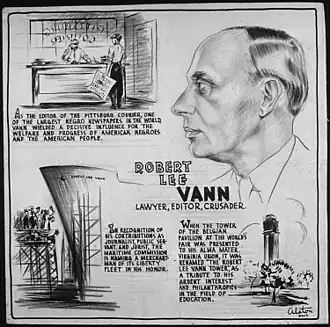
Os jornais afro-americanos floresceram nas principais cidades, com os editores desempenhando um papel importante na política e nos negócios. No século XX, jornais diários apareceram em Norfolk, Chicago, Baltimore e Washington, DC[15] Entre os líderes representativos estavam Robert Sengstacke Abbott (1870–1940) e John H. Sengstacke (1912–1997), editores do Chicago Defender; John Mitchell Jr. (1863–1929), editor do Richmond Planet e presidente da National Afro-American Press Association; Anthony Overton (1865–1946), editor do Chicago Bee; Garth C. Reeves Sr. (1919–2019), editor emérito do Miami Times; e Robert Lee Vann (1879–1940), editor e diretor do Pittsburgh Courier.[16]
Na década de 1940, o número de jornais cresceu de 150 para 250.[17] No final da Segunda Guerra Mundial, os jornais negros com maior circulação nos Estados Unidos eram o Pittsburgh Courier, o Afro-American, o Chicago Defender e o Norfolk Journal and Guide.[18]
De 1881 a 1909, a National Colored Press Association (American Press Association) funcionou como uma associação comercial. A National Negro Press Association, afiliada à National Negro Business League, desempenhou esse papel de 1909 a 1939.[19] A Associated Negro Press (1919–1964), com sede em Chicago, era uma agência de notícias por assinatura "com correspondentes e colaboradores em todos os principais centros de população negra".[20] Em 1940, Sengstacke liderou os editores de jornais afro-americanos na formação da associação comercial conhecida no século XXI como National Newspaper Publishers Association.[21]
Durante as décadas de 1930 e 1940, a imprensa negra do sul dos Estados Unidos tanto auxiliou quanto, em certa medida, dificultou o movimento por igualdade salarial entre professores negros. A cobertura jornalística do movimento serviu para dar visibilidade à causa. No entanto, a forma como o movimento foi retratado, e aqueles cujas lutas foram destacadas na imprensa, relegou as mulheres negras a um segundo plano em relação a um movimento que elas lideraram. Uma questão feminina, e uma questão feminina negra, estava sendo abordada pela imprensa. Contudo, essa cobertura diminuiu o papel das mulheres que lutavam pela igualdade salarial dos professores e “diminuiu a presença da luta pela igualdade salarial dos professores” nos debates nacionais sobre igualdade na educação.[22]

Existiram muitas publicações especializadas para negros, como as de Marcus Garvey e John H. Johnson. Esses homens romperam uma barreira que permitiu a entrada de pessoas negras na sociedade. O Roanoke Tribune foi fundado em 1939 por Fleming Alexander e recentemente celebrou seu 75.º aniversário. O Minnesota Spokesman-Recorder é o jornal de propriedade de negros mais antigo de Minnesota.[23]
Referências
- ↑ Arvarh E. Strickland and Robert E. Weems, eds. The African American Experience: An Historiographical and Bibliographical Guide (Greenwood, 2001), pp. 216–230. ISBN 978-0313298387
- ↑ Simmons, Charles A. The African American press: a history of news coverage during national crises, with special reference to four black newspapers, 1827–1965. McFarland, 2006, p. 2. ISBN 978-0786403875
- ↑ Bacon, Jacqueline (2003). «The History of Freedom's Journal: A Study in Empowerment and Community». The Journal of African American History. 88 (1): 1–20. JSTOR 3559045. doi:10.2307/3559045
- ↑ «Honoring African American Contributions: The Newspapers». 30 de julho de 2020. Consultado em 13 de agosto de 2023. Arquivado do original em 13 de agosto de 2023
- ↑ Knowlton, Steven. «LibGuides: African American Studies: Newspapers: 19th century». Libguides.princeton.edu. Consultado em 25 de outubro de 2017. Arquivado do original em 5 de novembro de 2016
- ↑ «History 313: Manual – Chapter 3». Consultado em 27 de julho de 2016. Arquivado do original em 1 de abril de 2016
- ↑ Anderson, Susan (20 de maio de 2007). «Only the walls will change». Los Angeles Times (em inglês). Consultado em 13 de julho de 2025
- ↑ «Daniel Rudd». Star Quest Production Network (SQPN) (em inglês). 3 de fevereiro de 2020. Consultado em 20 de outubro de 2020. Arquivado do original em 11 de junho de 2020
- ↑ Nina Mjagkij, ed. (2001), Organizing Black America: an Encyclopedia of African American Associations, ISBN 978-0815323099, Garland
- ↑ Gonzalez 2011.
- ↑ Stabel, Meredith (2021). Radicals, Volume 2: Memoir, Essays, and Oratory: Audacious Writings by American Women, 1830-1930 (em inglês). [S.l.]: University of Iowa Press. 173 páginas. ISBN 978-1-60938-768-6. JSTOR j.ctv1m9x358. doi:10.2307/j.ctv1m9x358
- ↑ «The Woman's Era» (em inglês). Josephine St. Pierre Ruffin. Consultado em 12 de fevereiro de 2024 – via Lewis H. Beck Center at Emory University
- ↑ Wade-Gayles, Gloria (1981). «Black Women Journalists in the South, 1880-1905: An Approach to the Study of Black Women's History»
 . Callaloo (11/13): 138–152. ISSN 0161-2492. JSTOR 3043847. doi:10.2307/3043847
- ↑ Rhodes, Jane (1998). Mary Ann Shadd Carry: The Black Press and Protest in the Nineteenth Century. Bloomington: Indiana University Press. pp. 120–123. ISBN 0253213509
- ↑ Jacqueline Bacon, Freedom's journal: the first African-American newspaper (2007).
- ↑ Patrick S. Washburn, The African American Newspaper: Voice of Freedom (2006).
- ↑ Mott, Frank Luther (1950). American Journalism: The history of newspapers in the United States 1690–1950. [S.l.]: Macmillan
- ↑ «Newspapers: The Norfolk Journal and Guide». PBS. Consultado em 2 de agosto de 2025
- ↑ «National Colored Press Association». nkaa.uky.edu. Consultado em 7 de fevereiro de 2022. Arquivado do original em 7 de fevereiro de 2022
- ↑ Associated Negro Press, Chicago Historical Society, consultado em 20 de março de 2017, cópia arquivada em 8 de junho de 2008
- ↑ Osgood, Harley (30 de setembro de 2018). «The National Newspaper Publishers Association (NNPA) (1940– )». Black Past (em inglês). Consultado em 7 de fevereiro de 2022. Arquivado do original em 7 de fevereiro de 2022
- ↑ Aiello, Thomas (fevereiro de 2018). «'Do We Have Any Men to Follow in Her Footsteps?': The Black Southern Press and the Fight for Teacher Salary Equalization». History of Education Quarterly (em inglês). 58 (1): 94–121. ISSN 0018-2680. doi:10.1017/heq.2017.50

- ↑ «About». Minnesota Spokesman-Recorder (em inglês). Consultado em 12 de fevereiro de 2024
Bibliografia
- Bacon, Jacqueline. Freedom's journal: the first African-American newspaper (Lexington Books, 2007)
- Belles, A. Gilbert (1975). «The Black Press in Illinois». Journal of the Illinois State Historical Society. 68 (4): 344–352. JSTOR 40191030 online
- Brown, Warren Henry (1946). Check list of Negro newspapers in the United States (1827–1946). Jefferson City, Mo.: Lincoln University School of Journalism. OCLC 36983520
- Bullock, Penelope L. The Afro-American Periodical Press, 1838–1909 (LSU Press, 1981).
- Buni, Andrew (1974). Robert L. Vann of the Pittsburgh courier: politics and Black journalism. [S.l.]: University of Pittsburgh Press. Arquivado do original em 29 de outubro de 2013
- Burma, John H. (1947). «An Analysis of the Present Negro Press». Social Forces. 26 (2): 172–180. JSTOR 2571774. doi:10.2307/2571774
- Clark, Benjamin Franklin, Sr. "The Editorial Reaction of Selected Southern Black Newspapers to the Civil Rights Movement, 1954-1968" (PhD dissertation, Howard University; ProQuest Dissertations & Theses, 1989. 9006612).
- Dann, Martin E. The Black Press, 1827–1890: The Quest for National Identity (1972). online
- Davis, Ralph N. "The Negro Newspapers and the War." Sociology and Social Research 27 (1943): 378–380.
- Detweiler, Frederick German (1922). The Negro Press in the United States. [S.l.]: U of Chicago Press. ISBN 978-0-7426-4265-2
- Eldridge, Lawrence Allen. Chronicles of a Two-front War: Civil Rights and Vietnam in the African American Press (University of Missouri Press, 2012)
- Finkelman, Paul, ed. (2006). «Newspapers». Encyclopedia of African American History, 1619–1895. 2. [S.l.]: Oxford UP. ISBN 978-0195167771
- Finkle, Lee. Forum for protest: The black press during World War II (Fairleigh Dickinson UP, 1975)
- Frisken, Amanda K. " 'A song without words': Anti-Lynching Imagery in the African American press, 1889–1898.” The Journal of African American History 97#3 2012, pp. 240–69. online
- Gonzalez, Juan; Joseph Torres (2011). News for All the People: The Epic Story of Race and the American Media. [S.l.]: Verso Books. ISBN 978-1844679423
- Gershenhorn, Jerry. Louis Austin and the Carolina Times: A Life in the Long Black Freedom Struggle. (U of North Carolina Press, 2018).
- Grose, Charles William. " Black newspapers in Texas, 1868-1970" (PhD dissertation, University of Texas at Austin; ProQuest Dissertations & Theses, 1972. 7307558).
- Guskin, Emily, Paul Moore, and Amy Mitchell. "African American media: Evolving in the new era." in The State of the News Media 2011 (2011).
- Haram, Kerstyn M. “The Palmetto Leader’s Mission to End Lynching in South Carolina: Black Agency and the Black Press in Columbia, 1925-1940.” South Carolina Historical Magazine 107#4 2006, pp. 310–33. online
- Haywood, D'Weston Lebutler. "Let Us Make Man: Black Newspapers and a Gendered Vision of Racial Advancement, 1915-1960s" (PhD dissertation, Northwestern University; ProQuest Dissertations & Theses, 2013. 3605715).
- Henritze, Barbara K. Bibliographic Checklist of African American Newspapers (Genealogical Publishing Com, 1995)
- Hogan, Lawrence D. A black national news service: the Associated Negro Press and Claude Barnett, 1919–1945 (Fairleigh Dickinson UP, 1984)
- Hutton, Frankie P. "The antebellum black press and the quest for inclusion: Ideals and messages of social responsibility, morality, class and style" (PhD dissertation, Rutgers U; ProQuest Dissertations & Theses, 1990. 9123284).
- Hutton, Frankie, " Social Morality in the Antebellum Black Press ," Journal of Popular Culture, 26#1 (Fall 1992), 71-84.
- Jones, Allen W. (1979). «The Black Press in the "New South": Jesse C. Duke's Struggle for Justice and Equality». The Journal of Negro History. 64 (3): 215–228. JSTOR 2717034. doi:10.2307/2717034
- La Brie, Henry G. A survey of Black newspapers in America (Mercer House Press, 1973).
- Meier, August (1953). «Booker T. Washington and the Negro Press: With Special Reference to the Colored American Magazine». The Journal of Negro History. 38 (1): 67–90. JSTOR 2715814. doi:10.2307/2715814
- Morris, James McGrath. Eye on the Struggle: Ethel Payne, the First Lady of the Black Press (New York: Amistad, 2015). xii, 466 pp.
- “Negro Higher Education as Seen Through the Antebellum Black Press.” The Journal of Blacks in Higher Education, no. 20, (1998), pp. 36–38. online
- Oak, Vishnu Vitthal. The Negro Newspaper (Greenwood, 1970)
- Odum-Hinmon, Maria E. "The Cautious Crusader: How the Atlanta Daily World Covered the Struggle for African American Rights from 1945 to 1985." (PhD Dissertation, U of Maryland, 2005). [1] Arquivado em 2023-12-07 no Wayback Machine
- Penn, Irvine Garland (1891). The Afro-American Press and Its Editors. Massachusetts: Willey and Co.
- Pride, Armistead Scott; Clint C. Wilson (1997). History of the Black Press. [S.l.]: Howard University Press. ISBN 978-0882581927
- Prides, Armistead S. A Register and History of Negro Newspapers in the United States: 1827–1950. (1950)
- Shortell, Timothy. “The Rhetoric of Black Abolitionism: An Exploratory Analysis of Antislavery Newspapers in New York State.” Social Science History 28#1 (2004), pp. 75–109. online
- Simmons, Charles A. The African American press: a history of news coverage during national crises, with special reference to four black newspapers, 1827–1965 (McFarland, 2006).
- Simmons, Charles Alexander. "Uma análise comparativa de quatro jornais negros e suas filosofias editoriais durante as eras da migração para o norte, da Primeira Guerra Mundial, da Segunda Guerra Mundial e do movimento pelos direitos civis." (PhD dissertation, Oklahoma State University; ProQuest Dissertations & Theses, 1995. 9601684).
- Spellman, Charles G. “The Black Press: Setting the Political Agenda During World War II.” Negro History Bulletin, vol. 51 1993, pp. 38–42. online
- Stevens, John D. "Conflict-cooperation content in 14 Black newspapers." Journalism Quarterly 47#3 (1970): 566–568.
- Strickland, Arvarh E., and Robert E. Weems, eds. The African American Experience: An Historiographical and Bibliographical Guide (Greenwood, 2001), pp. 216–230, with long bibliography
- Suggs, Henry Lewis, ed. The Black press in the south, 1865–1979 (Praeger, 1983).
- Suggs, Henry Lewis, ed. The Black Press in the Middle West, 1865–1985 (Greenwood Press, 1996). 416 pp.
- Vercellotti, Timothy, and Paul R. Brewer. “‘To Plead Our Own Cause’: Public Opinion Toward Black and Mainstream News Media among African Americans.” Journal of Black Studies 37#2, 2006, pp. 231–50. online
- Wade-Gayles, Gloria (1981). «Black Women Journalists in the South, 1880-1905: An Approach to the Study of Black Women's History». Callaloo (11/13): 138–152. JSTOR 3043847. doi:10.2307/3043847
- Washburn, Patrick S. The African American Newspaper: Voice of Freedom (Northwestern UP, 2006); covers 1827–1900; emphasis on Pittsburgh Courier and the Chicago Defender
- Washburn, Patrick Scott. A question of sedition: The federal government's investigation of the black press during World War II (Oxford UP, 1986).
- Williams, Kim M. “Black Political Interests on Immigrant Rights: Evidence from Black Newspapers, 2000–2013.” Journal of African American Studies 20# 3/4, 2016, pp. 248–71. online
- Wolseley, Roland Edgar. The black press, USA (Wiley-Blackwell, 1990). online
Fontes primárias
- Dunnigan, Alice. Alone Atop the Hill: The Autobiography of Alice Dunnigan, Pioneer of the National Black Press (University of Georgia Press, 2015)
- La Brie, Henry G. III, Black Pulitzers and Hearsts, coleção de história oral na Biblioteca Butler da Universidade Columbia com mais de 80 entrevistas com editores e publicadores negros