HIP 65426 b
HIP 65426 b, formalmente chamado de Najsakopajk, é um exoplaneta superjúpiter que orbita a estrela-mãe HIP 65426 na constelação de Centaurus. Foi descoberto em 6 de julho de 2017 pelo consórcio SPHERE usando o instrumento Spectro-Polarimetric High-Contrast Exoplanet Research (SPHERE) pertencente ao Observatório Europeu do Sul (ESO), sendo o primeiro planeta confirmado descoberto pelo instrumento SPHERE.[1] [a]Está a 385 anos-luz da Terra.[3] [4] [5] [6] [7] [8] [9]
Observações do Telescópio Espacial James Webb
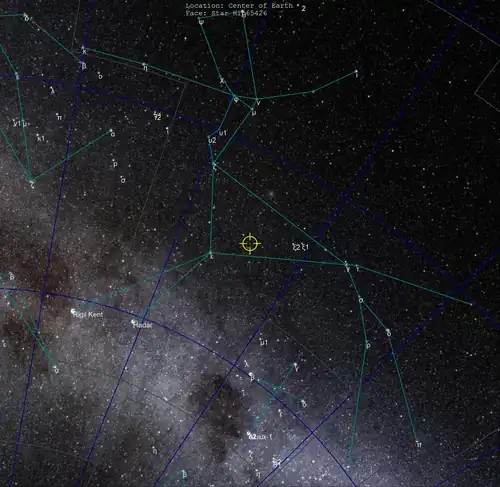
Mapa estelar HIP 65426

HIP 65426 b visto pelo James Webb Space Telescope (Agosto de 2022)
Referências
- ↑ «ESO's SPHERE Unveils its First Exoplanet». www.eso.org (em inglês). Consultado em 7 de julho de 2017
- ↑ Oransky, Ivan (14 de abril de 2022). «Triple sunrise, triple sunset: Science paper retracted when it turns out a planet is a star». Retraction Watch. Consultado em 25 de abril de 2022
- ↑ Chauvin, G.; Desidera, S.; Lagrange, A. -M.; Vigan, A.; Gratton, R.; Langlois, M.; Bonnefoy, M.; Beuzit, J. -L.; Feldt, M.; Mouillet, D.; Meyer, M.; Cheetham, A.; Biller, B.; Boccaletti, A.; d'Orazi, V.; Galicher, R.; Hagelberg, J.; Maire, A. -L.; Mesa, D.; Olofsson, J.; Samland, M.; Schmidt, T. O. B.; Sissa, E.; Bonavita, M.; Charnay, B.; Cudel, M.; Daemgen, S.; Delorme, P.; Janin-Potiron, P.; et al. (2017). «Discovery of a warm, dusty giant planet around HIP 65426». Astronomy and Astrophysics. 605: L9. Bibcode:2017A&A...605L...9C. arXiv:1707.01413
 . doi:10.1051/0004-6361/201731152
- ↑ «Scientists have found a planet that means everything they thought about planets isn't true». The Independent (em inglês). 8 de julho de 2017. Consultado em 2 de agosto de 2019
- ↑ «Astronomers Directly Image Super-Jupiter around HIP 65426 | Astronomy | Sci-News.com». Breaking Science News | Sci-News.com (em inglês). Consultado em 2 de agosto de 2019
- ↑ «Holiday Special: Eight nights of Exoplanet Light». Exoplanet Exploration: Planets Beyond our Solar System. NASA. Consultado em 3 de agosto de 2019
- ↑ Petrus, S.; Bonnefoy, M.; Chauvin, G.; Charnay, B.; Marleau, G.-D.; Gratton, R.; Lagrange, A.-M.; Rameau, J.; Mordasini, C.; Nowak, M.; Delorme, P.; Boccaletti, A.; Carlotti, A.; Houllé, M.; Vigan, A.; Allard, F.; Desidera, S.; d'Orazi, V.; Hoeijmakers, H. J.; Wyttenbach, A.; Lavie, B. (2021), «Medium-resolution spectrum of the exoplanet HIP 65426 B», Astronomy & Astrophysics, 648: A59, Bibcode:2021A&A...648A..59P, arXiv:2012.02798, doi:10.1051/0004-6361/202038914
- ↑ Carter, Aarynn L.; Hinkley, Sasha; Kammerer, Jens; Skemer, Andrew; Biller, Beth A.; Leisenring, Jarron M.; Millar-Blanchaer, Maxwell A.; Petrus, Simon; Stone, Jordan M.; Ward-Duong, Kimberly; Wang, Jason J.; Girard, Julien H.; Hines, Dean C.; Perrin, Marshall D.; Pueyo, Laurent (6 de julho de 2023). «The JWST Early Release Science Program for Direct Observations of Exoplanetary Systems I: High Contrast Imaging of the Exoplanet HIP 65426 b from 2-16 μm». The Astrophysical Journal Letters. 951 (1): L20. Bibcode:2023ApJ...951L..20C. arXiv:2208.14990. doi:10.3847/2041-8213/acd93e
- ↑ «2022 Approved Names». nameexoworlds.iau.org. IAU. Consultado em 7 de junho de 2023
Notas
- ↑ HD 131399 Ab was claimed to be detected earlier via SPHERE, but it was later shown to be an unrelated background object.[2]