Goethea

Erro de citação: Etiqueta <ref> inválida; "refs" sem nome devem ter conteúdo

Goethea
Goethea cauliflora
Goethea cauliflora
Classificação científica
Reino: Plantae
Divisão: Magnoliophyta
Classe: Magnoliopsida
Ordem: Malvales
Família: Malvaceae
Género: Goethea
Espécies

Goethea é um género botânico pertencente à família Malvaceae[1].

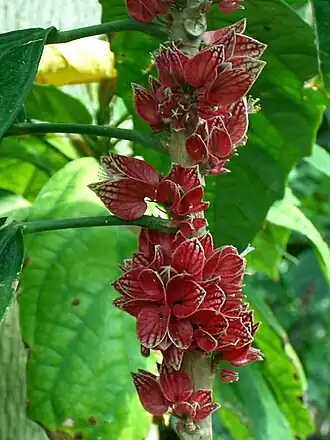
This isn't just a photo of a beautiful red flower. It was the subject of my master's thesis, revealing one of the most wonderful stories involving a Brazilian flower in the history of botany. Here we have the first high-quality photo of one of the world's most famous flowers, one that carries with it great historical and cultural significance. It reveals a rarity, never before seen. The species was discovered by Prince Maximilian of Weid-Neuweid on his 1815-1817 Journey to Brazil, and cultivated in Bonn, Germany, by the philosopher and botanist Christian Gottfried Daniel Nees von Esenbeck. He named it Goethea cauliflora (Nees) in 1821 as a living tribute to the great poet, author, and statesman, Johann Wolfgang von Goethe. The tribute was a return by naturalists to Goethe's interest in Brazil. Over time, the original Goethea (Goethea cauliflora) disappeared, giving way to a cultivated version, renamed Goethea strictiflora (Hook), which survives to this day in botanical gardens around the world. In Germany, it is a living monument in the city of Weimar, where Goethe reigned. Throughout the world, from the United States to China, it is a special attraction. But while the cultivated version became a celebrity in botanical gardens, the original wild species was forgotten and remained missing (unknown) for over a century until it was rediscovered by botanists at the New York Botanical Garden in Ilhéus in 1994. In 1999, the species of this rare genus were relocated to the genus Pavonia. But the original species (Pavonia cauliflora), unlike the cultivated species (Pavonia strictiflora) has become threatened, anonymous and on the verge of extinction in nature, surviving in a last space in a forest park in the city of Ilhéus. This image carries the powerful revelation of one of the first flowers cultivated in Europe as an ornamental, whose name straddles science and culture as a symbol and ecological and cultural monument. Therefore, this photograph is a revelation and recognition of an extremely rare species, which aims to restore its value to Brazil and the world as a natural and cultural monument, representing above all a great call for its recognition and preservation in nature. By searching for its name, we will find hundreds of photos of the cultivated species Goethea strictiflora (P. strictiflora), often mistakenly called Goethea cauliflora (P. cauliflora), although it is in fact the original species. (Source: Master's Dissertation by this author. "Goethea: The Missing Environmental Link," IPÊ-ESCAS, SP, 2015.)
GOETHEA 200 ANOS – O ELO PERDIDO AMBIENTAL

GOETHEA 200 ANOS – O ELO PERDIDO AMBIENTAL

This isn't just a photo of a beautiful red flower. It was the subject of my master's thesis, revealing one of the most wonderful stories involving a Brazilian flower in the history of botany. Here we have the first high-quality photo of one of the world's most famous flowers, one that carries with it great historical and cultural significance. It reveals a rarity, never before seen. The species was discovered by Prince Maximilian of Weid-Neuweid on his 1815-1817 Journey to Brazil, and cultivated in Bonn, Germany, by the philosopher and botanist Christian Gottfried Daniel Nees von Esenbeck. He named it Goethea cauliflora (Nees) in 1821 as a living tribute to the great poet, author, and statesman, Johann Wolfgang von Goethe. The tribute was a return by naturalists to Goethe's interest in Brazil.Over time, the original Goethea (Goethea cauliflora) disappeared, giving way to a cultivated version, renamed Goethea strictiflora (Hook), which survives to this day in botanical gardens around the world. In Germany, it is a living monument in the city of Weimar, where Goethe reigned. Throughout the world, from the United States to China, it is a special attraction. But while the cultivated version became a celebrity in botanical gardens, the original wild species was forgotten and remained missing (unknown) for over a century until it was rediscovered by botanists at the New York Botanical Garden in Ilhéus in 1994. In 1999, the species of this rare genus were relocated to the genus Pavonia. But the original species (Pavonia cauliflora), unlike the cultivated species (Pavonia strictiflora) has become threatened, anonymous and on the verge of extinction in nature, surviving in a last space in a forest park in the city of Ilhéus.This image carries the powerful revelation of one of the first flowers cultivated in Europe as an ornamental, whose name straddles science and culture as a symbol and ecological and cultural monument. Therefore, this photograph is a revelation and recognition of an extremely rare species, which aims to restore its value to Brazil and the world as a natural and cultural monument, representing above all a great call for its recognition and preservation in nature. By searching for its name, we will find hundreds of photos of the cultivated species Goethea strictiflora (P. strictiflora), often mistakenly called Goethea cauliflora (P. cauliflora), although it is in fact the original species. (Source: Master's Dissertation by this author. "Goethea: The Missing Environmental Link," IPÊ-ESCAS, SP, 2015.)
Goethea cauliflora[2] (Nees) x Goethea strictiflora (Hook.)

Dissertação sobre a redescoberta da verdadeira Goethea cauliflora (Nees, 1821) na natureza e os esforços necessários a sua proteção.

  1. «Goethea — World Flora Online». www.worldfloraonline.org. Consultado em 19 de agosto de 2020 
  2. Paiva, PSP. Goethea: O Elo Perdido Ambiental, IPÊ-ESCAS, SP, 2015.