George Rodney
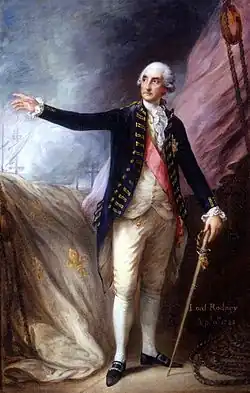
George Brydges Rodney, 1º Barão Rodney, KB (bat. 13 de fevereiro de 1718 – 24 de maio de 1792), foi um oficial da Marinha Real, político e administrador colonial. Ele é mais conhecido por seus comandos na Guerra da Independência Americana, particularmente sua vitória sobre os franceses na Batalha de Saintes em 1782. Frequentemente afirma-se que ele foi o comandante que pioneiramente empregou a tática de romper a linha.
Vida
Rodney veio de uma origem distinta, porém pobre, e foi para o mar aos quatorze anos. Sua primeira ação importante foi a Segunda Batalha do Cabo Finisterra em 1747. Ele conseguiu uma grande quantia de dinheiro de presas durante a década de 1740, permitindo-lhe comprar uma grande propriedade rural e um assento na Câmara dos Comuns da Grã-Bretanha. Durante a Guerra dos Sete Anos, Rodney esteve envolvido em várias operações anfíbias, como os ataques a Rochefort e Le Havre e o Cerco de Louisbourg. Ele tornou-se conhecido por seu papel na captura de Martinica em 1762. Após o Tratado de Paris, a situação financeira de Rodney estagnou. Ele gastou grandes somas de dinheiro perseguindo suas ambições políticas. Em 1774, havia acumulado grandes dívidas e foi forçado a fugir da Grã-Bretanha para evitar seus credores. Ele estava em uma prisão francesa quando a guerra foi declarada em 1778. Graças a um benfeitor francês, Rodney pôde garantir sua libertação e retornar à Grã-Bretanha, onde foi nomeado para um novo comando.[1][2][3]
Rodney conseguiu aliviar Gibraltar durante o Grande Cerco e derrotou uma frota espanhola durante a Batalha do Cabo de São Vicente de 1780, conhecida como "Batalha do Luar" porque ocorreu à noite. Ele então foi enviado para a Estação da Jamaica, onde se envolveu na controversa captura de Santo Eustáquio em 1781. Mais tarde naquele ano, ele brevemente retornou à Inglaterra sofrendo de problemas de saúde. Durante sua ausência, os britânicos perderam a crucial Batalha de Chesapeake, levando à rendição em Yorktown.[1][2][3]
Para alguns, Rodney era uma figura controversa, acusada de obsessão por dinheiro de presas. Isso chegou ao auge após sua tomada de Santo Eustáquio, pela qual foi fortemente criticado na Grã-Bretanha. Ordens para seu retorno haviam sido enviadas quando Rodney venceu uma vitória decisiva na Batalha de Saintes em abril de 1782, acabando com a ameaça francesa à Jamaica.[1][2][3]
Rodney acompanhou o futuro Rei Guilherme IV em sua visita (abril de 1783) a Cuba. Lá o príncipe conferenciou com o Capitão General Luis de Unzaga para chegar aos preliminares das condições de paz que mais tarde reconheceriam o nascimento dos Estados Unidos da América.[4] Em seu retorno à Grã-Bretanha, Rodney foi feito nobre e recebeu uma pensão anual de £2 000. Ele viveu em aposentadoria até sua morte em 1792.[1][2][3]
Referências
- ↑ a b c d Hannay, David. Life of Rodney. Macmillan, 1891.
- ↑ a b c d Stewart, William. Admirals of the World: A Biographical Dictionary 1500 to the Present. McFarland, 2009.
- ↑ a b c d Fraser, Edward (2009). Famous Fighters of the Fleet: Glimpses Through the Cannon Smoke in the Days of the Old Navy (1904). [S.l.]: Kessinger Publishing. ISBN 9781104820039
- ↑ Cazorla, Frank, Baena, Rose, Polo, David, Reder Gadow, Marion (2019) The governor Louis de Unzaga (1717-1793) Pioneer in the birth of the United States of America and in Liberalism. Foundation. Malaga. pages 108–116
Bibliografia
- Cundall, Frank (1915). Historic Jamaica. [S.l.]: West India Committee
- The Naval Chronicle, Volume 1 1799, J. Gold, London. (reissued by Cambridge University Press, 2010. ISBN 978-1-108-01840-1
- Fleming, Thomas. The Perils of Peace: America's Struggle for Survival After Yorktown. First Smithsonian books, 2008.
- Hibbert, Christopher. Redcoats and Rebels: The American Revolution Through British Eyes. Avon Books, 1990.
- General Mundy, Life and Correspondence of Admiral Lord Rodney (2 vols, 1830)
- O'Shaunhassey, Andrew Jackson. The Men Who Lost America: British Leadership, the American Revolution and the Fate of Empire. Yale University Press, 2013.
- Rodger, N. A. M. Command of the Ocean: A Naval History of Britain, 1649–1815. Penguin Books, 2006.
- Spinney, David. Rodney, George Allen & Unwin, 1969.
- Trew, Peter. Rodney and the Breaking of the Line. Pen and Sword, 2006.
- Weintraub, Stanley. Iron Tears: Rebellion in America, 1775–1783. Simon & Schuster, 2005.
- Rodney letters in 9th Report of Hist. manuscripts Coin., pt. iiL; "Memoirs," in Naval Chronicle, i. 353–93; and Charnock, Biographia Navalis, v. 204–28. Lord Rodney published in his lifetime (probably 1789)
- Letters to His Majesty's Ministers, etc., relative to St Eustatius, etc., of which there is a copy in the British Museum. Most of these letters are printed in Mundy's Life, vol. ii., though with many variant readings.
Leitura adicional
- Arbell, Mordechai. The Jewish Nation of the Caribbean, The Spanish-Portuguese Jewish Settlements in the Caribbean and the Guianas (2002) Geffen Press, Jerusalem
- Bernardini, P. & Fiering, N. (editors). The Jews and the Expansion of Europe to the West, 1450–1800 (2001), Berghan Press
- Charnock, John. Biographia Navalis volume, 5 pg 204–228. 1797, London.
- Ezratty, Harry. 500 Years in the Jewish Caribbean – The Spanish and Portuguese Jews in the West Indies (1997) Omni Arts, Baltimore
- Macintyre, Donald. Admiral Rodney (1962) Peter Davies, London.
- Middleton, Richard. The War of American Independence, 1775–1783. Pearson. London, 2012
- Mundy, Godfrey Basil. Life and Correspondence of Admiral Lord Rodney, Vols 1 and 2 1830
- Syrett, David. The Rodney Papers: selections from the correspondence of Admiral Lord Rodney 2007, Ashgate Publishing Ltd
- Hartog, J. History of St. Eustatius (1976) Central USA Bicentennial Committee of the Netherlands Antilles
- Attema, Y. A Short History of St. Eustatius and its Monuments (1976) Wahlberg Pers
Ligações externas
 Media relacionados com George Rodney no Wikimedia Commons
- Government House The Governorship of Newfoundland and Labrador
- George Rodney (em inglês) no Find a Grave
- "Retribution:Admiral Rodney and the Jews of St. Eustatius", by Louis Arthur Norton
- Chapter III, Rodney: The Form in George Rodney no Projeto Gutenberg , by A. T. Mahan
| Controle de autoridade |
|
|---|
