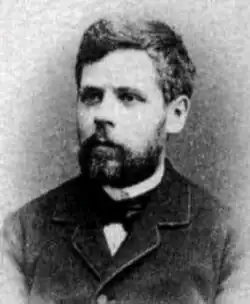
Friedrich Schottky
| Friedrich Hermann Schottky | |
|---|---|
 | |
| Nascimento | 24 de julho de 1851 |
| Morte | 12 de agosto de 1935 (84 anos) |
| Alma mater | Universidade Humboldt de Berlim |
| Carreira científica | |
| Orientador(es)(as) | Karl Weierstrass e Hermann von Helmholtz |
| Orientado(a)(s) | Heinrich Jung, Paul Koebe, Konrad Knopp, Leon Lichtenstein, Herman Müntz |
| Campo(s) | Matemática |
| Tese | 1875: Ueber die conforme Abbildung mehrfach zusammenhaengender ebener Flaechen |
Friedrich Hermann Schottky (Wrocław, 24 de julho de 1851 — Berlim, 12 de agosto de 1935) foi um matemático alemão.
Pai do físico alemão Walter Schottky.
Trabalhou com funções elípticas, variedade abeliana e função teta, e inventou o grupo de Schottky.
Obras
Ver também
- Problema de Schottky
Ligações externas
- O'Connor, John J.; Robertson, Edmund F., «Friedrich Schottky», MacTutor History of Mathematics archive (em inglês), Universidade de St. Andrews
- Friedrich Schottky (em inglês) no Mathematics Genealogy Project
