Fator de crescimento fibroblástico 19
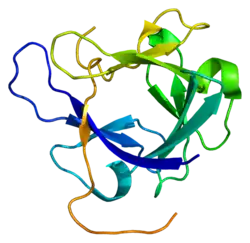
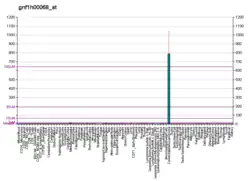
Fator de crescimento de fibroblastos 19 (FGF19) é uma proteína que em humanos é codificada pelo gene FGF19.[2] Funciona como um hormônio, regulando a síntese de ácidos biliares, com efeitos no metabolismo de glicose e lipídios. A síntese reduzida e os níveis sanguíneos baixos podem ser um fator na diarreia crônica por ácidos biliares e em certos distúrbios metabólicos.[3][4]
Funções
A proteína codificada por este gene é um membro da família do fator de crescimento de fibroblastos (FGF). Os membros da família FGF possuem amplas atividades mitogênicas e de sobrevivência celular, e estão envolvidos em uma variedade de processos biológicos, incluindo desenvolvimento embrionário, crescimento celular, morfogênese, reparo tecidual, crescimento tumoral e invasão. Este fator de crescimento é um ligante de alta afinidade, dependente de heparina, para o FGFR4 [en].[5] A expressão deste gene foi detectada apenas em tecido cerebral fetal, mas não adulto.[6] Foi demonstrado que a interação sinérgica do homólogo de pinto e Wnt-8c é necessária para o início do desenvolvimento do ouvido interno.[2][7][8]
A proteína ortóloga em tatos é o FGF15, que compartilha cerca de 50% de identidade de aminoácidos e tem funções semelhantes. Juntos, eles são frequentemente referidos como FGF15/19.[3][4]
O FGF19 tem papéis importantes como um hormônio produzido no íleo em resposta à absorção de ácidos biliares.[4] Os ácidos biliares ligam-se ao receptor X farnesóide (FXR), estimulando a transcrição do FGF19. Vários elementos de resposta a FXR / ácidos biliares foram identificados no gene FGF19.[9] Transcritos de FGF19 humano demonstraram ser estimulados aproximadamente 300 vezes por concentrações fisiológicas de ácidos biliares, incluindo ácido quenodesoxicólico [en], ácido glicoquenodesoxicólico [en] e ácido obeticólico [en] em explantes de mucosa ileal.[10]
O FGF19 regula a síntese de novos ácidos biliares, atuando através dos complexos receptores FGFR4 [en]/Klotho [en]-β no fígado para inibir a CYP7A1 [en].[11][12][13][14]
O FGF19 também tem efeitos metabólicos, afetando o metabolismo de glicose e lipídios quando usado em modelos experimentais de ratos.[15][16][17]
Quando o FGF19 foi inibido por anticorpos específicos anti-FGF19 em macacos, o resultado foi diarreia grave. Também houve evidência de toxicidade hepática. Foram encontrados aumentos na síntese de ácidos biliares, ácidos biliares totais séricos e fecais, e transportadores específicos de ácidos biliares.[18]
Papel como promotor de câncer
O FGF19 é frequentemente amplificado em cânceres humanos.[19] A amplificação do locus genômico do FGF19 foi encontrada em câncer de fígado, câncer de mama, câncer de pulmão, câncer de próstata, câncer de bexiga e câncer de esôfago, entre outros.[20][21][22][23][24] O direcionamento ao FGF19 inibe o crescimento tumoral em células de câncer de cólon e carcinoma hepatocelular.[25][26] O aumento do FGF19 correlaciona-se com a progressão tumoral e pior prognóstico do carcinoma hepatocelular.[27][28][29]
Significância clínica
Pacientes com diarreia crônica devido à má absorção de ácidos biliares [en] demonstraram ter FGF19 em jejum reduzido.[30] A ressecção cirúrgica do íleo (como ocorre frequentemente na doença de Crohn) reduzirá a absorção de ácidos biliares e removerá o estímulo para a produção de FGF19.
Na diarreia primária por ácidos biliares, a absorção de ácidos biliares é geralmente normal, mas a produção defeituosa de FGF19 pode produzir síntese excessiva de ácidos biliares, conforme demonstrado por níveis aumentados de 7α-hidroxi-4-colesten-3-ona [en], e perda fecal excessiva de ácidos biliares, indicada pela retenção reduzida de SeHCAT [en].[30][31] Isso foi confirmado em um estudo prospectivo de pacientes com diarreia crônica, onde o valor preditivo para FGF19 no diagnóstico de diarreia primária por ácidos biliares e resposta aos sequestradores de ácidos biliares foi demonstrado.[32]
O FGF19 também é encontrado no fígado de pacientes com colestase.[33] Pode ser sintetizado na vesícula biliar e secretado na bile.[34] O FGF19 é expresso em cerca de metade dos carcinomas hepatocelulares e foi associado a tamanho maior, recorrência precoce e mau prognóstico.[35]
Pacientes com síndrome metabólica, doença hepática gordurosa não alcoólica e resistência à insulina têm níveis reduzidos de FGF19.[36][37] O FGF19 aumenta para valores normais em pacientes obesos que se submetem a bypass gástrico em Y de Roux e outros tipos de cirurgia bariátrica.[38][39]
Referências
- ↑ «Human PubMed Reference:»
- ↑ a b «Entrez Gene: FGF19 fibroblast growth factor 19»
- ↑ a b Jones SA (2012). «Physiology of FGF15/19». Endocrine FGFS and Klothos. Col: Advances in Experimental Medicine and Biology. 728. [S.l.: s.n.] pp. 171–82. ISBN 978-1-4614-0886-4. PMID 22396169. doi:10.1007/978-1-4614-0887-1_11
- ↑ a b c Potthoff MJ, Kliewer SA, Mangelsdorf DJ (2012). «Endocrine fibroblast growth factors 15/19 and 21: from feast to famine». Genes Dev. 26 (4): 312–24. PMC 3289879
 . PMID 22302876. doi:10.1101/gad.184788.111
- ↑ Xie MH, Holcomb I, Deuel B, Dowd P, Huang A, Vagts A, Foster J, Liang J, Brush J, Gu Q, Hillan K, Goddard A, Gurney AL (1999). «FGF-19, a novel fibroblast growth factor with unique specificity for FGFR4». Cytokine. 11 (10): 729–35. PMID 10525310. doi:10.1006/cyto.1999.0485
- ↑ Nishimura T, Utsunomiya Y, Hoshikawa M, Ohuchi H, Itoh N (1999). «Structure and expression of a novel human FGF, FGF-19, expressed in the fetal brain». Biochim. Biophys. Acta. 1444 (1): 148–51. PMID 9931477. doi:10.1016/S0167-4781(98)00255-3
- ↑ Ladher RK, Anakwe KU, Gurney AL, Schoenwolf GC, Francis-West PH (2000). «Identification of synergistic signals initiating inner ear development». Science. 290 (5498): 1965–7. Bibcode:2000Sci...290.1965L. PMID 11110663. doi:10.1126/science.290.5498.1965
- ↑ Tamimi Y, Skarie JM, Footz T, Berry FB, Link BA, Walter MA (2006). «FGF19 is a target for FOXC1 regulation in ciliary body-derived cells». Hum. Mol. Genet. 15 (21): 3229–40. PMID 17000708. doi:10.1093/hmg/ddl400
- ↑ Miyata M, Hata T, Yamakawa H, Kagawa T, Yoshinari K, Yamazoe Y (2012). «Involvement of multiple elements in FXR-mediated transcriptional activation of FGF19». J. Steroid Biochem. Mol. Biol. 132 (1–2): 41–7. PMID 22561792. doi:10.1016/j.jsbmb.2012.04.008
- ↑ Zhang JH, Nolan JD, Kennie SL, Johnston IM, Dew T, Dixon PH, Williamson C, Walters JR (2013). «Potent stimulation of fibroblast growth factor 19 expression in the human ileum by bile acids». Am. J. Physiol. Gastrointest. Liver Physiol. 304 (10): G940–8. PMC 3652069. PMID 23518683. doi:10.1152/ajpgi.00398.2012
- ↑ Holt JA, Luo G, Billin AN, Bisi J, McNeill YY, Kozarsky KF, Donahee M, Wang DY, Mansfield TA, Kliewer SA, Goodwin B, Jones SA (2003). «Definition of a novel growth factor-dependent signal cascade for the suppression of bile acid biosynthesis». Genes Dev. 17 (13): 1581–91. PMC 196131. PMID 12815072. doi:10.1101/gad.1083503
- ↑ Lin BC, Wang M, Blackmore C, Desnoyers LR (2007). «Liver-specific activities of FGF19 require Klotho beta». J. Biol. Chem. 282 (37): 27277–84. PMID 17627937. doi:10.1074/jbc.M704244200
- ↑ Wu X, Ge H, Gupte J, Weiszmann J, Shimamoto G, Stevens J, Hawkins N, Lemon B, Shen W, Xu J, Veniant MM, Li YS, Lindberg R, Chen JL, Tian H, Li Y (2007). «Co-receptor requirements for fibroblast growth factor-19 signaling». J. Biol. Chem. 282 (40): 29069–72. PMID 17711860. doi:10.1074/jbc.C700130200
- ↑ Goetz R, Beenken A, Ibrahimi OA, Kalinina J, Olsen SK, Eliseenkova AV, Xu C, Neubert TA, Zhang F, Linhardt RJ, Yu X, White KE, Inagaki T, Kliewer SA, Yamamoto M, Kurosu H, Ogawa Y, Kuro-o M, Lanske B, Razzaque MS, Mohammadi M (2007). «Molecular insights into the klotho-dependent, endocrine mode of action of fibroblast growth factor 19 subfamily members». Mol. Cell. Biol. 27 (9): 3417–28. PMC 1899957. PMID 17339340. doi:10.1128/MCB.02249-06
- ↑ Tomlinson E, Fu L, John L, Hultgren B, Huang X, Renz M, Stephan JP, Tsai SP, Powell-Braxton L, French D, Stewart TA (2002). «Transgenic mice expressing human fibroblast growth factor-19 display increased metabolic rate and decreased adiposity». Endocrinology. 143 (5): 1741–7. PMID 11956156. doi:10.1210/endo.143.5.8850
- ↑ Fu L, John LM, Adams SH, Yu XX, Tomlinson E, Renz M, Williams PM, Soriano R, Corpuz R, Moffat B, Vandlen R, Simmons L, Foster J, Stephan JP, Tsai SP, Stewart TA (2004). «Fibroblast growth factor 19 increases metabolic rate and reverses dietary and leptin-deficient diabetes». Endocrinology. 145 (6): 2594–603. PMID 14976145. doi:10.1210/en.2003-1671
- ↑ Kir S, Beddow SA, Samuel VT, Miller P, Previs SF, Suino-Powell K, Xu HE, Shulman GI, Kliewer SA, Mangelsdorf DJ (2011). «FGF19 as a postprandial, insulin-independent activator of hepatic protein and glycogen synthesis». Science. 331 (6024): 1621–4. Bibcode:2011Sci...331.1621K. PMC 3076083. PMID 21436455. doi:10.1126/science.1198363
- ↑ Pai R, French D, Ma N, Hotzel K, Plise E, Salphati L, Setchell KD, Ware J, Lauriault V, Schutt L, Hartley D, Dambach D (2012). «Antibody-mediated inhibition of fibroblast growth factor 19 results in increased bile acids synthesis and ileal malabsorption of bile acids in cynomolgus monkeys». Toxicol. Sci. 126 (2): 446–456. PMID 22268002. doi:10.1093/toxsci/kfs011
- ↑ Liu Y, Cao M, Cai Y, Li X, Zhao C, Cui R (2020). «Dissecting the Role of the FGF19-FGFR4 Signaling Pathway in Cancer Development and Progression». Frontiers in Cell and Developmental Biology. 8: 95. PMC 7044267. PMID 32154250. doi:10.3389/fcell.2020.00095
- ↑ Sawey ET, Chanrion M, Cai C, Wu G, Zhang J, Zender L, et al. (março de 2011). «Identification of a therapeutic strategy targeting amplified FGF19 in liver cancer by Oncogenomic screening». Cancer Cell. 19 (3): 347–58. PMC 3061399. PMID 21397858. doi:10.1016/j.ccr.2011.01.040
- ↑ Hoover H, Li J, Marchese J, Rothwell C, Borawoski J, Jeffery DA, et al. (setembro de 2015). «Quantitative Proteomic Verification of Membrane Proteins as Potential Therapeutic Targets Located in the 11q13 Amplicon in Cancers». Journal of Proteome Research. 14 (9): 3670–9. PMID 26151158. doi:10.1021/acs.jproteome.5b00508
- ↑ Nagamatsu H, Teishima J, Goto K, Shikuma H, Kitano H, Shoji K, et al. (julho de 2015). «FGF19 promotes progression of prostate cancer». The Prostate. 75 (10): 1092–101. PMID 25854696. doi:10.1002/pros.22994
- ↑ Tiong KH, Tan BS, Choo HL, Chung FF, Hii LW, Tan SH, et al. (setembro de 2016). «Fibroblast growth factor receptor 4 (FGFR4) and fibroblast growth factor 19 (FGF19) autocrine enhance breast cancer cells survival». Oncotarget. 7 (36): 57633–57650. PMC 5295378. PMID 27192118. doi:10.18632/oncotarget.9328
- ↑ Zhang X, Kong M, Zhang Z, Xu S, Yan F, Wei L, Zhou J (novembro de 2017). «FGF19 genetic amplification as a potential therapeutic target in lung squamous cell carcinomas». Thoracic Cancer. 8 (6): 655–665. PMC 5668513. PMID 28906590. doi:10.1111/1759-7714.12504
- ↑ Desnoyers LR, Pai R, Ferrando RE, Hötzel K, Le T, Ross J, et al. (janeiro de 2008). «Targeting FGF19 inhibits tumor growth in colon cancer xenograft and FGF19 transgenic hepatocellular carcinoma models». Oncogene. 27 (1): 85–97. PMID 17599042. doi:10.1038/sj.onc.1210623
- ↑ French DM, Lin BC, Wang M, Adams C, Shek T, Hötzel K, et al. (2012). «Targeting FGFR4 inhibits hepatocellular carcinoma in preclinical mouse models». PLOS ONE. 7 (5). Bibcode:2012PLoSO...736713F. PMC 3352934. PMID 22615798. doi:10.1371/journal.pone.0036713
- ↑ Miura S, Mitsuhashi N, Shimizu H, Kimura F, Yoshidome H, Otsuka M, et al. (fevereiro de 2012). «Fibroblast growth factor 19 expression correlates with tumor progression and poorer prognosis of hepatocellular carcinoma». BMC Cancer. 12: 56. PMC 3293719. PMID 22309595. doi:10.1186/1471-2407-12-56
- ↑ Zhao H, Lv F, Liang G, Huang X, Wu G, Zhang W, et al. (março de 2016). «FGF19 promotes epithelial-mesenchymal transition in hepatocellular carcinoma cells by modulating the GSK3β/β- catenin signaling cascade via FGFR4 activation». Oncotarget. 7 (12): 13575–86. PMC 4924662. PMID 26498355. doi:10.18632/oncotarget.6185
- ↑ Hyeon J, Ahn S, Lee JJ, Song DH, Park CK (julho de 2013). «Expression of fibroblast growth factor 19 is associated with recurrence and poor prognosis of hepatocellular carcinoma». Digestive Diseases and Sciences. 58 (7): 1916–22. PMID 23456506. doi:10.1007/s10620-013-2609-x
- ↑ a b Walters JR, Tasleem AM, Omer OS, Brydon WG, Dew T, le Roux CW (2009). «A new mechanism for bile acid diarrhea: defective feedback inhibition of bile acid biosynthesis». Clin. Gastroenterol. Hepatol. 7 (11): 1189–94. PMID 19426836. doi:10.1016/j.cgh.2009.04.024
- ↑ Hofmann AF, Mangelsdorf DJ, Kliewer SA (2009). «Chronic diarrhea due to excessive bile acid synthesis and not defective ileal transport: a new syndrome of defective fibroblast growth factor 19 release». Clin. Gastroenterol. Hepatol. 7 (11): 1151–4. PMC 2850200. PMID 19665580. doi:10.1016/j.cgh.2009.07.026
- ↑ Pattni SS, Brydon WG, Dew T, Johnston IM, Nolan JD, Srinivas M, Basumani P, Bardhan KD, Walters JR (2013). «Fibroblast growth factor 19 in patients with bile acid diarrhoea: a prospective comparison of FGF19 serum assay and SeHCAT retention». Aliment. Pharmacol. Ther. 38 (8): 967–76. PMID 23981126. doi:10.1111/apt.12466
- ↑ Schaap FG, van der Gaag NA, Gouma DJ, Jansen PL (2009). «High expression of the bile salt-homeostatic hormone fibroblast growth factor 19 in the liver of patients with extrahepatic cholestasis». Hepatology. 49 (4): 1228–35. PMID 19185005. doi:10.1002/hep.22771
- ↑ Zweers SJ, Booij KA, Komuta M, Roskams T, Gouma DJ, Jansen PL, Schaap FG (2012). «The human gallbladder secretes fibroblast growth factor 19 into bile: towards defining the role of fibroblast growth factor 19 in the enterobiliary tract». Hepatology. 55 (2): 575–83. PMID 21953282. doi:10.1002/hep.24702
- ↑ Hyeon J, Ahn S, Lee JJ, Song DH, Park CK (2013). «Expression of fibroblast growth factor 19 is associated with recurrence and poor prognosis of hepatocellular carcinoma». Dig. Dis. Sci. 58 (7): 1916–22. PMID 23456506. doi:10.1007/s10620-013-2609-x
- ↑ Stejskal D, Karpísek M, Hanulová Z, Stejskal P (2008). «Fibroblast growth factor-19: development, analytical characterization and clinical evaluation of a new ELISA test». Scand. J. Clin. Lab. Invest. 68 (6): 501–7. PMID 18609104. doi:10.1080/00365510701854967
- ↑ Schreuder TC, Marsman HA, Lenicek M, van Werven JR, Nederveen AJ, Jansen PL, Schaap FG (2010). «The hepatic response to FGF19 is impaired in patients with nonalcoholic fatty liver disease and insulin resistance». Am. J. Physiol. Gastrointest. Liver Physiol. 298 (3): G440–5. PMID 20093562. doi:10.1152/ajpgi.00322.2009
- ↑ Pournaras DJ, Glicksman C, Vincent RP, Kuganolipava S, Alaghband-Zadeh J, Mahon D, Bekker JH, Ghatei MA, Bloom SR, Walters JR, Welbourn R, le Roux CW (2012). «The role of bile after Roux-en-Y gastric bypass in promoting weight loss and improving glycaemic control». Endocrinology. 153 (8): 3613–9. PMC 3404349. PMID 22673227. doi:10.1210/en.2011-2145
- ↑ Ryan PM, Hayward NE, Sless RT, Garwood P, Rahmani J (agosto de 2020). «Effect of bariatric surgery on circulating FGF-19: A systematic review and meta-analysis». Obesity Reviews. 21 (8). PMID 32329176. doi:10.1111/obr.13038
Leitura adicional
- Nicholes K, Guillet S, Tomlinson E, Hillan K, Wright B, Frantz GD, Pham TA, Dillard-Telm L, Tsai SP, Stephan JP, Stinson J, Stewart T, French DM (2002). «A mouse model of hepatocellular carcinoma: ectopic expression of fibroblast growth factor 19 in skeletal muscle of transgenic mice». Am. J. Pathol. 160 (6): 2295–307. PMC 1850847. PMID 12057932. doi:10.1016/S0002-9440(10)61177-7
- Katoh M, Katoh M (2003). «Evolutionary conservation of CCND1-ORAOV1-FGF19-FGF4 locus from zebrafish to human». Int. J. Mol. Med. 12 (1): 45–50. PMID 12792807. doi:10.3892/ijmm.12.1.45
- Harmer NJ, Pellegrini L, Chirgadze D, Fernandez-Recio J, Blundell TL (2004). «The crystal structure of fibroblast growth factor (FGF) 19 reveals novel features of the FGF family and offers a structural basis for its unusual receptor affinity» (PDF). Biochemistry. 43 (3): 629–40. PMID 14730967. doi:10.1021/bi035320k. Consultado em 30 de setembro de 2019. Cópia arquivada (PDF) em 8 de agosto de 2017