Fator de crescimento fibroblástico 13
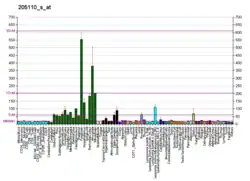
Fator de crescimento de fibroblastos 13 é uma proteína que em humanos é codificada pelo gene FGF13.[2][3]
A proteína codificada por este gene é um membro da família do fator de crescimento de fibroblastos (FGF). Os membros da família FGF possuem amplas atividades mitogênicas e de sobrevivência celular, e estão envolvidos numa variedade de processos biológicos, incluindo desenvolvimento embrionário, crescimento celular, morfogênese, reparo tecidual, crescimento de tumores, invasão e fisiologia neuronal. Este gene está localizado numa região associada à síndrome de Börjeson-Forssman-Lehmann [en] (BFLS), uma deficiência intelectual sindrômica ligada ao X, o que sugere que pode ser um gene candidato para casos familiares da síndrome BFL. A função deste gene ainda não foi determinada. Foram descritos vários transcritos alternativamente processados (spliced) que codificam diferentes isoformas para este gene.[3] A isoforma 1 do FGF13 (FGF13A) liga-se às repetições ricas em leucina do receptor específico de hominídeos LRRC37B [en].[4] Em neurônios piramidais humanos do córtex cerebral, essa interação leva a uma menor excitabilidade,[4] uma propriedade celular divergente dos neurônios piramidais humanos em comparação com outros mamíferos.[4]
Referências
- ↑ «Human PubMed Reference:»
- ↑ Smallwood PM, Munoz-Sanjuan I, Tong P, Macke JP, Hendry SH, Gilbert DJ, Copeland NG, Jenkins NA, Nathans J (Out 1996). «Fibroblast growth factor (FGF) homologous factors: new members of the FGF family implicated in nervous system development». Proc Natl Acad Sci U S A. 93 (18): 9850–7. Bibcode:1996PNAS...93.9850S. PMC 38518
 . PMID 8790420. doi:10.1073/pnas.93.18.9850
- ↑ a b «Entrez Gene: FGF13 fibroblast growth factor 13»
- ↑ a b c Libé-Philippot, Baptiste; Lejeune, Amélie; Wierda, Keimpe; Louros, Nikolaos; Erkol, Emir; Vlaeminck, Ine; Beckers, Sofie; Gaspariunaite, Vaiva; Bilheu, Angéline; Konstantoulea, Katerina; Nyitrai, Hajnalka; De Vleeschouwer, Matthias; Vennekens, Kristel M.; Vidal, Niels; Bird, Thomas W. (21 de dezembro de 2023). «LRRC37B is a human modifier of voltage-gated sodium channels and axon excitability in cortical neurons». Cell. 186 (26): 5766–5783.e25. ISSN 0092-8674. PMC 10754148. PMID 38134874. doi:10.1016/j.cell.2023.11.028
Leitura adicional
- Gerhard DS, Wagner L, Feingold EA, et al. (2004). «The status, quality, and expansion of the NIH full-length cDNA project: the Mammalian Gene Collection (MGC).». Genome Res. 14 (10B): 2121–7. PMC 528928. PMID 15489334. doi:10.1101/gr.2596504
- Wittmack EK, Rush AM, Craner MJ, et al. (2005). «Fibroblast growth factor homologous factor 2B: association with Nav1.6 and selective colocalization at nodes of Ranvier of dorsal root axons.». J. Neurosci. 24 (30): 6765–75. PMC 6729706. PMID 15282281. doi:10.1523/JNEUROSCI.1628-04.2004
- Popovici C, Conchonaud F, Birnbaum D, Roubin R (2004). «Functional phylogeny relates LET-756 to fibroblast growth factor 9.». J. Biol. Chem. 279 (38): 40146–52. PMID 15199049. doi:10.1074/jbc.M405795200
- Facchiano A, Russo K, Facchiano AM, et al. (2003). «Identification of a novel domain of fibroblast growth factor 2 controlling its angiogenic properties.». J. Biol. Chem. 278 (10): 8751–60. PMID 12496262. doi:10.1074/jbc.M209936200
- Strausberg RL, Feingold EA, Grouse LH, et al. (2003). «Generation and initial analysis of more than 15,000 full-length human and mouse cDNA sequences.». Proc. Natl. Acad. Sci. U.S.A. 99 (26): 16899–903. Bibcode:2002PNAS...9916899M. PMC 139241. PMID 12477932. doi:10.1073/pnas.242603899
- Schoorlemmer J, Goldfarb M (2003). «Fibroblast growth factor homologous factors and the islet brain-2 scaffold protein regulate activation of a stress-activated protein kinase.». J. Biol. Chem. 277 (51): 49111–9. PMC 4266389. PMID 12244047. doi:10.1074/jbc.M205520200
- Knox S, Merry C, Stringer S, et al. (2002). «Not all perlecans are created equal: interactions with fibroblast growth factor (FGF) 2 and FGF receptors.». J. Biol. Chem. 277 (17): 14657–65. PMID 11847221. doi:10.1074/jbc.M111826200
- Munoz-Sanjuan I, Smallwood PM, Nathans J (2000). «Isoform diversity among fibroblast growth factor homologous factors is generated by alternative promoter usage and differential splicing.». J. Biol. Chem. 275 (4): 2589–97. PMID 10644718. doi:10.1074/jbc.275.4.2589
- Gecz J, Baker E, Donnelly A, et al. (1999). «Fibroblast growth factor homologous factor 2 (FHF2): gene structure, expression and mapping to the Börjeson-Forssman-Lehmann syndrome region in Xq26 delineated by a duplication breakpoint in a BFLS-like patient.». Hum. Genet. 104 (1): 56–63. PMID 10071193. doi:10.1007/s004390050910
- Yao DL, Masonic K, Petullo D, et al. (1999). «Pretreatment with intravenous FGF-13 reduces infarct volume and ameliorates neurological deficits following focal cerebral ischemia in rats.». Brain Res. 818 (1): 140–6. PMID 9914447. doi:10.1016/S0006-8993(98)01118-4
- Greene JM, Li YL, Yourey PA, et al. (1998). «Identification and characterization of a novel member of the fibroblast growth factor family.». Eur. J. Neurosci. 10 (5): 1911–25. PMID 9751161. doi:10.1046/j.1460-9568.1998.00211.x