Fator de crescimento fibroblástico 12
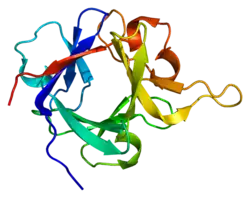

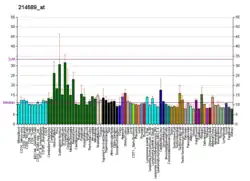
Fator de crescimento de fibroblastos 12 é uma proteína que em humanos é codificada pelo gene FGF12.[3][4][5]
A proteína codificada por este gene é membro da família do fator de crescimento de fibroblastos (FGF). Os membros da família FGF possuem amplas atividades mitogênicas e de sobrevivência celular, e estão envolvidos em uma variedade de processos biológicos, incluindo desenvolvimento embrionário, crescimento celular, morfogênese, reparo tecidual, crescimento de tumores e invasão.
Este fator de crescimento carece da sequência sinal N-terminal presente na maioria dos membros da família FGF, mas contém aglomerados de resíduos básicos que demonstraram agir como um sinal de localização nuclear. Quando transfectada em células de mamíferos, esta proteína acumulou-se no núcleo, mas não foi secretada. A função específica deste gene ainda não foi determinada. Foram relatadas duas variantes de transcrição alternativamente processadas (spliced) que codificam isoformas distintas.[5]
Referências
- ↑ «Doenças geneticamente associadas a FGF12 ver/editar referências no wikidata»
- ↑ «Human PubMed Reference:»
- ↑ Smallwood PM, Munoz-Sanjuan I, Tong P, Macke JP, Hendry SH, Gilbert DJ, Copeland NG, Jenkins NA, Nathans J (Outubro de 1996). «Fibroblast growth factor (FGF) homologous factors: new members of the FGF family implicated in nervous system development». Proc Natl Acad Sci U S A. 93 (18): 9850–7. Bibcode:1996PNAS...93.9850S. PMC 38518
 . PMID 8790420. doi:10.1073/pnas.93.18.9850
- ↑ Liu Y, Chiu IM (novembro de 1997). «Assignment of FGF12, the human FGF homologous factor 1 gene, to chromosome 3q29-->3qter by fluorescence in situ hybridization». Cytogenet Cell Genet. 78 (1): 48–9. PMID 9345906. doi:10.1159/000134625
- ↑ a b «Entrez Gene: FGF12 fibroblast growth factor 12»
Leitura adicional
- Robertson NG, Khetarpal U, Gutiérrez-Espeleta GA, et al. (1995). «Isolation of novel and known genes from a human fetal cochlear cDNA library using subtractive hybridization and differential screening.». Genomics. 23 (1): 42–50. PMID 7829101. doi:10.1006/geno.1994.1457. hdl:10669/15162
- Kok LD, Tsui SK, Waye M, et al. (1999). «Cloning and characterization of a cDNA encoding a novel fibroblast growth factor preferentially expressed in human heart.». Biochem. Biophys. Res. Commun. 255 (3): 717–21. PMID 10049777. doi:10.1006/bbrc.1999.0178
- Schoorlemmer J, Goldfarb M (2001). «Fibroblast growth factor homologous factors are intracellular signaling proteins.». Curr. Biol. 11 (10): 793–7. Bibcode:2001CBio...11..793S. PMC 3216481. PMID 11378392. doi:10.1016/S0960-9822(01)00232-9
- Liu CJ, Dib-Hajj SD, Renganathan M, et al. (2003). «Modulation of the cardiac sodium channel Nav1.5 by fibroblast growth factor homologous factor 1B.». J. Biol. Chem. 278 (2): 1029–36. PMID 12401812. doi:10.1074/jbc.M207074200
- Strausberg RL, Feingold EA, Grouse LH, et al. (2003). «Generation and initial analysis of more than 15,000 full-length human and mouse cDNA sequences.». Proc. Natl. Acad. Sci. U.S.A. 99 (26): 16899–903. Bibcode:2002PNAS...9916899M. PMC 139241. PMID 12477932. doi:10.1073/pnas.242603899
- Olsen SK, Garbi M, Zampieri N, et al. (2003). «Fibroblast growth factor (FGF) homologous factors share structural but not functional homology with FGFs.». J. Biol. Chem. 278 (36): 34226–36. PMID 12815063. doi:10.1074/jbc.M303183200
- Ota T, Suzuki Y, Nishikawa T, et al. (2004). «Complete sequencing and characterization of 21,243 full-length human cDNAs.». Nat. Genet. 36 (1): 40–5. PMID 14702039. doi:10.1038/ng1285
- Popovici C, Conchonaud F, Birnbaum D, Roubin R (2004). «Functional phylogeny relates LET-756 to fibroblast growth factor 9.». J. Biol. Chem. 279 (38): 40146–52. PMID 15199049. doi:10.1074/jbc.M405795200
- Gerhard DS, Wagner L, Feingold EA, et al. (2004). «The status, quality, and expansion of the NIH full-length cDNA project: the Mammalian Gene Collection (MGC).». Genome Res. 14 (10B): 2121–7. PMC 528928. PMID 15489334. doi:10.1101/gr.2596504