Emasculação
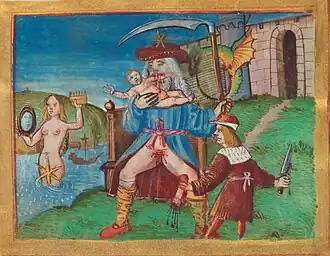
Emasculação é o ato de extirpação da genitália externa masculina: pênis e escroto com seu conteúdo (testículos). O ser humano ou o animal perde a capacidade de cópula e de reprodução.
A emasculação humana foi largamente empregada na antiguidade no processo para criação de eunucos, onde após uma guerra, determinados prisioneiros sofriam este tipo de mutilação.[1][2] Atualmente, tal procedimento bélico é considerado crime de guerra pela Convenção de Genebra.[3]
A emasculação é a remoção do pênis e do escroto (incluindo os testículos), os órgãos sexuais masculinos externos. É diferente da castração, que consiste na remoção apenas dos testículos, embora os termos às vezes sejam usados de forma intercambiável.[4]
Método
Existem vários métodos diferentes de emasculação. Tanto o pênis quanto os testículos podem ser removidos simultaneamente com um instrumento pontiagudo, como uma faca, navalha ou espada.[5][6] Pinças vasculares não esmagadoras também podem ser usadas em cirurgia médica para interromper a circulação sanguínea e reduzir o sangramento.[7]
Alternativamente, o pênis e os testículos podem ser removidos em diferentes estágios de tempo. Os cirurgiões médicos usam esse método ao realizar cirurgias em mulheres trans que desejam que seus órgãos genitais sejam removidos em múltiplas cirurgias de redesignação sexual (de homem para mulher), em vez de em uma única sessão.[8]
Consequências médicas
As consequências a curto prazo da emasculação incluem hemorragia[9] e infecção.[10] Historicamente, a morte também era uma complicação potencial, embora a prevalência seja contestada.[11]
As complicações a longo prazo incluem incontinência,[12] estenose uretral,[13] retenção urinária,[14] infecção do trato urinário,[15] extravasamento de urina[10] e cálculos na bexiga.[16] Alguns estudos descobriram que a emasculação pode causar uma série de alterações fisiológicas, como tronco encurtado,[17] estômago e quadris alargados,[18] aumento de altura, pernas arqueadas[17] e crânio alongado.[17] Além disso, os emasculados normalmente têm menos ou nenhum pêlo facial e corporal,[19] aumento do tecido adiposo ou ginecomastia[19] e um padrão de distribuição de gordura feminina.[20] Os efeitos fisiológicos da emasculação são mais graves para as pessoas que se submetem ao procedimento antes do início da puberdade.[21]
Outros significados
Por extensão, a palavra emasculação também passou a significar tornar um homem menos masculino, inclusive por meio da humilhação. Também pode significar privar qualquer coisa de vigor ou eficácia.
Na horticultura, a remoção de partes masculinas (pólen) de uma planta, em grande parte para polinização controlada e fins de reprodução, também é chamada de emasculação.[22]
Bibliografia
- Aboud, Khalid (1 de janeiro de 2013). «Eponyms in dermatology literature linked to genital skin disorders». Our Dermatology Online. doi:10.7241/OURD.20132.60. Consultado em 8 de julho de 2025
- Apeiranthitou, Vasiliki; Thomas, George; Louka, Penelope (16 de maio de 2019). «Gender dysphoria: A critical discussion of the understanding and treatment of gender dysphoria». Dialogues in Clinical Neuroscience & Mental Health. 2 (1): 72–80. doi:10.26386/obrela.v2i1.110
- Bellringer, J (2017a). «Surgery for Bodies Commonly Gendered as Male». In: Richard, C; Bouman, W P; Barker, M. Genderqueer and Non-Binary Genders. London: Palgrave Macmillan UK. pp. 247–263. ISBN 978-1-137-51052-5. doi:10.1057/978-1-137-51053-2_12
- Bellringer, J (2017b). «Genital surgery». In: Barrett, J. Transsexual and Other Disorders of Gender Identity: A Practical Guide to Management. Oxford, UK: Radcliffe Publishing. pp. 209–220. ISBN 9781498793131
- Bullough, Vern L. (2001). «Sterilization». Encyclopedia of birth control. ABC-CLIO. ISBN 978-1-57607-181-6
- Chatterton, Jocelyn; Bultitude, Matthew (2008). «Castration; The eunuchs of Qing dynasty China; A Medical and Historical Review». De Historia Urologie Europace. 15: 39–47
- Chauhan, VinaySingh; Yadav, Prateek; Goyal, Sunil; Khan, SahabazAli (2016). «Two cases of male genital self-mutilation». Industrial Psychiatry Journal. 25 (2): 228–231. PMC 5479100
 . PMID 28659706. doi:10.4103/0972-6748.207854
 - Chen, Mang L.; Reyblat, Polina; Poh, Melissa M.; Chi, Amanda C. (junho de 2019). «Overview of surgical techniques in gender-affirming genital surgery». Translational Andrology and Urology. 8 (3): 191–208. PMC 6626317. PMID 31380226. doi:10.21037/tau.2019.06.19
- Chiang, H (2012). Chiang, H, ed. Transgender China. New York: Palgrave Macmillan. ISBN 978-1-349-34320-1
- Coleman, Eli; Cesnik, John (abril de 1990). «Skoptic Syndrome: The Treatment of an Obsessional Gender Dysphoria with Lithium Carbonate and Psychotherapy». American Journal of Psychotherapy. 44 (2): 204–217. PMID 2114800. doi:10.1176/appi.psychotherapy.1990.44.2.204
- Dale, M. S. (1 de abril de 2010). «Understanding Emasculation: Western Medical Perspectives on Chinese Eunuchs». Social History of Medicine. 23 (1): 38–55. doi:10.1093/shm/hkp139
- Dale, M S (2018). Inside the World of the Eunuch A Social History of the Emperor's Servants in Qing China. Hong Kong: Hong Kong University Press. ISBN 978-988-8455-75-1
- DeMello, M (2007). Encyclopedia of Body Adornment. California, US: ABC-CLIO. ISBN 9780313336959
- Donnelly-Boylen, Kevin (outubro de 2016). «Gender dysphoria, serious mental illness, and genital self-mutilation: A case report». Journal of Gay & Lesbian Mental Health. 20 (4): 376–381. doi:10.1080/19359705.2016.1209395
- Emeliantseva, Ekaterina (2009). «Icons, portraits, or types? Photographic images of the Skoptsy in late Imperial Russia (1880-1917)». Jahrbücher für Geschichte Osteuropas. 57 (2): 189–204. JSTOR 41052249. doi:10.25162/jgo-2009-0009
- Engelstein, L (1997). «From Heresy to Harm: Self-Castrators in the Civic Discourse of Late Tsarist Russia». In: Teruyuki, H; Kimitaka, M. Empire and Society: New Approaches to Russian History. Hokkaido, Japan: Slavic Research Center, Hokkaido University. pp. 1–22
- Engelstein, L (1999). Castration and the Heavenly Kingdom: A Russian Folktale. Ithaca, London: Cornell University Press
- Evens, Starling C.; Whittle, Tom; Rous, Stephen N. (novembro de 1977). «Self-Emasculation: Review of the Literature, Report of a Case and Outline of the Objectives of Management». Journal of Urology. 118 (5): 775–776. PMID 916099. doi:10.1016/s0022-5347(17)58190-2
- Gearhart, John P.; Rock, John A. (setembro de 1989). «Total Ablation of the Penis After Circumcision with Electrocautery: A Method of Management and Longterm Followup». Journal of Urology. 142 (3): 799–801. PMID 2769863. doi:10.1016/s0022-5347(17)38893-6
- Goldberg, B Z (1930). The Sacred Fire: The Story of Sex in Religion. Norwich, UK: Jarrold Publishing
- Hedhly, A; Hormaza, J I; Herrero, M (2009). «Flower emasculation accelerates ovule degeneration and reduces fruit set in sweet cherry». Scientia Horticulturae. 119 (4): 455–457. Bibcode:2009ScHor.119..455H. doi:10.1016/j.scienta.2008.08.020
- Hoeckelmann, Michael (21 de junho de 2019). «To Rot and Not to Die: Punitive Emasculation in Early and Medieval China» (PDF). T'oung Pao. 105 (1–2): 1–42. doi:10.1163/15685322-10512p01. hdl:20.500.11820/a903bc02-1c0e-4e1f-8b6b-caf5a8eaf49b
- Hossain, Adnan (dezembro de 2012). «Beyond Emasculation: Being Muslim and Becoming Hijra in South Asia». Asian Studies Review. 36 (4): 495–513. doi:10.1080/10357823.2012.739994
- Hossain, Adnan (2 de dezembro de 2017). «The paradox of recognition: hijra , third gender and sexual rights in Bangladesh». Culture, Health & Sexuality. 19 (12): 1418–1431. PMID 28498049. doi:10.1080/13691058.2017.1317831. hdl:11245.1/4b35820e-309a-4ecf-be63-e618467cb19b
- Jackowich, Robyn A.; Vale, Rachel; Vale, Kayla; Wassersug, Richard J.; Johnson, Thomas W. (agosto de 2014). «Voluntary Genital Ablations: Contrasting the Cutters and Their Clients». Sexual Medicine. 2 (3): 121–132. PMC 4184492. PMID 25356309. doi:10.1002/sm2.33
- Johnson, Thomas W.; Wassersug, Richard J. (junho de 2010). «Gender Identity Disorder Outside the Binary: When Gender Identity Disorder-Not Otherwise Specified Is Not Good Enough». Archives of Sexual Behavior. 39 (3): 597–598. PMID 20182785. doi:10.1007/s10508-010-9608-1
- Johnson, Thomas W.; Wassersug, Richard J.; Roberts, Lesley F.; Sutherland, Michelle Brett; First, Michael B. (fevereiro de 2010). «Desire for Castration Is Not a Body Integrity Identity Disorder (BIID): A Response». The Journal of Sexual Medicine. 7 (2): 853–855. doi:10.1111/j.1743-6109.2009.01603.x
- Kaggwa, Sam; Galukande, Moses (dezembro de 2014). «Male genital mutilation (amputation) and its complications: a case report». BMC Research Notes. 7 (1). 519 páginas. PMC 4266893. PMID 25112277. doi:10.1186/1756-0500-7-519
- Kenyon, Herbert R.; Hyman, RM (17 de janeiro de 1953). «Total autoemasculation; report of three cases». Journal of the American Medical Association. 151 (3): 207–210. PMID 12999539. doi:10.1001/jama.1953.02940030041010a
- Khan, Shahnaz (junho de 2016). «What is in a Name? Khwaja Sara, Hijra and Eunuchs in Pakistan». Indian Journal of Gender Studies. 23 (2): 218–242. doi:10.1177/0971521516635327
- Khan, Shahnaz (setembro de 2017). «Khwaja sara, hijra, and the Struggle for Rights in Pakistan». Modern Asian Studies. 51 (5): 1283–1310. doi:10.1017/s0026749x16000068
- Khan, Sharful Islam; Hussain, Mohammed Iftekher; Parveen, Shaila; Bhuiyan, Mahbubul Islam; Gourab, Gorkey; Sarker, Golam Faruk; Arafat, Shohael Mahmud; Sikder, Joya (16 de setembro de 2009). «Living on the Extreme Margin: Social Exclusion of the Transgender Population (Hijra) in Bangladesh». Journal of Health, Population, and Nutrition. 27 (4): 441–451. PMC 2928103. PMID 19761079. doi:10.3329/jhpn.v27i4.3388
- Khan, S I; Khan, N M; Rahman, M; Gourab, G (2016). «Hijra/Heijra». In: Naples, N A. The Wiley Blackwell Encyclopedia of Gender and Sexuality Studies. Chicester, United Kingdom: John Wiley & Sons. pp. 1–2. ISBN 9781118663219. doi:10.1002/9781118663219
- Kim, Chin; LeBlang, Theodore (1975). «The Death Penalty in Traditional China». Georgia Journal of International & Comparative Law. 5 (1): 77–105
- Lipshultz, L I (1980). «Orchiectomy, Penectomy, Vaginoplasty for the Male Transsexual». In: Lipshultz, L I; Corriere, J N; Hafez, E S E. Surgery of the Male Reproductive Tract. Dordrecht: Springer. pp. 169–173. ISBN 978-94-009-8849-1
- Majno, G (1991). The Healing Hand: Man and Wound in the Ancient World. [S.l.]: Harvard University Press. ISBN 978-0-674-38331-9
- Mellon, Charles David; Barlow, Carrolee; Cook, Joshua; Clark, Lincoln (fevereiro de 1989). «Autocastration and autopenectomy in a patient with transsexualism and schizophrenia». Journal of Sex Research. 26 (1): 125–130. doi:10.1080/00224498909551496
- Money, John (16 de junho de 1988). «The Skoptic Syndrome: Castration and Genital Self-Mutilation as an Example of Sexual Body-Image Pathology». Journal of Psychology & Human Sexuality. 1 (1): 113–128. doi:10.1300/J056v01n01_09
- Mora, William; Drach, George W. (agosto de 1980). «Self-Emasculation and Self-Castration: Immediate Surgical Management and Ultimate Psychological Adjustment». Journal of Urology. 124 (2): 208–209. PMID 7401234. doi:10.1016/s0022-5347(17)55375-6
- Murray, G (1989). Slavery in the Arab World. Col: Companions to Asian Studies. [S.l.]: Rowman & Littlefield. ISBN 9780941533300
- Nanda, S (1999). Neither Man Nor Woman: The Hijras of India. Massachusetts: Cengage. ISBN 978-0534509033
- Nanda, S (1984). «The hijras of India. A preliminary report». Medicine and Law. 3 (1): 59–75. PMID 6538636
- Ochoa, Bernardo (setembro de 1998). «Trauma of the external genitalia in children: amputation of the penis and emasculation». The Journal of Urology. 160 (3 Pt 2): 1116–1119. PMID 9719288. doi:10.1097/00005392-199809020-00040
- Orakwe, J.C.; Undie, C.U. (junho de 2012). «Male genital injuries caused by ritual attacks in Nigeria: Problems of management». African Journal of Urology. 18 (2): 75–77. doi:10.1016/j.afju.2012.08.002
- Patwardhan, Sujata; Sawant, Ajit; Nagabhushana, M; Varma, Radheshyam; Ismail, Mohammed (2007). «Chronic urinary retention in eunuchs». Indian Journal of Urology. 23 (3): 317–318. PMC 2721615. PMID 19718339. doi:10.4103/0970-1591.33733
- Samm, Bill J; Steiner, Mitchell S (fevereiro de 1999). «Penectomy: a technique to reduce blood loss». Urology. 53 (2): 393–396. PMID 9933061. doi:10.1016/s0090-4295(98)00508-1
- Rana, A.; Johnson, A. D. (junho de 1993). «Sequential Self-castration and Amputation of Penis». British Journal of Urology. 71 (6). 750 páginas. PMID 8343905. doi:10.1111/j.1464-410x.1993.tb16079.x
- Scheidel, W (2009). Rome and China: Comparative Perspectives on Ancient World Empires. [S.l.]: Oxford University Press. ISBN 978-0-19-533690-0
- Schweitzer, Isaac (dezembro de 1990). «Genital Self-Amputation and the Klingsor Syndrome». Australian & New Zealand Journal of Psychiatry. 24 (4): 566–569. PMID 2073234. doi:10.3109/00048679009062914
- Shaw, Matthew B. K.; Sadove, A. Michael; Rink, Richard C. (março de 2003). «Reconstruction After Total Penile Amputation and Emasculation». Annals of Plastic Surgery. 50 (3): 321–324. PMID 12800913. doi:10.1097/01.sap.0000029629.81612.2e
- Singh, H; Kumar, P (2020). «Hijra: An Understanding». Journal of Psychosocial Research. 15 (1): 79–89. doi:10.32381/JPR.2020.15.01.6
- Stief, Matthew (janeiro de 2017). «The Sexual Orientation and Gender Presentation of Hijra, Kothi, and Panthi in Mumbai, India». Archives of Sexual Behavior. 46 (1): 73–85. PMID 27878410. doi:10.1007/s10508-016-0886-0
- van der Sluis, Wouter B.; Steensma, Thomas D.; Bouman, Mark-Bram (2 de abril de 2020). «Orchiectomy in transgender individuals: A motivation analysis and report of surgical outcomes». International Journal of Transgender Health. 21 (2): 176–181. PMC 7430475. PMID 33015667. doi:10.1080/26895269.2020.1749921
- Vale, Kayla; Johnson, Thomas W.; Jansen, Maren S.; Lawson, B. Keith; Lieberman, Tucker; Willette, K. H.; Wassersug, Richard J. (7 de maio de 2010). «The Development of Standards of Care for Individuals with a Male-to-Eunuch Gender Identity Disorder». International Journal of Transgenderism. 12 (1): 40–51. doi:10.1080/15532731003749095
- Wassersug, Richard (2010). «On the invisibility of the emasculated». Anthropology Today. 26 (1): 1–3. ISSN 0268-540X
- Wibowo, J E; Johnson, T W; Wassersug, R J (2016). «Infertility, impotence, and emasculation - psychosocial contexts for abandoning reproduction». Asian Journal of Andrology. 18 (3): 403–408. PMC 4854090. PMID 26924280. doi:10.4103/1008-682X.173937
- Wilson, Jean D.; Roehrborn, Claus (dezembro de 1999). «Long-Term Consequences of Castration in Men: Lessons from the Skoptzy and the Eunuchs of the Chinese and Ottoman Courts». The Journal of Clinical Endocrinology & Metabolism. 84 (12): 4324–4331. PMID 10599682. doi:10.1210/jcem.84.12.6206
- Wilson, Jennifer (1 de novembro de 2018). «Dostoevsky's Timely Castration». TSQ: Transgender Studies Quarterly. 5 (4): 565–573. doi:10.1215/23289252-7090031
- Zhang, E Y (2001). «Goudui and the State: Constructing Entrepreneurial Masculinity in Two Cosmopolitan Areas of Post-Socialist China». In: Hodgson, D L. Gendered Modernities. New York: Palgrave Macmillan. pp. 235–265. ISBN 978-1-137-09944-0. doi:10.1007/978-1-137-09944-0_9
Referências
- ↑ «Quem foram os eunucos? Eles podiam ter ereção?». Revista Mundo Estranho. Consultado em 24 de novembro de 2017
- ↑ «La maldición de los eunucos». Historia y Vida. Consultado em 24 de novembro de 2017
- ↑ «DECRETO Nº 42.121, DE 21 DE AGOSTO DE 1957». Câmara dos deputados. Consultado em 24 de novembro de 2017
- ↑ Chiang 2012, p. 33; Hoeckelmann 2019, p. 4.
- ↑ Chen et al. 2019, p. 191; Lipshultz 1980, pp. 169–170; van der Sluis, Steensma & Bouman 2020, p. 176.
- ↑ Bellringer 2017a, p. 249; Chiang 2012, pp. 30–31, 46; Dale 2010, pp. 40–41; Engelstein 1997, p. 6; Hossain 2012, pp. 40–41.
- ↑ Samm & Steiner 1999, pp. 393–396.
- ↑ Bellringer 2017a, p. 250; Bellringer 2017b, p. 210; van der Sluis, Steensma & Bouman 2020, p. 177.
- ↑ Dale 2010, p. 45; Wilson & Roehrborn 1999, p. 4326.
- ↑ a b Wilson & Roehrborn 1999, p. 4326.
- ↑ Dale 2010, p. 42.
- ↑ Dale 2010, p. 46; Dale 2018, p. 39; Wilson & Roehrborn 1999, p. 4326.
- ↑ Patwardhan et al. 2007, p. 1.
- ↑ Dale 2010, p. 46; Patwardhan et al. 2007, p. 1; Wilson & Roehrborn 1999, p. 4326.
- ↑ Ochoa 1998, p. 1117; Wilson & Roehrborn 1999, p. 4326.
- ↑ Dale 2018, p. 196; Wilson & Roehrborn 1999, pp. 4328–4330.
- ↑ a b c Wilson & Roehrborn 1999, pp. 4328–4330.
- ↑ Dale 2010, p. 46; Wilson & Roehrborn 1999, p. 4326.
- ↑ a b Dale 2010, p. 49; Dale 2018, p. 196.
- ↑ Dale 2010, p. 49.
- ↑ Dale 2010, pp. 48–49.
- ↑ Hedhly, Hormaza & Herrero 2009.