Delta Muscae
| δ Muscae | |
|---|---|
| Dados observacionais (J2000) | |
| Constelação | Musca |
| Asc. reta | 13h 02m 16,3s[1] |
| Declinação | -71° 32′ 55,9″[1] |
| Magnitude aparente | 3,62[1] |
| Características | |
| Tipo espectral | K2 III[1] |
| Cor (U-B) | 1,26[2] |
| Cor (B-V) | 1,18[2] |
| Astrometria | |
| Velocidade radial | 36,5 km/s[1] |
| Mov. próprio (AR) | 264,17 mas/a[1] |
| Mov. próprio (DEC) | -22,75 mas/a[1] |
| Paralaxe | 35,88 ± 0,44 mas[1] |
| Distância | 91 ± 1 anos-luz 27,9 ± 0,3 pc |
| Magnitude absoluta | 1,39 |
| Detalhes | |
| Raio | 16[3] R☉ |
| Outras denominações | |
| CD-70 997, HR 4923, HD 112985, HIP 63613, SAO 257000.[1] | |
| Localização | |
 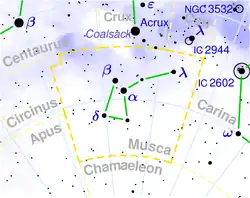 | |
Delta Muscae (δ Mus, δ Muscae) é a terceira estrela mais brilhante da constelação de Musca, com uma magnitude aparente de 3,62.[1] Medições de paralaxe indicam que está a aproximadamente 91 anos-luz (27,9 parsecs) da Terra.[1]
O sistema Delta Muscae é composto por duas estrelas que formam uma binária espectroscópica com um período orbital de 847 dias e uma excentricidade de 0,4.[4][5] A estrela principal é uma gigante laranja com um tipo espectral de K2 III.[1] Seu raio foi calculado em cerca de 16 vezes o raio solar.[3] Com base na classe espectral, tem uma temperatura efetiva entre 3 500 e 4 900 K.[6]
Ver também
Referências
- ↑ a b c d e f g h i j k l «SIMBAD query result - del Mus». SIMBAD. Centre de Données astronomiques de Strasbourg. Consultado em 27 de janeiro de 2014
- ↑ a b Johnson, H. L.; et al. (1966). «UBVRIJKL photometry of the bright stars». Communications of the Lunar and Planetary Laboratory. 4 (99). Bibcode:1966CoLPL...4...99J
- ↑ a b Pasinetti Fracassini, L. E.; et al. (fevereiro de 2001), «Catalogue of Apparent Diameters and Absolute Radii of Stars (CADARS) - Third edition - Comments and statistics», Astronomy and Astrophysics, 367: 521–524, Bibcode:2001A&A...367..521P, arXiv:astro-ph/0012289
 , doi:10.1051/0004-6361:20000451.
- ↑ Pourbaix, D.; Tokovinin, A. A.; Batten, A. H.; Fekel, F. C.; Hartkopf, W. I.; Levato, H.; Morrell, N. I.; Torres, G.; Udry, S (setembro de 2004). «SB9: The ninth catalogue of spectroscopic binary orbits». Astronomy and Astrophysics. 424. pp. 727–732. Bibcode:2004A&A...424..727P. doi:10.1051/0004-6361:20041213
- ↑ Eggleton, P. P.; Tokovinin, A. A. (setembro de 2008), «A catalogue of multiplicity among bright stellar systems», Monthly Notices of the Royal Astronomical Society, 389 (2): 869–879, Bibcode:2008MNRAS.389..869E, arXiv:0806.2878, doi:10.1111/j.1365-2966.2008.13596.x.
- ↑ «The Colour of Stars», Commonwealth Scientific and Industrial Research Organisation, Australia Telescope, Outreach and Education, 21 de dezembro de 2004, consultado em 31 de janeiro de 2014