David Siegmund
| David Siegmund | |
|---|---|
 | |
| Nascimento | 15 de novembro de 1941 St. Louis |
| Cidadania | Estados Unidos |
| Filho(a)(s) | Kimberly Siegmund |
| Alma mater | |
| Ocupação | estatístico, acadêmico, professor universitário, matemático |
| Distinções |
|
| Empregador(a) | Universidade Stanford |
| Orientador(a)(es/s) | Herbert Robbins |
| Página oficial | |
| https://profiles.stanford.edu/david-siegmund | |
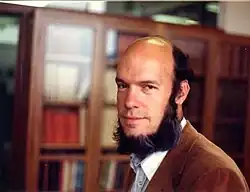
David Oliver Siegmund (15 de novembro de 1941)[1] é um estatístico estadunidense, que trabalhou extensivamente com análise sequencial.[2]
Recebeu o Prêmio Samuel Wilks de 1998. Foi palestrante convidado do Congresso Internacional de Matemáticos em Berlim (1998).[3]
Publicações selecionadas
- com Y.S. Chow e H. Robbins, Great Expectations: The Theory of Optimal Stopping, Boston: Houghton Mifflin, 1971.
- com Rupert Miller, Maximally Selected Chi Square Statistics, Biometrics, 38, #4 (December 1982), pp. 1011–1016.
- Sequential Analysis: Tests and Confidence Intervals, New York: Springer, 1985, ISBN 0-387-96134-8.
- com John D. Storey e Jonathan E. Taylor, Strong control, conservative point estimation and simultaneous conservative consistency of false discovery rates: a unified approach, Journal of the Royal Statistical Society, Series B 66, #1 (February 2004), pp. 187–205, doi:10.1111/j.1467-9868.2004.00439.x.
Referências
- ↑ p. 114, Reports of the president and of the treasurer, John Simon Guggenheim Memorial Foundation, 1974.
- ↑ Biography of David O. Siegmund, David Appell, Proceedings of the National Academy of Sciences 101, #21 (May 25, 2004), pp. 7843–7844, doi:10.1073/pnas.0402953101.
- ↑ Siegmund, David (1998). «Genetic linkage analysis: An irregular statistical problem». Doc. Math. (Bielefeld) Extra Vol. ICM Berlin, 1998, vol. III. [S.l.: s.n.] pp. 291–300
Ligações externas
- David O. Siegmund, home page at Stanford
- David Siegmund (em inglês) no Mathematics Genealogy Project
