CDH23
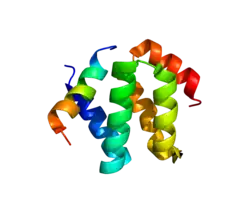


CDH23 (em inglês, cadherin 23), frequentemente chamada de caderina-23, é um gene humano que codifica a proteína caderina-23.[3][4][5]
Função
O gene CDH23 pertence à superfamília das caderinas (grupo das moléculas de adesão celular), que codificam glicoproteínas de adesão célula-célula dependentes de cálcio. A proteína codificada por este gene é transmembranar de passagem única e possui um grande domínio extracelular contendo 27 repetições homólogas ao ectodomínio de caderina. Essa proteína é expressa no epitélio sensorineural e acredita-se que esteja envolvida na formação do feixe de estereocílios, estruturas essenciais para a captação de estímulos sonoros. Acredita-se que ela interaja com a protocaderina-15 na formação dos filamentos de ligação que conectam os estereocílios entre si, contribuindo para a mecanoeletricidade auditiva.[6][7][8]
Importância clínica
O CDH23 está localizado em uma região do genoma que contém os loci da perda auditiva DFNB12 e USH1D.[5][8][9] Mutações alélicas nesse gene são responsáveis pela síndrome de Usher do tipo 1D e pela perda auditiva autossômica recessiva não-sindrômica DFNB12.[10]
Além das implicações auditivas, estudos associaram variantes do CDH23 com o declínio da função renal em populações humanas.[11]
Interações
Verificou-se que a proteína CDH23 interage fisicamente com a proteína USH1C (harmonina).[12][13]
Referências
- ↑ «Doenças geneticamente associadas a CDH23 ver/editar referências no wikidata»
- ↑ «Human PubMed Reference:»
- ↑ Bolz H et al. (2001). "Mutation of CDH23, encoding a new member of the cadherin gene family, causes Usher syndrome type 1D". Nature Genetics. 27(1): 108–112. doi:10.1038/83667. PMID 11138009.
- ↑ Bork JM et al. (2001). "Usher Syndrome 1D and Nonsyndromic Autosomal Recessive Deafness DFNB12 Are Caused by Allelic Mutations of the Novel Cadherin-Like Gene CDH23". American Journal of Human Genetics. 68(1): 26–37. doi:10.1086/316954. PMC 1234923. PMID 11090341.
- ↑ a b Entrez Gene: 64072. National Center for Biotechnology Information (NCBI).
- ↑ Kazmierczak P et al. (2007). "Cadherin 23 and protocadherin 15 interact to form tip-link filaments in sensory hair cells". Nature. 449(7158): 87–91. doi:10.1038/nature06091. PMID 17805295.
- ↑ Liao, Baoqiong; Xie, Wuming; Liu, Rutian; Zhang, Qi; Xie, Ting; Jia, Dan; He, Shuwen; Huang, Hailong (1 de março de 2025). «Identification of novel CDH23 heterozygous variants causing autosomal recessive nonsyndromic hearing loss». Genes & Genomics (em inglês). Consultado em 8 de agosto de 2025
- ↑ a b Willems, Patrick J., ed. (2003). Genetic Hearing Loss (em inglês) 1 ed. [S.l.]: CRC Press. Consultado em 8 de agosto de 2025
- ↑ de Guimaraes, Thales A. C.; Robson, Anthony G.; de Guimaraes, Isabela M. C.; Laich, Yannik; Aychoua, Nancy; Wright, Genevieve; Kalitzeos, Angelos; Mahroo, Omar A.; Webster, Andrew R. (17 de julho de 2024). «CDH23 -Associated Usher Syndrome: Clinical Features, Retinal Imaging, and Natural History». Investigative Ophthalmology & Visual Science (em inglês) (8). 27 páginas. ISSN 1552-5783. PMC 11262472
 . PMID 39017633. doi:10.1167/iovs.65.8.27. Consultado em 20 de setembro de 2025
- ↑ Woo HM et al. (2014). "Identification of CDH23 mutations in Korean families with hearing loss by whole-exome sequencing". BMC Medical Genetics. 15(1): 46. doi:10.1186/1471-2350-15-46. PMC 4036425. PMID 24767429.
- ↑ Gorski M et al. (2015). "Genome-wide association study of kidney function decline in individuals of European descent". Kidney International. 87(5): 1017–1029. doi:10.1038/ki.2014.361. PMC 4425568. PMID 25493955.
- ↑ Boëda B et al. (2002). "Myosin VIIa, harmonin and cadherin 23, three Usher I gene products that cooperate to shape the sensory hair cell bundle". EMBO Journal. 21(24): 6689–6699. doi:10.1093/emboj/cdf689. PMC 139109. PMID 12485990.
- ↑ Siemens J et al. (2002). "The Usher syndrome proteins cadherin 23 and harmonin form a complex by means of PDZ-domain interactions". Proceedings of the National Academy of Sciences U.S.A. 99(23): 14946–14951. doi:10.1073/pnas.232579599. PMC 137525. PMID 12407180.
Leitura adicional
- McHugh RK; Friedman RA (2006). «Genetics of hearing loss: Allelism and modifier genes produce a phenotypic continuum». The Anatomical Record Part A: Discoveries in Molecular, Cellular, and Evolutionary Biology. 288A (4): 370–381. PMID 16550584. doi:10.1002/ar.a.20297
- Marres HA; Cremers CW (1989). «Autosomal recessive nonsyndromal profound childhood deafness in a large pedigree. Audiometric features of the affected persons and the obligate carriers». Archives of Otolaryngology–Head & Neck Surgery. 115 (5): 591–595. PMID 2706105. doi:10.1001/archotol.1989.01860290049013
- Chaib H; et al. (1996). «Mapping of DFNB12, a gene for a non-syndromal autosomal recessive deafness, to chromosome 10q21-22». Human Molecular Genetics. 5 (7): 1061–1064. PMID 8817348. doi:10.1093/hmg/5.7.1061
- Bonaldo MF; Lennon G; Soares MB (1996). «Normalization and subtraction: two approaches to facilitate gene discovery». Genome Research. 6 (9): 791–806. PMID 8889548. doi:10.1101/gr.6.9.791
- Wayne S; et al. (1996). «Localization of the Usher syndrome type ID gene (Ush1D) to chromosome 10». Human Molecular Genetics. 5 (10): 1689–1692. PMID 8894709. doi:10.1093/hmg/5.10.1689
- Di Palma F; et al. (2001). «Mutations in Cdh23, encoding a new type of cadherin, cause stereocilia disorganization in waltzer, the mouse model for Usher syndrome type 1D». Nature Genetics. 27 (1): 103–107. PMID 11138008. doi:10.1038/83660
- Nagase T; et al. (2001). «Prediction of the Coding Sequences of Unidentified Human Genes. XX. The Complete Sequences of 100 New cDNA Clones from Brain Which Code for Large Proteins in vitro». DNA Research. 8 (2): 85–95. PMID 11347906. doi:10.1093/dnares/8.2.85
- Wilson SM; et al. (2001). «Mutations in Cdh23 cause nonsyndromic hearing loss in waltzer mice». Genomics. 74 (2): 228–233. PMID 11386759. doi:10.1006/geno.2001.6554
- Nakajima D; et al. (2001). «Identification of three novel non-classical cadherin genes through comprehensive analysis of large cDNAs». Molecular Brain Research. 94 (1–2): 85–95. PMID 11597768. doi:10.1016/S0169-328X(01)00218-2
- von Brederlow B; et al. (2002). «Identification and in vitro expression of novel CDH23 mutations of patients with Usher syndrome type 1D». Human Mutation. 19 (3): 268–273. PMID 11857743. doi:10.1002/humu.10049
- Astuto LM; et al. (2002). «CDH23 Mutation and Phenotype Heterogeneity: A Profile of 107 Diverse Families with Usher Syndrome and Nonsyndromic Deafness». American Journal of Human Genetics. 71 (2): 262–275. PMC 379159. PMID 12075507. doi:10.1086/341558
- Siemens J; et al. (2002). «The Usher syndrome proteins cadherin 23 and harmonin form a complex by means of PDZ-domain interactions». Proceedings of the National Academy of Sciences of the United States of America. 99 (23): 14946–14951. PMID 12407180. doi:10.1073/pnas.232579599
- de Brouwer AP; et al. (2003). «Mutations in the calcium-binding motifs of CDH23 and the 35delG mutation in GJB2 cause hearing loss in one family». Human Genetics. 112 (2): 156–163. PMID 12522556. doi:10.1007/s00439-002-0833-0
- Weil D; et al. (2003). «Usher syndrome type I G (USH1G) is caused by mutations in the gene encoding SANS, a protein that associates with the USH1C protein, harmonin». Human Molecular Genetics. 12 (5): 463–471. PMID 12588794. doi:10.1093/hmg/ddg051