Bloqueio turco-azerbaijano da Armênia
| Bloqueio turco-azerbaijano da Armênia | |||
|---|---|---|---|
Acima: Um selo georgiano em comemoração ao oleoduto azeri-georgiano-turco que passa notavelmente pela Armênia. Abaixo: A fronteira armênia-turca, fechada desde 1993. | |||
| Período | 16 de julho de 1989 | ||
| Local | Armenia and Nagorno-Karabakh | ||
| Objetivos |
| ||
| Métodos | |||
| Resultado | |||
| Partes | |||
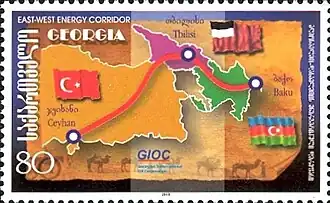
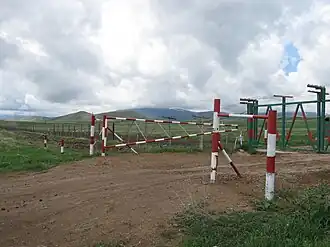

O bloqueio conjunto turco-azerbaijano da Armênia é um embargo econômico e de transporte em andamento contra a Armênia que impactou significativamente sua economia e a dinâmica comercial regional do Cáucaso. O bloqueio foi iniciado em 1989 pelo Azerbaijão, originalmente em resposta ao movimento Karabakh, que clamava pela independência do Azerbaijão e pela reunificação com a Armênia. A Turquia posteriormente se juntou ao bloqueio contra a Armênia em 1993. O bloqueio visa isolar a Armênia (e Nagorno-Karabakh até 2023) para pressionar o lado armênio a fazer concessões:[8][9][10] ou seja, a resolução do conflito de Nagorno-Karabakh em favor do Azerbaijão, a cessação da busca da Armênia pelo reconhecimento internacional do genocídio perpetrado pelos turcos na Armênia Ocidental, a ratificação pela Armênia das fronteiras de 1921 herdadas do Tratado de Kars kemalista-soviético,[a] e o estabelecimento de um corredor extraterritorial através do território armênio.
Este duplo bloqueio levou a uma escassez aguda de bens essenciais,[11] uma crise energética, desemprego, [6] emigração,[12][13] danos ecológicos,[14] e pobreza generalizada na Armênia e em Nagorno-Karabakh, ao mesmo tempo que dificultou o desenvolvimento econômico e o comércio internacional. O bloqueio impede a movimentação de suprimentos e pessoas entre a Armênia, a Turquia e o Azerbaijão e isolou o lado armênio por 30 anos;[15] no entanto, com exceção da passagem ferroviária Kars-Gyumri, a fronteira turco-armênia já estava fechada desde a década de 1920[16] e às vezes é descrita como o último vestígio da Cortina de Ferro.[17][18][19] Apesar dos efeitos devastadores iniciais do bloqueio, a Armênia e Nagorno-Karabakh foram apelidados de "Tigre Caucasiano",[20][21] por seu crescimento econômico significativo, particularmente no início dos anos 2000; no entanto, a pobreza continua generalizada na Armênia, com o crescimento económico a continuar a depender fortemente de investimentos externos.[22][23][24]
Entre 2022 e 2023, o Azerbaijão intensificou seu bloqueio a Nagorno-Karabakh, fechando o corredor de Lachin com um posto de controle militar, sabotando a infraestrutura civil[25][26][27][28] e atacando trabalhadores agrícolas.[29][30][31][32] O cerco militar de dez meses à região isolou-a do mundo exterior[33][34][35] e produziu uma crise humanitária amplamente considerada genocida por especialistas e defensores dos direitos humanos.[36][37][38] Em 2023, o Azerbaijão utilizou a força militar para assumir o controle de Nagorno-Karabakh, resultando na fuga de toda a população para a Armênia.
Apesar da pressão internacional para o levantamento do bloqueio e da resolução militar do conflito de Nagorno-Karabakh pelo Azerbaijão, a Turquia e o Azerbaijão continuam mantendo suas fronteiras fechadas para a Armênia.[39] Com esses dois países representando metade dos quatro vizinhos da Armênia,[40] 84% das fronteiras internacionais da Armênia permanecem fechadas,[41][42][41][43] tornando o país sem litoral extremamente dependente da Rússia e com comércio limitado com a Geórgia e o Irã.[44][45][46][42][47]
Notas
- ↑ Após a invasão da Armênia pela Turquia em 1920, a República Democrática da Armênia assinou o Tratado de Alexandropol sob coação, aceitando efetivamente as demandas territoriais turcas. No entanto, o tratado nunca foi ratificado por uma Armênia pós-soviética independente.
Referências
- ↑ Avedian, Vahagn (8 de fevereiro de 2022), «Exploring the Normalization of Relations Between Armenia and Turkey», E-International Relations (em inglês), consultado em 30 de agosto de 2024
- ↑
- Brent Hierman (2017). Russia and Eurasia 2017–2018. [S.l.]: Rowman & Littlefield. p. 213. ISBN 978-1-4758-3517-5
- Bohlen, Celestine (7 de fevereiro de 1993), «Blockade and Winter Deepen Misery in Armenia», The New York Times (em inglês), consultado em 11 de setembro de 2024, cópia arquivada em 15 de novembro de 2020,
Two weeks ago, the hospital's telephones went dead when Armenia's last functioning gas pipeline was damaged in an explosion attributed to Azerbaijani terrorists.
supplying Armenia through Georgia - Uhlig, Mark A. (1993). «The Karabakh War». World Policy Journal. 10 (4): 47–52. ISSN 0740-2775. JSTOR 40209334
- Curtis, Glenn E. (Glenn Eldon) (1995). «Armenia, Azerbaijan, and Georgia: country studies». (No Title). Area handbook series (em inglês)
- Stanton, Elizabeth A.; Ackerman, Frank; Resende, Flávia (2009). The Socio-Economic Impact of Climate Change in Armenia (PDF) (Relatório). Somerville, MA: Stockholm Environment Institute – U.S. Center, Tufts University. Consultado em 23 de agosto de 2024
- «Armenia TED Case Study», gurukul.ucc.american.edu, consultado em 3 de setembro de 2024, cópia arquivada em 27 de fevereiro de 2017 and attacking Armenian locomotive crews
- Nadein-Raevski, V. (1 de janeiro de 1992), «The Azerbaijani Armenian Conflict: Possible Paths towards Resolution», ISBN 978-1-349-22215-5, Palgrave Macmillan UK, Ethnicity and Conflict in a Post-Communist World (em inglês), p. 124, doi:10.1007/978-1-349-22213-1_7, consultado em 23 de agosto de 2024, cópia arquivada em 15 de junho de 2018 Georgia did not investigate these acts of terrorism and was believed to steal fuel destined for Armenia that came from Turkmenistan
- Vardanian, Astghik; Berndt, Jerry (Julho de 1996). «Armenia's Choice». Bulletin of the Atomic Scientists (em inglês). 52 (4): 50–54. Bibcode:1996BuAtS..52d..50V. ISSN 0096-3402. doi:10.1080/00963402.1996.11456644
- ↑
-
- Caroline Cox, John Eibner (1993). Ethnic Cleansing in Progress: War in Nagorno Karabakh. [S.l.]: Institute for Religious Minorities in the Islamic World, 1993. pp. 3–4. ISBN 978-3-9520345-2-1
- Bohlen, Celestine (7 de fevereiro de 1993), «Blockade and Winter Deepen Misery in Armenia», The New York Times (em inglês), consultado em 11 de setembro de 2024
- Times, Los (24 de janeiro de 1993), «Explosion of pipeline plunges Armenia into cold and dark», baltimoresun.com (em inglês), consultado em 26 de agosto de 2024, cópia arquivada em 1 de setembro de 2023
- Vardanian, Astghik; Berndt, Jerry (Julho de 1996). «Armenia's Choice». Bulletin of the Atomic Scientists (em inglês). 52 (4): 50–54. Bibcode:1996BuAtS..52d..50V. ISSN 0096-3402. doi:10.1080/00963402.1996.11456644
- Curtis, Glenn (1995), Armenia, Azerbaijan, and Georgia: country studies (em inglês), D.C.: Federal Research Division, consultado em 22 de agosto de 2024
-
- ↑ Bohlen, Celestine (7 de fevereiro de 1993), «Blockade and Winter Deepen Misery in Armenia», The New York Times (em inglês), consultado em 11 de setembro de 2024, cópia arquivada em 24 de abril de 2014,
Cut off from its traditional sources of natural gas, much of which flowed through Azerbaijan, Armenia went through its first energy crisis last winter, when the Government closed schools and factories and rationed heat and electricity to keep the population going.
- ↑
- «Armenia's Isolation Grows Only Deeper», The New York Times (em inglês), 26 de dezembro de 2004, consultado em 11 de setembro de 2024,
The limited opportunities have contributed to an exodus of working-age Armenians since independence 13 years ago, with some estimates putting the population loss at nearly 30 percent.
- Jerry L. Johnson (2000). Crossing Borders—confronting History Intercultural Adjustment in a Post-Cold War World. [S.l.]: University Press of America. ISBN 0-7618-1536-8.
The destabilizing exodus of some 800,000 educated and resourceful Armenians, mostly young people, occurred at a time when they were needed the most for nation-building.
- «Armenia | Caucasus, Soviet Union, Genocide», Encyclopedia Britannica (em inglês), consultado em 21 de agosto de 2024, cópia arquivada em 10 de agosto de 2024,
A blockade imposed by Azerbaijan in 1989 had devastated the Armenian economy; the resulting severe decline in living conditions led hundreds of thousands of Armenians to emigrate.
- «Armenia's Isolation Grows Only Deeper», The New York Times (em inglês), 26 de dezembro de 2004, consultado em 11 de setembro de 2024,
- ↑ a b
-
- Ohanyan, Anna; Broers, Laurence (2020). Armenia's Velvet Revolution Authoritarian Decline and Civil Resistance in a Multipolar World. [S.l.]: Bloomsbury Publishing. p. 77. ISBN 978-1-78831-717-7.
Armenia's GDP dropped by 56 per cent in 1990-3, and half a million jobs - accounting for one third of all those employed - disappeared.
- Miller, Donald E.; Miller, Lorna Touryan; Berndt, Jerry (Setembro de 2003). Armenia: Portraits of Survival and Hope 1st ed. Berkeley: University of California Press. p. 145. ISBN 978-0-520-23492-5
- Vardanian, Astghik (1 de julho de 1996), «Armenia's Choice», Routledge, Bulletin of the Atomic Scientists (em inglês), 52 (4): 50–54, Bibcode:1996BuAtS..52d..50V, doi:10.1080/00963402.1996.11456644,
And so the crisis began. Industiy slowed, factories shut down, and office workers were laid off. Even ambulance service was halted because of a lack of gasoline. People passed the winters in their apartments, where room temperatures hovered close to freezing. Deprived of their jobs, they had only two reasons to go out—to get fuel and food.
Alt URL - Bohlen, Celestine (7 de fevereiro de 1993). «Blockade and Winter Deepen Misery in Armenia». The New York Times (em inglês). Cópia arquivada em 15 de novembro de 2020.
Most of the working population is on a prolonged furlough, at half pay.
- Paturyan, Yevgenya (2024). «Revolution, Covid-19, and War in Armenia: Impacts on Various Forms of Trust». Brill Schöningh. Caucasus Survey (em inglês). 13: 2024. doi:10.30965/23761202-bja10036
 .
. The economic blockade imposed on Armenia by Azerbaijan and Turkey further exacerbated the situation, leading to widespread poverty and unemployment.
- Ohanyan, Anna; Broers, Laurence (2020). Armenia's Velvet Revolution Authoritarian Decline and Civil Resistance in a Multipolar World. [S.l.]: Bloomsbury Publishing. p. 77. ISBN 978-1-78831-717-7.
-
- ↑
- Vardanian, Astghik (1 de julho de 1996), «Armenia's Choice», Routledge, Bulletin of the Atomic Scientists (em inglês), 52 (4): 50–54, Bibcode:1996BuAtS..52d..50V, doi:10.1080/00963402.1996.11456644, consultado em 27 de agosto de 2024,
The Ministry of Ecology estimates that 800,000 trees were chopped down throughout the country in the first two Winters.
as the blockade cut off fuel supplies, forcing people to rely heavily on wood for heating and cooking during harsh winters. - Higgins, Andrew (6 de junho de 1995), «Energy-starved Armenians risk a new Chernobyl», The Independent (em inglês), consultado em 27 de agosto de 2024 Armenian Environmental Committee Chairman Samuel Shahinian explained: "Our people are so cold we cannot explain anything to them, they just want to be warm."
- Brown, Paul (2 de junho de 2004). «EU halts aid to Armenia over quake-zone nuclear plant». The Guardian. London. Consultado em 1 de maio de 2009 Alexis Louber, Head of the EU delegation in Yerevan, likened secret nuclear fuel airlifts to "flying around a potential nuclear bomb."
- Shapiro, Margaret (30 de janeiro de 1993), «Armenia's 'Good Life' Lost to Misery, Darkness, Cold», The Washington Post (em inglês), consultado em 27 de agosto de 2024 describing the impact of the blockade on daily life.
- Bohlen, Celestine (7 de fevereiro de 1993), «Blockade and Winter Deepen Misery in Armenia», The New York Times (em inglês), consultado em 11 de setembro de 2024 reporting severe winter hardships and infrastructure collapse.
- Suny, Ronald; E., Glenn (1 de janeiro de 1995), Armenia, Azerbaijan, and Georgia: country studies (em inglês), Federal Research Division, Library of Congress, pp. 28–34, consultado em 21 de agosto de 2024,
The large-scale felling of trees for fuel during the winters of the blockade has created another environmental crisis....The Ministry of the Environment reported that the lake's water level had dropped by fifty centimeters in 1993. Experts said that this drop brought the level to within twenty-seven centimeters of the critical point where flora and fauna would be endangered.
- Rutland, Peter (1 de janeiro de 1994), «Democracy and nationalism in Armenia», Taylor & Francis Group, Europe-Asia Studies (em inglês), 46 (5): 839–861, doi:10.1080/09668139408412202, consultado em 27 de agosto de 2024 noting the reopening of the Nairit Chemical Plant despite environmental concerns.
- Vardanian, Astghik (1 de julho de 1996), «Armenia's Choice», Routledge, Bulletin of the Atomic Scientists (em inglês), 52 (4): 50–54, Bibcode:1996BuAtS..52d..50V, doi:10.1080/00963402.1996.11456644, consultado em 27 de agosto de 2024,
- ↑ Jardine, Bradley. «With new railway, Turkey seeks to isolate Armenia and integrate Azerbaijan». Eurasianet (em inglês). Columbia University. Consultado em 21 de agosto de 2024. Cópia arquivada em 18 de abril de 2024
- ↑ Avedian, Vahagn (31 de outubro de 2013). «The Unsustainable European Policy towards the South Caucasus». Foreign Policy Journal (em inglês). Consultado em 21 de agosto de 2024.
The outspoken Azeri policy (in conjunction with the Turkish embargo) is to force Armenians to choose "prosperity without Karabakh or poverty with Karabakh," pushing Armenia to the degree of destitution that "people will even stop thinking about Karabakh." This has been confirmed on numerous occasions by President Aliyev himself, the latest from October 7, 2013: 'We must further keep Armenia isolated from diplomatic, political, economic, regional initiatives.' The same applies to the Turkish policy, which, in addition to the Karabakh dispute, also aims at the issue of forcing Armenia to drop its efforts for an international recognition of the 1915 Armenian genocide.
- ↑ Ter-Matevosyan, Vahram (4 de maio de 2017). «Armenia in the Eurasian Economic Union: reasons for joining and its consequences». Routledge. Eurasian Geography and Economics (em inglês). 58 (3): 340–360. doi:10.1080/15387216.2017.1360193. Consultado em 21 de agosto de 2024. Cópia arquivada em 18 de novembro de 2023.
By inventing a "one nation, two states" formula, the leaders of Turkey and Azerbaijan have worked closely since the early 1990s to marginalize Armenia from regional energy and communication Projects.
- ↑ Zinner, Ellen S.; Williams, Mary Beth (2013). When A Community Weeps Case Studies In Group Survivorship. [S.l.]: Routledge. p. 90. ISBN 978-0-87630-953-7.
This blockade began in 1988, preventing 80% of goods destined to Armenia from entering that country.
- ↑ Chaloyan, Astghik (2017). Fluctuating Transnationalism Social Formation and Reproduction among Armenians in Germany. [S.l.]: Springer. p. 65. ISBN 978-3-658-18826-9.
Roughly calculated, this wave can be determined from 1991 until 1995. According to CRRC (the Caucasus Research Resource Centres)...more than 17% of Armenia's population migrated between the years of 1991-1995...
- ↑ Jerry L. Johnson (2000). Crossing Borders—confronting History Intercultural Adjustment in a Post-Cold War World. [S.l.]: University Press of America. ISBN 0-7618-1536-8.
The destabilizing exodus of some 800,000 educated and resourceful Armenians, mostly young people, occurred at a time when they were needed the most for nation-building.
- ↑ Suny, Ronald; E., Glenn (1 de janeiro de 1995), Armenia, Azerbaijan, and Georgia: country studies (em inglês), Federal Research Division, Library of Congress, p. 28, consultado em 21 de agosto de 2024,
The large-scale felling of trees for fuel during the winters of the blockade has created another environmental crisis....The Ministry of the Environment reported that the lake's water level had dropped by fifty centimeters in 1993. Experts said that this drop brought the level to within twenty-seven centimeters of the critical point where flora and fauna would be endangered.
- ↑ «Averting a New War between Armenia and Azerbaijan». Crisis Group (em inglês). 30 de janeiro de 2023. Consultado em 21 de agosto de 2024. Cópia arquivada em 5 de julho de 2024
- ↑ Cheterian, Vicken (2 de janeiro de 2017). «The Last Closed Border of the Cold War: Turkey-Armenia». Journal of Borderlands Studies (em inglês). 32 (1): 71–90. ISSN 0886-5655. doi:10.1080/08865655.2016.1226927
- ↑ «Unprecedented progress». Deutsche Welle (em inglês). 9 de setembro de 2009. Consultado em 16 de setembro de 2024
- ↑ Parsons, Robert (2 de fevereiro de 2012). «1915 Massacre Under Spotlight». Radio Free Europe/Radio Liberty (em inglês). Consultado em 16 de setembro de 2024
- ↑ «Armenia-Turkey». Eurasian Partnership Foundation. Consultado em 16 de setembro de 2024
- ↑ The Caucasian Tiger: Sustaining Economic Growth in Armenia. [S.l.]: World Bank Publications. 2007. ISBN 978-0-8213-6812-1 – via Google Books
- ↑ «Nagorno-Karabakh's militarised social democracy». openDemocracy (em inglês). Consultado em 18 de setembro de 2024
- ↑ «Armenia a Model for Developing Nations», Bloomberg (em inglês), 23 de outubro de 2007, consultado em 18 de setembro de 2024
- ↑ Punsmann, Burcu Gültekin, et al. "Review of isolation policies within and around the South Caucasus." Journal of Conflict Transformation (Caucasus Edition) 18 (2016). "At the same time, the two-digit economic growth in the early 2000s, largely due to the development of the construction sector, earned Armenia even the title of the 'Caucasian Tiger', vindicating Kocharyan's approach. However, Kocharyan and his entourage understood very well, that this was more a 'paper tiger' and that without opening the borders, Armenia's economy would not be able to sustain its growth."
- ↑ «A "Tiger" Is Born in 15 Years». Armenian General Benevolent Union (em inglês). Consultado em 18 de setembro de 2024
- ↑ «Why Are There No Armenians in Nagorno-Karabakh?». Freedom House (em inglês). Consultado em 5 de setembro de 2024. Cópia arquivada em 4 de setembro de 2024.
The blockade was accompanied by the regular cutting of the supply of gas and electricity, as well as disrupting lines of communication, such as telephone landlines, cellular signals, and internet. Azerbaijani state actors regularly shut down the supply of gas to Nagorno-Karabakh during the first four months of the blockade...On January 9, 2023, the high-voltage cable from Armenia to Nagorno-Karabakh, the main source of electricity, was damaged in the territory of the Lachin Corridor. Azerbaijani officials did not allow any repair work on it, and the supply of electricity was never restored.
- ↑ «Statement Condemning the Azerbaijani Blockade of the Artsakh (Nagorno-Karabakh)» (PDF). International Association of Genocide Scholars. 1 de fevereiro de 2023
- ↑ «Ensuring free and safe access through the Lachin Corridor». Parliamentary Assembly of the Council of Europe. 22 de junho de 2023.
85. Calculations of gas flow indicate that the gas goes to the village of Pekh, and not beyond that point, suggesting that a valve has been installed. The blockage can be checked with the level of gas pressure.
- ↑ «Nagorno-Karabakh reports gas cut for second time since start of blockade». OC Media (em inglês). 17 de janeiro de 2023. Consultado em 18 de janeiro de 2023
- ↑ «Why Are There No Armenians in Nagorno-Karabakh?», Freedom House (em inglês), consultado em 5 de setembro de 2024,
In addition to creating the blockade, Azerbaijan took deliberate measures to instill a sense of insecurity in Nagorno-Karabakh. The shootings near the line of contact continued, targeting people carrying out agricultural work, which was needed for self-sustenance during the blockade.
- ↑ ռ/կ, Ազատություն (14 de novembro de 2022), «Armenian PM Reacts To Reported Shooting At Farmers In Karabakh», Ազատություն ռ/կ (em arménio), consultado em 4 de setembro de 2024, cópia arquivada em 3 de outubro de 2023
- ↑ Khulian, Artak (24 de março de 2023). «Azerbaijani Troops Accused Of Shooting At Karabakh Farmers». Ազատություն ռ/կ (em arménio). Consultado em 4 de setembro de 2024. Cópia arquivada em 29 de abril de 2024
- ↑ «Azerbaijani serviceman who killed a 65-year-old civilian». English Jamnews (em inglês). 5 de dezembro de 2021. Consultado em 4 de setembro de 2024
- ↑ «Nagorno-Karabakh authorities warn of "critical" situation as Azerbaijan bans Red Cross vehicles | Eurasianet». eurasianet.org (em inglês). Consultado em 11 de agosto de 2025.
Azerbaijan has barred the International Committee of the Red Cross (ICRC) from using the only road connecting Nagorno-Karabakh to Armenia and the outside world.
- ↑ «Why Are There No Armenians in Nagorno-Karabakh?». Freedom House (em inglês). pp. 28–30. Consultado em 11 de agosto de 2025
- ↑ Badalian, Susan; Sahakian, Nane (16 de junho de 2023). «Relief Supplies To Karabakh Blocked By Baku». «Ազատ Եվրոպա/Ազատություն» ռադիոկայան (em arménio). Consultado em 11 de agosto de 2025.
Azerbaijan did not allow relief supplies to and medical evacuations from Nagorno-Karabakh for the second consecutive day on Friday, aggravating a humanitarian crisis in the Armenian-populated region effectively cut off from the outside world since December.
- ↑ «Report: Risk Factors and Indicators of the Crime of Genocide in the Republic of Artsakh: Applying the UN Framework of Analysis for Atrocity Crimes to the Nagorno-Karabakh Conflict» (PDF), Lemkin Institute (em inglês), consultado em 5 de setembro de 2024,
Prominent figures in the field of human rights, such as Juan Ernesto Mendez, the Former Special Advisor to the Secretary-General on the Prevention of Genocide (2004–2007) at the United Nations and a former UN Special Rapporteur on Torture (2010–2016), and a collection of the world's foremost scholars within the discipline of Genocide Studies, have described the blockade as indicative of genocide.
- ↑ Forgey, Elisa von Joeden (30 de dezembro de 2023). «Why Prevention Fails: Chronicling the Genocide in Artsakh». International Journal of Armenian Genocide Studies (em inglês). 8 (2): 86–107. ISSN 1829-4405. doi:10.51442/ijags.0046.
Many Armenian officials, international genocide scholars, and international genocide prevention organizations were united in identifying Azerbaijan's actions as a mass atrocity crime, either "ethnic cleansing" or "genocide". Armenian officials tended to prefer the term "ethnic cleansing" while genocide scholars were convinced that Azerbaijan was committing genocide. The latter includes former ICC chief prosecutor Luis Moreno Ocampo, Genocide Watch, and the Lemkin Institute for Genocide Prevention. These same organizations, as well as the International Association of Genocide Scholars (IAGS), repeatedly warned about the threat of genocide in the months before Azerbaijan's September 19 attack, and, after 12 December 2022, about the already genocidal nature of Azerbaijan's blockade of Artsakh.
- ↑ Vardanyan, Arnold. «In the Wake of Nagorno-Karabakh Conflict: Current Challenges to Regional Peace and International Law». Cambridge International Law Journal (em inglês). Consultado em 5 de setembro de 2024.
Although Azerbaijani authorities rejected claims of ethnic cleansing, numerous international bodies, including the European Parliament, adopted a resolution declaring that the 'forced exodus' of Armenians from Nagorno-Karabakh 'amounted to ethnic cleansing.'
- ↑ Saparov, Arsène (3 de setembro de 2024). «Normalizing conflict – concealing genocide? Expert neutrality in the Armenian Azerbaijani conflict». Southeast European and Black Sea Studies (em inglês): 1–21. ISSN 1468-3857. doi:10.1080/14683857.2024.2384138.
During the 1990-94 conflict between Armenia and Azerbaijan, Turkey's military involvement was limited and unofficial. For example, politically, Turkey supported Azerbaijan, by completely closing its border with Armenia in the wake of Armenian victories in 1992. This border remains closed despite the Azerbaijani victory in 2020, which removed the reason for the closure of the border. Thus, the Turkish involvement on the Azerbaijani side is currently at an unprecedented level, both politically and militarily.
- ↑ Abrahamyan, Gayane, «Armenia: Yerevan Wants to Open Up to Iran», Columbia University, Eurasianet (em inglês), consultado em 4 de setembro de 2024, cópia arquivada em 30 de outubro de 2022
- ↑ a b Avedian, Vahagn (1 de janeiro de 2013). «Recognition, Responsibility and Reconciliation: The Trinity of the Armenian Genocide». Facultas. Europa Ethnica (em inglês). 70 (3/4): 77–86. doi:10.24989/0014-2492-2013-34-77. Consultado em 21 de agosto de 2024. Cópia arquivada em 2 de dezembro de 2023
- ↑ a b Giragosian, Richard (8 de abril de 2016). «Armenia's National Security: External Threats, Domestic Challenges». Reassessing Security in the South Caucasus (em inglês). [S.l.]: Routledge. doi:10.4324/9781315603872-5 (inativo 7 de agosto de 2025). Consultado em 21 de agosto de 2024
- ↑ Donald E. Miller, Lorna Touryan Miller (2003). Armenia Portraits of Survival and Hope. [S.l.]: University of California Press. pp. 8–10, 34. ISBN 978-0-520-23492-5
- ↑ Sidhu, Arman (20 de agosto de 2024), «Armenia-Iran Secret Arms Deal: Implications For The South Caucasus – Analysis», Eurasia Review (em inglês), consultado em 21 de agosto de 2024
- ↑ Ter-Matevosyan, Vahram (4 de maio de 2017). «Armenia in the Eurasian Economic Union: reasons for joining and its consequences». Routledge. Eurasian Geography and Economics (em inglês). 58 (3): 340–360. doi:10.1080/15387216.2017.1360193. Consultado em 21 de agosto de 2024.
Suffice to say that because of the sealed borders, Armenia is one of the unique cases in the world that has 80% of its land borders closed. Borders with Georgia and Iran are the only ones open, which, in turn, makes Armenia overly dependent on them.
- ↑ Ter-Matevosyan, Vahram; Mkrtchyan, Narek (2021). «The Conduct of Armenian Foreign Policy: Limits of the Precarious Balance». Small States and the New Security Environment. Col: The World of Small States (em inglês). 7. [S.l.]: Springer International Publishing. pp. 203–215. ISBN 978-3-030-51528-7. ISSN 2627-6003. doi:10.1007/978-3-030-51529-4_14. Consultado em 21 de agosto de 2024. Cópia arquivada em 14 de janeiro de 2022.
Armenia is one of the rare states in the world that has more than 80% of its borders sealed. Armenia has only two open borders—Georgia (219 km) in the north and Iran (44 km) in the south.
- ↑ Tocci, Nathalie (2007). The Case for Opening the Turkish-Armenian Border (PDF) (Relatório). Trans-European Policy Studies Association.
This all the more so given that Armenia is a landlocked country, and its only practical access to the sea is through Georgia and Iran. Landlocked, with two of its borders closed, connected to its distant markets via uncertain and expensive routes through Georgia and Iran, Armenia's development is thus heavily handicapped by the current closure.