Batalha de Haengju
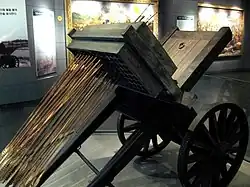
A Batalha de Haengju ocorreu em 14 de março de 1593 durante a invasão japonesa da Coreia de 1592–1598. O ataque japonês não conseguiu superar a fortaleza de Haengju.
Contexto
Gwon Yul estava estacionado na fortaleza de Haengju, uma paliçada de madeira em um penhasco sobre o Rio Han. Haengju representava uma ameaça para Hanseong (atual Seul e capital de Joseon) devido à sua proximidade, então os japoneses a atacaram em março.[1]
Batalha
O ataque japonês liderado por Konishi Yukinaga ocorreu em 14 de março de 1593 com 30 000 homens. Eles se revezavam atacando a paliçada devido ao espaço limitado. Os coreanos retaliaram com flechas, canhões e hwacha.[1]
Após três ataques, um com torre de cerco, e outro em que Ishida Mitsunari foi ferido, Ukita Hideie conseguiu romper as defesas externas e alcançar a parede interna. No entanto, ele também foi ferido e teve que recuar.[2]
No último ataque, Kobayakawa Takakage queimou um buraco nas estacas de madeira da fortaleza, mas os coreanos conseguiram contê-los por tempo suficiente para que fosse reparado.[2]
Quando os coreanos estavam quase sem flechas, I Bun chegou com navios de suprimento contendo mais 10 000 flechas, e eles continuaram a lutar até o anoitecer, quando os japoneses recuaram.[2]
Consequências
Além da derrota, a situação japonesa tornou-se ainda mais precária depois que Zha Dashou liderou um pequeno grupo de invasores até Hanseong, queimando mais de 6 500 toneladas de grãos. Isso deixou os japoneses com menos de um mês de provisões.[3][4]
Após várias negociações com Shen Weijing, os japoneses abandonaram Hanseong em 17 de maio de 1593. O que Li Rusong e Song Yingchang testemunharam ao entrar na cidade foi um povo que "parecia fantasmas".[5]
Ver também
Referências
- ↑ a b Hawley 2005, p. 318.
- ↑ a b c Hawley 2005, p. 321.
- ↑ Hawley 2005, p. 323.
- ↑ Swope 2009, p. 167.
- ↑ Swope 2009, p. 170.
Bibliografia
- Turnbull, Stephen (2002). Samurai invasion: Japan's Korean War 1592-1598. [S.l.]: Cassel & Co. ISBN 0-304-35948-3
- Alagappa, Muthiah (2003), Asian Security Order: Instrumental and Normative Features, ISBN 0-8047-4629-X, Stanford University Press
- Arano, Yasunori (2005), The Formation of a Japanocentric World Order, International Journal of Asian Studies
- Brown, Delmer M. (1948), «The Impact of Firearms on Japanese Warfare, 1543–1598», The Far Eastern Quarterly, 7 (3): 236–53, JSTOR 2048846, doi:10.2307/2048846
- Eikenberry, Karl W. (1988), «The Imjin War», Military Review, 68 (2): 74–82
- Ha, Tae-hung; Sohn, Pow-key (1977), 'Nanjung Ilgi: War Diary of Admiral Yi Sun-sin, ISBN 89-7141-018-3, Yonsei University Press
- Haboush, JaHyun Kim (2016), The Great East Asian War and the Birth of the Korean Nation
- Hawley, Samuel (2005), The Imjin War, ISBN 89-954424-2-5, The Royal Asiatic Society, Korea Branch/UC Berkeley Press
- Jang, Pyun-soon (1998), Noon-eu-ro Bo-nen Han-gook-yauk-sa 5: Gor-yeo Si-dae (눈으로 보는 한국역사 5: 고려시대), Park Doo-ui, Bae Keum-ram, Yi Sang-mi, Kim Ho-hyun, Kim Pyung-sook, et al., Joog-ang Gyo-yook-yaun-goo-won. 1998-10-30. Seoul, Korea.
- Kim, Ki-chung (1999), «Resistance, Abduction, and Survival: The Documentary Literature of the Imjin War (1592–8)», Korean Culture, 20 (3): 20–29
- Kim, Yung-sik (1998), «Problems and Possibilities in the Study of the History of Korean Science», Osiris, 2nd Series, 13: 48–79, JSTOR 301878, doi:10.1086/649280
- 桑田忠親 [Kuwata, Tadachika], ed., 舊參謀本部編纂, [Kyu Sanbo Honbu], 朝鮮の役 [Chousen no Eki] (日本の戰史 [Nihon no Senshi] Vol.5), 1965.
- Neves, Jaime Ramalhete (1994), «The Portuguese in the Im-Jim War?», Review of Culture, 18: 20–24
- Niderost, Eric (2001), «Turtleboat Destiny: The Imjin War and Yi Sun Shin», Military Heritage, 2 (6): 50–59, 89
- Niderost, Eric (2002), «The Miracle at Myongnyang, 1597», Osprey Military Journal, 4 (1): 44–50
- Park, Yune-hee (1973), Admiral Yi Sun-shin and His Turtleboat Armada: A Comprehensive Account of the Resistance of Korea to the 16th Century Japanese Invasion, Shinsaeng Press
- Rockstein, Edward D. (1993), Strategic And Operational Aspects of Japan's Invasions of Korea 1592–1598 1993-6-18, Naval War College
- Sadler, A. L. (1937), «The Naval Campaign in the Korean War of Hideyoshi (1592–1598)», Transactions of the Asiatic Society of Japan, Second Series, 14: 179–208
- Sansom, George (1961), A History of Japan 1334–1615, ISBN 0-8047-0525-9, Stanford University Press
- Sohn, Pow-key (1959), «Early Korean Painting», Journal of the American Oriental Society, 79 (2): 96–103, JSTOR 595851, doi:10.2307/595851
- Stramigioli, Giuliana (1954), «Hideyoshi's Expansionist Policy on the Asiatic Mainland», Transactions of the Asiatic Society of Japan, Third Series, 3: 74–116
- Strauss, Barry (2005), «Korea's Legendary Admiral», MHQ: The Quarterly Journal of Military History, 17 (4): 52–61
- Swope, Kenneth M. (2006), «Beyond Turtleboats: Siege Accounts from Hideyoshi's Second Invasion of Korea, 1597–1598», Sungkyun Journal of East Asian Studies, 6 (2): 177–206
- Swope, Kenneth M. (2005), «Crouching Tigers, Secret Weapons: Military Technology Employed During the Sino-Japanese-Korean War, 1592–1598», The Journal of Military History: 69, 11–42
- Swope, Kenneth M. (2002), «Deceit, Disguise, and Dependence: China, Japan, and the Future of the Tributary System, 1592–1596», The International History Review, 24 (4): 757–1008, doi:10.1080/07075332.2002.9640980
- Swope, Kenneth M. (2009), A Dragon's Head and a Serpent's Tail: Ming China and the First Great East Asian War, 1592–1598, University of Oklahoma Press
- Turnbull, Stephen (1998), The Samurai Sourcebook, ISBN 1-85409-523-4, Cassell & Co
- Villiers, John (1980), SILK and Silver: Macau, Manila and Trade in the China Seas in the Sixteenth Century (A lecture delivered to the Hong Kong Branch of the Royal Asiatic Society at the Hong Kong Club. 10 June 1980) (PDF), The HKUL Digital Initiatives
- Yi, Min-woong (2004), Imjin Wae-ran Haejeonsa: The Naval Battles of the Imjin War [임진왜란 해전사], ISBN 89-89722-49-7, Chongoram Media [청어람미디어]