Assembleia Antifascista para a Libertação Nacional da Macedônia
Assembleia Antifascista para a Libertação Nacional da Macedônia (ASNOM) Antifašističko sobranie za narodno osloboduvanje na Makedonija | |
|---|---|
| Tipo | |
| Tipo | |
| História | |
| Fundação | 2 de agosto de 1944 |
| Dissolução | 16 de abril de 1945 |
| Sucedida por | Assembleia Nacional da Macedônia |
| Liderança | |
Presidente | Metodija Andonov-Čento |
A Assembleia Antifascista para a Libertação Nacional da Macedônia (em macedônio/macedónio: Антифашистичко собрание за народно ослободување на Македонија (АСНОМ), Antifašističko sobranie za narodno osloboduvanje na Makedonija; servo-croata: Antifašističko sobranje narodnog oslobođenja Makedonije; abr. ASNOM) foi o órgão representativo do povo legislativo e executivo supremo do estado comunista da Macedônia de agosto de 1944 até o final da Segunda Guerra Mundial. O órgão foi criado pelos Partisans Macedônios durante os estágios finais da Segunda Guerra Mundial na Macedônia Iugoslava (Luta de Libertação Nacional), clandestinamente em agosto de 1944, na zona de ocupação búlgara da Iugoslávia.
História
Primeira sessão (sob ocupação)
Significado
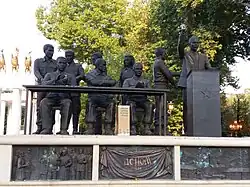
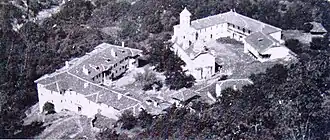
A primeira sessão plenária da ASNOM foi apelidada de "Segunda Ilinden" porque foi convocada clandestinamente na data simbólica de 2 de agosto (dia da Revolta de Ilinden) de 1944 no Mosteiro de São Prohor Pčinjski, atualmente na Sérvia. [1] [2] [nota 1] As decisões mais importantes da assembleia foram: [4] [5]
- A proclamação de um Estado-nação macedônio de etnia macedônia.
- A decisão de tornar o macedônio a língua oficial do Estado macedônio.
- A garantia de que os cidadãos da Macedônia, independentemente de sua afiliação étnica, teriam todos os direitos civis assegurados, bem como o direito à sua língua materna e à sua profissão de fé.
- A proclamação de Ilinden como feriado nacional.
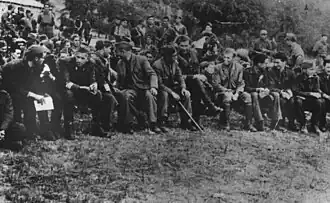
A primeira sessão foi aberta com o hino da Organização Revolucionária Interna da Macedônia (IMRO) - "Levanta-te, alvorecer da liberdade" e o hino não oficial da Iugoslávia - "Hei, Eslavos!". [6] A Assembleia emitiu um Manifesto que descrevia a posição da Macedônia do Vardar sob a antiga Iugoslávia como a de uma colônia e declarava "fraternidade e unidade" com os demais povos iugoslavos. [7] Também declarava seu apoio à igualdade de todas as nacionalidades na Macedônia e convocava albaneses, turcos e valáquios a se juntarem à luta de libertação nacional. [8] Um apelo pela "unificação de todo o povo macedônio", ou seja, em toda a região geográfica da Macedônia, também foi feito. Panko Brashnarov, ex-membro da ORIM e membro mais antigo, presidiu a reunião inaugural, e Metodija Andonov-Čento foi eleito presidente. Ambos desejavam maior independência para a futura república. Eles viam a adesão à Iugoslávia como uma forma de segunda dominação sérvia sobre a Macedônia e preferiam a adesão a uma Federação Balcânica ou então a independência completa. Čento e, em parte, Brashnarov entraram em conflito com Svetozar Vukmanović-Tempo, enviado de Josip Broz Tito à Macedônia. Um dos participantes da Assembleia foi Kiro Gligorov, o futuro primeiro Presidente da República da Macedônia. [9] [10] De acordo com alguns pesquisadores, a primeira sessão foi manipulada por representantes pró-Iugoslávia, e o número de delegados presentes é contestado. [11]
Desenvolvimentos
No início de setembro, a Alemanha Nazista tentou brevemente estabelecer um estado fantoche chamado Macedônia independente. No entanto, o estado não foi estabelecido de facto devido à falta de apoio militar. Apesar disso, foi declarado pelos nacionalistas de direita macedônios em 8 de setembro. Depois que a Bulgária mudou de lado na guerra em 9 de setembro, o 5º Exército búlgaro estacionado na Macedônia retornou às antigas fronteiras da Bulgária. No início de outubro, o recém-formado Exército Popular Búlgaro, juntamente com o Exército Vermelho, reentrou na Iugoslávia ocupada. Os alemães foram expulsos da Macedônia do Vardar no final de novembro pelo Exército Búlgaro [12] [13] [14] [15] [16] com a ajuda dos Partisans macedônios. [17] [18]
Segunda sessão
A ASNOM tornou-se oficialmente operacional em dezembro, pouco depois da retirada alemã de Skopje. [19] Durante esta sessão, Lazar Koliševski, o novo líder do Partido Comunista da Macedônia, foi declarado o primeiro vice de Čento na presidência da ASNOM durante a segunda sessão desta assembleia, de 28 a 31 de dezembro. [20] Em setembro de 1944, Koliševski, que era prisioneiro, foi libertado pelo novo governo búlgaro pró-comunista. Na mesma sessão, foi tomada a decisão de criar um tribunal que julgaria "os colaboradores dos ocupantes que difamaram o nome macedônio e a honra nacional macedônia". [21] [22]
Terceira sessão
Na terceira sessão, realizada em abril de 1945, o órgão transformou-se em um parlamento republicano. [23] Čento foi substituído por Koliševski, que começou a implementar totalmente a linha pró-Iugoslávia e reforçou fortemente a construção da nação macedônia na República Socialista da Macedônia. [24] A ASNOM formou um comitê para padronizar a língua macedônia e seu alfabeto.
Consequências e legado
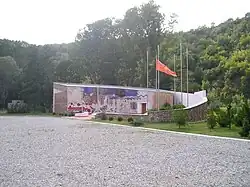
No final de 1944, a lei para a proteção da honra nacional macedônia foi aprovada pelo governo da RS da Macedônia, para a qual o Presidium da ASNOM criou um tribunal especial para implementá-la e perseguiu os acusados de colaboração pró-búlgara em um evento que ficaria conhecido como o Natal Sangrento. [25] [26] [27] No final da década de 1940, os primeiros líderes da ASNOM, Čento, Pavel Shatev e Brashnarov, foram expurgados de seus cargos, isolados, presos e encarcerados sob acusações fabricadas, como agentes estrangeiros, tendo inclinações pró-búlgaras, exigindo maior independência, colaborando com o Cominform, formando grupos políticos conspiratórios, exigindo maior democracia e coisas semelhantes. [28]
Na atual Macedônia do Norte, ASNOM tornou-se um "objeto de memória" e é considerada a data de sua formação como Estado, bem como a realização dos objetivos da Revolta de Ilinden. É comemorada como um feriado nacional conhecido como Dia da República [29] [30]
Galeria
-
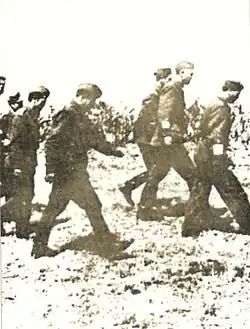 Delegados chegando para a primeira sessão plenária da ASNOM.
 -
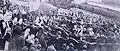 Celebração Oro em comemoração ao evento
 -
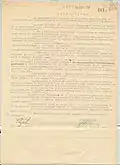 Declaração da ASNOM sobre os direitos fundamentais dos cidadãos da Macedônia Federal (2 de agosto de 1944)
 -
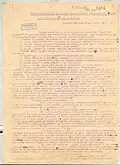 A parte formal da abertura da 1ª Sessão da Assembleia Antifascista da Libertação Nacional da Macedônia (ASNOM) com o discurso de boas-vindas de Panko Brashnarov.
 -
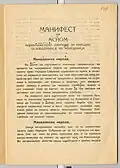 Manifesto da ASNOM sobre a luta do povo macedônio pela liberdade nacional e o estabelecimento do Estado macedônio. (2 de agosto de 1944), Primeira página
 -
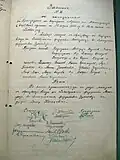 Ata da 11ª Sessão do Presidium da ASNOM sugerindo a criação do Governo Popular da República Popular da Macedônia e atribuindo mandato a Lazar Kolishevski (14 de abril de 1945)
Ver também
Notas
Referências
- ↑ Loring M. Danforth (1997). The Macedonian conflict: ethnic nationalism in a transnational world. [S.l.]: Princeton University Press. ISBN 978-0-691-04356-2
- ↑ Dejan Djokić (2003). Yugoslavism: Histories of a Failed Idea, 1918-1992. [S.l.]: C. Hurst & Co. Publishers. ISBN 9781850656630
- ↑ Ivo Banac (2018). With Stalin against Tito: Cominformist Splits in Yugoslav Communism. [S.l.]: Cornell University Press. p. 104. ISBN 9781501720833
- ↑ Hugh Poulton (2000). Who are the Macedonians?. [S.l.]: C. Hurst & Co. Publishers. ISBN 9781850655343
- ↑ Andrew Rossos (2013). Macedonia and the Macedonians: A History. [S.l.]: Hoover Press. pp. 196–197; 224; 264. ISBN 9780817948832
- ↑ Aleksandar Pavković; Christopher Kelen (2016). Anthems and the Making of Nation States: Identity and Nationalism in the Balkans. [S.l.]: I.B. Tauris. pp. 164–165. ISBN 9781784531263
- ↑ Dejan Djokić (2003). Yugoslavism: Histories of a Failed Idea, 1918-1992. [S.l.]: C. Hurst & Co. Publishers. ISBN 9781850656630
- ↑ Hugh Poulton (2000). Who are the Macedonians?. [S.l.]: C. Hurst & Co. Publishers. ISBN 9781850655343
- ↑ Andrew Rossos (2013). Macedonia and the Macedonians: A History. [S.l.]: Hoover Press. pp. 196–197; 224; 264. ISBN 9780817948832
- ↑ Interview, "Utrinski vesnik" daily newspaper, issue 1497, August 31, 2006 Skopje, Republic of Macedonia Arquivado em maio 30, 2011, no Wayback Machine
- ↑ Мичев, Добрин. Партизанското движение във Вардарска Македония, 1941–1944 г. сп. Македонски преглед, МНИ, кн. 2, София, 1995, стр. 5–40; Палешутски, Костадин. Югославската комунистическа партия и македонският въпрос, 1919 – 1945, Изд. на Българската Академия на Науките, София, 1985, стр. 319. Веселин Ангелов (2003) Македонската кървава Коледа (Създаване и утвърждаване на Вардарска Македония като република в югославската федерация. (1943 – 1946), ISBN 9548008777, стр. 67-68; Michael Palairet, Macedonia: A Voyage through History (Vol. 2, From the Fifteenth Century to the Present), Volume 2, Cambridge Scholars Publishing, 2016, ISBN 9781443888493, p. 210.
- ↑ "By the end of November, almost all of Macedonia and Serbia had been liberated and cleansed of German units. The Bulgarian army is largely responsible for achieving this goal. A military contingent of more than 450,000 troops participated in the campaign. Even though the Bulgarian offensive was undertaken with the cooperation of the Yugoslav Liberation Army, as all observers at the time noted, the latter's forces were absolutely insufficient and without Bulgarian participation, defeating the enemy would have been impossible. Another thing noted at the time was the wholly upright behavior of Bulgarian troops in Macedonia and Serbia. After conquering a given territory, the army turned over control to the new administration that was being formed from the ranks of the Yugoslav opposition. In contradiction to preliminary expectations, it was found that on the whole the local population, especially in urban areas, calmly accepted the Bulgarian military presence in the region. This generally positive attitude was connected to the idea of a future federation between Yugoslavia and Bulgaria that was beginning to be promoted." For more see: Ivaylo Znepolski et al., Bulgaria under Communism, Routledge Histories of Central and Eastern Europe, Routledge, 2018, ISBN 1351244892.
- ↑ "Military realities, however, made this incident look very ironic indeed, for Skopje was liberated by Bulgarian forces, while the Macedonian Partisans remained in the surrounding hills, and came down only to celebrate their entrance to the city. Similar scenes occurred in many other towns of Macedonia and Serbia, pointing to the fact that, from a military perspective the Russians were right: the Bulgarian army was the only force capable of driving the Germans quickly from Yugoslavia. Needless to say, the official Macedonian historiography, written mainly by Apostolski himself, understandably played down the crucial role of the Bulgarians. The glorification of the Partisan movement, an essential component of the post-war Yugoslav political culture-and more personal Partisan considerations left little room for such “technicalities”... For information on the military situation in Macedonia and Serbia and the role of the Bulgarian army see FO 371/43608, R17271, 24/11/1944; FO 371/44279, R16642,14/10/1944; FO 371/43630, R19495, 24/11/1944; WO 208, 113B, 12/9/1944. The sources, which contain intelligence reports from BLOs, confirm the decisive role of the Bulgarian army in the liberation of Skopje, Nis, Prilep, and the Morava Valley." For more see: Dimitris Livanios, The Macedonian Question: Britain and the Southern Balkans 1939–1949, Oxford University Press: Oxford, 2008; ISBN 9780199237685, p. 134.
- ↑ "For a detailed description of the German withdrawal from Greece through Macedonia and the central Balkans to Bosnia… see the account by one of the participants, Erich Schmidt-Richberg, „Der Endkampf auf dem Balkan“. General Schmidt-Richberg was chief of staff of Army Group E, deployed in Greece... The Yugoslavs' main criticism of the book was that it did not mention the Partisan units that fought the Germans as soon as they entered Yugoslav territory in Macedonia. Schmidt-Richberg only mentioned Bulgarian divisions, which had changed camps and were now fighting the Germans. But the Yugoslavs claimed that the main burden of fighting the Germans was theirs and that the Bulgarians did not have their heart in fighting their erstwhile allies. The claim applies to Partisan operations in the area between the Greek frontier on the south and the Drina River on the northwest – Macedonia, Southern Serbia, Kosovo and Sndjak. It is interesting to note that in a series of maps from Army Group E on its withdrawal through Macedonia and Serbia toward the Drina River and Bosnia, there is almost no indications on Yugoslav Partisan units… The contribution of Bulgarian troops in fighting the Germans in the fall of 1944 in Macedonia and Serbia is still much debated between Yugoslav and Bulgarian military historians." For more see: Jozo Tomasevich, War and Revolution in Yugoslavia, 1941-1945: Occupation and Collaboration. Volume 2, Stanford University Press, 2002, ISBN 0804779244, pp. 751-752.
- ↑ "Soviet arrogance was evident at all levels of the Red Army, beginning with its commander in chief. Stalin told Tito at a meeting that the Bulgarian army (which switched sides in the war in September 1944) was superior to Partisans, praising the professionalism of its officers. This was a pure provocation from the Soviet leader. The Bulgarians were Partisan wartime foes, and regardless of whether it was true, Stalin meant to put the assertive Yugoslav leadership in its place by insulting Tito's proudest achievement: his army. Furthermore, the Red Army's operational maps often excluded Partisan units, indicating the command's failure to even acknowledge that Yugoslavs played any role in the defeat of the Germans in the country. Further below in the chain of command, Partisan commanders had to appeal to the Red Army's political departments to include in their public statements the fact that Belgrade was liberated jointly by the Red Army and Partisans and not just by the Soviets, as well as to cease treating the Partisans as unknowledgeable and as a second-rate army." For more see: Majstorović, Vojin. “The Red Army in Yugoslavia, 1944–1945.” p. 414 in Slavic Review, vol. 75, no. 2, 2016, pp. 396–421. JSTOR.
- ↑ "By 23 October the Bulgarians had reached the vicinity of Podujevo, in the north-eastern corner of Kosovo; another Bulgarian force was also closing on Kumanovo, a strategically important town just to the north-east of Skopje. For a crucial period of a fortnight, however, this front remained more or less static. This was thanks to two factors: the disruption of the Bulgarian army by the sudden removal (at Russian insistence) of its old officer corps, and the dogged resistance of the Scholz Group, which was assisted by up to 5,000 Albanians in the Prishtina-Mitrovica area (of whom some belonged to the security force recruited in Albania by Xhafer Deva, and 700 were members of the Skanderbeg division) as well as some local Chetnik formations. The Germans formed a plan for the orderly evacuation of their forces, which they were able to carry out on schedule, abandoning Skopje on 11 November, destroying installations at the Trepcha mine on the 12th and leaving Prishtina on the 19th, from where they retreated north-westwards into Bosnia. Accounts of these events published in post-war Yugoslavia give the impression that the Germans were driven out by the Partisans, who 'liberated' the cities of Kosovo by force. There was some fighting by a combined force of Yugoslav and Albanian Partisans in Western Kosovo, mainly against the remnants of the Skanderbeg division; but these actions were quite insignificant compared with the Soviet-Bulgarian advance. The war diary of the commander of the German Army Group 'E', with its detailed day-by-day record of military actions in Kosovo, contains hardly any references to Partisan actions at all. The general pattern was that the towns in Western Kosovo were 'liberated', i.e. taken over by Partisan forces, only after the Germans and their auxiliaries had left; in Eastern Kosovo it was the Soviet and Bulgarian forces (with some Yugoslav Partisans attached to them) who took over, also after the Germans had got out." For more, see Noel Malcolm, Kosovo: A Short History, New York University Press, 1998, pp. 310-313, ISBN 0814755984.
- ↑ Volume 5 of Istoria na Bŭlgarite, Author Georgi Bakalov, TRUD Publishers, 2007, ISBN 954-621-235-0, p. 567.
- ↑ Bulgarian-Yugoslavian political relations, 1944–1945, Georgi Daskalov, Kliment Ohridski University, 1989, p. 113.
- ↑ Dimitar Bechev (2019). Historical Dictionary of North Macedonia 2nd ed. [S.l.]: Rowman & Littlefield. ISBN 9781538119624
- ↑ Andrew Rossos (2013). Macedonia and the Macedonians: A History. [S.l.]: Hoover Press. pp. 196–197; 224; 264. ISBN 9780817948832
- ↑ Кочанковски, Јован, Битола и Битолско во Народноослободителната и антифашистичка воjна на Македонија (1941–1945), том 2: 1944–1945, с. 427
- ↑ To make sure that not only those sympathizers of the Bulgarian orientation who had committed war crimes could be held responsible, the new crime of "violation of the Macedonian national honor" was introduced and a special court set up. According to a Macedonian historian: "this court... put on trial those violations of national honor which cannot be qualified as treason, or as support of the occupier in his war crimes." For more see: Stefan Troebst, Das makedonische Jahrhundert: von den Anfängen der nationalrevolutionären Bewegung zum Abkommen von Ohrid 1893-2001; ausgewählte Aufsätze; (2007) Oldenbourg, p. 255, ISBN 3486580507.
- ↑ Dimitar Bechev (2019). Historical Dictionary of North Macedonia 2nd ed. [S.l.]: Rowman & Littlefield. ISBN 9781538119624
- ↑ Bernard A. Cook, Europe Since 1945: An Encyclopedia, Taylor & Francis, 2001, ISBN 0815340575, p. 808.
- ↑ James Horncastle (2019). The Macedonian Slavs in the Greek Civil War, 1944–1949. [S.l.]: Rowman & Littlefield. ISBN 1498585051
- ↑ Kostov, Chris (2010). Contested Ethnic Identity: The Case of Macedonian Immigrants in Toronto, 1900-1996. [S.l.]: Peter Lang. pp. 84–85. ISBN 9783034301961
- ↑ Управување со Дигиталната Безбедност и Анонимност, Жарко Ѓуров и Лилјана Ацковска. Закон за Македонската национална чест - UDBAMK
- ↑ Historical dictionary of the Republic of Macedonia, Dimitar Bechev, Scarecrow Press, 2009, ISBN 0-8108-5565-8, pp. 15–16.
- ↑ James Frusetta (2004). «Common Heroes, Divided Claims: IMRO Between Macedonia and Bulgaria». In: John R. Lampe, Mark Mazower. Ideologies and national identities: the case of twentieth-century Southeastern Europe. [S.l.]: Central European University Press. 112 páginas. ISBN 978-963-9241-82-4
- ↑ Livezeanu; von Klimo, eds. (2017). The Routledge History of East Central Europe Since 1700. [S.l.]: Taylor & Francis. ISBN 9781351863438
