Óleo de algas
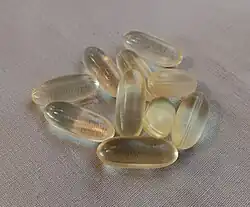
O óleo de algas marinhas, também chamado de óleo de algas, é usado para fazer alimentos, com o produto purificado quase incolor e inodoro.[1] Também está em desenvolvimento como um possível combustível alternativo e agente de fabricação.[2]
O óleo de algas também é usado como fonte de suplemento alimentar de ácidos gordos, pois contém gorduras mono e poliinsaturadas, em particular EPA e DHA, ambos ácidos gordos ômega-3.[3] O conteúdo de DHA do suplemento é aproximadamente equivalente ao do suplemento de óleo de peixe à base de salmão.[4][5]
O óleo de algas também é usado para biocombustível, fabricação de produtos farmacêuticos, óleo de massagem, sabonetes e loções.[6]
Ver também
Referências
- ↑ «Seaweed». Harvard University T.H. Chan School of Public Health. 1 de agosto de 2023. Consultado em 29 de setembro de 2023
- ↑ Farghali M, Mohamed MA, Osman AI, Rooney DW (2023). «Seaweed for climate mitigation, wastewater treatment, bioenergy, bioplastic, biochar, food, pharmaceuticals, and cosmetics: a review». Environmental Chemistry Letters. 21 (1): 97–152. Bibcode:2023EnvCL..21...97F. PMC 9547092
 . PMID 36245550. doi:10.1007/s10311-022-01520-y
- ↑ Scott D. Doughman; Srirama Krupanidhi; Carani B. Sanjeevi (2007). «Omega-3 Fatty Acids for Nutrition and Medicine: Considering Microalgae Oil as a Vegetarian Source of EPA and DHA». Current Diabetes Reviews. 3 (3): 198–203. PMID 18220672. doi:10.2174/157339907781368968
- ↑ Arterburn, LM (julho de 2008). «Algal-Oil Capsules and Cooked Salmon: Nutritionally Equivalent Sources of Docosahexaenoic Acid». Journal of the American Dietetic Association. 108 (7): 1204–1209. PMID 18589030. doi:10.1016/j.jada.2008.04.020. Consultado em 20 de janeiro de 2017
- ↑ Lenihan-Geels, G; Bishop, K. S.; Ferguson, L. R. (2013). «Alternative Sources of Omega-3 Fats: Can We Find a Sustainable Substitute for Fish?». Nutrients. 5 (4): 1301–1315. PMC 3705349. PMID 23598439. doi:10.3390/nu5041301
- ↑ Farghali M, Mohamed MA, Osman AI, Rooney DW (2023). «Seaweed for climate mitigation, wastewater treatment, bioenergy, bioplastic, biochar, food, pharmaceuticals, and cosmetics: a review». Environmental Chemistry Letters. 21 (1): 97–152. Bibcode:2023EnvCL..21...97F. PMC 9547092. PMID 36245550. doi:10.1007/s10311-022-01520-y