Introdução

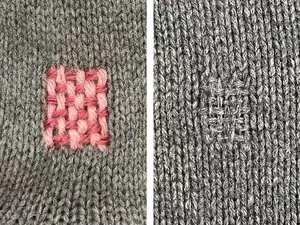
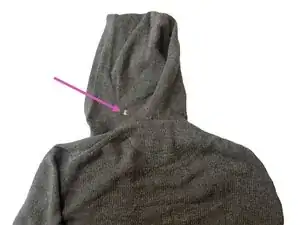
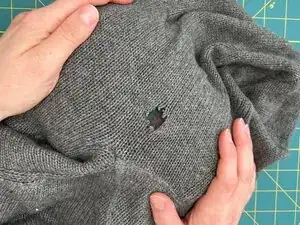
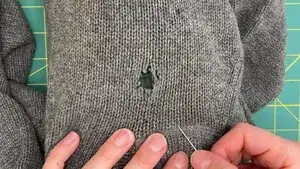
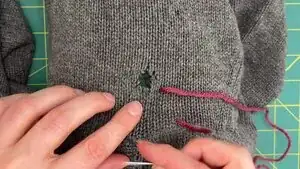
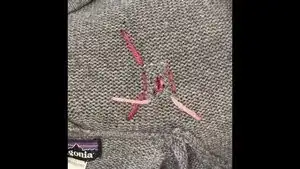
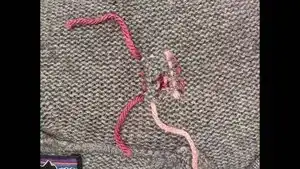
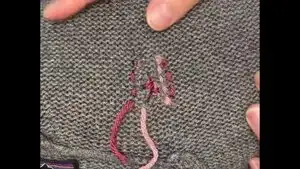
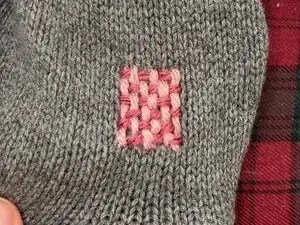
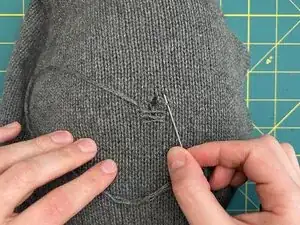
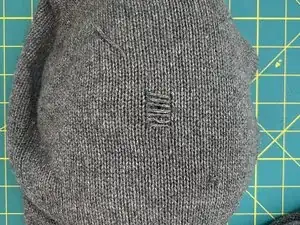
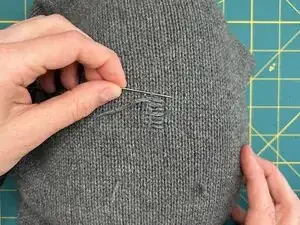
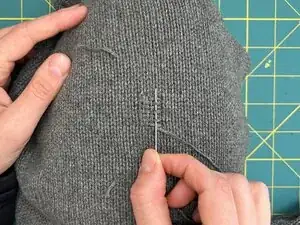
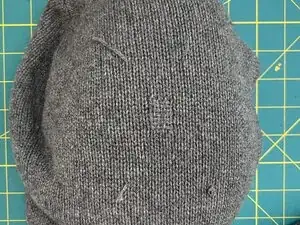
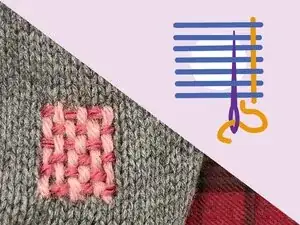
This guide demonstrates how to repair a hole on a Patagonia® wool sweater using woven darning. Darning is a mending technique that recreates stitches to fill and reinforce holes.

This tutorial outlines a specific technique called surface darning, where rows of stitches are laid on top of the fabric, and is best done with knits made of medium to heavy weight yarns. For a technique that works well on lightweight knits, see How to Darn a Hole in a Knitted Garment.

Hand sewn repairs are a fun and effective way to extend the life of gear at home. DIY repairs won't void the Patagonia warranty—they're actually encouraged!

Patagonia items can also be taken in to a local retail store for repair evaluation or sent in to Patagonia through their mail-in repair service.

Let's get fixing!

Related Tutorials

Related Articles

Return to the Patagonia Care & Repair homepage.

  1. KIM6pIa1gD3yVofr
    KIM6pIa1gD3yVofr
    wnqVHDD4VZjhqftI
    M3HjMlOySYf6Zy2V
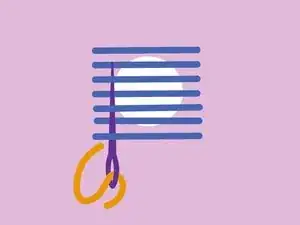
    • Structure - Woven darning is a repair technique that involves interweaving perpendicular threads or yarns to create a small, woven patch.

    • Repair Use - Woven darning is used on small holes where yarn is missing or the area is worn thin and the resulting gap needs to be filled or reinforced. Despite being a woven technique, it's used on both woven and knit garments.

    • This tutorial outlines a specific technique called surface darning, where rows of stitches are laid on top of the fabric.

  2. XbCLGbTXIjBKNxkC
    XbCLGbTXIjBKNxkC
    iitZtBXQLIVweEhv
    2nsJc6Neo6e6i1Pb
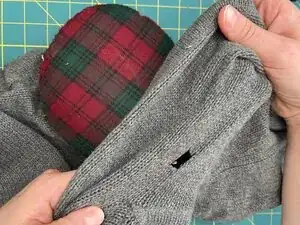
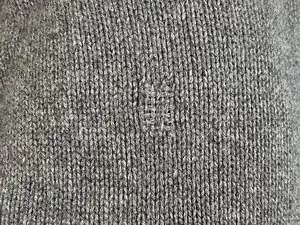
    • Locate the hole.

    • Place something behind the hole. It can be a darning egg or darning mushroom, an ironing ham, or even a piece of paper.

    • If the damaged area of the garment is curved, choose something with similar curvature.

    • In the pictured repair, an ironing ham is used.

    • The repair will occur entirely from the front side of the garment, so this item ensures that the garment stays in place and creates a barrier between the repair area and the rest of the garment.

  3. UPl4MsP2ZxOlvOgK
    UPl4MsP2ZxOlvOgK
    DIAmC5mU3NmB6ABe
    vjRPimFIObO6ydQO
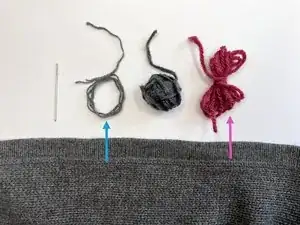
    • Needle: The best needle for this technique has a ballpoint, a blunt end that can push aside individual knit stitches without puncturing the yarn.

    • Yarn: The ideal yarn is the same fiber content, weight, and color as the garment. This will create the most invisible repair.

    • In this tutorial, heavier contrast color yarn is used to show the technique. See details on the invisible version in Steps 17 - 19.

    • Thread the needle with a length of yarn no longer than 24 inches (~61 cm). Don't knot the thread.

    • For more info, see Needles and Thread.

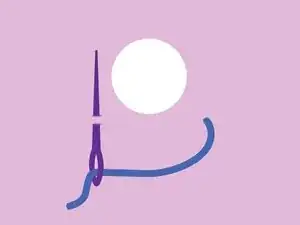
  4. From the front side, insert the needle at least one needle‑length diagonally away from the damage, approximately 2 inches (~51 mm), and come up 1/4 inch (~6 mm) diagonally away from one corner of the damage.
    • From the front side, insert the needle at least one needle‑length diagonally away from the damage, approximately 2 inches (~51 mm), and come up 1/4 inch (~6 mm) diagonally away from one corner of the damage.

    • Pull the needle and thread through, leaving a short tail.

    • This will secure the threads out of the way of the sewing area. At the end of the repair, the yarn ends will be stitched into the back of the repair.

    • This technique is used instead of knotting because knots are often uncomfortable and ineffective with heavier knits.

  5. VSumrU6E2FDIHh1i
    VSumrU6E2FDIHh1i
    CVhArSWFi2VesWdY
    gM4FhqtXxpIYKLbY
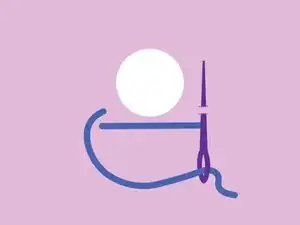
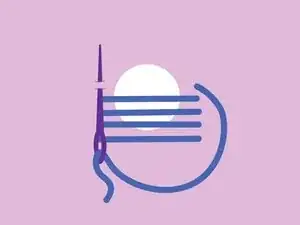
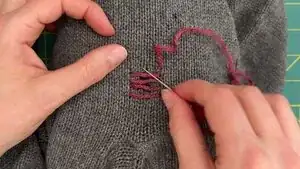
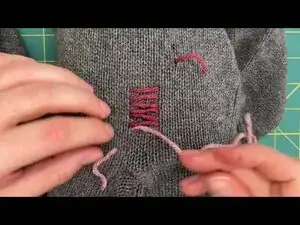
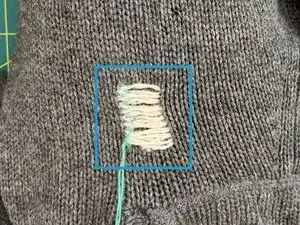
    • Cross the needle to the opposing side of the damage and make an upward stitch. Pull through to create a horizontal line of yarn.

    • Continue to cross back and forth over the hole, creating lines of floating horizontal stitches.

    • The first and last yarn lines should lay about 1/4 inch (~6 mm) beyond the damage.

    • The darning will look the best if these rows start and stop on the same vertical and align with the knit rows of the garment.

    • The ideal gap between each row is the same as the width of the yarn. See the last step of this guide for examples of spacing that's too tight and too loose.

    • See the next two steps for detailed videos of this technique.

  6. Use the yarn as a guide for where to stitch on the opposite side of the damage.
    • Use the yarn as a guide for where to stitch on the opposite side of the damage.

    • Pass the needle between existing loops of knit stitches instead of piercing through them.

    • The ballpoint of the needle will help with this.

    • Consistently adjust the yarn to maintain the correct tension.

  7. Continue until the hole is covered and the last row of yarn is at least 1/4 inch (~6 mm) beyond the damage.
    • Continue until the hole is covered and the last row of yarn is at least 1/4 inch (~6 mm) beyond the damage.

    • Insert needle and come back up at least 2 inches (~51 mm) away from the damage.

    • Cut the yarn, leaving a short tail.

  8. Insert the needle approximately 2 inches (~51 mm) away from the damage diagonally.
    • Insert the needle approximately 2 inches (~51 mm) away from the damage diagonally.

    • Come up one yarn width below the bottom row and about one yarn width inward.

    • Pull the yarn through, leaving a short tail.

  9. EGOaMHi4PT2KiwdY
    EGOaMHi4PT2KiwdY
    SOTNrxlB2pTJpt5a
    3oiOdGvGl3UoNJHI
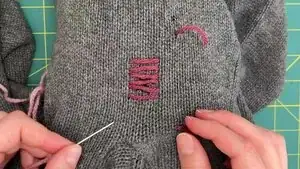
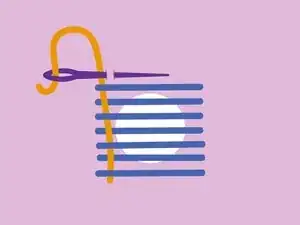
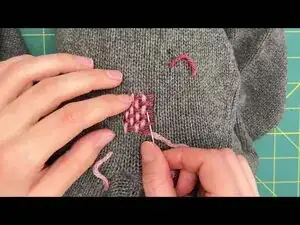
    • Pass the needle through the horizontal yarns, alternating over and under each row.

    • Optionally, flip the needle around and use the eye of the needle to weave in and out of the horizontal threads because it's larger, blunter and easier to see.

    • After passing through all rows, pull the yarn through to create a vertical line of yarn, then make a horizontal stitch at the top to secure the yarn.

    • Then move back across, weaving the needle over and under the rows in the opposite way.

    • Repeat this process, alternating over and under with each pass and securing each pass with a small horizontal stitch.

    • See the next two steps for detailed videos of this technique.

  10. Carefully weave the needle between the existing rows of yarn.
    • Carefully weave the needle between the existing rows of yarn.

    • The horizontal rows aren't tight so they will move around during this process.

    • After each pass, use the needle to shift the yarn over so it lays vertical.

  11. Continue until the last vertical yarn lays within a yarn width of where the horizontal threads end.
    • Continue until the last vertical yarn lays within a yarn width of where the horizontal threads end.

    • After each pass, use the needle to push the yarns over to make room for the next pass of yarn.

    • To finish, insert the needle and come back up at least 2 inches (~51 mm) away diagonally.

    • Cut the yarn, leaving a short tail.

  12. I2CtWGUIvsAKIvM2
    I2CtWGUIvsAKIvM2
    4ThMBCb3y22Mllym
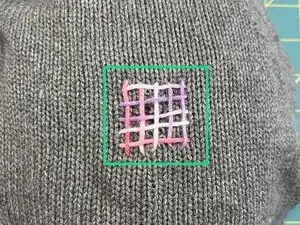
    • Before moving on to finishing, inspect the woven darning.

    • Ideally, there should be the same number of horizontal and vertical yarns.

    • Check the hand feel and density of the stitching compared to the rest of the garment. Hold the repaired area up to the light and see if the same amount of light passes through the darning as the rest of the garment.

    • At this point it's possible to add additional rows and stitching to fill out the weaving.

  13. Flip the garment over to the backside.
    • Flip the garment over to the backside.

    • Carefully pull out each yarn end.

    • One at a time, thread each end into the needle and stitch the yarn back in the direction that it came from.

    • Backing the thread over itself will create a secure finishing.

    • Pull the yarn tight and snip the loose end.

    • It can be difficult to thread a short tail onto the needle, this is why the yarn tails needed to be so long at the start!

    Very helpful to see the videos! I'm surprised about leaving the thread loose won't unravel eventually with washing and wearing.
    Also, "backing it over itself"; it doesn't look back in the direction it came from--it looks perpendicular as the pink was vertical and the finishing video looks horizontal. ?

    Green Yogini -

    That's a good point! I think the finishing videos might be turned at an angle so the orientation isn't aligned. I'll see if I can get them updated!

    Clara Redwood -

  14. Double check that the yarn end is being stitched back in the direction that it came from.
    • Double check that the yarn end is being stitched back in the direction that it came from.

    • To avoid these stitches showing through on the front side:

    • Try to stitch only into the garment, keeping to the top layer and not piercing all the way through.

    • Don't extend the running stitch past the repaired area.

  15. In the case where two yarn ends are close to one another, it's possible to tie them together in an overhand knot.
    • In the case where two yarn ends are close to one another, it's possible to tie them together in an overhand knot.

    • This is quicker but may be slightly uncomfortable to the wearer.

  16. wYns5TsSeQEmOJri
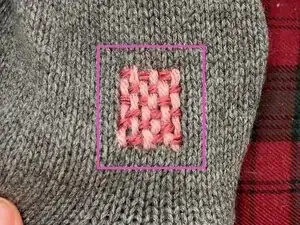
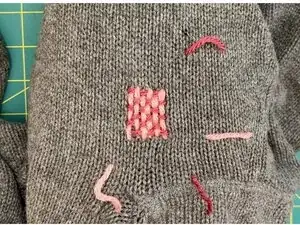
    • Now the woven darning repair is complete!

    • Lightly steam the area and gently massage it with your fingers to help the fibers settle in.

  17. d5LVluxpQbIURIMF
    d5LVluxpQbIURIMF
    4GRDYULhR4db3X2Q
    K1t5jn36TQjFdtsV
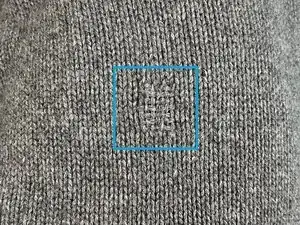
    • Use this method to create a nearly invisible repair by using yarn that matches the garment in color, fiber content, and weight. However, it can be quite difficult to see the stitches so go slowly and ensure there's good lighting.

  18. i52JDPsCDIBFES1n
    i52JDPsCDIBFES1n
    gvQrlZEXhkCDQGNl
    tkjIJrsaWf1YLEVs
    • Take care to create evenly spaced stitches that follow the rows and columns of the knit garment. This should be easier with a yarn that's the same weight as the yarn in the garment.

  19. V3tEeVJgadTvAiRM
    • The invisible woven darning repair is complete!

    • Lightly steam the area and gently massage it with fingers to help the fibers settle in.

  20. 3uys5YcPtYAoZfCO
    3uys5YcPtYAoZfCO
    xTaXGXajAyR5FTkD
    geIv6KXOnvADtMF1
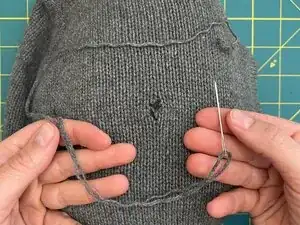
    • Stabilizing Circumference Stitch: To be extra sure that the hole doesn't expand or fray, place a running stitch around the circumference of the hole before beginning. Place the stitch about 1/4 inch (~6 mm) away from the damage and ensure the vertical and horizontal darning stitches extend past it.

    • Gap Between Rows: Try to create a gap between each horizontal and vertical row that's the same as the width of the yarn. This will create the most balanced weave structure, with the horizontal and vertical yarns appearing an equal amount like a checkerboard.

    • Too Close: The yarns are packed too tightly. This will make it difficult to weave in the vertical yarns and the resulting woven patch will be thick and unbalanced.

    • Too Far: The weave structure will be very loose with visible gaps.

Clara Redwood

Membro desde: 12/11/24

2559 Reputação

0 comentários