Introdução
If a Whirlpool top-load washing machine won’t spin, or it spins too weakly to remove water, the cause is often a setup issue, an error code, a balance problem, or a failed drive component underneath the washer. This guide shows how to find and use the technician’s manual, read and clear error codes, run forced spin and agitation tests, and inspect and test common spin-related parts like the belt, splutch, shift actuator, motor, and capacitor.


Peças
-
-
Open the lid, and use a 1/4 inch hex driver to remove the three screws along the rear edge.
-
Remove the metal cover plate that’s held by those rear screws.
-
Unlock the top by pulling it toward the front, lifting up, and sliding it toward the back to release the hidden bracket.
-
Tilt the top back and support it against a wall or a stable surface.
-
Find the technician manual in a plastic bag at the front-left corner, and move the plastic drum area as needed to reach it.
-
-
-
Lower the washer top back into position.
-
Lock it by pulling the top toward the front, pressing down, and sliding it toward the back.
-
-
-
Unplug the washer, wait 30 seconds, and plug it back in.
-
Wait 30 seconds for the control to boot.
-
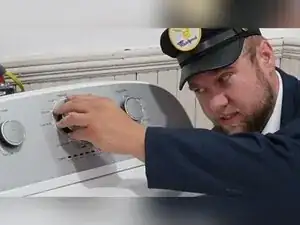
Rotate the dial counterclockwise one full revolution to the 12 o’clock position.
-
Within six seconds, turn the dial right three times, left once, and right once.
-
Confirm diagnostic mode when the LEDs flash on and off in sequence.
-
-
-
Rotate the dial clockwise one click until the Done light flashes, then press Start to enter error code mode.
-
Rotate the dial clockwise one more click to show the first stored code.
-
Read the two-part flash pattern where Fill lit means the F code, and Fill unlit means the E code.
-
Add any additional lit numbers together to determine the exact F and E values.
-
Rotate the dial clockwise through the next three clicks to view additional codes.
-
-
-
Rotate to the position where all lights are flashing, then press and hold Start to purge the stored codes.
-
-
-
Spin the agitator or washplate by hand and check whether it’s very loose or flops around.
-
If it’s loose, tighten the retention bolt, or replace the hub under the washplate if it’s damaged.
-
Press the basket down hard, release it quickly, and watch how it rebounds.
-
Replace the suspension rods if excessive bouncing is present.
-
-
-
Re-enter diagnostics using the same dial sequence without unplugging the washer.
-
Rotate the dial until the Spin and Done lights are on to select manual mode, then press Start to engage it.
-
Press Start again to lock the lid, and confirm the red lid lock light is on.
-
-
-
If you need visual access, release the top by pulling it forward, lifting up, and sliding it back while the lid lock remains active.
-
Turn the dial to select a spin test, then press Start to begin spinning.
-
-
-
If the washer struggles to get up to speed, suspect a weak run capacitor or a mechanical drag issue.
-
If the agitator or washplate spins but the tub doesn’t move, suspect a failed hub under the washplate or agitator.
-
If the washer won’t spin at all in forced mode, suspect an underside drive component such as the shift actuator.
-
-
-
Turn the dial clockwise twice to select an agitation mode, then press Start to force the transmission to shift.
-
To exit tests, rotate the dial until only the lid lock light is on, then press and hold Start for three to four seconds to reset.
-
-
-
Unplug the washing machine before tipping it back for underside access.
-
Tilt the washer backward or slide it forward until the bottom is accessible.
-
Support the washer on a sturdy box and keep the drain hose suspended above the washer height to reduce draining.
-
Visually inspect underneath for anything out of place and for green residue that could be detergent or transmission oil.
-
-
-
Use a 5/16 inch hex driver to remove the two screws from the belt cover.
-
Remove the cover to expose the motor, belt, pulley and splutch assembly, shift actuator, and capacitor.
-
-
-
Inspect the belt for fraying or damage, and rotate the pulley to confirm it turns smoothly.
-
Remove the belt by pulling it toward you while rotating the pulley until it slips off.
-
-
-
Inspect the shift actuator and confirm its armature sits correctly in the transmission coupler.
-
If the arm has popped out, slot it back into place, but replace the actuator if it repeatedly falls out.
-
Replace the actuator if it looks burnt, damaged, or heavily rusted.
-
Move the actuator arm back and forth to confirm the splutch and transmission can shift between spin and agitate.
-
If the arm can’t move the mechanism, suspect a failed splutch and cam assembly.
-
-
-
Use a nut driver to remove the two long green screws that secure the shift actuator.
-
Press the locking tab on the wire harness clip, and disconnect the harness from the actuator.
-
-
-
Locate the capacitor below the pulley and inspect it for melted or burnt areas.
-
Lift the capacitor slightly with a screwdriver if needed, twist it counterclockwise, and pull it out.
-
-
-
Disconnect the motor harness, set a multimeter to resistance in ohms, and test the motor windings at the connector pins.
-
Test the shift actuator motor by measuring between the third and sixth pins, and look for about 2,000 to 3,000 ohms.
-
If the actuator reads far outside that range or shows OL, replace the shift actuator.
-
Test the drive motor by measuring pin two to pin four for roughly 3 to 6 ohms, and pin two to pin three for roughly 4 to 10 ohms.
-
If the motor reads OL or an extremely high resistance value, replace the motor.
-
-
-
Use an insulated-handled screwdriver, or wear rubber gloves, and short the capacitor terminals to discharge it.
-
Set the multimeter to ohms, place the leads on the capacitor terminals, and watch for resistance that rises over time and eventually goes to OL.
-
If it shows OL immediately from the start, replace the capacitor.
-
-
-
Reinstall any replaced parts by reversing the removal steps, and confirm every wire harness clip is fully seated.
-
Reinstall the belt and belt cover, then set the washer upright.
-
Plug the washer in and re-run the manual spin and agitation tests to confirm the spin issue is resolved.
-
Use the technician manual to match any stored error codes to likely causes, then confirm the symptom with manual spin and agitation tests before replacing parts. Most no-spin problems come from a loose washplate hub, a balance issue from worn suspension rods, or a failed underside drive component like the shift actuator, belt system, motor, splutch, or run capacitor. If codes return after clearing, treat those as current faults and focus diagnosis there.